GCSE French Homework Grade Impact: Does It Matter?
GCSE French homework grade impact explained: discover what counts towards your final result, which tasks help most, and when maths revision should come first.
A French worksheet is due tomorrow. Your maths mock is getting closer. Both feel urgent, but only one may address the marks you are currently losing.
The GCSE French homework grade impact is indirect: ordinary homework does not normally contribute marks to your final GCSE French grade. Your result comes from the formal assessments specified by your exam board. However, well-designed homework can improve the vocabulary, grammar, listening, reading, speaking and writing skills tested in those assessments.
So homework matters, but not simply because it has been set. Its value depends on what you do, what you learn and whether feedback changes your next attempt.
The short answer: how much does French homework matter?
Use this checklist before deciding how much time to give a task:
- Ordinary homework is not usually part of your final GCSE mark.
- Formal listening, speaking, reading and writing assessments determine the result.
- Useful homework can raise performance indirectly by building the knowledge those assessments test.
- Quality matters more than sheer quantity.
- Feedback, correction and later recall make a task more valuable.
- During maths exam preparation, French homework should not automatically consume all available revision time.
- You should still follow school deadlines and speak to your teacher if workload or access is a problem.
This is not an argument for ignoring homework. It is an argument for understanding its purpose.
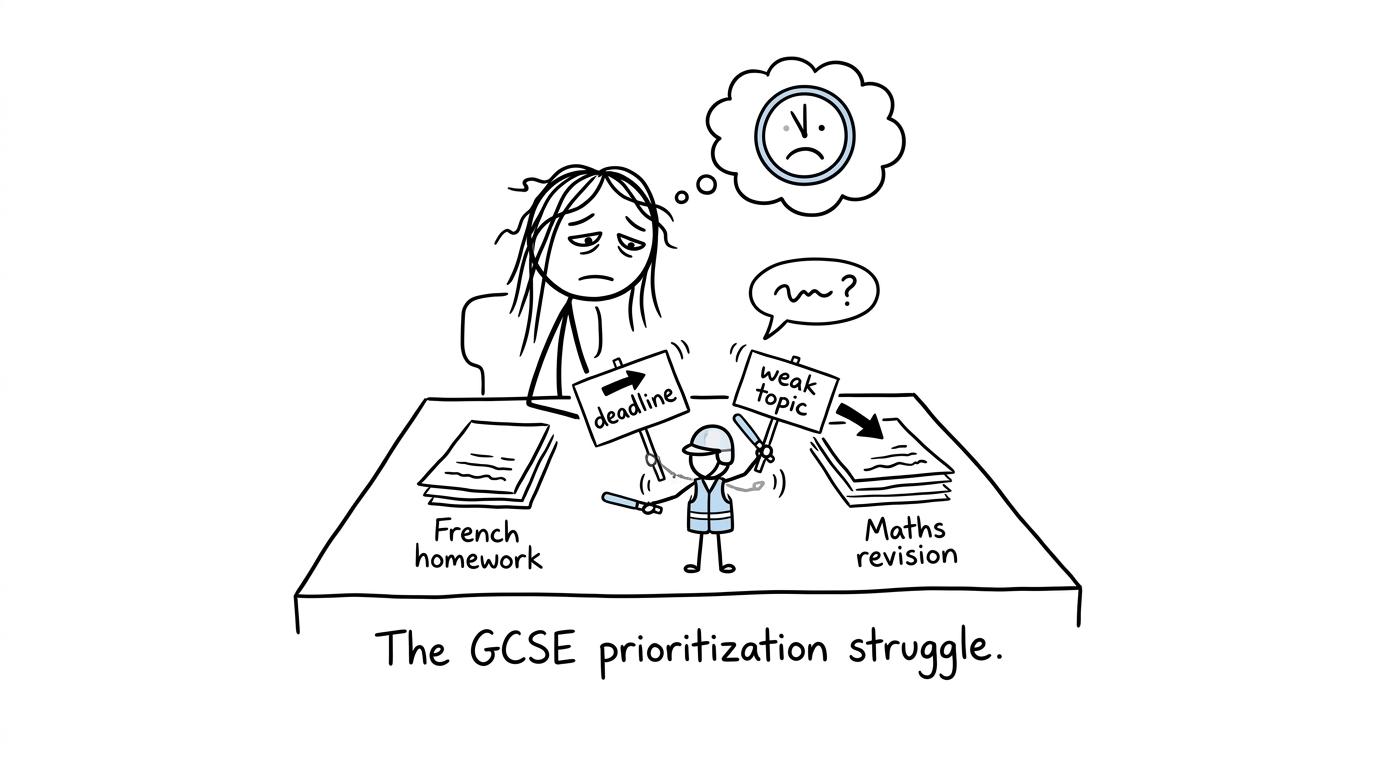 A GCSE student choosing between French homework and maths revision
Does French homework count towards your final GCSE grade?
For the reformed GCSE French qualifications first assessed in summer 2026, students are assessed through listening, speaking, reading and writing components. In specifications such as AQA and Pearson Edexcel, each component represents 25%25\%25% of the qualification, although assessment-objective weightings cut across those components.
Foundation tier generally covers grades 111 to 555, while higher tier covers grades 444 to 999. Students take their French assessments at the same tier. Always confirm the precise format with your teacher and current AQA, Edexcel, OCR or Eduqas specification.
An ordinary vocabulary sheet, grammar exercise or practice paragraph completed at home is not itself added to your examination total. A school may record a homework mark for reports, progress monitoring or teacher feedback, but that is different from the mark used to award the GCSE qualification.
The important exception is any work your school explicitly identifies as part of a formal assessment. For example, the GCSE speaking component is conducted in school under controlled arrangements. That is an assessment, not ordinary homework. Your teacher should make the distinction clear.
Homework may also contribute to the evidence teachers use when discussing progress, support or tier entry. Even then, a single missed worksheet does not mechanically remove marks from the final examination total.
Why homework can still move your French grade
The absence of direct marks does not mean the work is pointless. A football training session does not appear on the scoreboard either. It changes what the player can do when the match begins.
The Education Endowment Foundation’s current evidence summary reports a positive average effect for homework at secondary level, equivalent to around five months of additional progress. That is a broad average rather than a promise for an individual student, and the evidence security is rated low. It is not a French-specific grade guarantee.
More useful than the headline figure are the conditions attached to it. Homework tends to be more effective when it:
- connects clearly with classroom learning;
- has a specific purpose;
- requires active independent thinking;
- receives useful feedback;
- is corrected rather than merely completed;
- avoids excessive volume.
In French, a focused vocabulary recall task can support reading and listening. Sentence construction can strengthen grammar and writing. Reading aloud can support pronunciation and the speaking assessment. Translation can expose uncertainty that passive rereading hides.
The weak version of homework is completion without thought. The strong version is a small cycle:
attempt, check, correct, recall, reuse.
That final step matters. If you correct a verb ending but never use the corrected form again, the feedback may disappear as quickly as it arrived.
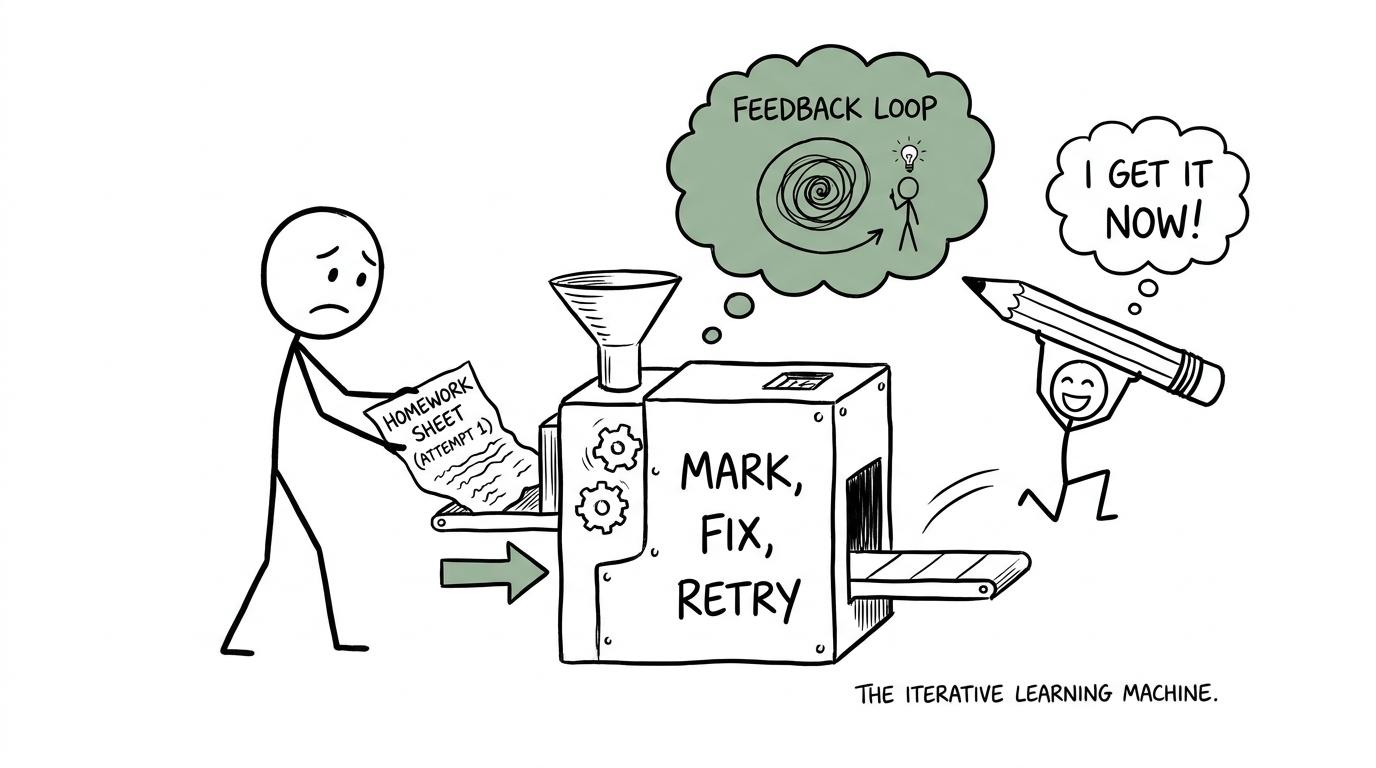 A homework sheet going through a mark, fix and retry machine
Which French homework has the greatest grade impact?
Not every task deserves the same amount of time. Judge homework by how closely it develops an assessed skill.
Active vocabulary retrieval
Testing yourself from memory is more demanding than looking repeatedly at a vocabulary list. Cover the French, retrieve it, check it and collect the words you missed. Reverse the direction later so that recognition becomes production.
This supports more than a vocabulary test. Prescribed vocabulary and grammar appear across listening, reading, speaking and writing tasks in the current GCSE specifications.
Listening and dictation practice
The revised GCSE includes dictation within listening assessment. Short listening tasks can therefore be especially useful when they require accurate recognition and spelling rather than vague familiarity.
Replay should be used purposefully. First attempt the task under the stated conditions. Then identify the sounds, spellings or grammatical endings you missed.
Speaking completed aloud
Writing a speaking answer is preparation, not speaking practice. The useful part begins when you say it aloud without reading every word, respond to an unexpected question and notice where hesitation appears.
A polished paragraph that cannot be spoken independently offers less protection in the actual assessment than a smaller bank of flexible language you can retrieve reliably.
Writing that receives correction
Writing homework is valuable when feedback becomes action. Do not simply read a teacher’s correction and close the book. Rewrite the relevant sentence, identify the rule and reuse the structure in a fresh context.
Exam-style reading and translation
These tasks help when you mark them carefully and separate vocabulary gaps from misreading. Translation is particularly revealing because it tests whether you can preserve meaning while applying accurate grammar.
When should maths revision come before French homework?
For a student preparing for maths exams, the real question is not whether French matters. It is how to allocate limited time without allowing the loudest deadline to control every evening.
Maths revision may deserve priority when:
- a maths mock or GCSE paper is significantly closer;
- a recent paper has revealed serious gaps in high-value topics;
- the French task is low-value repetition you can complete efficiently later;
- you have already completed the essential French learning but are extending presentation unnecessarily;
- missing maths practice would break an important cycle of learning, marking and retesting.
French may deserve priority when:
- the deadline is immediate and the task is manageable;
- it prepares you for a speaking assessment or classroom test;
- it targets a known weakness in vocabulary or grammar;
- your teacher will provide feedback you can use;
- leaving it undone would create avoidable problems at school.
The right approach is usually not to abandon one subject. It is to set a boundary. Complete the essential French task to a thoughtful standard, then protect a defined maths block.
Use the free MathsGenie revision planner to make those boundaries visible. If exams are several weeks away, the GCSE one-month maths revision plan provides a sustainable structure. When time is much tighter, use the one-week GCSE maths revision plan rather than improvising each evening.
A better way to balance French homework and maths
Start by separating obligation from improvement.
Obligation means the work your school reasonably expects you to submit. Improvement means the activity most likely to repair a weakness before the exam. Sometimes they are the same task. Sometimes they are not.
For maths, begin with evidence. The GCSE maths revision hub brings together revision lessons, practice questions, papers and solutions for major exam boards. A short diagnostic can reveal whether your next session should focus on algebra, number, geometry, probability or statistics.
Then use this routine:
- Check both subjects’ deadlines and assessment dates.
- Identify the essential outcome of the French homework.
- Give the task a clear stopping point.
- Use the remaining block for one specific maths weakness.
- Mark your maths work immediately.
- Schedule any unfinished task rather than leaving it as a vague worry.
If you do not know where to begin in maths, the best order for learning GCSE maths topics gives you a sensible route through the curriculum. When you are ready for mixed assessment, learn how to use GCSE past papers properly.
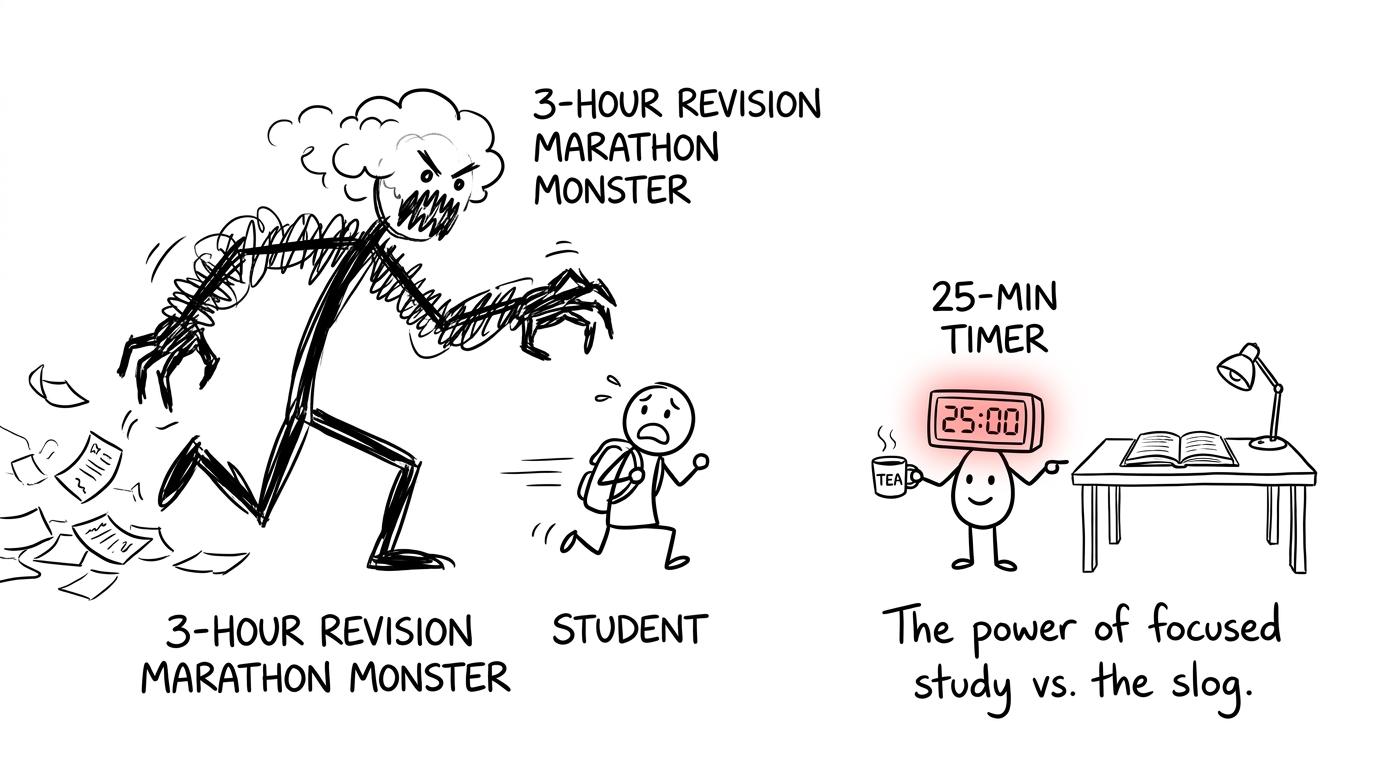 A friendly short timer rescuing a student from a revision marathon
Common mistakes when deciding whether homework matters
Assuming a homework percentage equals the final GCSE weighting
A school portal may display an average homework mark, but this is not automatically a percentage of the qualification. Formal GCSE marks and grade boundaries determine the awarded grade.
Rushing French to create more maths time
Poorly completed homework can waste the time you do spend. If you are going to do it, identify the learning purpose and work accurately. Efficient does not mean careless.
Spending too long making work look perfect
Presentation matters when it supports clarity. It becomes unhelpful when decorating a task replaces retrieval, correction or exam practice. Stop when the educational purpose has been met.
Treating all maths revision as equally valuable
An hour spent repeating comfortable questions may achieve less than a shorter session repairing a weakness. MathsGenie’s guidance on when to start GCSE past papers can help you move from topic practice to timed work at the right stage.
Ignoring feedback
Homework without review can become a record of mistakes rather than a route out of them. Read comments, make corrections and test the same skill again without support.
Staying silent when the workload is unmanageable
Access to a quiet space, suitable technology and enough time is not equal for every student. If homework is repeatedly impossible, speak to the teacher, form tutor or pastoral team. A homework club, adjusted deadline or alternative resource may be available.
Homework is a tool, not the final score
The honest conclusion is balanced. French homework usually does not add marks directly to your GCSE result, but purposeful homework can strengthen the exact skills your formal assessments measure. Its impact comes from learning, not submission alone.
When maths exams are approaching, do not let every worksheet consume unlimited time. Meet reasonable expectations, prioritise tasks linked to real weaknesses and protect regular maths revision. Start at the MathsGenie GCSE maths hub, choose your board and tier, and build a repeatable cycle using free revision lessons, practice questions, mini tests, past papers, predicted papers, mark schemes and video solutions.
The goal is not to work on everything at once. It is to make each piece of work earn its place.