GCSE French Grade Boundaries Explained
GCSE French grade boundaries explained clearly: learn why raw marks vary each year, how boards set grades and how to use past papers wisely.

A mark can feel wonderfully definite. You count the ticks, total the numbers and convert the result into a percentage. Yet the grade beside that mark may still be uncertain.
That is because a GCSE grade is not awarded using one permanent percentage scale. In GCSE French grade boundaries explained simply means this: your marks from listening, speaking, reading and writing are combined according to your specification, then compared with boundaries set for that exam series. Those boundaries can move because papers vary in difficulty.
The purpose is fairness. A slightly harder paper should not make the same standard of French worth a lower grade simply because it was sat in a different year.
GCSE French grade boundaries at a glance
Before looking at the detail, keep these points in mind:
- A raw mark is the number of marks awarded for your responses.
- Some component marks may be scaled before they are combined.
- Your overall grade normally depends on the total subject mark, not a separate grade for each paper.
- Grade boundaries are set after the assessments have been taken and marking is nearly complete.
- Boundaries can differ by year, exam board, specification and tier.
- A past boundary is useful evidence, but it is not a promise about the next exam series.
- Revised GCSE French specifications are being awarded from summer 202620262026, so older boundaries may belong to a different qualification.
The same central principle applies to GCSE maths. The MathsGenie guide to GCSE grade boundaries explains how a total mark is turned into a final grade without assuming that every grade has a fixed percentage.
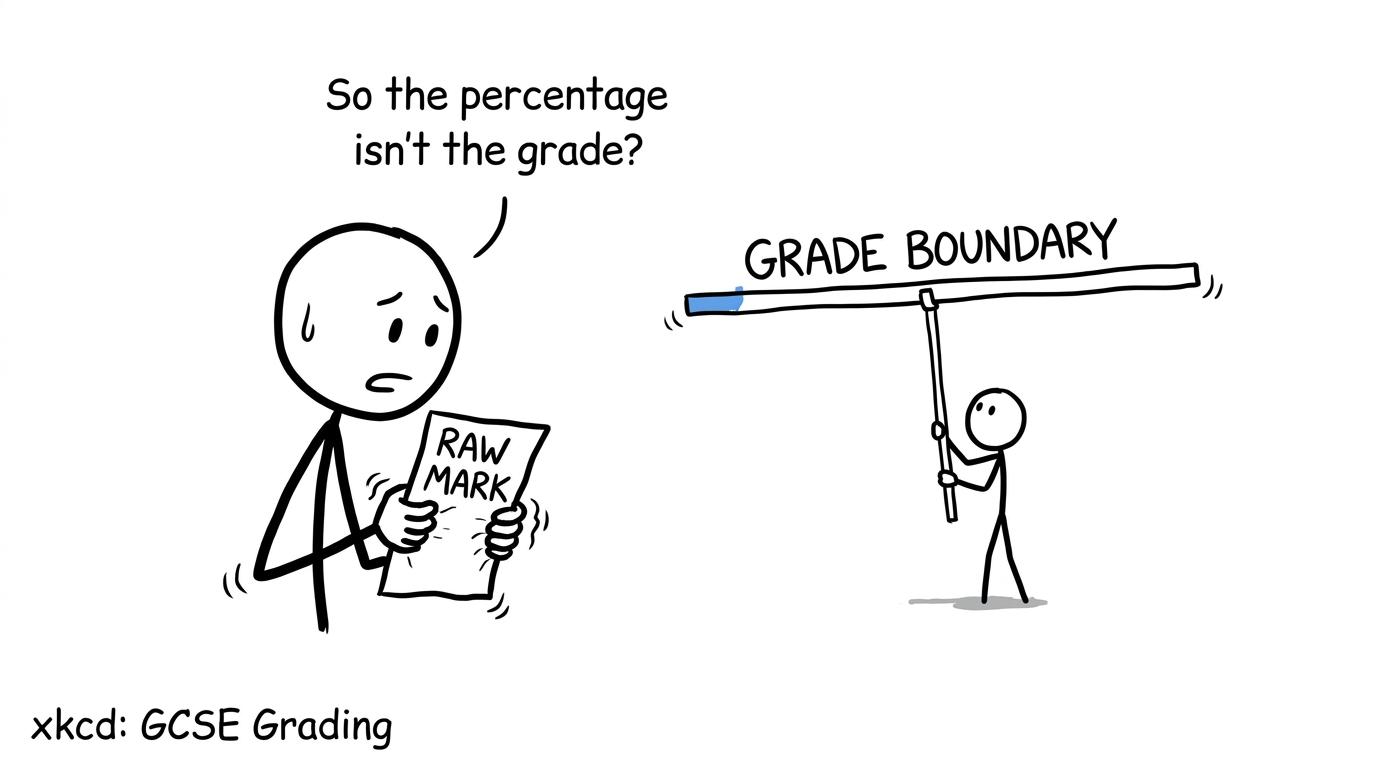 A student discovers that a raw percentage is not automatically a GCSE grade
Why your raw mark is not just a percentage
A percentage describes the proportion of available marks you achieved. If your raw mark is rrr and the maximum available mark is mmm, the calculation is:
Percentage mark=rm×100\text{Percentage mark}=\frac{r}{m}\times 100Percentage mark=mr×100That calculation is mathematically valid. What it does not tell you automatically is your GCSE grade.
There is no universal rule saying that one fixed percentage always equals grade 444, grade 777 or grade 999. Instead, a grade boundary is the minimum total mark required for a grade in a particular exam series.
Imagine two French papers that test the same specification. One contains listening extracts that students generally find more demanding; the other proves more accessible. If both used permanent percentage thresholds, the paper itself could affect grades unfairly. Moving boundaries help exam boards maintain a comparable standard over time.
This does not mean exam boards simply decide that a certain percentage of students must receive each grade. Ofqual’s published explanation says the aim is to maintain standards, not to force precisely the same proportion of candidates into every grade each year.
How GCSE French marks are combined
GCSE French commonly assesses four areas:
- listening;
- speaking;
- reading;
- writing.
Under the revised AQA, Pearson Edexcel and Eduqas specifications for first award in 202620262026, these four components each contribute 25%25\%25% of the qualification. Students take assessments at one tier, with Foundation generally offering grades 111 to 555 and Higher principally offering grades 444 to 999. Exact grading rules should always be checked against your own specification.
Equal weighting does not necessarily mean every paper begins with the same maximum raw mark. Scaling may be used so that each component makes the intended contribution.
For example, AQA’s current French specification gives Foundation listening a maximum raw mark of 404040 and applies a scaling factor of 1.251.251.25, producing a maximum scaled contribution of 505050. The other components also contribute a maximum of 505050, making the total scaled mark 200200200.
The underlying relationship is:
Scaled mark=Raw mark×Scaling factor\text{Scaled mark}=\text{Raw mark}\times\text{Scaling factor}Scaled mark=Raw mark×Scaling factorThis is not a penalty or a bonus. It is an administrative calculation that preserves the published weighting of each component.
Why one paper does not normally have its own final grade
Students often say they earned a grade 777 in reading or a grade 555 in listening. In classroom feedback, that shorthand can be useful. Officially, however, linear GCSE French qualifications award one overall subject grade from the combined total.
Exam boards may publish notional component boundaries. These can help teachers interpret performance, but they are illustrative rather than separate qualifications. A weaker listening performance can therefore be balanced by stronger marks elsewhere, provided the final combined mark reaches the required subject boundary.
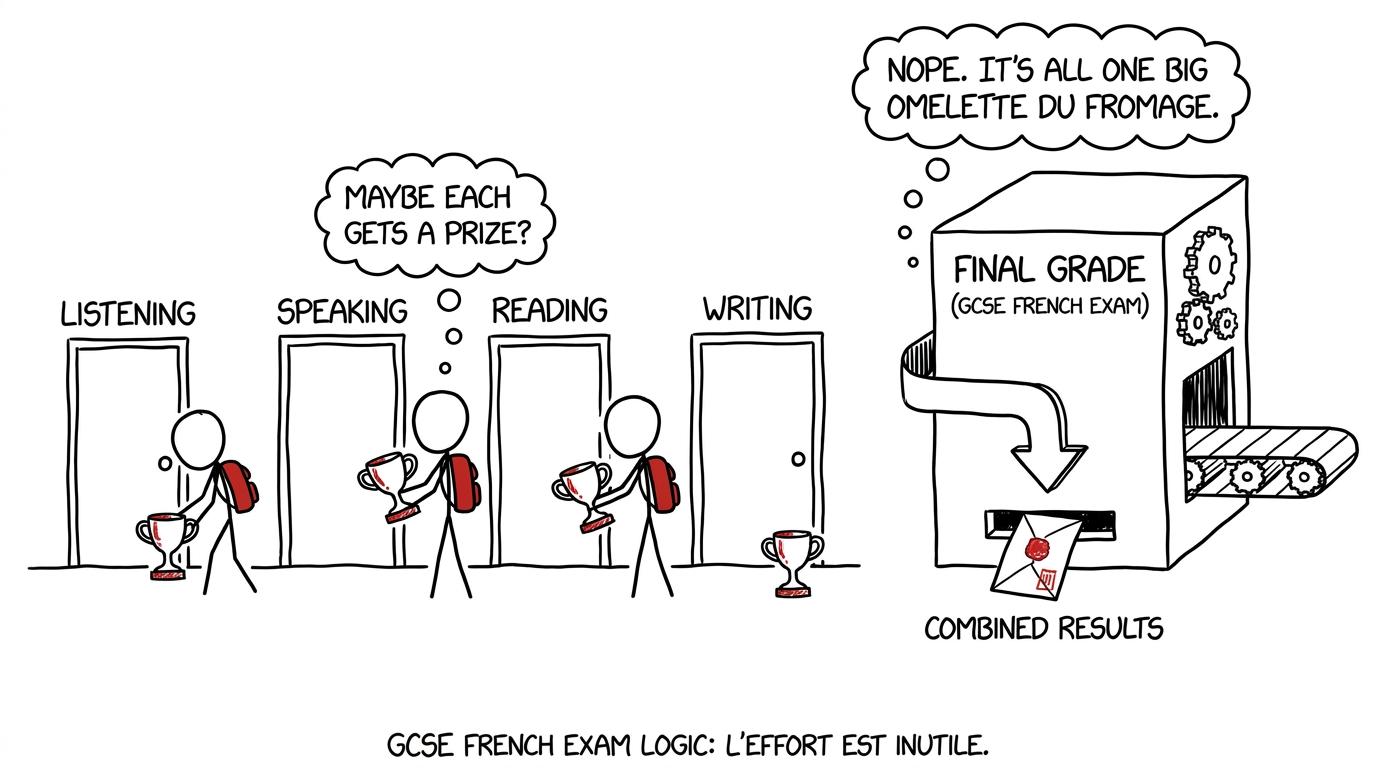 Four French components feed into one final GCSE grade
How exam boards actually set the boundaries
Boundaries are not finalised when the paper is written. They are set after students have taken the assessments and marking is nearly complete.
Exam boards use several forms of evidence. Statistical information indicates how the current cohort performed and helps reveal whether a paper behaved differently from previous assessments. Senior examiners also examine samples of real student work around possible boundary marks. They compare the quality of those responses with the standard represented by earlier awards.
The process can be summarised as follows:
- responses are marked and raw marks are collected;
- any required scaling is applied;
- assessment experts analyse how the papers performed;
- senior examiners review work around possible key boundaries;
- evidence from examiner judgement and statistical analysis is considered together;
- final subject boundaries are agreed and later published by the exam board.
If a paper was more difficult, a boundary may be lower. If it was more accessible, the corresponding boundary may be higher. The aim is for the grade to represent a consistent level of attainment, even though the raw mark required changes.
Different boards such as AQA, Edexcel, OCR and Eduqas use different papers and specifications. Their raw boundary numbers are therefore not directly interchangeable. A lower-looking boundary does not prove that one board is easier.
You can see how boundaries vary between specifications by comparing MathsGenie’s historical AQA GCSE grade boundaries and OCR GCSE grade boundaries.
Why older French boundaries need careful interpretation
Historical data can provide context, but GCSE French students face an additional complication. Revised French specifications began teaching in September 202420242024, with first certification in summer 202620262026 for boards including AQA, Pearson Edexcel and Eduqas.
That means a French boundary from summer 202520252025 may relate to an outgoing specification with different tasks, mark totals or assessment arrangements. It should not be treated as a direct prediction for the revised qualification.
When comparing boundaries, check all of the following:
- the exam board;
- the specification code;
- the exam series;
- Foundation or Higher tier;
- the maximum subject mark;
- whether figures are raw, scaled or notional component marks.
A number without this context can be technically accurate and still be useless for your revision decisions.
How to use boundaries without becoming distracted by them
Boundaries are best used as a measuring tool, not as a target to land on exactly. If a previous grade boundary was bbb and your practice-paper total is sss, your historical margin is:
Margin=s−b\text{Margin}=s-bMargin=s−bA positive margin is encouraging, but it is not a guaranteed future grade. Practice conditions, mark-scheme interpretation and annual boundary movement all create uncertainty. Aim for a comfortable margin rather than trying to finish one mark above an old threshold.
Maths students can apply the same principle. Start from the free GCSE maths revision hub, complete an appropriate paper, mark it honestly and identify where marks were lost. The useful question is not, “What do I hope the boundary will be?” It is, “Which marks can I make more reliable?”
A productive review separates mistakes into:
- missing knowledge;
- inaccurate recall;
- misunderstood instructions;
- weak exam technique;
- avoidable slips;
- incomplete answers caused by timing.
Then turn each category into action. MathsGenie’s guide to using GCSE past papers properly shows how marking, diagnosis and targeted practice work together. If you are deciding how much full-paper practice to schedule, read how many GCSE past papers to complete.
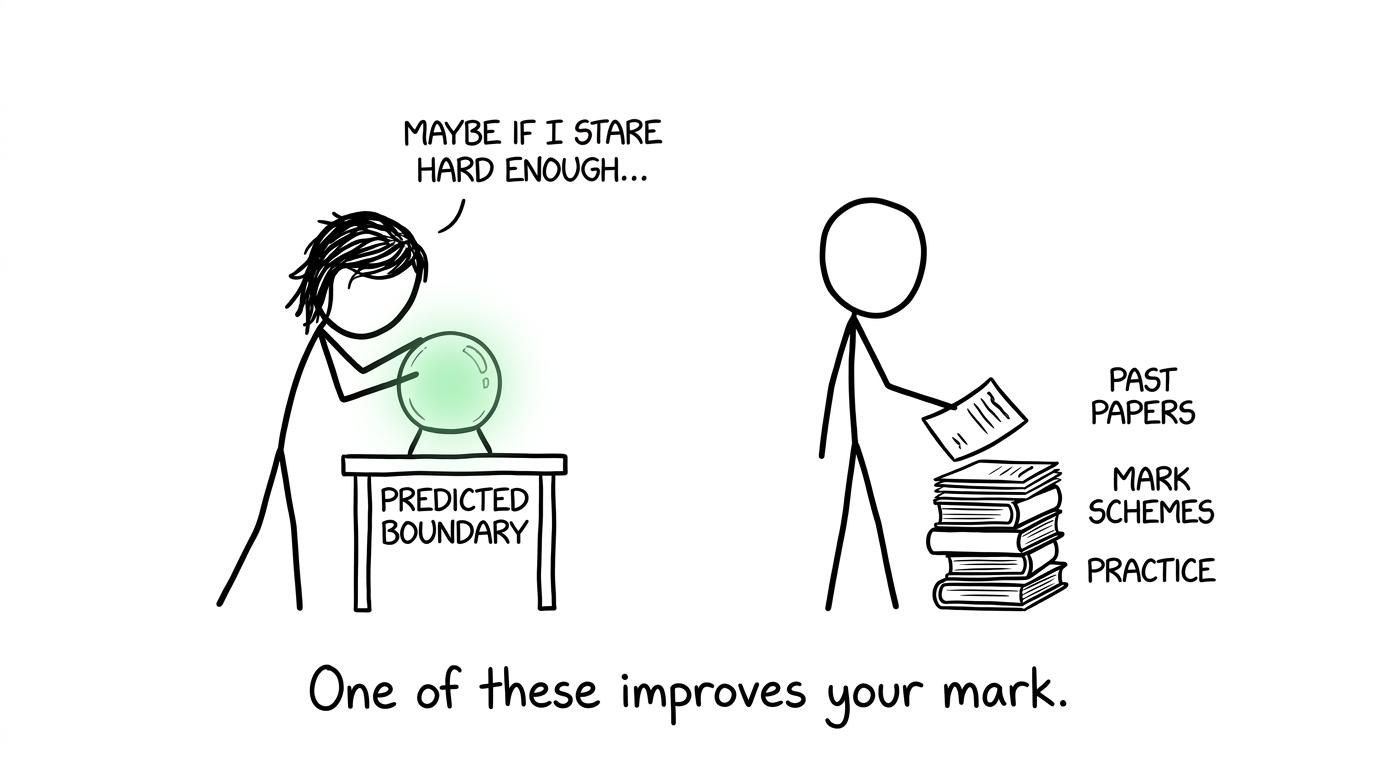 Revision resources quietly outperform a crystal ball predicting grade boundaries
Common mistakes when reading French grade boundaries
Treating a percentage as a permanent grade
A percentage is a description of your mark, not a fixed national grade conversion. Always compare the correct total mark with the official boundary for your board, specification, tier and series.
Adding raw marks when scaling is required
If the specification scales a component, simply adding its raw mark to the others may produce the wrong subject total. Use the scaling information supplied by the exam board or the total reported by your school.
Giving every component an official grade
Listening, speaking, reading and writing contribute to one qualification. Notional component boundaries are diagnostic guides; they do not replace the overall subject boundary.
Comparing different maximum marks
A boundary out of 200200200 cannot sensibly be compared with one out of 240240240 by looking only at the raw numbers. Even percentage comparisons remain limited when specifications and paper demands differ.
Using an old specification as a prediction
This is particularly important for the first awards of revised GCSE French qualifications in 202620262026. Check the specification code before drawing conclusions from older tables.
Believing an unofficial prediction is confirmed
Official boundaries are set after the assessments and are published by exam boards on results day. Any figure circulating beforehand is an estimate. The same caution applies when reading predicted topics: MathsGenie’s guide to revising without guessing topics explains why broad preparation is safer than prediction chasing.
Focus on the marks you can influence
A boundary is the final line drawn beneath a long assessment process. You cannot control where that line will sit. You can control the vocabulary you retrieve, the details you hear, the accuracy of your grammar and the completeness of your responses.
The lesson carries directly into maths revision. Use historical boundaries for perspective, then return your attention to learnable methods and recoverable marks. Build a realistic routine with the GCSE one-month maths revision plan, then use MathsGenie’s free revision lessons, practice questions, mini tests, past papers, predicted papers, mark schemes and video solutions.
Do not revise for a rumoured boundary. Revise so that reasonable boundary movement no longer decides your result.