

GCSE French Grade 8 Meaning: Ability Explained
GCSE French grade 8 meaning explained: discover the ability it represents, how it compares with old A and A* grades, and what students should do next now.
A Grade 8 can look wonderfully precise on a results sheet. Yet it raises a surprisingly difficult question: what can someone with that grade actually do?
The short answer to the GCSE French grade 8 meaning is that it represents very high attainment in GCSE French. A Grade 8 student has typically shown strong understanding and communication across listening, speaking, reading and writing, using a broad range of vocabulary and grammar with considerable accuracy. It is close to the top of the grades 9-1 scale, sitting below Grade 9 and comfortably above Grade 7.
It does not mean complete fluency. Nor does it guarantee perfection in every paper. It means the student has performed exceptionally well against the GCSE assessment criteria across the qualification as a whole.
For students balancing French with maths, science and other subjects, that distinction matters. A grade describes demonstrated exam performance, not a permanent label for your ability.
Grade 8 in GCSE French at a glance
Here is the practical interpretation:
- Grade 8 is the second-highest grade in the grades 9-1 system used in England.
- It broadly occupies part of the territory previously associated with an A*.
- It is awarded from a student's total mark across the assessed components, not from one isolated skill.
- It indicates sophisticated communication, strong comprehension and generally accurate use of French.
- It does not mean the student speaks like a native speaker or will never make mistakes.
- Grade boundaries change between exam series and exam boards, so there is no permanent mark or percentage that always guarantees Grade 8.
That last point is important. The grade is stable as a standard, but the raw mark needed to reach it can move because papers vary in difficulty.
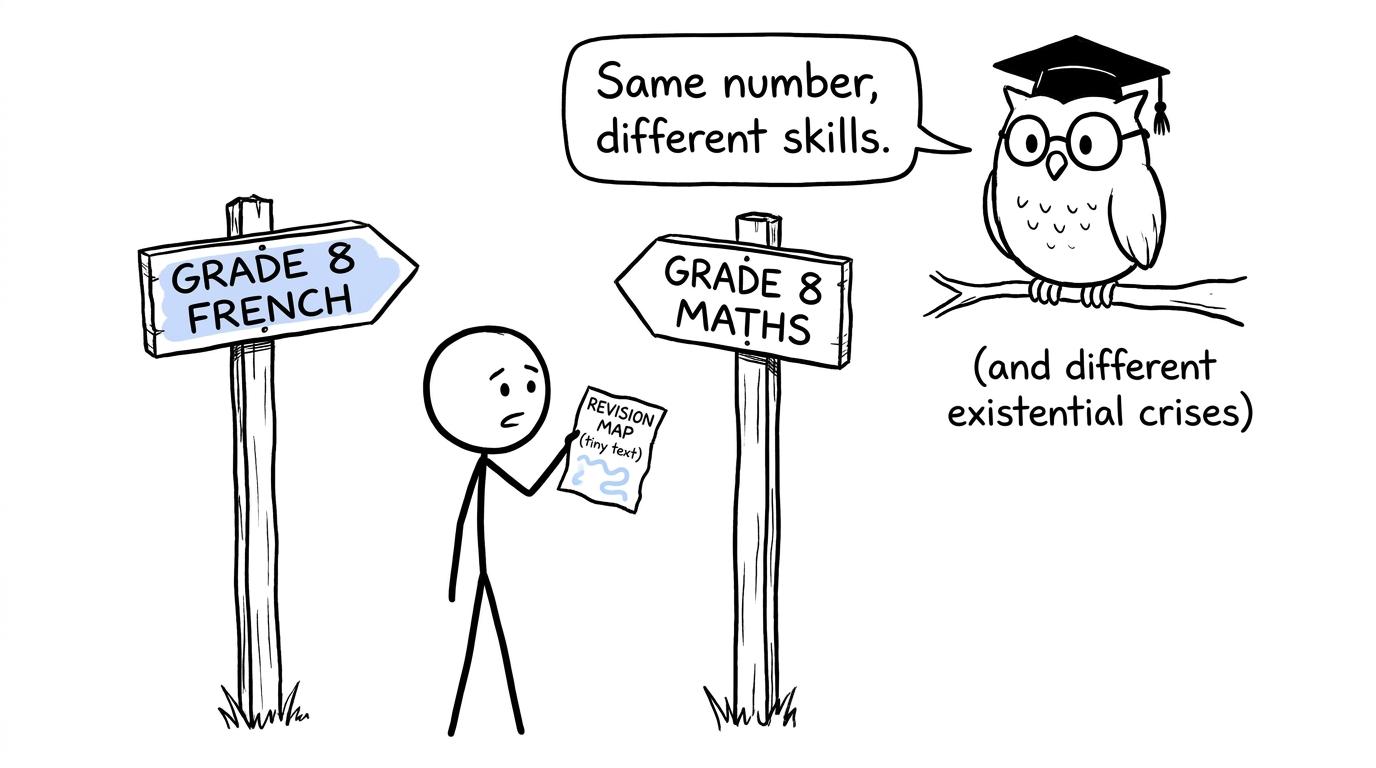 A student choosing between Grade 8 French and Grade 8 Maths revision paths
What ability does a Grade 8 in French represent?
Official GCSE grade descriptors describe typical performance rather than a rigid checklist completed identically by every student. A Grade 8 therefore represents a pattern of high-level performance across several connected abilities.
Understanding spoken and written French
A high-attaining student can usually identify main ideas, important details, opinions and attitudes in spoken and written material. They are also better able to cope when every word is not immediately familiar.
This involves more than remembering vocabulary. Strong readers and listeners use context, grammar and the surrounding information to infer plausible meaning. They can distinguish between what happened, what normally happens and what may happen next.
In an examination, that understanding might be tested through listening comprehension, dictation, reading questions or translation. The precise task format depends on the exam board and specification being followed.
Communicating ideas with depth
At Grade 8, answers tend to move beyond short statements. Students can describe events, express and justify opinions, explain preferences and refer to different time frames.
In speaking and writing, this may involve:
- developing answers rather than stopping after one sentence;
- giving reasons and relevant detail;
- using past, present and future contexts appropriately;
- responding to less predictable questions;
- adapting language to the task rather than relying entirely on memorised paragraphs.
That final skill is particularly valuable. Memorisation can provide useful building blocks, but high grades normally require students to manipulate language when a question is phrased differently from the version they practised.
Using vocabulary and grammar accurately
Grade 8 performance usually demonstrates a wide range of vocabulary and grammatical structures, with errors that do not prevent effective communication. Accuracy matters, especially where grammar changes meaning, but the standard is not error-free French.
A student may still miss an agreement, choose an imperfect word or hesitate during the speaking assessment. What matters is the overall quality: variety, control, clarity and the ability to recover when the language becomes demanding.
Translating meaning rather than individual words
Translation tasks test whether students can preserve meaning while controlling vocabulary and grammar. Strong students recognise that French and English do not always match word for word.
At Grade 8, translations are likely to be mostly accurate, with sensible choices based on context. The student can handle a range of structures without allowing one unfamiliar phrase to derail the whole response.
Is Grade 8 equivalent to an A or an A*?
Grade 8 is commonly described as being broadly comparable with an A*, but the old letter grades and the grades 9-1 scale do not have exact one-to-one conversions.
When the numerical system was introduced in England, key alignment points were established. The bottom of Grade 7 was aligned with the bottom of the old Grade A, while Grade 4 was aligned with the bottom of Grade C. Grade 9 was designed to identify a smaller group of the very highest-performing students than the old A* did.
This means Grade 8 sits between Grade 7 and Grade 9 in the high-attainment range. In broad everyday comparisons, it falls within performance previously associated with A and particularly A* outcomes. It is more accurate to say Grade 8 is a very high grade broadly within the old A region* than to claim that every Grade 8 converts exactly into one particular letter grade.
This is also why comparing siblings' results from different grading systems can be misleading. The labels changed, and the way the upper end of attainment is divided changed with them.
Maths students may recognise the same issue. The meaning of a Grade 8 in GCSE Maths is also about high performance within that subject's assessment, not a universal percentage shared by every paper.
Does a Grade 8 mean you are fluent in French?
Not in the usual meaning of fluency.
GCSE French measures performance within a defined secondary-school curriculum. It assesses vocabulary, grammar and communication across prescribed themes and examination tasks. Real-world fluency is broader. It includes sustaining unplanned conversations, understanding different accents, reading outside familiar contexts and communicating naturally over long periods.
A Grade 8 provides an excellent foundation for A Level French and further language learning. It suggests that the student can understand and produce increasingly detailed French, but it should not be treated as a formal declaration of native-like or professional fluency.
The distinction is encouraging rather than disappointing. A GCSE is a stage on the journey. Grade 8 means that stage has been completed to a notably high standard.
How GCSE French is assessed
GCSE French normally examines four language skills:
- listening;
- speaking;
- reading;
- writing.
For the reformed specifications first examined in England in 2026, students may also encounter features such as dictation, reading aloud, translation and an explicit focus on prescribed vocabulary and grammar. Exact paper structures and timings vary, so students should use the specification and sample assessment materials for their own board.
AQA, Pearson Edexcel and Eduqas offer current GCSE French qualifications in England. Do not assume that arrangements from another subject, school or older past paper apply to your course. Your teacher can confirm the correct board, tier and specification.
Grade 8 is available through higher tier. Under the current reformed specifications, higher tier targets grades 4-9, while foundation tier targets the lower grade range. Schools decide entries with students based on evidence from lessons and assessments.
Most importantly, the final grade reflects the combined result. A slightly weaker listening performance does not automatically prevent Grade 8 if the overall mark remains above the relevant boundary. Equally, one excellent speaking assessment does not guarantee the grade on its own.
Why Grade 8 boundaries change
Exam boards set grade boundaries after papers have been sat and marked. Boundaries can move to account for differences in paper difficulty, helping to maintain comparable standards between exam series.
This is why statements such as “Grade 8 always requires a particular percentage” should be treated cautiously. A past boundary can help you interpret a specific paper, but it is not a promise for the next examination.
Use the boundary published for the exact board, tier, specification and series when reviewing a past paper. For revision, the safer target is consistently strong performance rather than trying to land exactly on an old threshold.
The same principle applies when you use GCSE maths past papers and revision resources. Marks are most useful when they reveal what to practise next.
Turning the meaning of Grade 8 into a revision plan
Understanding the grade is useful only if it changes what you do.
For French, separate your revision into the skills being assessed. Vocabulary retrieval alone is not enough. Practise listening without a transcript, responding aloud to unpredictable questions, reading for both general meaning and precise details, and writing under a realistic time limit.
Then use a simple feedback loop:
- complete a focused task;
- mark it using the official criteria or teacher feedback;
- identify one recurring weakness;
- practise that weakness separately;
- return to a mixed task later.
This is almost identical to an effective maths routine. MathsGenie's guide to the best order for learning GCSE maths topics explains why secure foundations should come before the hardest material. Short, repeatable sessions also work better than waiting for a heroic burst of motivation. The 20-minute GCSE maths revision routine can help you protect time for maths while revising languages.
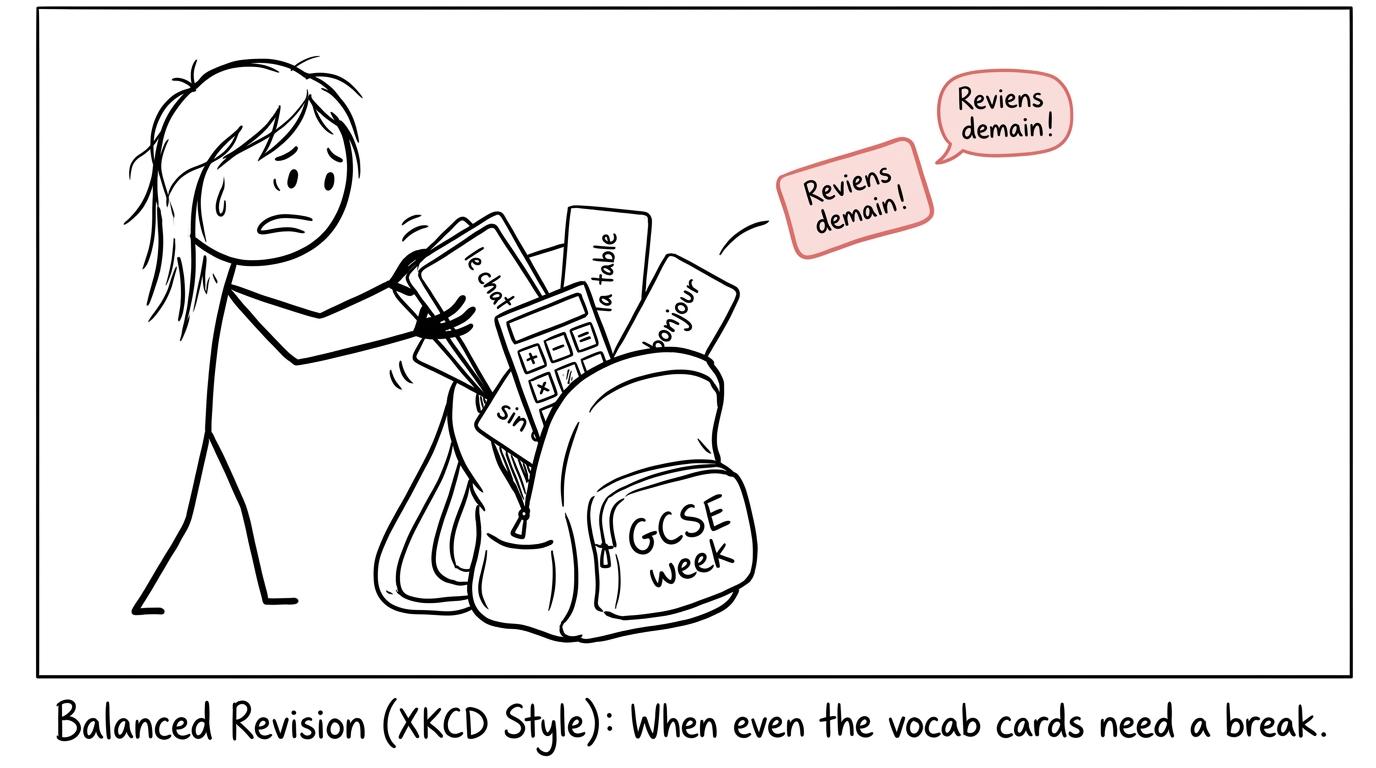 A GCSE revision backpack overflowing with French cards and a calculator
Common mistakes when interpreting a Grade 8
Treating Grade 8 as an exact old A*
The comparison is broad, not an exact conversion. Grade 8 sits in the very high attainment range, but the numerical scale reorganised the top grades.
Assuming it proves complete fluency
Grade 8 proves excellent performance against GCSE criteria. Fluency in unrestricted real-world situations is a wider claim.
Looking for one permanent percentage
Grade boundaries vary by board and exam series. Always match a boundary to the exact paper being used.
Believing every skill must be equally strong
The final grade comes from the combined assessment. Students can have different profiles across listening, speaking, reading and writing while achieving the same overall grade.
Letting French revision replace maths practice
A demanding language goal can quietly consume every available revision hour. Keep both subjects visible in your timetable. Use GCSE maths mini tests for short diagnostic practice, then return to full papers when you have more time.
Using old materials without checking the specification
Older papers can still contain valuable language, but task formats may not match a current qualification. For maths, the same discipline matters: choose resources for your board and tier, and follow advice on when to begin GCSE past papers.
A high grade is evidence, not an identity
A Grade 8 in GCSE French means a student has demonstrated excellent language knowledge and communication across demanding GCSE assessments. It sits close to the top of the grades 9-1 scale and broadly in the area associated with the old A* grade, without being a perfect one-to-one equivalent.
The number is meaningful, but its best use is practical. It tells you what strong performance looks like: accurate language, developed communication, careful comprehension and the ability to adapt knowledge under examination pressure.
As you balance French with maths, give both subjects a repeatable system. Start at the MathsGenie GCSE maths revision hub, use free revision lessons and practice questions to repair weak topics, then test your progress with mini tests, past papers and predicted papers. Mark with the available mark schemes, use video solutions when a method remains unclear, and let each lost mark decide the next piece of revision.











