Can You Sit GCSE French at a Different Exam Centre?
GCSE French different exam centre guidance: find an approved centre, arrange the speaking test, check fees and enter correctly as a private candidate.
A school timetable can make a subject feel more final than it really is. If French is missing from the options sheet, you may assume the qualification is closed to you. It is not necessarily.
The short answer to GCSE French different exam centre questions is yes: you can normally sit GCSE French at another approved exam centre as a private candidate, provided that centre accepts you, offers your chosen exam board and can conduct every required component, including the speaking assessment. Your entry must be made through the centre; you cannot enter directly with the exam board.
The difficult part is rarely permission in principle. It is finding a centre willing and equipped to manage the complete qualification. Starting early matters.
Your GCSE French exam-centre checklist
Before paying or committing to a course, confirm each of the following:
- Ask whether your own school can make an entry or arrange support.
- Choose the exact GCSE French exam board and specification.
- Find an approved centre that accepts private candidates.
- Confirm that the centre provides the compulsory speaking assessment.
- Check whether it offers your required foundation or higher tier.
- Ask for its entry deadline, total fees and cancellation terms in writing.
- Discuss access arrangements when applying, not shortly before the exam.
- Check your statement of entry, assessment dates and personal details.
- Plan travel for the speaking test and every written paper.
This is separate from preparing for your other subjects. Keep your maths revision organised through the free GCSE Maths revision hub, where you can select your board and use revision lessons, exam questions and papers without allowing French administration to consume the rest of your timetable.
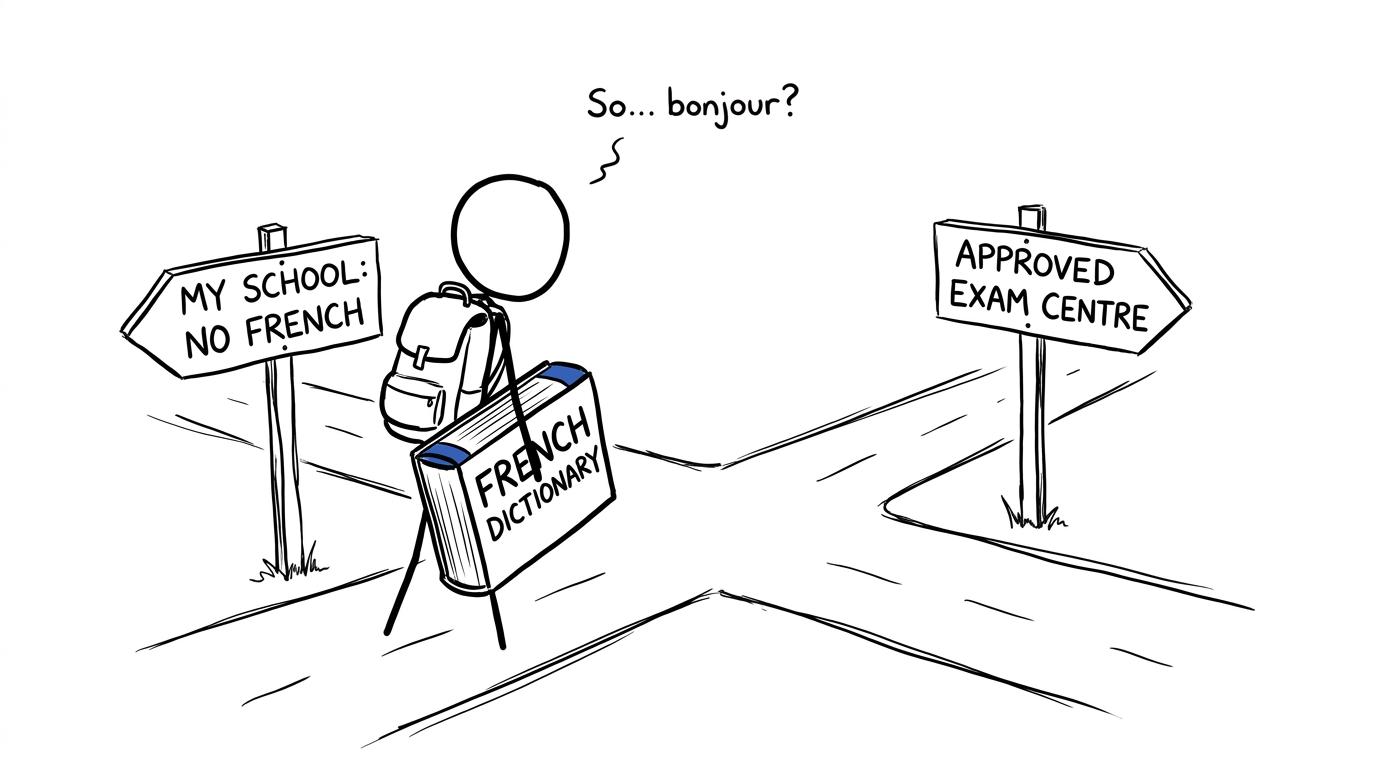 A student discovering that another approved exam centre may offer GCSE French
What to do if your school does not offer GCSE French
Begin with a conversation rather than an assumption. Speak to your head of languages, examinations officer or another appropriate member of staff. A school that does not teach French may still be willing to explore an entry, although it is not automatically required to provide the course, a French teacher or the assessment arrangements.
Ask clear questions:
- Can the school enter me for GCSE French as one of its candidates?
- Can it conduct and record the speaking assessment correctly?
- Which exam board and specification could it support?
- Would I need to find an external tutor or prepare independently?
- If it cannot help, can the examinations officer suggest a local approved centre?
The answer may still be no. That is useful information, because it tells you to move immediately to the private-candidate route rather than waiting for the school’s options process to change.
Decide how you will learn the course
An exam centre provides assessment arrangements, but it may not provide tuition. You might prepare through a private tutor, distance-learning provider, supplementary school or independent revision. Before choosing one, compare its course with the current specification for the board you intend to take.
Do not buy a course merely labelled “GCSE French” without checking the qualification. The vocabulary, themes, task formats and speaking requirements must match your actual specification. Current arrangements differ between awarding organisations and can change between exam series.
How to find a different exam centre
JCQ maintains a private-candidate search service for approved schools, colleges and other centres. Search by location, qualification and awarding organisation, then contact centres directly. A listing is a starting point, not a guaranteed booking: centres set their own subjects, capacity, fees, supporting-document requirements and internal deadlines.
Not every centre accepting private candidates offers French. Fewer still may be able to run its speaking assessment. Build a shortlist and contact several centres rather than waiting for one reply at a time.
Your first message should state:
- that you want to take GCSE French as a private candidate;
- your preferred awarding organisation and specification code;
- your intended exam series;
- your required tier, if known;
- whether this is a first entry or resit;
- whether you need access arrangements;
- your age and general location, where requested; and
- that you need the centre to provide all written and speaking components.
Ask for a complete quotation. The exam-board entry charge may be only one part of the price. A centre may charge separately for administration, invigilation, the speaking assessment, late entry or access-arrangement work. There is no single national private-candidate fee, so avoid treating an online estimate as a promise.
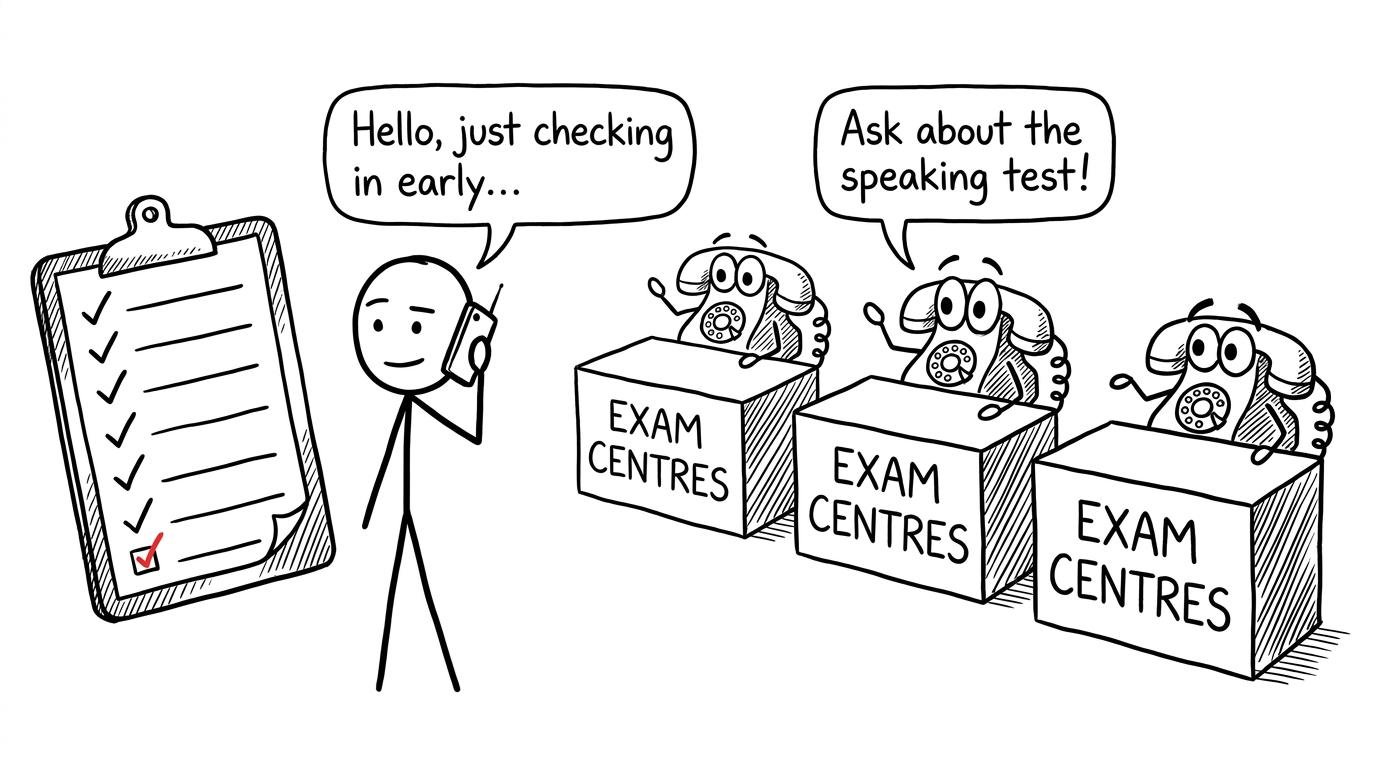 Cartoon telephones reminding a student to ask centres about the speaking test
Why the French speaking assessment matters
GCSE French is not simply a collection of written papers that any examination hall can host. The qualification includes a speaking component requiring controlled preparation, suitable accommodation, secure materials, an appropriate teacher-examiner or assessor, recording and submission under the board’s rules.
For example, AQA states that an entering centre accepting a private GCSE French candidate must take responsibility for supervising and authenticating the relevant non-exam assessment arrangements. Pearson Edexcel likewise requires centres to conduct and record the speaking assessment during its prescribed window and submit the recording appropriately. Exact procedures depend on the specification and exam series.
This is why “We accept private GCSE candidates” is not enough. Ask the more precise question: “Can you enter me for this GCSE French specification and conduct its compulsory speaking component?”
Also ask when the centre expects to hold speaking tests. They normally take place during a specified window before or around the main written-exam period, and the centre will allocate the actual appointment. Do not arrange travel based only on the dates of the written papers.
Choosing the exam board and tier
If your school has no French course, you may have some choice over the awarding organisation. Common possibilities include AQA, Pearson Edexcel and WJEC Eduqas, depending on where you live and what an available centre supports. Do not assume that every board offers the same current qualification or that every centre is registered for every awarding organisation.
In practice, centre availability may decide the board for you. A nearby centre already running one French specification is often more realistic than persuading it to adopt another solely for one candidate.
Before registering, compare:
- the current specification and qualification code;
- foundation and higher tier requirements;
- speaking task structure;
- listening, reading and writing formats;
- approved dictionaries or other assessment rules;
- the exam series in which the qualification is available; and
- whether your learning provider teaches that exact course.
Once entered, inspect your statement of entry carefully. Check your name, date of birth, subject, specification, tier and candidate details. A vague verbal agreement is not a substitute for an accurate formal entry.
Deadlines, transfers and access arrangements
Private candidates are responsible for approaching a centre and supplying the requested information in time. Exam boards publish entry deadlines, but centres commonly impose earlier internal deadlines so they can verify identities, collect fees and organise assessments. Late entries may cost more or be refused.
If you are already entered through one centre and later want to sit elsewhere, do not simply book another venue. This may require an official transferred-candidate arrangement between the entering and host centres, with approval and deadlines under JCQ rules. The original entry normally remains with the entering centre. Contact its examinations officer immediately.
Access arrangements also need early attention. If you may require extra time, a reader, modified papers, supervised rest breaks or another reasonable adjustment, tell the prospective centre when you enquire. The centre must consider the evidence, establish the appropriate arrangement and meet the relevant application deadlines. Previous support does not automatically transfer without the correct process.
Private candidates may also be asked for photographic identification or other evidence so the centre can verify that the person sitting the assessment is the person entered.
Protecting your maths revision while arranging French
Administrative uncertainty expands to fill whatever time you give it. The remedy is to separate arranging the exam from preparing for it.
Set aside one short weekly block for emails, calls and documents. Keep a record of centres contacted, replies, fees, deadlines and speaking arrangements. Once a booking is confirmed, return that time to revision.
For maths, use a similarly contained cycle:
- identify one weak topic;
- use a short revision lesson;
- complete practice questions;
- mark them immediately;
- record the exact error; and
- retest the skill later.
If exams are approaching, the GCSE one-week revision plan can help you divide limited time sensibly. If you are earlier in the year, read when to start GCSE past papers and build towards full timed practice gradually.
Students unsure where to begin can follow the best order for learning GCSE Maths topics. If your marks have stalled, use the focused advice for GCSE Maths revision at a pass grade rather than responding with unfocused hours.
 A student balancing French and maths revision while a calendar offers tea
Common mistakes when booking another centre
Assuming every private-candidate centre offers French
A centre may accept private candidates for written subjects but lack the staff, rooms or systems needed for a language speaking assessment. Confirm the entire qualification before paying.
Leaving the search until the published entry deadline
A centre’s own deadline may be earlier, and speaking capacity can be limited. Begin enquiries as soon as you know your school cannot support the subject.
Choosing a course before confirming the specification
Preparing for the wrong board can leave you learning unsuitable themes or task formats. Secure a realistic centre and verify its specification before committing to materials.
Forgetting to discuss access arrangements
These cannot safely be added as a last-minute preference. Tell the centre about your needs at the initial enquiry stage and provide requested evidence promptly.
Treating the speaking date as flexible
The board sets an assessment window, but the centre determines its timetable within that window. Confirm when you must be available and what happens if you cannot attend.
Neglecting other GCSE subjects
Finding a French centre is important, but it should not quietly replace maths preparation. If the final evening before a paper feels crowded, use the GCSE Maths night-before plan rather than attempting an exhausting catch-up session. Resit students can also use the GCSE Maths resit revision plan to rebuild their routine.
Make the arrangement, then return to the work
You can sit GCSE French at a different approved exam centre when your school does not offer it, but the arrangement depends on finding a centre willing to enter you for the correct specification and deliver every component. Ask your school first, search for private-candidate centres early, verify the speaking assessment, obtain written costs and deadlines, and check your formal entry.
Once those decisions are made, revision becomes simpler. Let the exam centre handle the regulated assessment process while you prepare consistently for French and your other GCSEs.
For maths, make MathsGenie’s free GCSE revision resources your starting point. Use revision lessons and practice questions to repair individual topics, mini tests to check recall, and past papers, predicted papers, mark schemes and video solutions to prepare for the real exam. The aim is not to carry every decision in your head. It is to build a plan you can trust, and then follow it.