GCSE French Cram Guide: A 1-Week Plan
GCSE French cram guide 1 week plan: revise vocabulary, grammar, listening, speaking, reading and writing with a calm, focused seven-day timetable.

The calendar says seven days. Your French folder seems to say seven months. That mismatch is uncomfortable, but it is not hopeless.
This GCSE French cram guide for 1 week gives you a direct plan: identify the exact papers you will sit, revise high-frequency vocabulary and grammar, practise all four language skills, complete timed tasks and use mistakes to decide what happens next. You cannot relearn an entire course perfectly in a week. You can, however, become much better at recognising questions, retrieving useful language and producing accurate answers under pressure.
The goal is not frantic coverage. It is controlled improvement.
Your one-week GCSE French checklist
Before the first session, confirm your exam board, tier and assessment dates with your teacher or exam timetable. Current GCSE French courses can differ in their task structure, timings and prescribed vocabulary, particularly following the introduction of reformed specifications for first assessment from summer 2026.
Your plan is simple:
- Day one: diagnose your weakest skills and organise resources.
- Day two: rebuild essential vocabulary.
- Day three: strengthen grammar and translation.
- Day four: focus on listening, dictation and sound patterns.
- Day five: practise speaking and reading aloud.
- Day six: complete reading and writing under time pressure.
- Day seven: rehearse, review errors and stop at a sensible time.
Aim for two focused sessions each day, separated by a proper break. If French is not your only approaching exam, keep one shorter block available for another subject. The MathsGenie GCSE maths revision hub can keep your maths practice structured while this plan temporarily gives French more attention.
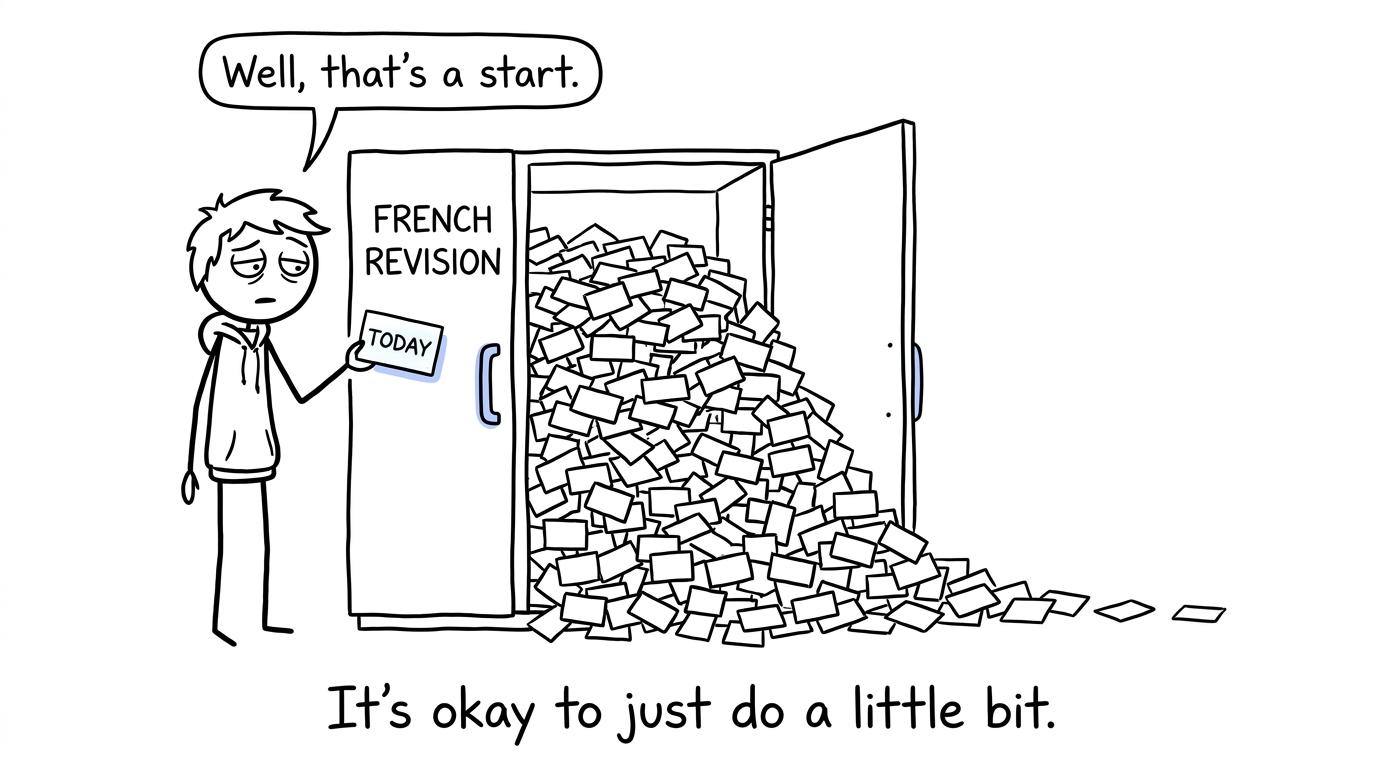 A student calmly choosing one vocabulary card as revision cards avalanche from a cupboard
Understand the paper before revising the subject
A week is too short for vague revision. Start by finding the specification, vocabulary list, sample assessment materials and any guidance supplied by your school. Use resources for your actual exam board rather than assuming every GCSE French paper looks the same.
Reformed AQA and Pearson Edexcel GCSE French qualifications assess listening, speaking, reading and writing. Their current specifications also place explicit emphasis on prescribed vocabulary and grammar, dictation, sound-symbol relationships and reading aloud. Eduqas students should follow the materials supplied for their own specification. Do not borrow timings or task formats from another board.
Check:
- whether you are entered for foundation or higher tier;
- the order and dates of your assessments;
- the permitted preparation for the speaking assessment;
- the length and format of each paper;
- the required themes, vocabulary and grammar;
- whether your class is taking a legacy or reformed specification.
Speaking assessments may take place before the written papers, so rearrange the seven days if speaking is your first component. A cram plan only works when it follows the real deadline.
Day one: diagnose before you memorise
Complete a short sample from each skill without notes: listening, reading, writing and speaking. This is not a mock designed to produce a flattering mark. It is an audit.
For every mistake, record one cause:
- vocabulary was unknown;
- vocabulary was known but not recognised quickly;
- the tense or grammar was misunderstood;
- the question instruction was misread;
- spelling or pronunciation caused the problem;
- the answer lacked enough detail;
- time ran out.
Rank the resulting weaknesses. Spend most of the week on the problems that affect several papers. Weak verb knowledge, for instance, can damage listening, reading, speaking, translation and writing at once.
This is the same evidence-led principle described in MathsGenie's guide to finding your weakest GCSE topics: test first, classify lost marks and then retest. Revision feels less comforting this way, but it becomes far more useful.
Finish day one by creating a compact error log and assembling only the resources you will use. Resource hunting can easily disguise itself as work.
Day two: learn vocabulary you can retrieve
Do not attempt to absorb an entire vocabulary list alphabetically. Prioritise words that unlock many contexts:
- common verbs and verb forms;
- opinions and reasons;
- time expressions;
- question words;
- connectives;
- negatives;
- people, places and everyday activities;
- quantities and descriptive language;
- vocabulary from your weakest themes.
Use active recall. Look at the English prompt, produce the French, check it and record errors. Then reverse the direction. Speak difficult words aloud so spelling, meaning and sound become connected.
Separate vocabulary into three groups: secure, hesitant and unknown. Revisit the hesitant pile frequently because these words are close to becoming dependable. The unknown pile needs smaller batches rather than one exhausting session.
End with a brief mixed test. Retrieval should be slightly difficult. Rereading a list may feel fluent because the answer remains visible; the examination will not provide that comfort.
Day three: secure grammar and translation
Grammar revision should concentrate on structures you are likely to use and recognise repeatedly. Review:
- present, past and future time frames required by your tier;
- common irregular verbs;
- subject and verb agreement;
- adjective agreement and position;
- negatives;
- pronouns;
- word order;
- articles and prepositions;
- question formation.
After reviewing each area, complete short translation or sentence-building tasks. Mark immediately and write the corrected form rather than merely placing a cross beside the error.
Build a personal accuracy checklist for written and spoken answers. Before finishing a task, check verbs, agreements, negatives, accents and whether every part of the prompt has been answered. Accuracy improves when checking becomes a routine rather than a vague final glance.
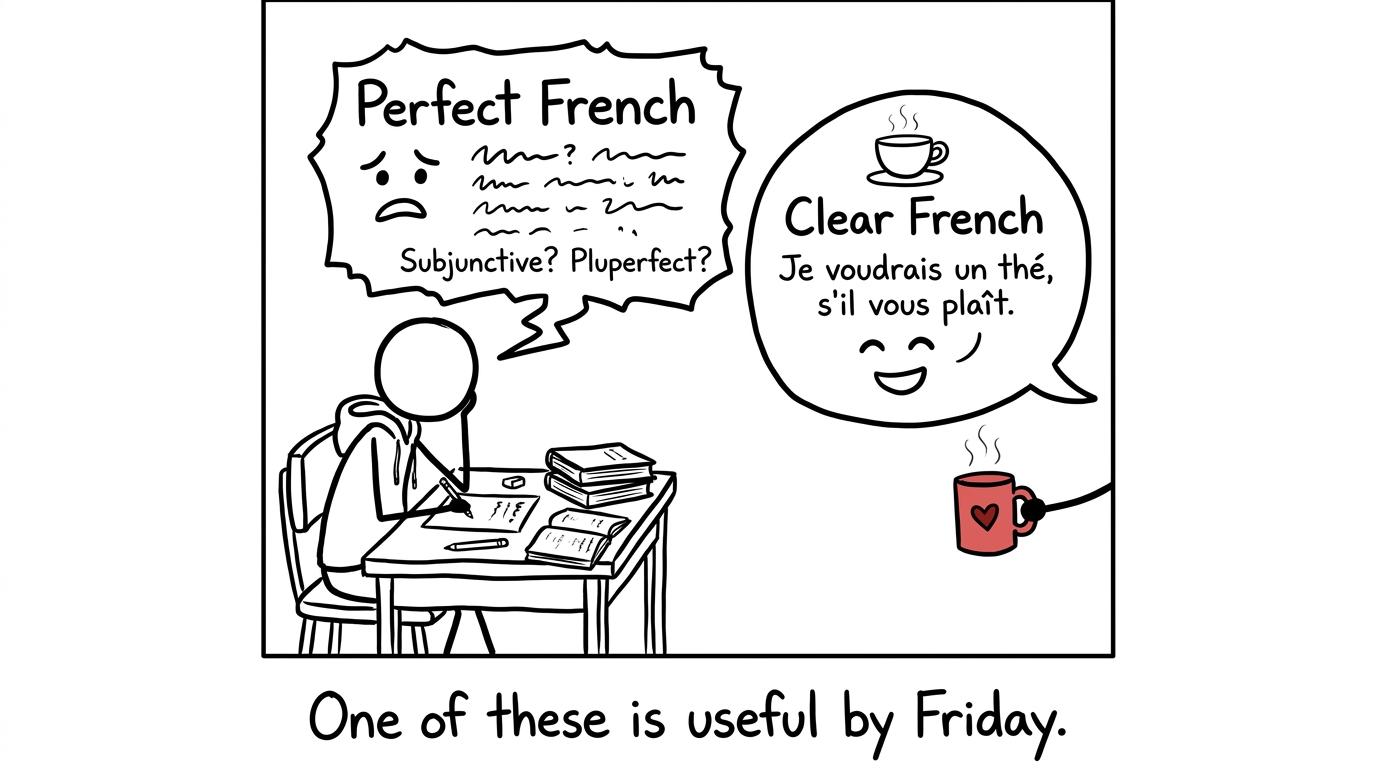 Clear French offers a student tea while Perfect French tries to negotiate
Day four: train listening and dictation
Listening improves through repeated, deliberate contact with audio, not by keeping French playing in the background.
Use short recordings from your course materials. Before listening, read the question and predict the kind of information required. On the first play, identify the topic and overall message. On another play, listen for precise details, negatives, changes of opinion, time references and contrasts.
For dictation practice, pause after a short phrase and write exactly what you hear. Compare your version with the transcript. Diagnose whether the error came from vocabulary, spelling, verb endings or a sound-symbol relationship.
Read the transcript only after attempting the audio. Then listen again while following it, mark difficult sound patterns and replay the section without the text. This turns one recording into a complete correction cycle.
Do not panic when one word is unfamiliar. Keep listening for information that still answers the question. Losing the next sentence while worrying about the previous word is one of the costliest listening habits.
Day five: make speaking predictable
Speaking feels unpredictable when every response is invented under pressure. Reduce that burden by preparing flexible language for opinions, reasons, descriptions, past experiences, future plans and comparisons.
Practise the exact task types on your specification. These may include a role-play, reading aloud, visual stimulus or follow-up conversation, depending on your board and course. Record your responses, listen back and notice where hesitation damages clarity.
Complete three rounds:
- speak slowly with notes;
- repeat using keywords only;
- respond again without looking.
For reading aloud, focus on accuracy and clear pronunciation rather than theatrical speed. Mark letter combinations or endings that you regularly mispronounce. For spontaneous questions, listen carefully to the question word and tense before answering.
Ask a teacher, classmate or family member to select prompts in an unpredictable order. If nobody is available, shuffle prompt cards and record yourself. The aim is flexible recall, not a memorised monologue that collapses when the question changes.
Day six: combine reading and writing
Complete a timed reading section and a timed writing task using materials for your board and tier.
In reading, underline negatives, time markers, opinions and words indicating contrast. Use the whole sentence when inferring meaning. A familiar-looking word can be misleading when context changes its role.
In writing, plan briefly before starting. Identify every bullet point and decide which time frame or idea will answer it. Give each bullet enough attention, but avoid writing far beyond the suggested length if doing so creates avoidable mistakes or prevents checking.
When marking, separate communication errors from language errors. Missing a bullet point requires a different fix from using the wrong verb ending. Rewrite weak sections accurately, then attempt a fresh prompt later without copying the correction.
If other exams are approaching, use a protected short session rather than abandoning them completely. MathsGenie's twenty-minute GCSE maths routine is designed for busy days, while the broader GCSE maths revision timetable can help you rebalance your subjects after the French paper.
Day seven: rehearse, repair and rest
The final day is for consolidation, not a desperate expansion of the syllabus.
Begin with a mixed retrieval test covering your error log. Complete one short timed task in the skill being assessed first. Mark it carefully, repair a small number of recurring errors and retest those points later.
Then prepare for the assessment itself:
- confirm the start time and location;
- pack the permitted equipment;
- check whether the next assessment is speaking or written;
- set a stopping time;
- protect your sleep.
Avoid a full paper late at night. It can reveal problems without leaving enough time or energy to repair them. The principles in MathsGenie's GCSE night-before plan transfer well here: use a short exam-style set, correct a few repeated mistakes and finish calmly.
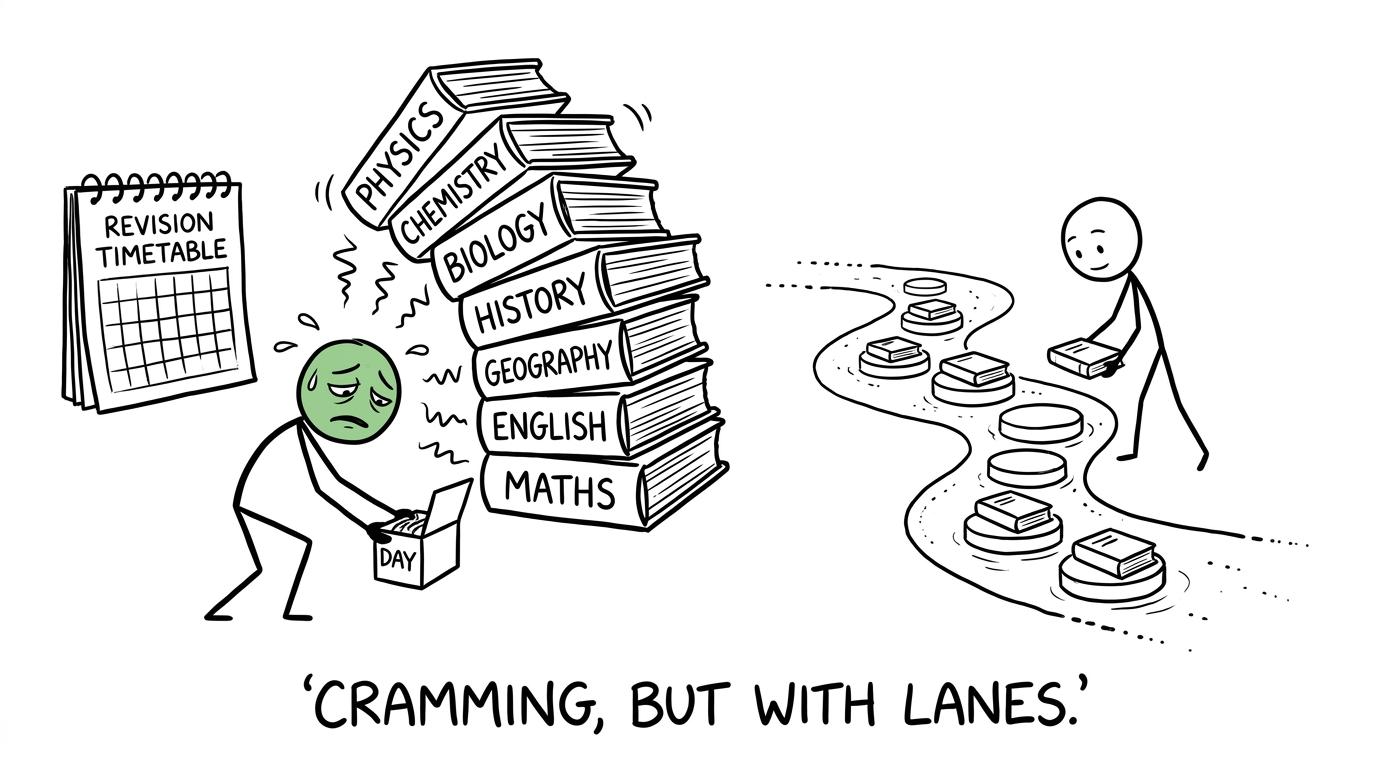 A sensible student puts one revision book on each of seven stepping stones
Common mistakes during a GCSE French cram week
Revising only vocabulary
Vocabulary matters, but the examination also requires listening, pronunciation, grammar, translation, reading strategy and controlled production. Give every assessed skill at least one focused session.
Copying notes instead of retrieving
Neat notes can create the impression of progress without testing memory. Close the book, produce an answer and then check it.
Memorising one perfect response
Prepared language is useful; a rigid script is fragile. Practise changing the topic, person, tense and opinion so your language can respond to the actual prompt.
Using resources for the wrong specification
Task structures, timings and vocabulary expectations can change between boards and specifications. Check your board, tier and assessment year before beginning.
Completing papers without reviewing them
The mark is only the diagnosis. Improvement comes from understanding each error, correcting it and retesting the same skill.
Sacrificing every other subject
A French emergency should not create a maths emergency. Keep a small maintenance block for other imminent papers. When you return to maths, MathsGenie's guide to starting GCSE past papers explains how to combine timed work with targeted correction.
Seven days can still change the exam
Starting late limits what you can cover, but it also forces a useful decision: you must revise what produces evidence of improvement.
Diagnose first. Learn language you can retrieve. Practise the real task formats. Mark honestly. Repair repeated errors. Then arrive rested enough to use what you know.
Once the French assessment is complete, return to MathsGenie's free GCSE revision resources. Use revision lessons and practice questions to rebuild weak topics, mini tests to check recall, and past papers, predicted papers, mark schemes and video solutions to prepare for your maths exams with the same disciplined loop: learn, practise, mark, fix and retest.