GCSE French Access Arrangements: How to Apply
GCSE French access arrangements explained: request extra time, understand the evidence your school needs and prepare for approval before your exams.
The difficult part of an exam is supposed to be demonstrating what you know. It should not be reaching the questions, hearing the recording or writing quickly enough to show your understanding.
That is the purpose of GCSE French access arrangements. If a disability, learning difficulty, medical condition, sensory impairment or temporary injury places you at a substantial disadvantage, an arrangement such as extra time, supervised rest breaks, assistive technology or a modified paper may help. Speak to your school's SENCo or access arrangements co-ordinator as early as possible. The school gathers evidence, confirms your normal way of working and makes any required application; students do not normally apply directly to AQA, Edexcel, OCR or Eduqas.
The details matter particularly in French because listening, speaking, reading and writing test different skills. An arrangement permitted in a written maths paper may not work in exactly the same way in a French speaking or listening assessment.
Your access arrangements checklist
Start with these actions:
- Tell a teacher, tutor, SENCo or access arrangements co-ordinator what makes timed assessments difficult.
- Explain what happens in lessons, internal tests and mock exams, not only how you feel about the final exam.
- Ask which arrangements are already recorded as your normal way of working.
- Complete any assessment or evidence-gathering requested by the school.
- Practise using the arrangement in mocks and classroom assessments.
- Check how it will operate in each French component.
- Confirm the room, equipment, timings and supervision before the assessment.
- Ask whether the same approved arrangement will apply to your GCSE maths papers.
An access arrangement is not a shortcut to extra marks. It changes how you access an assessment without removing the knowledge or skill being tested.
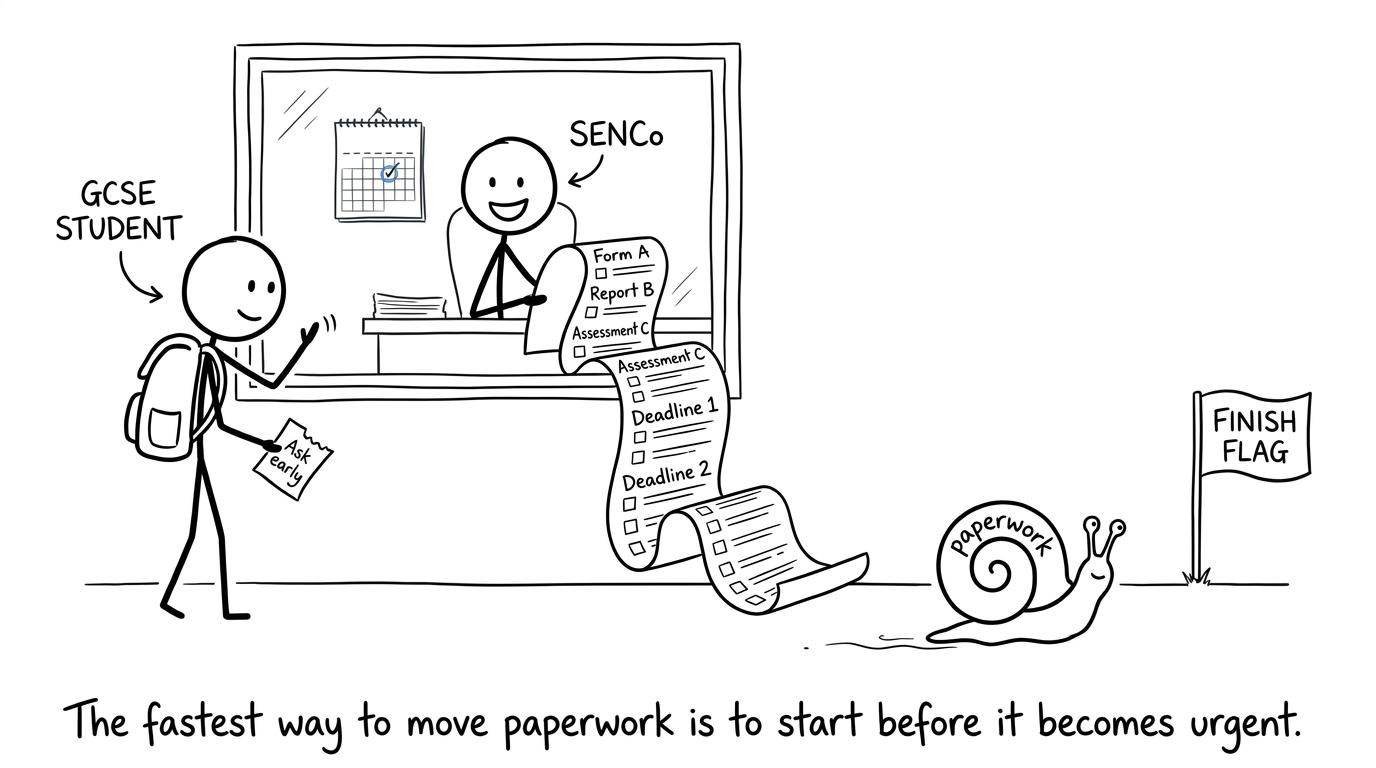 A student encouraging a paperwork snail to start early
Who can request GCSE French access arrangements?
You can raise a concern yourself, and a parent or carer can contact the school on your behalf. A French teacher may also notice a persistent difficulty during timed work and refer it to the SENCo.
The formal decision is evidence-led and made through the centre. A diagnosis, Education, Health and Care Plan or medical history can be relevant, but a diagnosis does not automatically produce a particular arrangement. Equally, students should not assume that they cannot ask for support because they do not have an EHCP.
The school must establish the difficulty, the disadvantage it creates and the support that reflects your usual way of working. For some arrangements, it can make the decision under delegated JCQ rules. Others, including applications for extra time, a reader or a scribe in relevant circumstances, normally require processing through Access Arrangements Online.
Private candidates should contact their intended examination centre particularly early. The centre still needs to understand the candidate's needs, secure appropriate evidence and determine whether it can provide the arrangement.
How to request an arrangement through your school
Begin with a specific conversation
Saying "I need more time" may begin the discussion, but specific information is more useful. Explain whether you have difficulty processing written instructions, reading at speed, maintaining concentration, hearing recorded speech, writing for sustained periods or managing a medical condition.
Describe what teachers already do that helps. This might include supervised rest breaks, a word processor, enlarged materials, a smaller room or extra processing time. The aim is to identify a consistent need rather than invent a new exam-day routine.
Let the centre gather evidence
For learning difficulties, the SENCo may arrange an assessment by the centre's appointed assessor. Current JCQ rules specify the evidence and forms required for different arrangements. For disabilities, sensory impairments or medical conditions, specialist evidence and centre-based records may be relevant.
For applications for 25%25\%25% extra time processed under the current evidence route, schools also need evidence showing how the arrangement is used in relevant internal tests or mocks, supported by observations from teaching staff. This is why using the arrangement regularly matters. It gives the school evidence and gives you the chance to learn how to use the time effectively.
Wait for confirmation, not assumptions
A teacher's informal permission in one lesson is not the same as an approved examination arrangement. Ask for confirmation from the SENCo or exams officer. You should know which arrangement has been agreed, which components it covers and how it will run on the day.
How extended time works in GCSE French
A common arrangement is 25%25\%25% extra time. If the standard working time is TTT, the adjusted time is:
T+0.25T=1.25TT + 0.25T = 1.25TT+0.25T=1.25TThat does not mean every part of every French assessment is automatically stretched in the same way. JCQ guidance says centres should seek advice from the relevant awarding body about applying approved extra time in listening and speaking examinations.
Listening assessments
Listening papers use recordings, controlled pauses and prescribed assessment conditions. Depending on the student's needs and the exam board's instructions, support might involve extra time, amplification equipment, a separate room, a live speaker or access to a specially prepared version of the assessment.
A live speaker may be available where a candidate has persistent and significant difficulty following speech at normal speed and this reflects their normal way of working. The centre must follow the rules governing the transcript and delivery. It cannot simply pause or replay a standard recording whenever a student chooses unless the approved instructions permit that approach.
Speaking assessments
In speaking assessments, extra time may be applied to preparation rather than extending the assessed conversation itself. The exact approach depends on the specification and awarding body's guidance. AQA and Edexcel, for example, set maximum assessment times for their current GCSE French speaking tests. Continuing beyond that maximum could change the assessment rather than provide access to it.
Your centre should therefore confirm how additional preparation time, rest breaks or another adjustment will operate before the speaking assessment begins. Do not rely on a general statement that you "get extra time" across all subjects.
Reading assessments
GCSE French reading papers assess your ability to understand written French. A human reader cannot normally read the assessed French text aloud because that would turn a reading task into a listening task. A computer reader may be permitted in circumstances covered by JCQ rules because it allows the candidate to operate the technology independently, but the centre must verify what is allowed for the paper.
A reader may be able to read English instructions where that does not compromise the skill being assessed. Again, this is a decision for the centre under the relevant regulations.
Writing assessments
Possible arrangements include extra time, supervised rest breaks, a word processor or, in tightly defined circumstances, a scribe. French creates an important restriction: if a scribe records assessed words in the foreign language, the candidate may have to dictate each word letter by letter. Otherwise, the scribe could supply spelling that the candidate is meant to demonstrate.
A standard bilingual dictionary is not normally permitted in a modern foreign language examination when it would translate the language being assessed. Being allowed a bilingual dictionary in another GCSE therefore does not mean you may use an English-French dictionary in GCSE French.
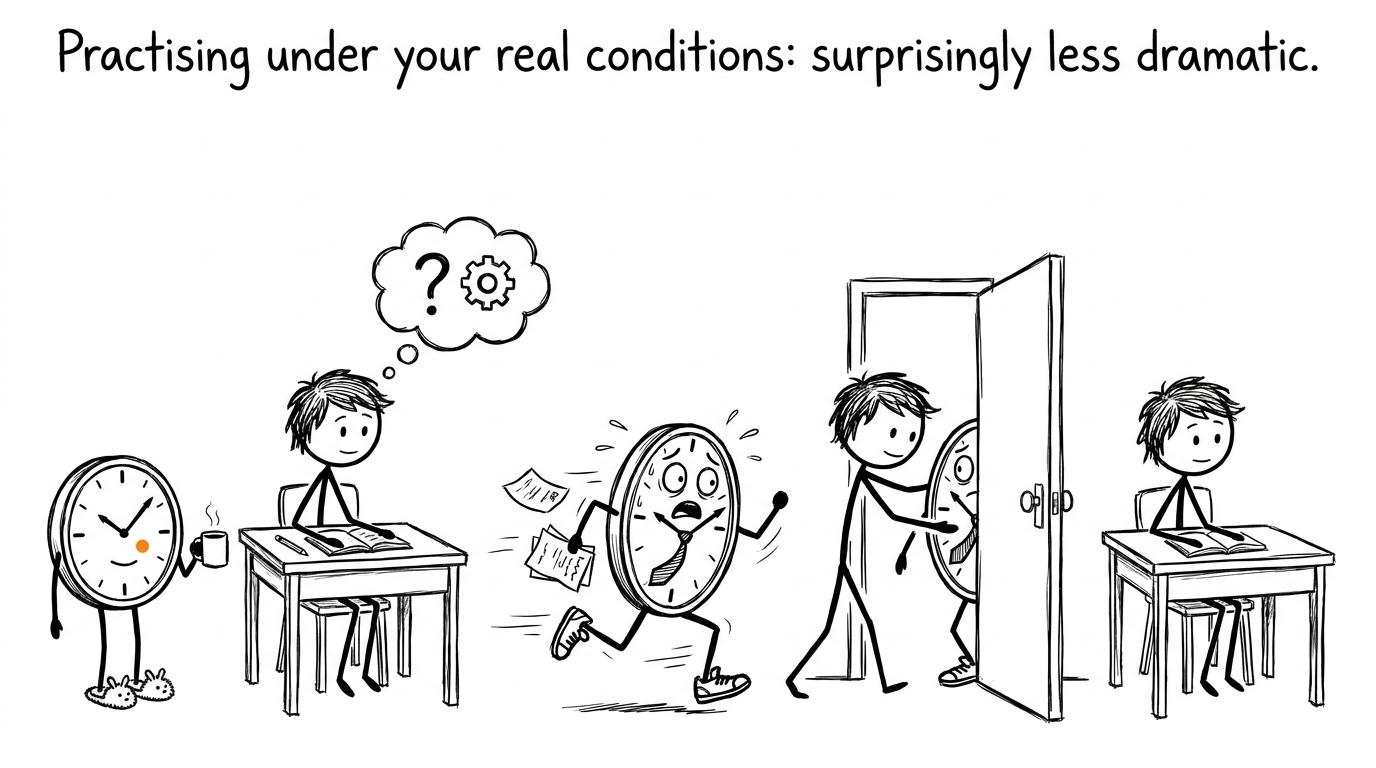 A calm revision clock replacing a frantic exam clock
Other arrangements that may be available
Extra time is only one possibility. Depending on demonstrated need and the assessment rules, support may include:
- supervised rest breaks;
- a smaller room away from the main examination room;
- a word processor;
- coloured overlays or modified-colour papers;
- large-print or Braille papers;
- amplification equipment or a live speaker;
- a computer reader or reader where the assessed skill permits it;
- a prompter;
- practical assistance;
- modified language papers;
- a component exemption as a last resort.
Some arrangements require an online application, while others can be approved by the centre. Modified papers have an earlier ordering deadline. Exemptions are considered only where another reasonable adjustment cannot remove the disadvantage, and they cannot be used merely because a component is difficult.
The timeline for getting approval
The safest timeline begins long before the summer examination series.
Year 9 or early Year 10
Raise persistent difficulties and begin using appropriate support in ordinary lessons and assessments. An assessment for learning difficulties used in the access arrangements process is generally completed from Year 9 onwards under current JCQ rules.
During Year 10
The centre can trial possible arrangements, collect teacher observations and retain evidence from timed assessments. This helps distinguish between an arrangement that genuinely improves access and one that is unlikely to be appropriate.
Autumn and early spring of Year 11
Confirm your exam entries, revisit the evidence and ask the exams team about its internal deadline. Schools usually set internal dates earlier than JCQ's final deadline so there is time to resolve missing evidence or refer a case to an awarding body.
For context, under the published June 2026 timetable, the deadline for ordering modified papers was 31 January 2026, while the deadline for processing other online access arrangement applications was 21 March 2026. JCQ publishes regulations and dates for each academic year, so students preparing for a later series must ask their centre for the current deadlines rather than reusing these dates.
Before mocks and final assessments
Use the arrangement under realistic conditions. Confirm how it applies to French listening and speaking, where awarding-body instructions may differ from the treatment of an ordinary written paper.
If you also receive the arrangement in maths, use it while completing timed material from the GCSE Maths Revision Hub. You can organise that practice with the MathsGenie revision planner and gradually move towards authentic conditions using the past papers library.
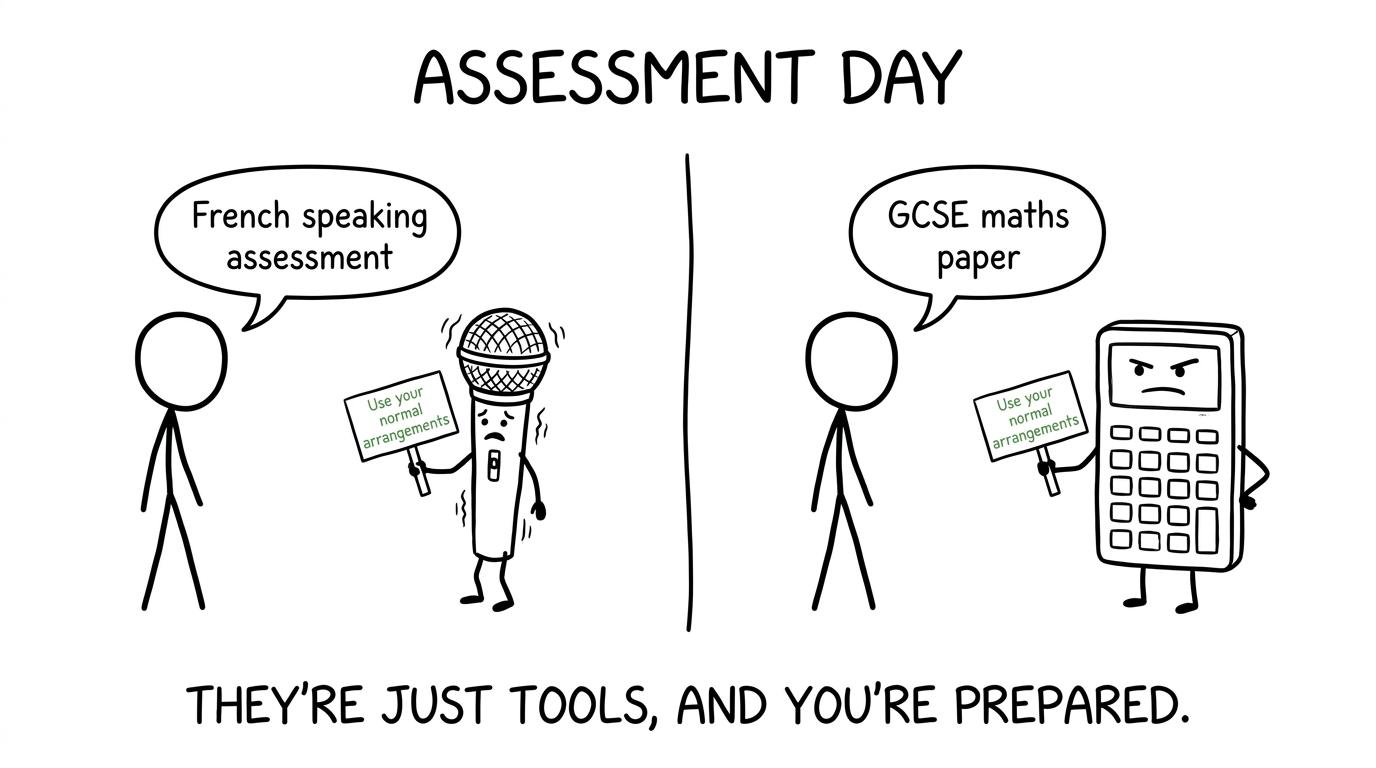 A microphone and calculator agreeing on normal arrangements
What if your needs change close to the exam?
Tell the school immediately. A temporary injury, newly diagnosed condition or sudden change in health may require a late adjustment. The centre will decide what evidence is available, whether an arrangement can be implemented safely and whether the awarding body must be contacted.
Access arrangements and special consideration are different. Access arrangements are normally agreed before an assessment and change how you take it. Special consideration is a limited post-assessment adjustment for eligible candidates whose performance was affected by a temporary illness, injury or other adverse circumstance at the time.
Common mistakes to avoid
Waiting until the speaking test
French speaking assessments can take place before the main written papers. Asking during the assessment leaves little room to gather evidence or obtain board-specific guidance.
Assuming extra time works identically everywhere
A written maths paper, French listening recording and French speaking assessment do not operate in the same way. Ask how the arrangement applies component by component.
Not using the arrangement in mocks
An arrangement should reflect your normal way of working. Mock papers provide evidence and let you develop a sensible timing routine. Maths students can use the process in GCSE past-paper practice, then fix weak topics rather than treating extra time as unstructured finishing time.
Confusing support with reduced standards
Arrangements cannot remove the skill being tested. A reader cannot normally read assessed French in a reading paper, and a scribe cannot silently supply accurate French spelling.
Revising without your real conditions
If you have approved rest breaks, extra time or a word processor, practise with them. Use short mini-test revision sessions before building up to full papers. A structured GCSE maths revision timetable can also leave room for French without turning every evening into a marathon.
Make the arrangement part of your preparation
The best access arrangement is almost boring by exam day. You know where you will sit, how the timing works and what equipment you will use. Nothing is being improvised while the clock is running.
Start by contacting your SENCo or access arrangements co-ordinator and asking for a clear review of each French component. Then apply the same discipline to maths revision. Use MathsGenie's free revision lessons and practice questions to repair weak topics, follow the one-month GCSE revision plan, and finish with past papers, mark schemes, video solutions, mini tests and predicted papers under your approved conditions.
Support works best when it is requested early, practised regularly and understood clearly. Your next step is simple: ask the question now, not in the week of the exam.