GCSE French 6 to 9: How to Make the Leap
GCSE French 6 to 9: discover what separates strong answers from exceptional ones, then improve grammar, vocabulary, spontaneity and exam technique.

A grade 6 in GCSE French usually means you can communicate successfully. You understand familiar material, express relevant ideas and use several tenses, although accuracy or detail may be inconsistent. A grade 9 demands something more controlled: precise comprehension, flexible language, sustained accuracy and the ability to respond when the task becomes unfamiliar.
The journey from GCSE French 6 to 9 is therefore not about memorising a few impressive phrases. It is about making specific improvements across listening, speaking, reading and writing, then proving those improvements under exam conditions.
That distinction matters. Many students work harder without changing how they practise. They learn longer vocabulary lists but still miss negatives in listening. They memorise paragraphs but struggle with an unexpected speaking question. Progress begins when revision targets the reason marks are being lost.
Your grade 6 to grade 9 checklist
Use this as a quick diagnosis:
- Confirm that you are entered for higher tier, which targets grades 4-9.
- Learn vocabulary through active recall rather than rereading.
- Control present, past and future time frames accurately.
- Replace memorised paragraphs with adaptable sentence structures.
- Practise listening for detail, including negatives and changes of opinion.
- Develop speaking answers spontaneously instead of reciting scripts.
- Complete timed reading and writing tasks regularly.
- Analyse mark schemes and examiner feedback from your own exam board.
- Keep an error log and revisit recurring mistakes.
- Train all four skills rather than concentrating only on writing.
The same diagnose, practise, mark, repair cycle works across subjects. If you are balancing French with maths, the MathsGenie GCSE revision hub provides a clear model: identify a weakness, learn the skill, answer questions and check the solution.
What separates a grade 6 from a grade 9 in GCSE French?
There is no universal list of features that automatically produces a particular grade. Grade boundaries are set after each exam series and can change, while your final result reflects performance across the whole qualification.
Still, the differences between a broadly grade 6 performance and a top-band performance are visible.
| A typical grade 6 performance | A grade 9-level ambition |
|---|---|
| Communicates the main message | Communicates detailed, fully relevant ideas |
| Uses familiar vocabulary effectively | Selects varied and precise vocabulary flexibly |
| Attempts several time frames | Moves accurately between time frames |
| Gives opinions with simple reasons | Develops and justifies opinions naturally |
| Understands the main points | Identifies detail, attitude and implied meaning |
| Relies partly on prepared language | Adapts language to unfamiliar questions |
| Makes errors that sometimes interrupt clarity | Maintains strong control even in complex language |
| Performs well in preferred skills | Produces consistently strong work across all components |
The decisive word is control. Complexity helps only when it communicates clearly. One accurate, developed sentence is more valuable than an elaborate construction whose meaning collapses.
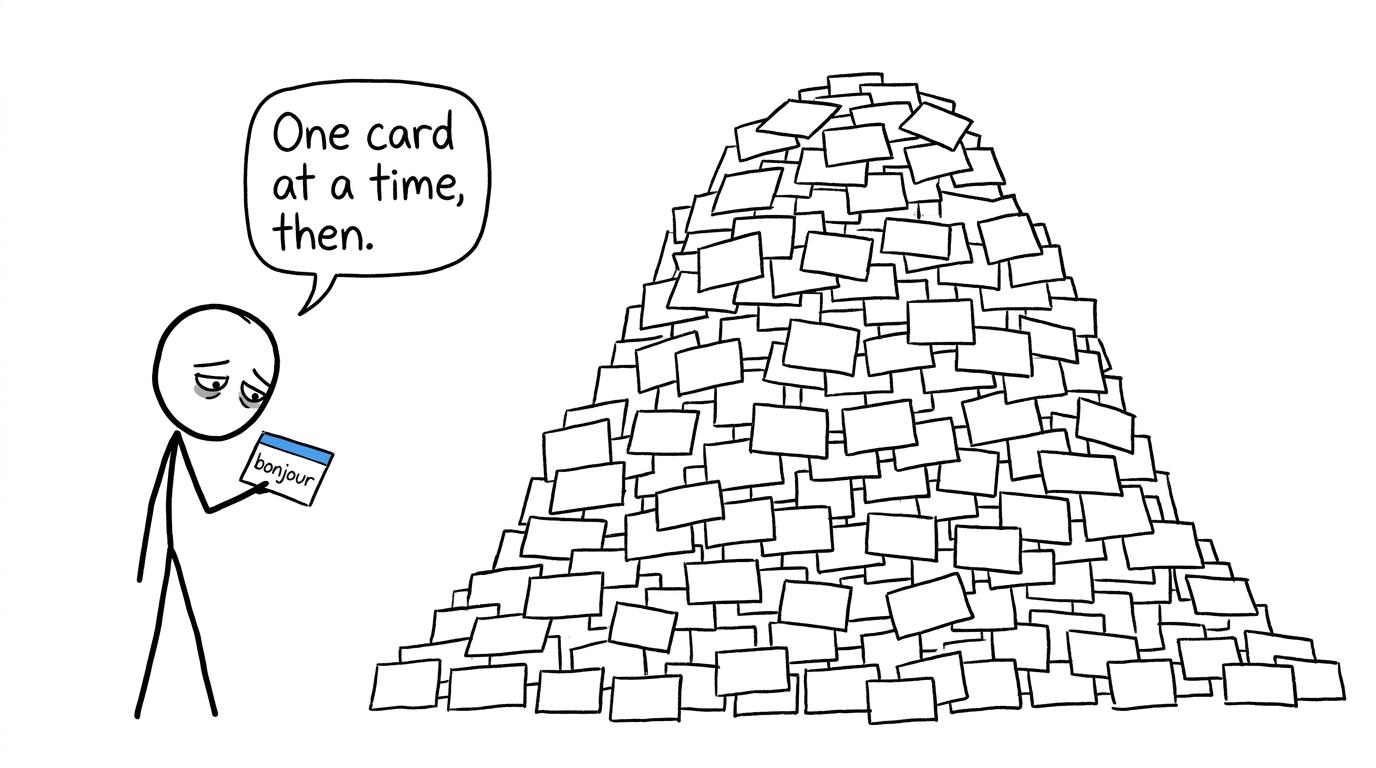 A student facing a mountain of French flashcards and deciding to take one card at a time
Understand the current GCSE French assessment
For qualifications first assessed in summer 2026, AQA, Pearson Edexcel and Eduqas assess listening, speaking, reading and writing. Each component contributes 25% of the qualification, although paper order, timings and task details vary by board.
The reformed specifications use three assessment objectives:
- AO1: understanding and responding to spoken language in speech and writing
- AO2: understanding and responding to written language in speech and writing
- AO3: demonstrating knowledge and accurate application of prescribed grammar and vocabulary
Across the qualification, these are weighted at 35%, 45% and 20% respectively. New-style tasks include dictation, reading aloud, role-play, visual stimuli, translation and unprepared interaction. Always use the specification and sample materials for your board rather than assuming an older paper has the same format.
Higher tier is essential for a grade above 5. Ask your teacher to confirm your board, tier and specification code before building a revision plan.
Turn vocabulary into usable language
A grade 9 student does not merely recognise a word on a list. They can retrieve it quickly, understand it in speech and place it accurately inside a sentence.
Build vocabulary in three directions:
- French to English for reading and listening
- English to French for speaking and writing
- Sound to spelling for dictation and pronunciation
Study words inside short chunks, including their grammatical partners. Learn nouns with an article, verbs with useful constructions and adjectives in forms you are likely to need. Record whether a mistake came from meaning, spelling, gender, agreement or pronunciation.
Short, repeated retrieval sessions are more useful than one enormous weekly session. The planning principles in MathsGenie's GCSE revision timetable guide transfer well: revisit material, combine focused practice with timed work and allow space to repair weaknesses.
Make grammar reliable before making it impressive
Students often imagine that grade 9 writing must contain the longest possible sentences. Examiners need communication and accuracy, not decoration.
Prioritise control of:
- present, perfect, imperfect and future forms required by your specification
- common irregular verbs
- adjective agreement
- negatives
- object and reflexive pronouns
- word order
- connectives and subordinate clauses
- justified opinions
- questions
Create a grammar audit rather than revising everything equally. Label each area secure, inconsistent or missing. Spend most of your time on the middle category: these are skills you partly understand and can often improve quickly.
After correction, produce a fresh response without copying the answer. Recognition creates comfort; independent production creates exam readiness.
Improve listening and reading precision
At grade 6, students often understand the general topic but lose marks on small details. Grade 9 performance depends on noticing exactly what happened, when it happened and how the speaker or writer feels.
Train listening in layers
On the first listen, identify context and overall meaning. On the next, focus on names, time references, reasons, negatives and contrasts. Then check the transcript, if available, and classify the problem:
- the word was unknown
- the word was known but not recognised at speed
- a familiar sound was misheard
- grammar changed the meaning
- the answer included an unsupported assumption
Dictation deserves separate practice because it connects listening, phonics, vocabulary and spelling. Replay short extracts and write exactly what you hear rather than summarising the message.
Read for evidence, not expectation
Before answering, locate the words that support your conclusion. Watch for paraphrase: the question may express the same idea differently from the source. Use surrounding grammar and context to infer unfamiliar vocabulary rather than stopping at the first unknown word.
Past papers should become more frequent gradually. MathsGenie's guide to when you should start GCSE past papers explains the useful progression from diagnosis to timed sections and full papers. Apply that structure using official French materials for your board.
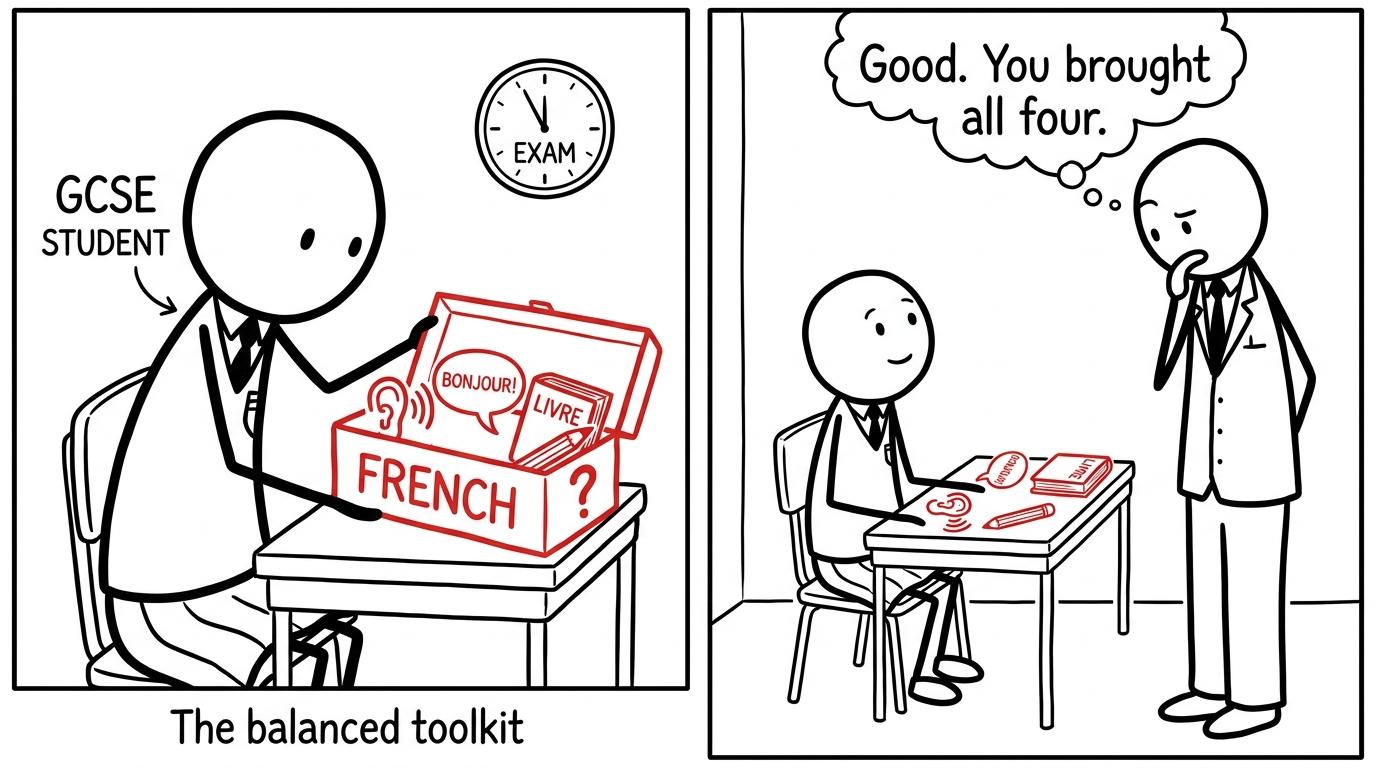 A GCSE student bringing listening, speaking, reading and writing tools into an exam
Build spontaneous, controlled speaking
Memorised answers can sound fluent until the teacher asks an unexpected question. Grade 9 candidates need language they can rearrange in real time.
Prepare flexible building blocks for opinions, reasons, past experiences, future intentions and comparisons. Then practise answering unseen questions with brief planning time. Record yourself and listen for:
- whether every part of the question was answered
- clarity of pronunciation
- unnecessary pauses
- repeated vocabulary
- verb accuracy
- whether ideas were developed
For reading-aloud tasks, learn the sound and spelling relationships listed by your board. Read unfamiliar passages aloud, mark difficult sound combinations and check whether your pronunciation remains clear when you are nervous.
A speaking partner can deliberately interrupt your rehearsed route with follow-up questions. That mild discomfort is useful. The exam is not asking whether you can remember a speech; it is testing whether you can communicate.
Upgrade writing without losing accuracy
Strong writing answers the whole task. Before composing, turn every bullet point into a small requirement and check each one off only when it has been addressed clearly.
Plan for variety with purpose:
- more than one time frame where relevant
- opinions supported by reasons
- specific detail rather than empty description
- connectives that show contrast or consequence
- vocabulary suited to the context and register
- a final accuracy check
When proofreading, do not simply reread for meaning. Perform separate checks for verbs, agreements, negatives, accents and omitted words. Focused checking is more reliable because the brain tends to see what it intended to write.
If exams are close, adapt the focused structure in the GCSE one-week revision plan: diagnose first, repair a limited number of weaknesses and include timed practice. Avoid trying to relearn the entire course in seven days.
Use an error log to move up a grade band
The most valuable revision document may be a small notebook containing mistakes you genuinely make.
After each task, record:
- the original error
- why it happened
- the corrected rule or wording
- when you will test it again
Group errors into vocabulary, grammar, comprehension, pronunciation and exam technique. Patterns soon become visible. If most lost marks come from tense formation, another general vocabulary session will not solve the problem.
This is the language equivalent of the marks-leak approach described in how to revise without wasting time. Feedback matters only when it changes the next attempt.
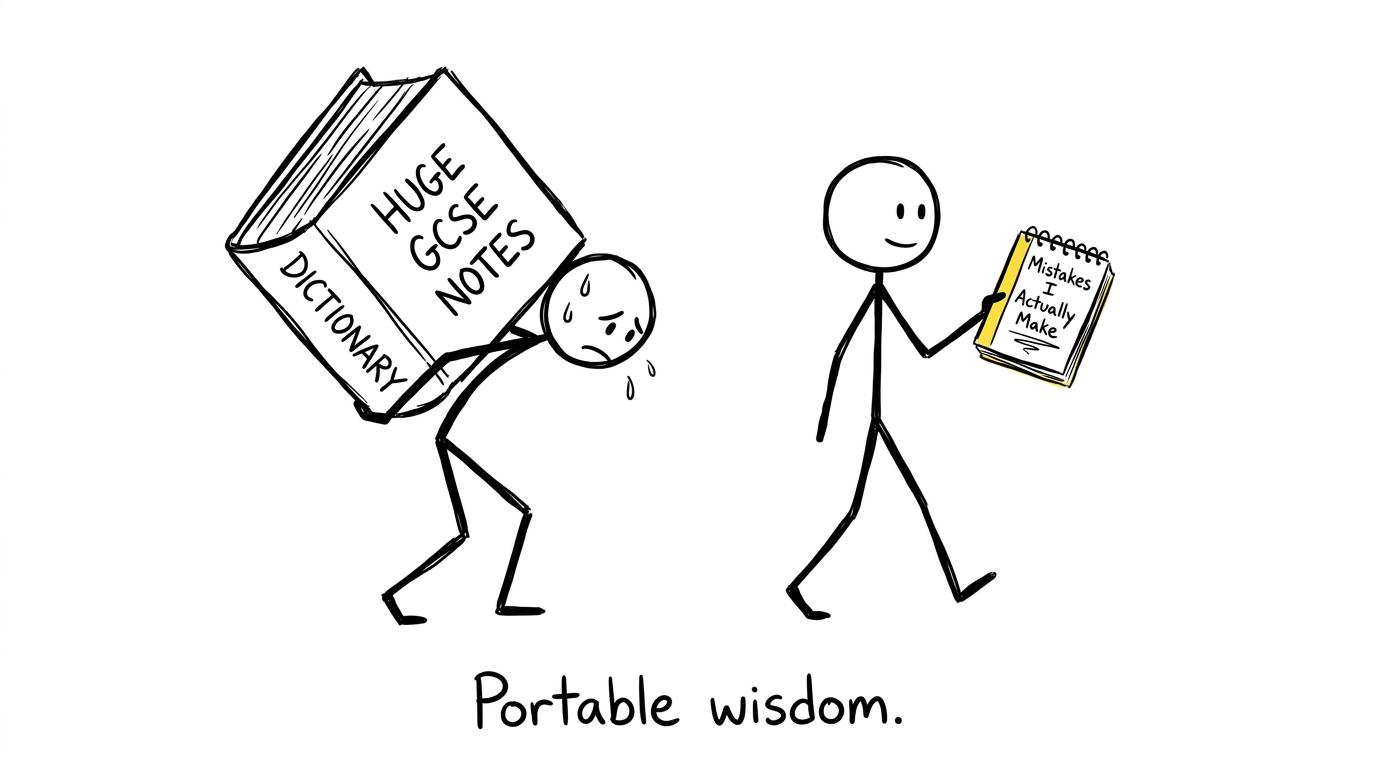 One student carrying a huge dictionary while another confidently carries a small mistake notebook
Common mistakes that keep students at grade 6
Memorising entire answers
A polished paragraph may not fit the actual question. Memorise adaptable structures and vocabulary, then practise recombining them.
Choosing complexity over clarity
Advanced grammar is useful when it is controlled. Do not replace an accurate answer with a fragile construction merely because it sounds impressive.
Revising only writing
Vocabulary notes and written paragraphs can feel productive, but listening and spontaneous speaking require different practice. Give every component regular attention.
Marking without repairing
Reading a mark scheme is not the end of the task. Correct the response, explain the error and attempt a similar task later without notes.
Ignoring accents, agreements and small words
Minor-looking details can change accuracy or meaning. Build them into your final checking routine instead of hoping to notice everything at once.
Using the wrong specification materials
The assessment format changed for first examination in 2026. Check that practice papers match your board and qualification. Older papers can still provide language practice, but they may not reproduce the current tasks.
Doing a full paper the night before
Late panic rarely produces durable learning. Use a short task, correct a few recurring errors and stop at a sensible time. MathsGenie's night-before GCSE plan follows the same calm principle.
A repeatable weekly route towards grade 9
A strong week contains all four skills and at least one feedback cycle:
- Session one: active vocabulary recall and short dictation
- Session two: one grammar weakness followed by independent sentences
- Session three: listening or reading under timed conditions
- Session four: unprepared speaking questions and pronunciation review
- Session five: a timed writing task, careful marking and error-log update
- Weekend review: retest errors from earlier in the week
Increase the amount of timed work as the exam approaches, but keep targeted repair in the plan. A score tells you where you are. Correction changes where you are going.
Make the next mark easier to earn
Going from grade 6 to grade 9 in GCSE French is an ambitious target, and no revision method can guarantee a grade. But the direction is clear: become more precise, more adaptable and more consistent across every component.
Start with one recent task. Identify the three biggest sources of lost marks. Repair them, retest them and repeat the process next week.
MathsGenie remains your free home for maths revision lessons, practice questions, mini tests, past papers, predicted papers, mark schemes and video solutions. Use the one-month GCSE revision plan to organise your wider exam season, then apply the same disciplined learn and practise, mark and fix cycle to French using materials from your school and exam board. Better grades are rarely built through one heroic evening. They are built when the next practice attempt is more intelligent than the last.