GCSE French 20 Minute Study Routine
GCSE French 20 minute study routine: build vocabulary, listening, speaking, reading and writing with a calm daily plan that fits around maths revision.
There is a familiar revision trap: maths needs practice, French needs vocabulary, every other subject wants attention, and the evening is already disappearing. The temptation is to postpone French until there is enough time for a “proper” session. Usually, that time never arrives.
A GCSE French 20 minute study routine solves the problem by making French small enough to begin and structured enough to matter. Spend two minutes setting up, six minutes retrieving vocabulary, five minutes reading or listening, five minutes speaking or writing, and two minutes checking mistakes. Repeat it most days rather than relying on an exhausting session before the exam.
This routine is designed to fit beside maths revision, homework and a busy school week. It covers the four essential language skills while giving extra attention to vocabulary, grammar, pronunciation and correction.
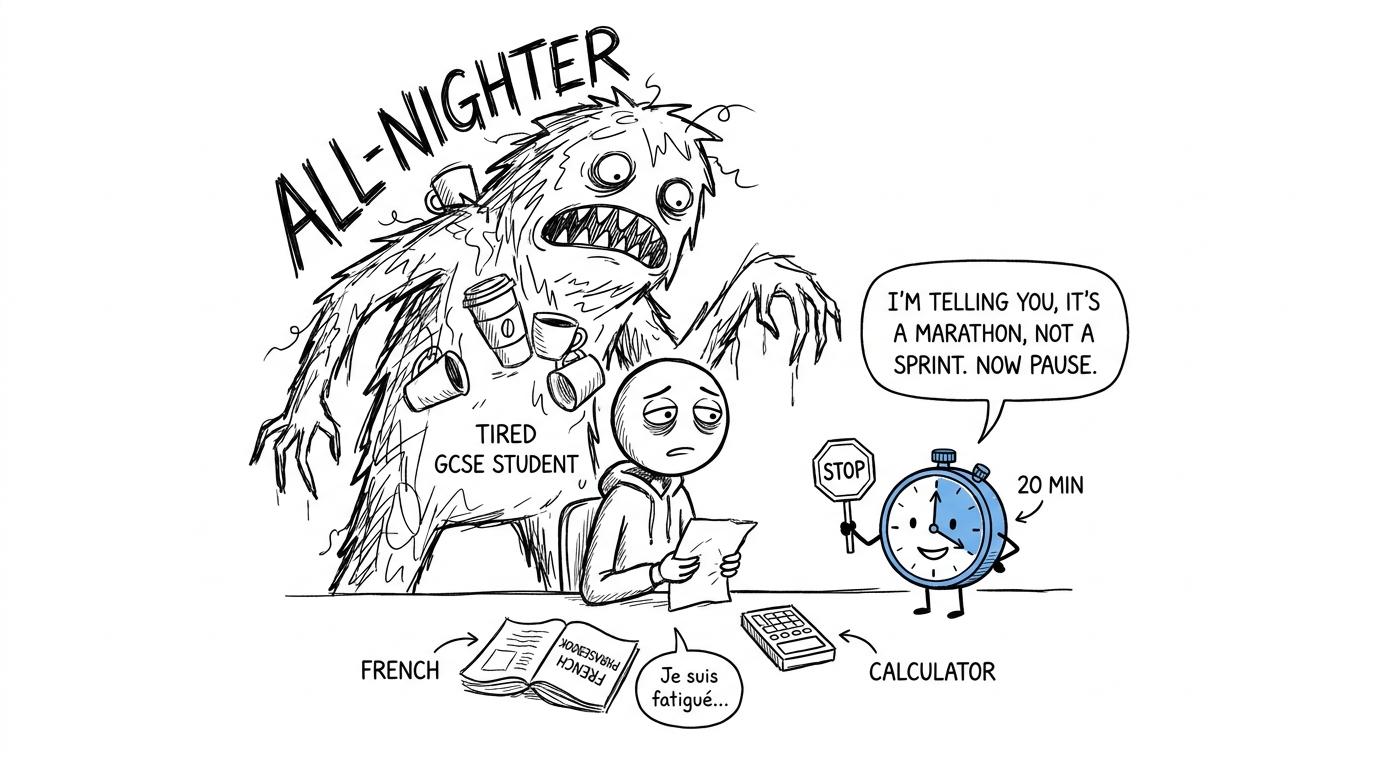 A small revision timer protects a student from the all-nighter monster
Your 20-minute GCSE French checklist
Use the same framework each day so that you spend your energy revising, not deciding how to revise:
- Two minutes: choose one topic and prepare your resources.
- Six minutes: retrieve vocabulary without looking at your notes.
- Five minutes: complete a short listening or reading activity.
- Five minutes: produce French through speaking or writing.
- Two minutes: check, correct and record what to revisit.
The allocation is deliberately simple:
2+6+5+5+2=202+6+5+5+2=202+6+5+5+2=20Keep the routine stable, but change the topic or skill emphasis. One evening might centre on school and future plans; another might focus on holidays, relationships or the environment. Follow the themes and prescribed vocabulary in your own exam board specification rather than relying on a generic online list.
Why short daily French revision works
French is not one fact that can be memorised the night before an exam. It is a network of words, sounds, grammatical patterns and responses. Those connections become more accessible when they are revisited over time.
Research into learning consistently supports two ideas behind this routine: spacing and retrieval practice. Spacing means distributing revision across separate sessions. Retrieval means trying to recall information before checking the answer. For vocabulary, that could mean seeing the English meaning and producing the French word from memory rather than repeatedly reading both sides of a list.
The effort matters. A word that feels slightly difficult to retrieve is often more useful than a word you have just copied. Correction matters too: retrieval without feedback can leave an error unchallenged.
This principle applies equally to maths. MathsGenie’s 20-minute GCSE maths revision routine uses the same broad rhythm: recall, active practice, feedback and a clear next step. You can alternate the two subjects without allowing either to consume the whole evening.
How to use each part of the routine
Set one narrow target
In the first two minutes, avoid goals such as “revise French”. Choose something observable:
- recall vocabulary about free time;
- recognise present-tense verb endings;
- listen for opinions and reasons;
- practise a reading-aloud passage;
- answer questions about a familiar theme;
- correct yesterday’s agreement errors.
Keep the required page, audio or vocabulary list ready before the timer begins. If your phone provides the audio, switch off unrelated notifications. A short session loses much of its value when half of it is spent searching for materials.
Retrieve vocabulary for six minutes
Cover the French side of your list and attempt the words from English prompts. Then reverse the direction. Producing French is usually harder than recognising it, and both directions deserve attention.
Mix newer vocabulary with words previously learned. Include useful verbs, connectives, time phrases, negatives and opinion structures rather than collecting nouns alone. Sentences need connecting tissue.
Say each French answer aloud after checking it. This links spelling with pronunciation and helps you notice sound-symbol relationships. The revised GCSE French specifications taught from September 2024, with first examinations in summer 2026, place explicit importance on prescribed vocabulary, grammar and the relationship between written and spoken language.
Do not treat a missed word as a failure. Put it on tomorrow’s retrieval list. A mistake is most useful when it changes the next session.
Read or listen for five minutes
Choose one receptive skill each day. For listening, use a short extract and decide in advance what you are listening for: a time, an opinion, a negative, a change of tense or the speaker’s reason. Replay only after making a genuine first attempt.
For reading, use a brief exam-style passage. Identify familiar roots, grammatical clues and qualifying words before reaching for a dictionary. Translation can be included, but understanding the overall message should not become a word-by-word decoding exercise.
Current GCSE French qualifications assess understanding of spoken and written language. Exact paper formats differ between AQA, Pearson Edexcel and Eduqas, so use materials matching the specification and tier your school has entered you for.
Speak or write for five minutes
Input alone creates familiarity; the examination also asks you to produce language. Alternate between speaking and writing.
On a speaking day, respond aloud to a small set of familiar questions. Aim for a direct answer, an opinion and a reason where appropriate. Record yourself occasionally, then listen for clarity, missing verbs and pronunciation that could obscure meaning. Reading aloud and responding to spoken prompts are particularly relevant to the reformed qualifications.
On a writing day, produce a short paragraph from memory. Use vocabulary you can control and check whether each sentence contains a clear verb. Practise moving between present, past and future time frames when required by your course and tier, but do not force complicated language you cannot use accurately.
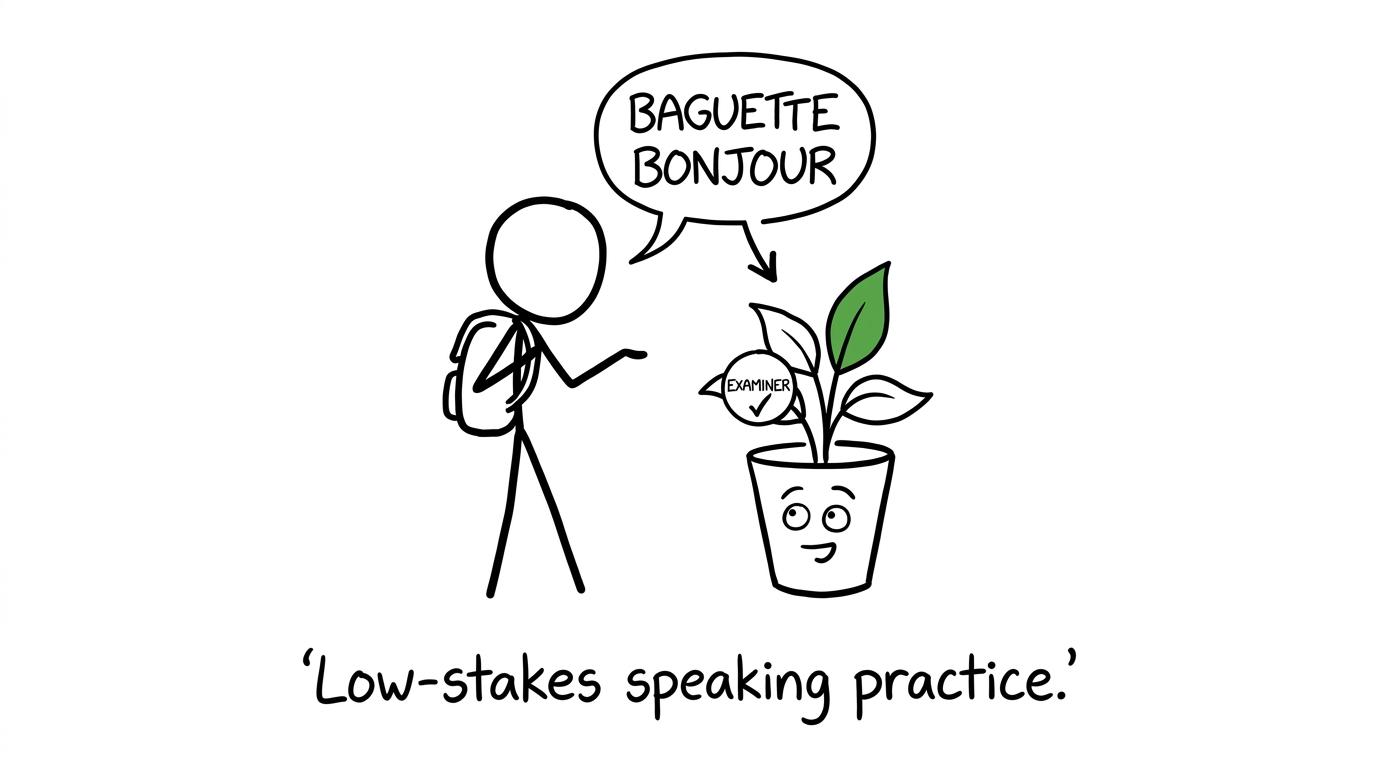 A houseplant acts as a friendly examiner during speaking practice
Finish with correction
Use the final two minutes to compare your work with an answer, transcript, model response or teacher feedback. Record no more than three items:
- one word to retrieve tomorrow;
- one grammar or pronunciation correction;
- one skill that needs another attempt.
This is your French error log. Keep the entries specific. “Forgot the negative” gives you something to fix; “bad at French” does not.
Maths revision benefits from the same precision. The guide to finding your weakest GCSE topics explains how evidence from mistakes can shape the next short session.
A weekly rotation that covers every skill
The daily framework stays the same while the emphasis rotates:
- Monday: core vocabulary and pronunciation;
- Tuesday: listening and short dictation;
- Wednesday: reading and translation;
- Thursday: speaking and reading aloud;
- Friday: writing and grammar accuracy;
- Saturday: mixed retrieval and correction of the week’s errors;
- Sunday: rest, catch up or a very light review.
You do not need to give every skill equal attention every week. If listening is consistently weaker, give it a second day. If the speaking assessment is approaching, increase short speaking practice while continuing to maintain vocabulary and reading.
Keep the plan responsive rather than decorative. A beautiful timetable that ignores your mistakes is less useful than a plain list built from real evidence.
Fitting French around GCSE maths revision
French and maths compete for time only when revision has no boundaries. Give each subject a defined job.
For example, use French as a short session before dinner and maths as the main practice block later. On a heavily scheduled day, complete one twenty-minute routine and move the other subject to tomorrow. A sustainable week can absorb adjustment; an overpacked timetable cannot.
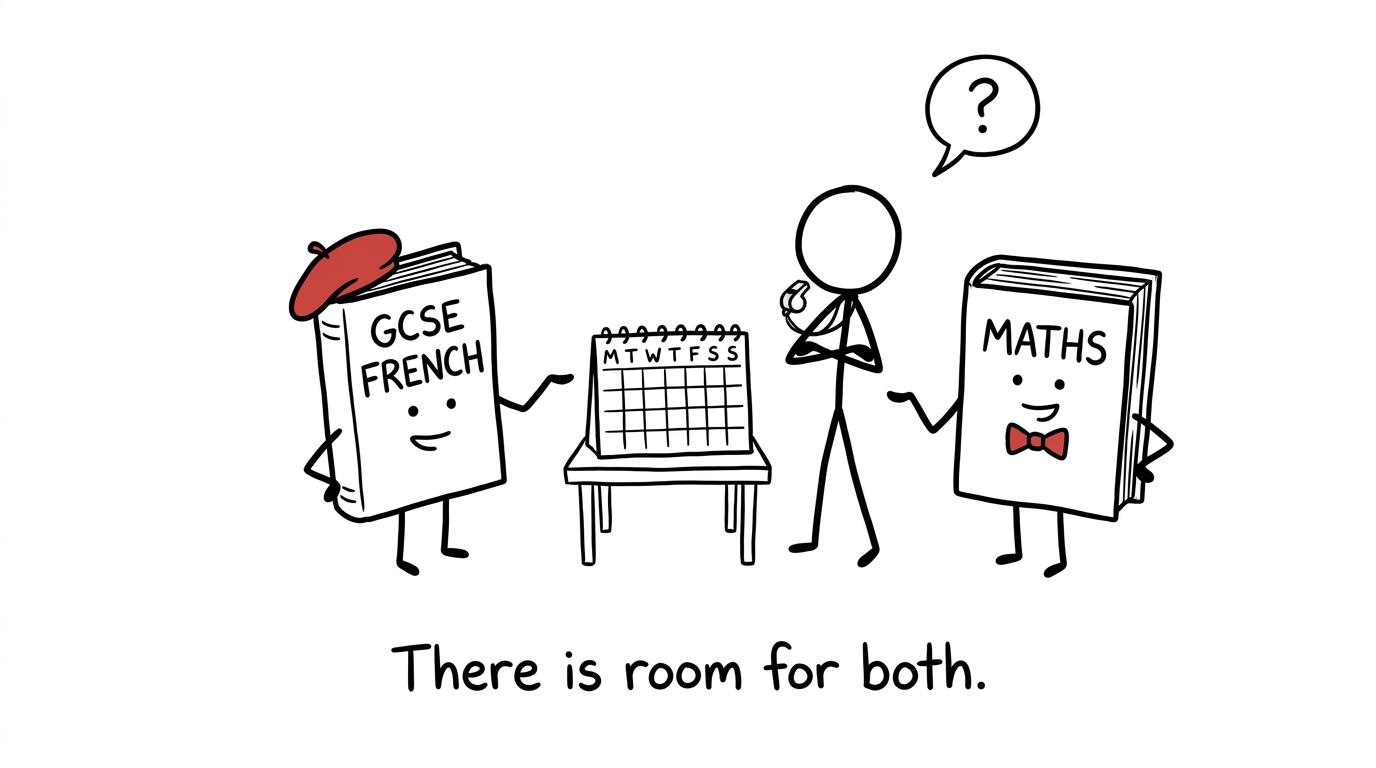 French and maths negotiate calmly over a weekly calendar
The GCSE maths revision timetable guide can help you allocate longer maths sessions around school and other subjects. When time is limited, use the GCSE maths revision hub to move directly to the relevant board, tier or topic rather than searching randomly.
Short maths activities also pair well with this French routine. Edexcel GCSE Maths mini tests, for example, provide focused timed practice without requiring a full paper. Students following AQA, OCR, Eduqas or another board should choose the corresponding resources from the main hub.
Longer sessions still have a role. French eventually requires sustained exam tasks, just as maths requires complete papers. Use a weekend or quieter evening for those. MathsGenie’s guide to using GCSE past papers properly shows how to turn a paper into an error log, targeted practice and a retest rather than merely producing a score.
Common mistakes in a short French study routine
Spending the session copying vocabulary
Copying can look productive without requiring recall. Close the book, attempt an answer and then check it. Use copying only to correct an inaccurate spelling or reinforce a difficult form.
Revising only the skill you enjoy
Students who enjoy reading may avoid speaking; confident speakers may neglect accurate writing. The examination samples a broad range of language skills. Rotate them deliberately, then give additional time to the weakest area.
Using resources from the wrong specification
Materials from older courses can still contain useful French, but task formats and prescribed content have changed. Confirm your exam board, specification and foundation or higher tier with your teacher. Use current sample assessment materials and school-approved resources for exam-format practice.
Learning impressive phrases without control
A memorised phrase is fragile if you cannot adapt its verb, subject or tense. Prioritise high-frequency language that you understand. Accuracy and relevance are more useful than complexity inserted without purpose.
Skipping feedback because the timer ended
Correction is part of the twenty minutes, not an optional extra. If you never check what happened, the routine records activity rather than improvement.
Turning one missed day into a missed week
Do not repay a missed short session with an all-nighter. Resume the routine at the next realistic opportunity. Consistency is not perfection; it is the ability to restart without drama.
Make the next 20 minutes count
The strength of this routine is not that twenty minutes can cover an entire GCSE. It cannot. Its strength is that twenty focused minutes can keep vocabulary active, expose weaknesses and make tomorrow’s session obvious. Repeated across a term, that is far more valuable than waiting for a free evening that never quite appears.
Start today with one French theme, a timer and a blank error log. Then organise the rest of your exam preparation through MathsGenie. Use free GCSE past papers, revision lessons, practice questions, mark schemes, video solutions, mini tests and predicted papers to make your maths sessions just as purposeful.
French can have its twenty minutes. Maths can have a clear plan. The all-nighter does not need to have either.