GCSE Food vs Design Technology: What Employers Notice
GCSE food and nutrition vs design and technology: employers usually value your grade and demonstrated skills, while colleges may require a relevant subject.
Choosing a GCSE can feel like making a decision for an employer you have never met, about a career you may not yet understand. Search for GCSE food and nutrition vs design and technology employers, though, and the practical answer is reassuring: most employers do not automatically rank one above the other. They are more likely to notice your overall grades, especially English and maths, alongside the skills and evidence you can discuss.
Colleges can be more specific. A course in product design may prefer or require Design and Technology, while a food science, nutrition or hospitality course may favour Food Preparation and Nutrition. Entry requirements vary, so check the precise course rather than relying on a general rule.
The best choice is usually the subject that matches your interests, future direction and way of working, and in which you can earn the strongest grade.
The quick decision checklist
Before comparing subject names, ask:
- Am I more interested in food science, nutrition and practical cooking, or products, materials and iterative design?
- Which assessment style suits me better?
- Does a sixth form, college course or apprenticeship I am considering name a preferred GCSE?
- In which subject am I more likely to produce strong work and earn a good grade?
- Can I manage an extended non-exam assessment alongside English, science and GCSE maths revision?
If you have no fixed career plan, either subject can be a sound option. A balanced set of GCSEs and strong core grades will generally keep more doors open than choosing an optional subject solely because its title sounds employable.
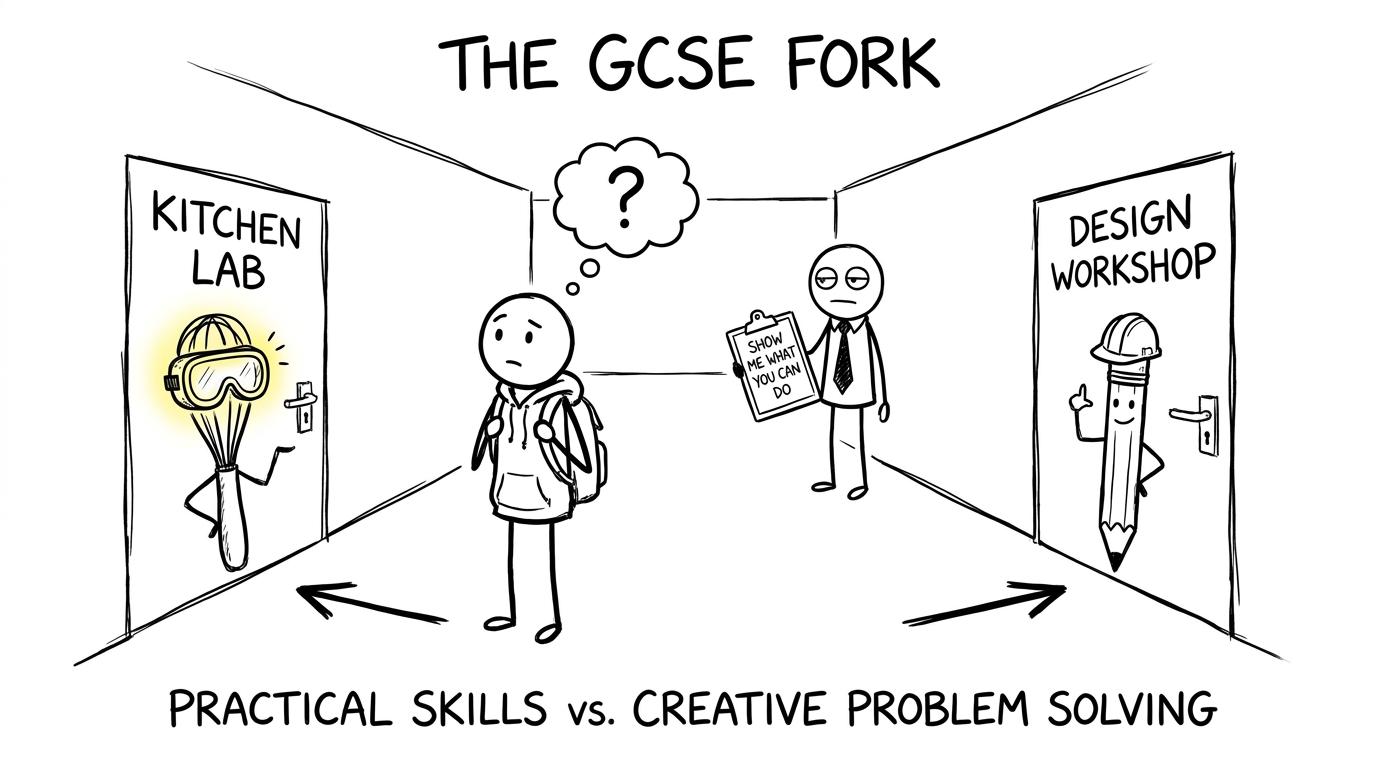 A student choosing between the kitchen lab and design workshop
What do employers actually notice?
For many entry-level jobs and apprenticeships, employers advertise requirements in terms of a number of GCSE passes or particular grades in English and maths. A specific GCSE in Food Preparation and Nutrition or Design and Technology is less commonly a universal requirement.
That does not make either subject irrelevant. It changes how the subject creates value.
An employer may notice:
- the grade you achieved;
- whether you completed a sustained project;
- how you planned time and responded to problems;
- whether you can explain and justify decisions;
- your accuracy, safety awareness and attention to detail;
- how your experience connects with the role.
Imagine two application statements. One merely lists Design and Technology. The other explains how the applicant investigated a user need, compared materials, developed a prototype and evaluated its limitations. The second gives the employer evidence.
The same applies to food. Listing the qualification is less persuasive than explaining how you organised practical work, followed food-safety procedures, investigated ingredients and evaluated a finished outcome. Employers cannot infer every skill from a subject title. You often need to make the connection visible.
What colleges and sixth forms care about
Colleges and sixth forms set their own entry requirements. General requirements often focus on the number and grades of GCSEs achieved, with English and maths appearing frequently. Subject-specific routes may then add further conditions.
For example, a provider might ask for a particular grade in Design and Technology before admitting a student to A Level Product Design. A food science and nutrition course might request Food Preparation and Nutrition, accept a related subject such as science, or say that prior food study is helpful rather than essential.
There is no single UK-wide rule. Requirements can differ between providers and can change between application years. Check the current course page, attend an open day and ask the admissions team these questions:
- Is either GCSE required, preferred or simply useful?
- Is a portfolio or practical task considered?
- What grade is expected in English, maths or science?
- Are related GCSEs accepted?
This distinction matters. A required subject can determine eligibility. A preferred subject may strengthen preparation but not be compulsory. A useful subject may simply help you settle into the course more quickly.
What GCSE Food Preparation and Nutrition demonstrates
The formal qualification is usually called GCSE Food Preparation and Nutrition, although students often shorten it to food or food and nutrition. Specifications from boards such as AQA, OCR, Eduqas and WJEC should always be checked through your school because assessment details and available qualifications can vary across the UK.
The subject combines practical cooking with food science, nutrition, food provenance, safety and evaluation. Under the current qualification framework in England, non-exam assessment contributes 50%50\%50% of the qualification. It assesses an investigation into ingredients and a practical food-preparation task, while the remaining assessment is examined.
This can provide relevant evidence for routes connected with:
- food science and food technology;
- nutrition and public health education;
- catering, hospitality and professional kitchens;
- product development and quality control;
- consumer research and food retail.
It is not simply a test of whether you can cook. The course involves planning, scientific understanding, controlled practical work and written evaluation.
Maths appears naturally too. Nutritional information uses quantities, proportions and percentages. Recipe adaptation depends on scale factors and consistent units. Costing requires accurate arithmetic, while data from investigations must be interpreted sensibly. MathsGenie's proportion and recipe revision and ratio revision guide strengthen skills that transfer directly.
What GCSE Design and Technology demonstrates
GCSE Design and Technology covers technical principles alongside designing and making. Students investigate needs, generate and develop ideas, select materials or components, create a prototype and evaluate decisions.
Current English GCSE specifications divide assessment between a written examination and non-exam assessment, each normally contributing 50%50\%50%. For AQA, for example, the non-exam assessment is a substantial design-and-make task supported by a portfolio. Always follow your own board's specification and your teacher's instructions rather than assuming every board uses identical wording.
D&T can connect naturally with:
- product and industrial design;
- engineering and manufacturing;
- architecture and the built environment;
- electronics and systems;
- crafts, materials and technical production.
The subject can also reveal how you think. A finished prototype is visible, but the more valuable story may be the chain of decisions behind it: identifying a need, testing possibilities, rejecting weak ideas and improving the outcome.
Mathematical confidence matters here. Design work can involve measurement, scale, ratios, costs, graphs, tolerances, area and volume. Weak unit conversion can undermine an otherwise good proposal. Building number fluency through the best order for learning GCSE maths topics helps these calculations feel like tools rather than interruptions.
 A student balancing non-exam assessment and exam demands
Which subject has more employer value?
Neither has greater value in every situation. Relevance depends on the destination.
Food Preparation and Nutrition is the clearer signal for a student already interested in food development, hospitality or nutrition-related education. Design and Technology is the clearer signal for product design, manufacturing or some engineering pathways. Outside those areas, the difference often becomes smaller.
A strong grade in the subject you genuinely engage with can be more useful than a weaker grade chosen because it seemed more impressive. Interest tends to support persistence, and both courses demand sustained practical and written work.
There is also an opportunity-cost question. Non-exam assessment takes planning and regular attention. If one course fits your strengths better, it may leave more energy for the core subjects that colleges and employers commonly specify. That does not mean choosing the easiest option. It means choosing a workload you can execute well.
How to turn either GCSE into application evidence
Do not wait for an employer to interpret your qualification. Translate it.
Record the process, not only the product
Keep a short record of challenges, decisions and improvements. You could note when you changed a method after testing, resolved a timing problem or used feedback to improve an outcome. Follow your school's rules on retaining assessed material.
Use precise skill language
Instead of writing that you are creative, describe what you did: investigated requirements, compared evidence, planned a sequence, controlled risk, measured accurately or evaluated against criteria.
Connect your maths
Maths is often the bridge between a practical idea and a dependable result. You might discuss scaling quantities, interpreting data, calculating costs or checking dimensions. You do not need to exaggerate. A clear explanation of ordinary, accurate work is credible.
If maths currently feels less secure, use a repeatable revision routine. MathsGenie's efficient GCSE maths revision guide recommends learning a focused skill, practising it, marking the work and repairing the exact error. A realistic GCSE maths revision timetable can help you protect time for both exam preparation and project deadlines.
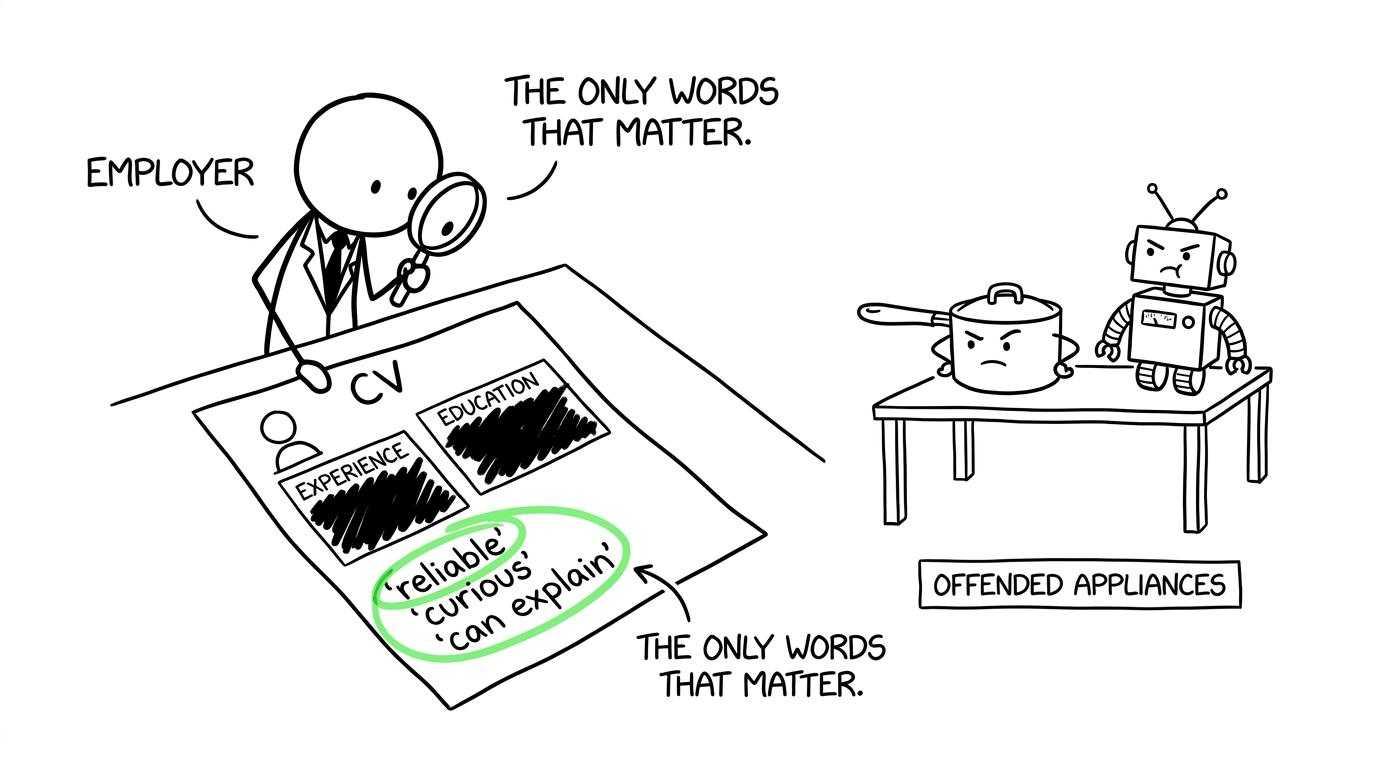 An employer looking beyond GCSE subject titles
Common mistakes when choosing between the subjects
Choosing for prestige alone
Neither title automatically impresses every employer. Choose for relevance, aptitude and the likelihood of producing strong evidence.
Assuming one subject is entirely practical
Both involve theory, written explanation, analysis and examination. Read your school's course information and the current specification before deciding.
Ignoring non-exam assessment pressure
An extended project can become stressful when deadlines collide. Plan backwards, break the work into smaller tasks and keep maths revision active rather than pausing it for weeks.
Treating all college requirements as identical
One college may require a related GCSE while another accepts several alternatives. Verify each course individually.
Neglecting English and maths
A specialised optional GCSE can support your direction, but it does not replace common core entry requirements. Use GCSE past papers at the right stage and check your mistakes with mark schemes rather than judging progress from revision time alone.
Make the choice, then make it valuable
The honest answer is simple: employers rarely treat Food Preparation and Nutrition as universally better than Design and Technology, or vice versa. Relevant colleges may care more, particularly when a course names a prerequisite or preferred subject. Your grade, core qualifications and ability to explain what you learnt usually matter more than an imagined league table of optional GCSEs.
Choose the subject that fits your likely direction and your strengths. Then build evidence through careful practical work, thoughtful evaluation and reliable maths.
For the maths supporting either route, make MathsGenie your revision base. Begin with free revision lessons and practice questions, use mini tests to locate weak areas, and progress to past papers with mark schemes and video solutions. Near the exams, add GCSE predicted papers to sharpen timing and expose the final gaps. The subject choice matters, but what you do consistently after choosing it matters more.