

GCSE Food and Nutrition Results Day: Wrong Grade?
GCSE food and nutrition results day wrong grade? Follow a first-hour checklist, check component marks, and understand reviews, scripts and moderation now.
Results day can turn a quiet doubt into a loud one. Your mock suggested one grade, your teacher predicted another, and the result in front of you feels impossible. If you are searching for gcse food and nutrition results day wrong grade advice, the immediate answer is simple: do not assume an error, but do not leave without asking for evidence.
In your first hour, speak to your school’s exams officer, request your component marks, tell your Food Preparation and Nutrition teacher, and contact your intended college if the result affects your place. Ask about access to your marked script and the school’s deadline for post-results services. A predicted grade alone cannot justify a change, but an unexpected component mark, an unmarked response or incorrectly applied marking may support further investigation.
The goal is not to decide everything while emotions are high. It is to leave results day knowing what happened, who is checking it and when you must act.
Your first-hour results day checklist
Use this sequence before comparing results with friends or disappearing into a group chat.
The first ten minutes: check the result carefully
Confirm the exact subject title, exam board and grade. The qualification is normally called GCSE Food Preparation and Nutrition, although schools may shorten this to Food and Nutrition.
Then check whether your results information includes:
- an overall grade;
- an overall mark;
- separate marks for the written examination and non-exam assessment, known as NEA;
- an exam board or specification code;
- any note showing that a result is pending or incomplete.
Take a photograph or keep the digital statement somewhere secure. Do not post candidate numbers, centre numbers or other private details online.
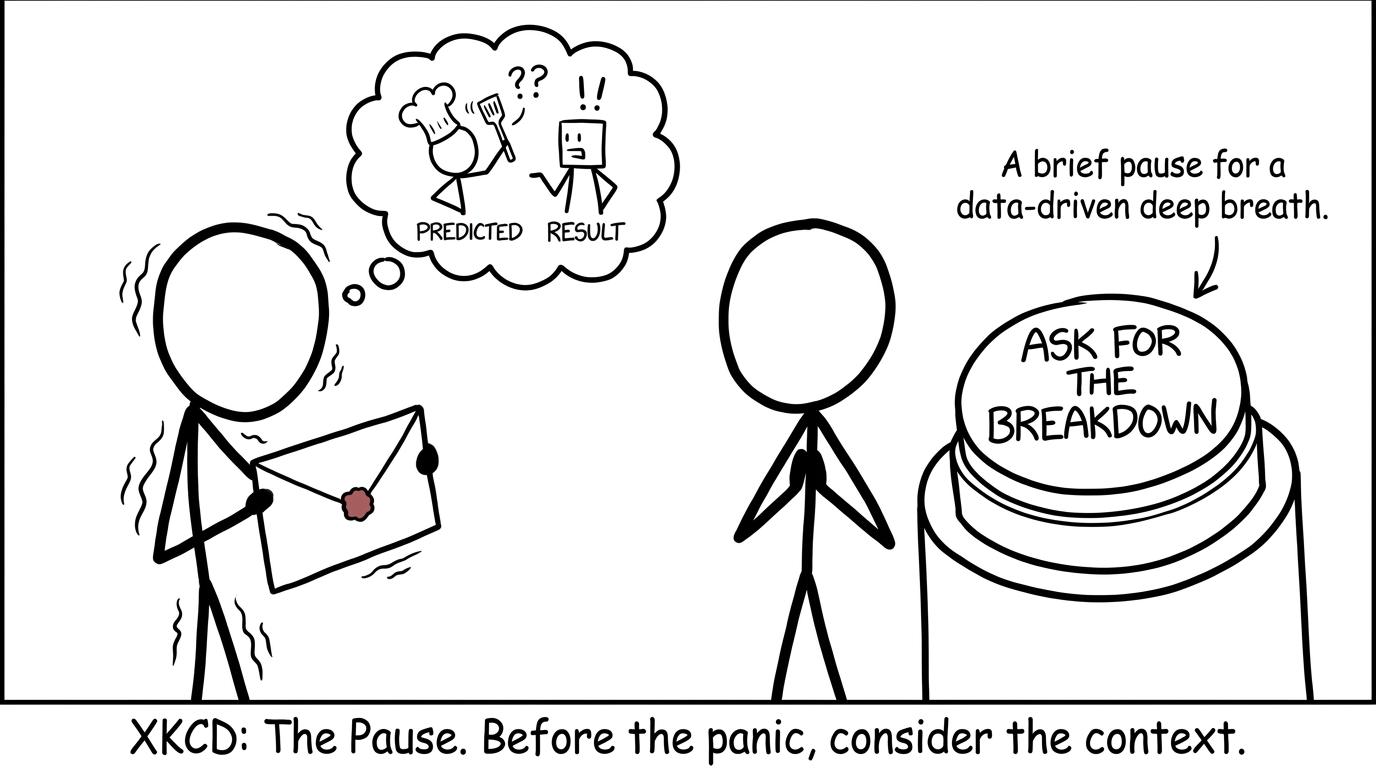 A student pauses before panicking and asks for the results breakdown
The next twenty minutes: find the right people
Speak to the exams officer and your Food Preparation and Nutrition teacher. If the teacher is unavailable, ask who is handling subject queries that day.
Use specific questions:
- What were my marks for each component?
- Was my NEA mark changed during external moderation?
- How far was my overall mark from the next grade boundary?
- Can the school request my marked written paper?
- Does my teacher see any reason to consider a clerical re-check or review of marking?
- What is the school’s internal deadline?
The final awarding-body deadline is not necessarily your deadline. Schools need time to collect consent, discuss fees and submit requests, so their cut-off may be earlier.
For the June 2026 series, GCSE results are released on Thursday 20 August. JCQ’s published arrangements set 24 September 2026 as the deadline for reviews of results, but access-to-script deadlines can be earlier and vary by awarding body. For example, AQA’s deadline for priority copies of June 2026 GCSE scripts is 3 September. Always follow the deadline provided by your exams officer for your board.
By the end of the hour: protect your next step
If the grade affects sixth-form or college admission, contact the provider immediately. Explain that you have received an unexpected result and are discussing a possible post-results request with your school. Ask whether they can consider component marks, teacher information or a pending review, but do not assume that a place will automatically be held.
Record the name of everyone you speak to and the next action agreed. The GCSE results day checklist can help you organise the wider decisions around enrolment, documents and backup options.
Your one-hour checklist is therefore:
- verify the qualification and grade;
- collect the component marks;
- speak to the exams officer;
- ask your subject teacher to examine the breakdown;
- confirm the board and specification;
- request information about scripts and reviews;
- note every relevant deadline;
- contact your next provider if progression is affected.
Why the grade may differ from your mock or prediction
A mock grade is an estimate based on particular questions, boundaries and marking decisions. A predicted grade is a professional judgement about likely performance. Neither guarantees the final result.
Official grade boundaries are set after assessments have been marked. They can change from year to year to account for differences in paper difficulty while maintaining comparable standards. There is no fixed quota requiring a certain number of students to pass or fail.
Food Preparation and Nutrition also combines different forms of assessment. On current AQA and OCR specifications, the written examination contributes 50%50\%50% of the qualification and the NEA contributes 50%50\%50%. The NEA itself contains investigation and food-preparation work. Eduqas also uses written assessment alongside NEA, but component structures and codes should always be checked against the relevant specification.
This means a strong practical experience does not automatically translate into the overall grade you expected. The final result depends on the submitted NEA marks after moderation, the written paper and the grade boundaries for that series.
The useful comparison is not simply:
predicted gradeversusfinal grade\text{predicted grade} \quad \text{versus} \quad \text{final grade}predicted gradeversusfinal gradeIt is:
written mark+final NEA contribution⟶overall mark and grade\text{written mark} + \text{final NEA contribution} \longrightarrow \text{overall mark and grade}written mark+final NEA contribution⟶overall mark and gradeYou are looking for a plausible explanation or evidence of a potential error, not proof that the prediction should replace the result.
Which post-results service might apply?
The phrase “re-mark” is often used casually, but the official services are more precise.
Clerical re-check
A clerical re-check looks for administrative problems. It checks matters such as whether all parts of the script were marked and whether marks were recorded and totalled correctly.
This may be suitable if the component mark looks unexpectedly low or there is reason to suspect that a page, question or mark was missed. It does not reconsider the academic judgement behind every awarded mark.
Access to the marked script
Your centre can normally request access to a marked GCSE script with your written permission. A teacher can then compare the marking with the published mark scheme and look for a specific concern.
This is often the most informative step because it changes the conversation from “the grade feels wrong” to “this response may not have been credited correctly”. Availability, format, fees and deadlines depend on the board and component.
Review of marking
A review of marking checks whether the original mark scheme was applied correctly to an externally assessed component. It is not an automatic fresh mark from the beginning, and marks are not added merely because you were close to a boundary.
Your mark can rise, remain unchanged or fall. Because the grade can also go down, your school must obtain your written consent after results have been published before requesting the service.
The distance from a boundary matters, but it is not the only question. Teacher scrutiny of the script is more useful than hoping proximity alone will create extra marks.
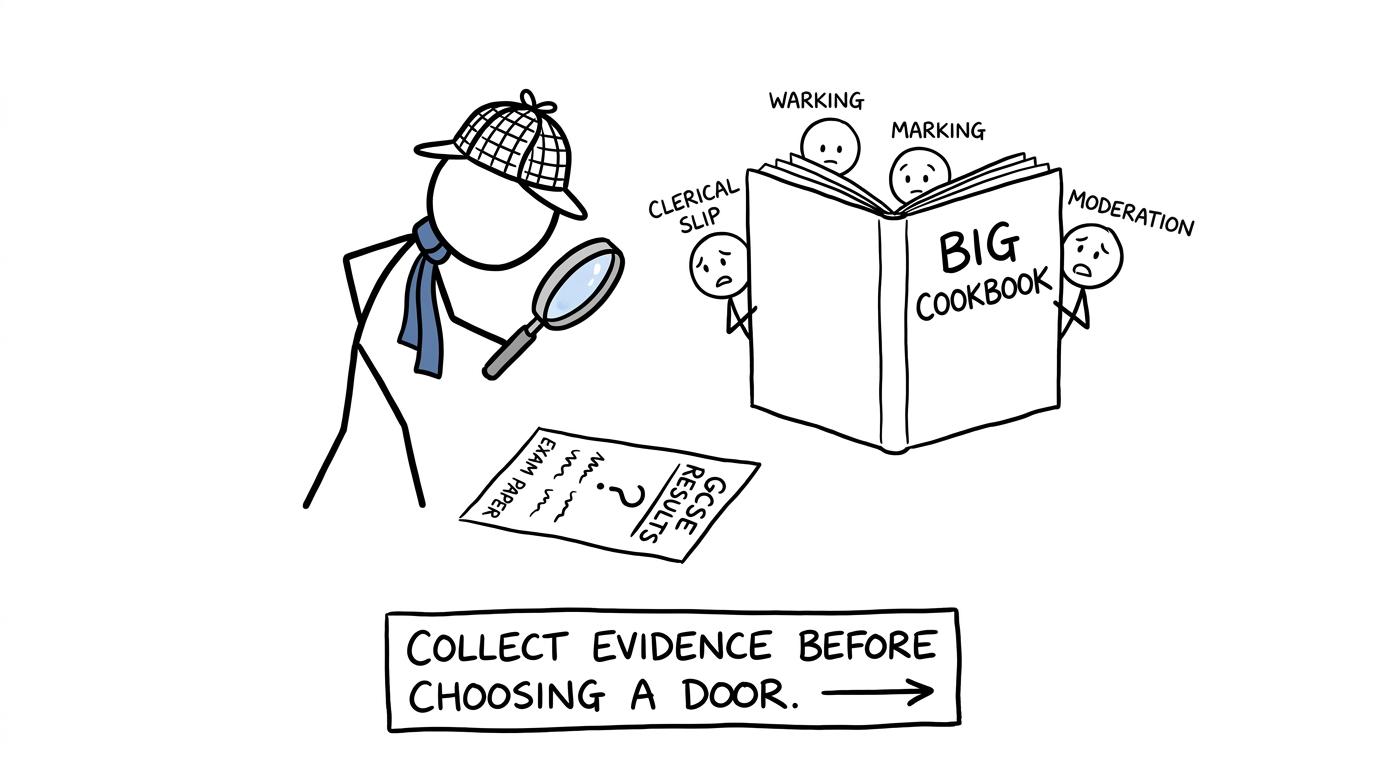 A results-day detective investigates the possible source of an unexpected grade
Review of moderation
NEA is marked by teachers and then moderated by the exam board. If moderation changes a centre’s marks, the school may be able to request a review of moderation.
This is not an individual service for one student. It concerns the centre’s original sample and whether moderation was conducted correctly. The decision therefore belongs to the school or college rather than an individual candidate.
Students should normally have been told their teacher-assessed NEA marks before submission and given access to the centre’s internal review process at that stage. Results day is not usually an opportunity to reopen the original teacher marking of one portfolio simply because the overall grade is disappointing.
How to decide whether a review is sensible
Ask your teacher and exams officer to consider four things together:
- Evidence: Does the script reveal a response that may have been missed or assessed inconsistently with the mark scheme?
- Boundary distance: How many additional marks would be required for the next grade?
- Downward risk: Could losing marks place the current grade at risk?
- Consequence: Does the grade affect a course requirement or another important progression decision?
Fees are set independently by exam boards, and schools have their own payment arrangements. Ask for the exact charge before consenting. A school must also provide a route for you to challenge its decision if it refuses to request a review of marking.
National review statistics show why evidence matters. For the summer 2025 series in England, most reviewed GCSE component marks did not change. Some grades did change, but a review is a correction process rather than a second attempt at the examination.
What to do while you wait
An unresolved grade can make every other plan feel suspended. Try to separate the administrative question from your next practical action.
If you may need to reconsider your route, use the GCSE results day backup plan. If maths is part of your next course or a resit remains possible, open the GCSE Maths revision hub and identify your board and tier.
You can then organise short sessions with the free MathsGenie revision planner. Revision does not prejudge the review outcome. It simply protects your options.
A calm revision loop is enough:
- use a revision lesson to rebuild one weak topic;
- complete targeted practice questions;
- check the mark scheme and video solution;
- retest with a mini test;
- move towards complete papers when the method is secure.
The guide to finding your weakest GCSE topics explains how to turn lost marks into specific revision decisions. For realistic preparation, use Edexcel GCSE Maths past papers or select your board from the main hub. GCSE predicted papers can provide fresh practice, but they should supplement topic revision and past papers rather than replace them.
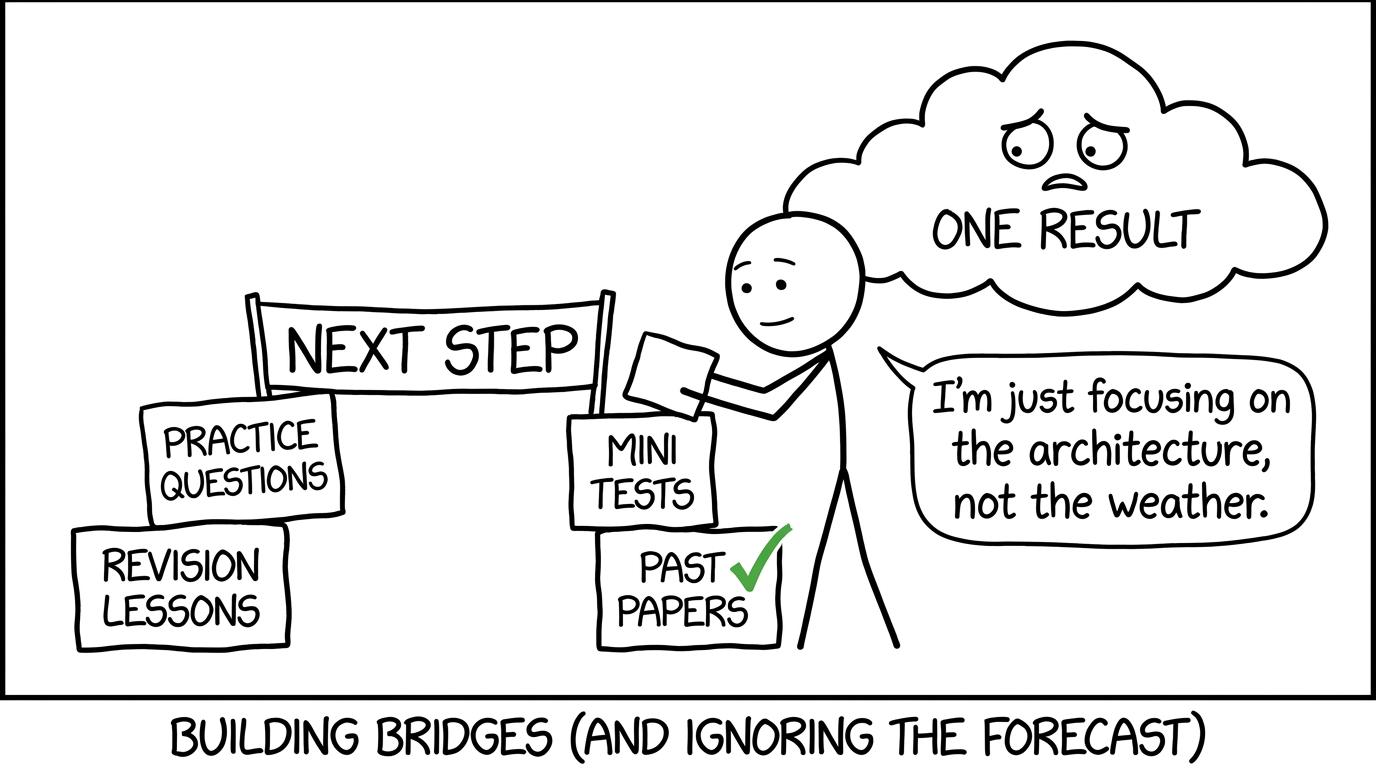 A student builds a bridge towards the next step using structured revision
Common mistakes when challenging a Food and Nutrition grade
Treating a prediction as proof
A mock or predicted grade gives context, but the exam board cannot award extra marks because the final grade was lower than expected. Ask for component evidence.
Asking for “a re-mark” without choosing the right service
A clerical re-check, review of marking, access to scripts and review of moderation solve different problems. Describe your concern and let the exams officer explain the suitable route.
Focusing only on the written paper
Food Preparation and Nutrition includes substantial NEA. Ask whether the unexpected difference came from the examination, the moderated NEA marks or both.
Missing an internal deadline
Do not wait for the awarding body’s final date. Your school may close requests earlier, while access-to-script deadlines can arrive sooner still.
Forgetting that marks can fall
A review of marking can leave the mark unchanged, raise it or lower it. Read the consent information and discuss the risk before signing.
Waiting silently when a college place is affected
Contact the provider on results day. A prompt, factual conversation gives staff more opportunity to explain available options.
Turn uncertainty into a clear next action
An unexpected result deserves attention, but it needs evidence rather than panic. In the first hour, collect the component breakdown, speak to the exams officer and teacher, protect any college application, and write down the deadlines. Then decide whether access to the script, a clerical re-check, a review of marking or a centre-led moderation query fits the evidence.
One grade can influence the next decision, but it does not have to control every decision after that. While your school investigates, keep your options moving. Use MathsGenie’s free revision lessons, practice questions, mini tests, past papers, predicted papers, mark schemes and video solutions to prepare for the maths route ahead. Start with the GCSE maths resit results-day plan, place your first task in the revision planner and let the next action be smaller than the worry.











