GCSE Results Day Checklist: What You Need to Know
GCSE results day checklist for Year 11: what to bring, how to prepare, read your grades, and handle sixth form, marking reviews or resits calmly.

Results day can make one envelope feel heavier than it is. The useful truth is simpler: good GCSE results day preparation turns an uncertain morning into a sequence of manageable decisions. Confirm how you will receive your results, bring the right information, compare your grades with your offer and speak to the appropriate person before making assumptions.
For the June 2026 exam series, GCSE results are released to candidates on Thursday 20 August 2026. Your school or exam centre decides its own collection time and method, so its instructions matter more than general advice online.
Your GCSE results day checklist at a glance
Before the day
- Confirm when, where and how your school will release results.
- Check whether you need photo identification or login details.
- Save your candidate number and exam centre contact details.
- Find the entry requirements for your sixth form, college or apprenticeship.
- Save the provider's telephone number and enrolment instructions.
- Prepare a realistic backup option.
- Arrange authorised collection if you cannot attend.
On the morning
- Bring a charged phone, identification if requested and a pen.
- Keep your results slip safe.
- Check every subject, grade and personal detail.
- Compare your actual grades with your offer conditions.
- Speak to school staff before requesting any post-results service.
- Contact your next provider promptly if an entry requirement is affected.
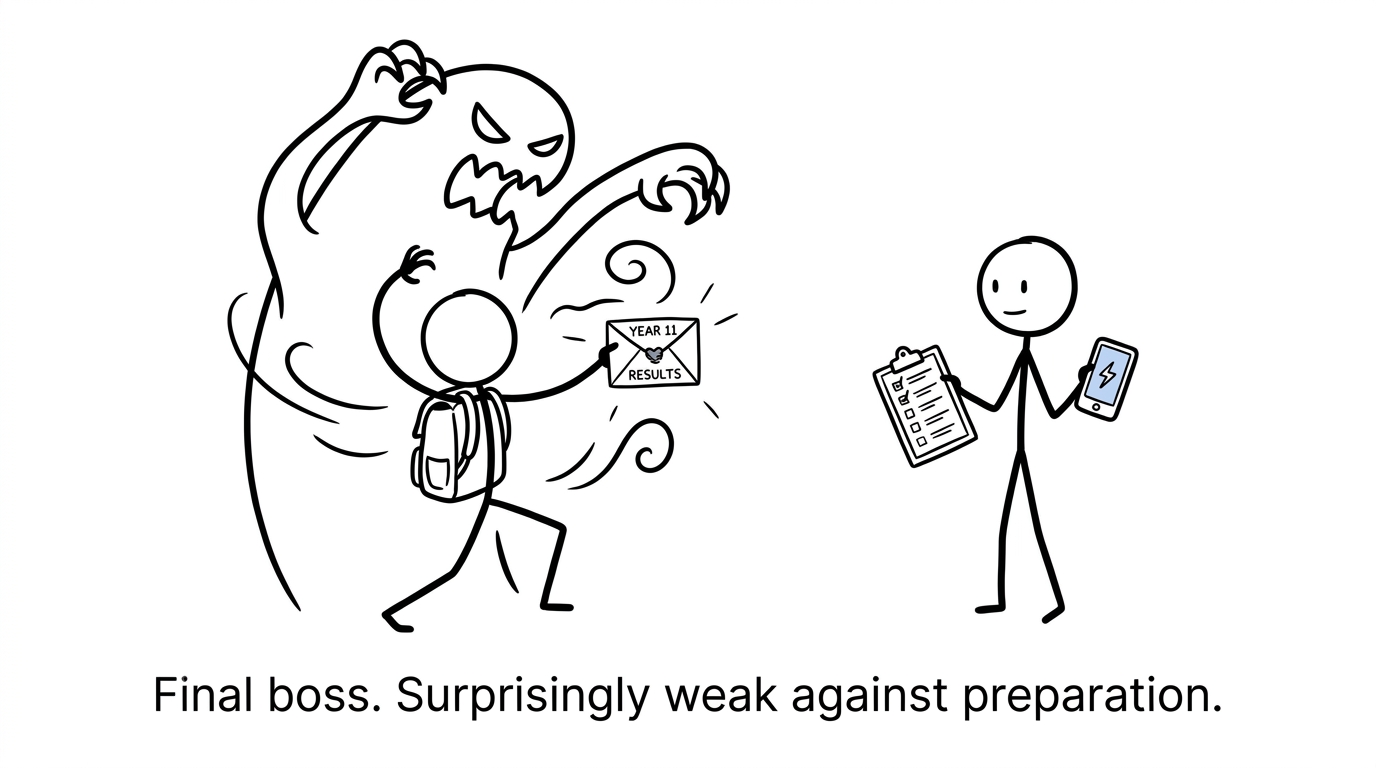 A student discovers that the results-day final boss is vulnerable to preparation
GCSE results day preparation before you leave home
Confirm your school's arrangements
Schools may distribute results in person, through a secure portal or by another stated method. Check the official message from your school rather than assuming it will open at a particular time.
If somebody else must collect your results, contact the exams officer beforehand. Schools commonly require written authorisation and identification from the nominated person. A parent cannot necessarily collect them simply because they are your parent.
Prepare your next-step information
Write down:
- your preferred course and its exact entry requirements;
- your backup course or provider;
- enrolment dates, times and required documents;
- contact details for the admissions team;
- the name of a teacher, careers adviser or exams officer who can help.
This is not pessimism. A backup plan is what allows you to think clearly when the first plan changes.
Prepare emotionally, not just practically
Decide in advance whether you want to open your results privately, with friends or beside a trusted adult. Avoid promising to post your grades immediately. You are allowed time to understand them first.
Predicted grades are estimates, not guarantees. Equally, one surprising result does not define your ability or erase the work behind it. Treat the results slip as information that guides the next conversation.
What to bring on GCSE results day
Your school's instructions come first, but this compact list covers the essentials:
- photo identification, if requested;
- your candidate number;
- a fully charged phone;
- a pen and small folder;
- sixth-form, college or apprenticeship details;
- enrolment documents if you are attending immediately afterwards;
- contact details for a trusted adult.
Keep the original results slip and make a secure digital copy. Results shown on the day are provisional until certificates are issued, and post-results services can alter them.
How to check your GCSE results
Read the whole slip before reacting to one grade. Check your name, subjects, exam boards and results. In England, GCSEs generally use grades 999 to 111, with 999 the highest. Grading arrangements differ in Wales and Northern Ireland, so use the system applying to your qualification and awarding body.
For maths, also check that the result corresponds to the qualification and tier you entered. Foundation and higher tier do not produce separate GCSE qualifications, but they affect the range of grades available.
Then compare your grades with the actual conditions of your next-step offer. Do not rely on what a friend needed or what somebody remembers from an open evening.
What to do after opening your results
If you received the grades you need
Confirm your place and complete every enrolment instruction. A successful result does not automatically complete registration. Check email folders, portals and deadlines, then retain any confirmation.
If you missed an entry requirement
Contact the sixth form, college or apprenticeship provider promptly. Explain your actual grades and ask whether your place remains available or whether an alternative course is possible. Missing a condition does not always settle the decision, but only the provider can confirm your options.
Speak to your school's careers or pastoral team as well. They may know which local providers have places and which routes fit your longer-term plans.
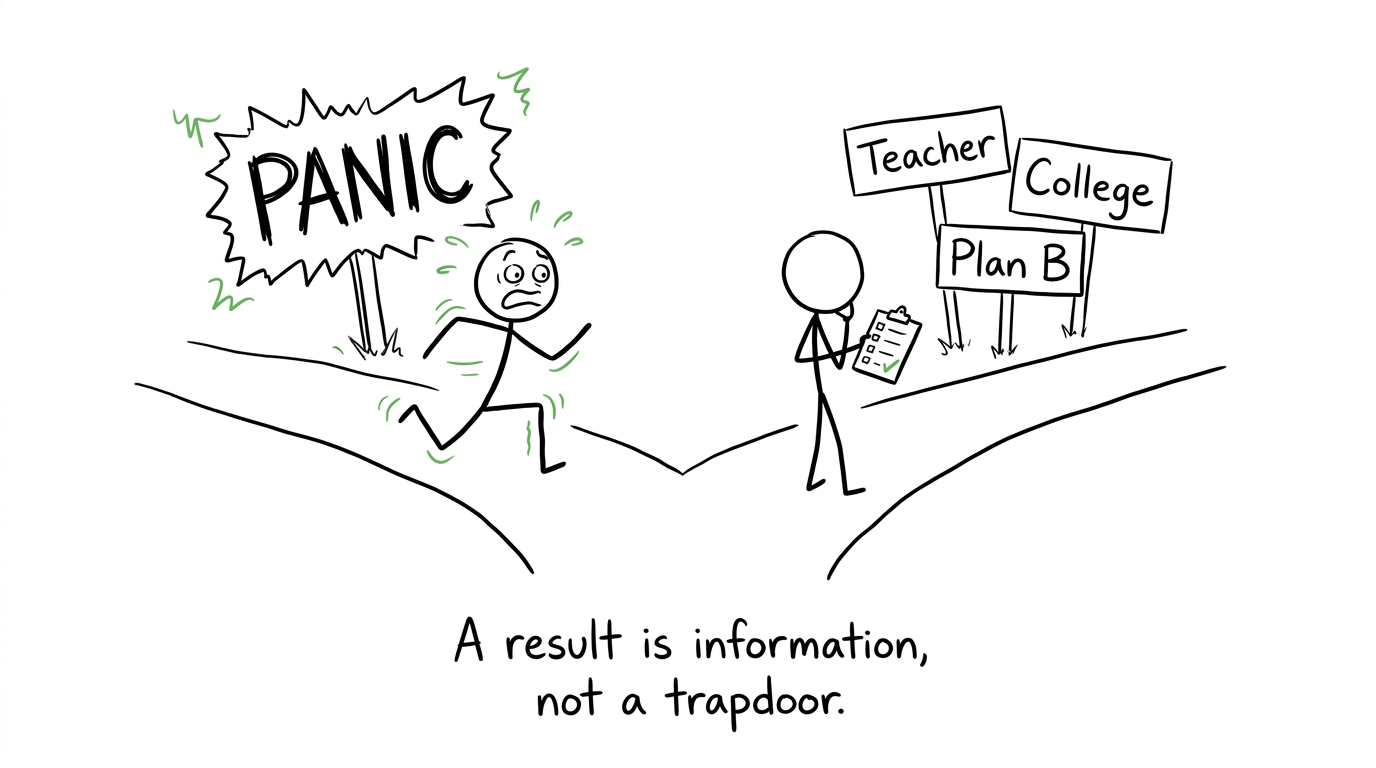 A calm student chooses useful conversations instead of the path marked panic
If a maths grade looks unexpectedly low
Talk to your maths teacher or exams officer that day. They can consider your mark, the grade boundary and your script before advising whether there is evidence of a marking error.
A review of marking is not a request for extra marks because you were close to a boundary. The marking is checked for errors, so the mark and grade may rise, remain unchanged or fall. Your centre normally submits the request and requires your written consent; fees may apply.
For the June 2026 series, the JCQ deadline for awarding bodies to receive standard reviews of results is 24 September 2026, but schools set earlier internal deadlines. Ask immediately if the outcome affects a place.
If you need to resit GCSE maths
In England, students who have not achieved the required standard in GCSE maths may need to continue working towards it in post-161616 education, depending on their grade and programme. GCSE maths resits are available in November for eligible students aged at least 161616 by the relevant August date, as well as in a later summer series.
Start by asking your new provider which entry, tier and teaching arrangement applies. Then rebuild methodically with the GCSE Maths revision hub, choosing resources for AQA, Edexcel, OCR, Eduqas or your relevant board. Edexcel students can use the dedicated Edexcel GCSE Maths revision page, including foundation and higher content.
Common GCSE results day mistakes
Assuming the worst before making a call
A missed condition is a reason to contact the provider, not proof that every route has closed.
Comparing grades immediately
Friends may have different courses, circumstances and goals. Understand your own results before turning the morning into a ranking exercise.
Requesting a review solely because a mark is close
Proximity to a boundary does not prove an error. Ask a teacher to assess the script and remember that marks can move in either direction.
Losing the results slip
Store the original safely and keep a digital copy. You may need the information for enrolment or employment before certificates arrive.
Waiting too long to ask for help
Course places, enrolment appointments and school post-results deadlines can be time-sensitive. Deal with urgent decisions first; process the emotions afterwards with somebody you trust.
Turn the result into a plan
Results day is a checkpoint, not a final description of what you can become. If maths remains part of your next step, use the result diagnostically. The Maths Genie revision planner can turn a broad intention into regular sessions, while GCSE Maths past papers, predicted papers and revision resources and mini tests help you practise under realistic conditions.
Use topic video lessons when a method needs rebuilding, then answer practice questions and check the mark scheme or video solution. That sequence matters: learn, practise, review, repeat.
Complete this GCSE results day checklist now, save the contacts you may need and begin with the free Maths Genie revision planner. Preparation cannot choose the grades in the envelope. It can ensure that, whatever they are, you know what to do next.