GCSE Food and Nutrition Predicted Grades Accuracy
GCSE Food and Nutrition predicted grades accuracy explained: discover how reliable estimates are, why results differ and what you can still control.
A predicted grade can feel strangely permanent. One number appears on a report, and suddenly it seems to describe both your past work and your future result. It does neither.
The honest answer on GCSE Food and Nutrition predicted grades accuracy is that predictions can be useful, but they are not guaranteed. A prediction based on several assessments, completed non-exam assessment and consistent classwork may give a sensible indication of your likely result. One based mainly on an early mock is much less dependable.
There is no widely published national accuracy figure specifically showing how often GCSE Food Preparation and Nutrition predictions match final grades. Schools also calculate predictions differently. Treat yours as a reasoned estimate, preferably a range, rather than a promise about results day.
The short answer: how reliable is your prediction?
A Food Preparation and Nutrition predicted grade tends to be more informative when:
- it uses several recent assessments rather than one test;
- your teacher has enough evidence from both theory and practical work;
- much of your non-exam assessment, or NEA, has been completed and marked;
- the assessments reflect your actual exam board specification;
- your performance has been reasonably consistent;
- the estimate allows for uncertainty around grade boundaries and moderation.
It is less reliable when it is based on limited evidence, old results, unusually easy or difficult mocks, or incomplete NEA work.
Before reacting to the grade, ask three questions:
- What evidence produced it?
- How much of the course had been assessed?
- Which areas would raise the underlying mark?
That final question matters most. A prediction cannot earn marks. Your next piece of work can.
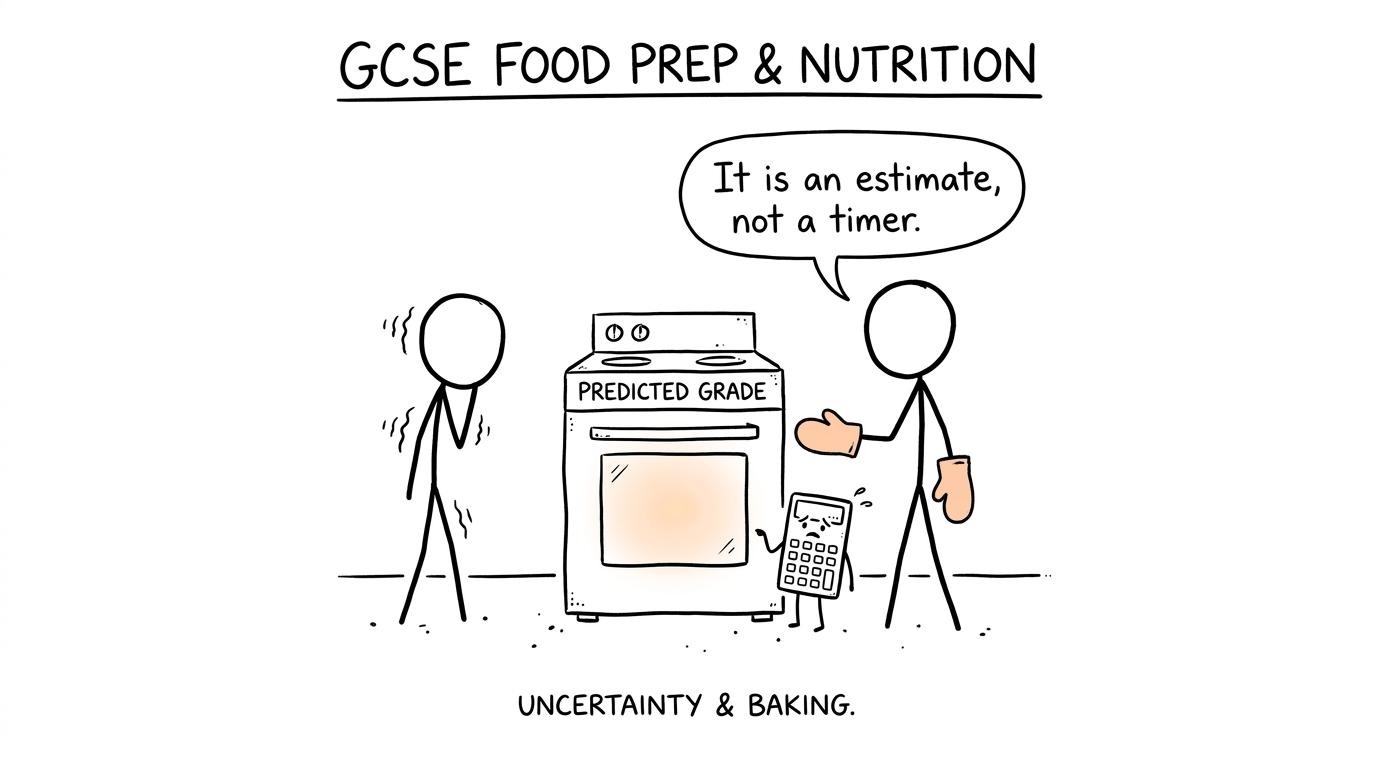 A predicted grade waits in an oven while a student learns that estimates are not timers
Why Food and Nutrition predictions are difficult
GCSE Food Preparation and Nutrition combines different kinds of performance. Students need theoretical knowledge, application, analysis, evaluation, food science understanding and practical competence. A single classroom test cannot capture all of that equally well.
Across the current AQA, OCR and Eduqas specifications, the written examination contributes 50%50\%50% of the qualification and NEA contributes the other 50%50\%50%. Pearson Edexcel's GCSE Food Preparation and Nutrition follows the same overall 50%50\%50% examination and 50%50\%50% NEA split. Exact component names, timings and administrative arrangements differ, so always check the specification used by your school.
Broadly, an estimated total may be represented as:
Estimated total=0.5(exam estimate)+0.5(NEA estimate)\text{Estimated total} = 0.5(\text{exam estimate}) + 0.5(\text{NEA estimate})Estimated total=0.5(exam estimate)+0.5(NEA estimate)This is not a prediction formula that every school must use. It simply shows why neither the mock nor the practical portfolio tells the whole story.
The NEA may still be changing
Food Preparation and Nutrition predictions can become more stable once both NEA tasks are substantially complete. Earlier in the course, teachers may have only provisional evidence about investigation, planning, technical skills, presentation and evaluation.
NEA is internally marked and externally moderated. Therefore, the mark used for an internal prediction may not necessarily be the final moderated mark. Teachers work from the assessment criteria, but moderation exists to maintain a common standard between centres.
A prediction made before a substantial amount of NEA has been assessed contains more uncertainty than one made later with stronger evidence.
A mock measures one performance
Mocks are valuable because they reveal recall, timing and written exam technique. But they are still samples taken on particular days.
A low mock can underestimate your eventual result if you had not finished the course, misunderstood the paper structure or improved significantly afterwards. A high mark can overestimate the final result if the paper contained familiar questions, generous internal boundaries or topics that happened to suit you.
This is why repeated evidence is stronger than one dramatic score. The same principle applies in maths: use GCSE mini tests and mixed papers to identify a pattern rather than allowing one result to define you.
Why predicted grades can be higher than final results
An over-prediction does not automatically mean anyone acted carelessly. It often reflects uncertainty between the moment of prediction and the final award.
Predictions may assume continued progress
Some schools produce a forecast of what a student is likely to achieve if their current progress continues. Others report a grade supported by present evidence. These are different judgements, even when both are labelled “predicted grade”.
A forecast can end up too high if later revision is inconsistent, important content remains insecure or exam-day performance falls below the standard shown in class.
Internal boundaries are only estimates
Exam boards establish qualification grade boundaries after papers have been sat and marked. They can vary between examination series because the demand of the assessment can vary.
Schools may use historical boundaries or their own conversion method for mocks. That can produce a useful guide, but it cannot reproduce a future boundary that does not yet exist. A student near the edge of a grade is therefore harder to predict precisely.
Coursework evidence may be provisional
A working NEA mark can change following final marking, internal standardisation or external moderation. If an early prediction assumes that unfinished sections will reach a particular standard, the resulting grade may be higher than the eventual outcome.
The final paper can expose narrow preparation
Knowing facts is only part of the written assessment. Students must also apply knowledge to unfamiliar contexts, interpret information, justify choices and evaluate food-related decisions. Revision based only on memorising notes may produce confidence without flexible exam performance.
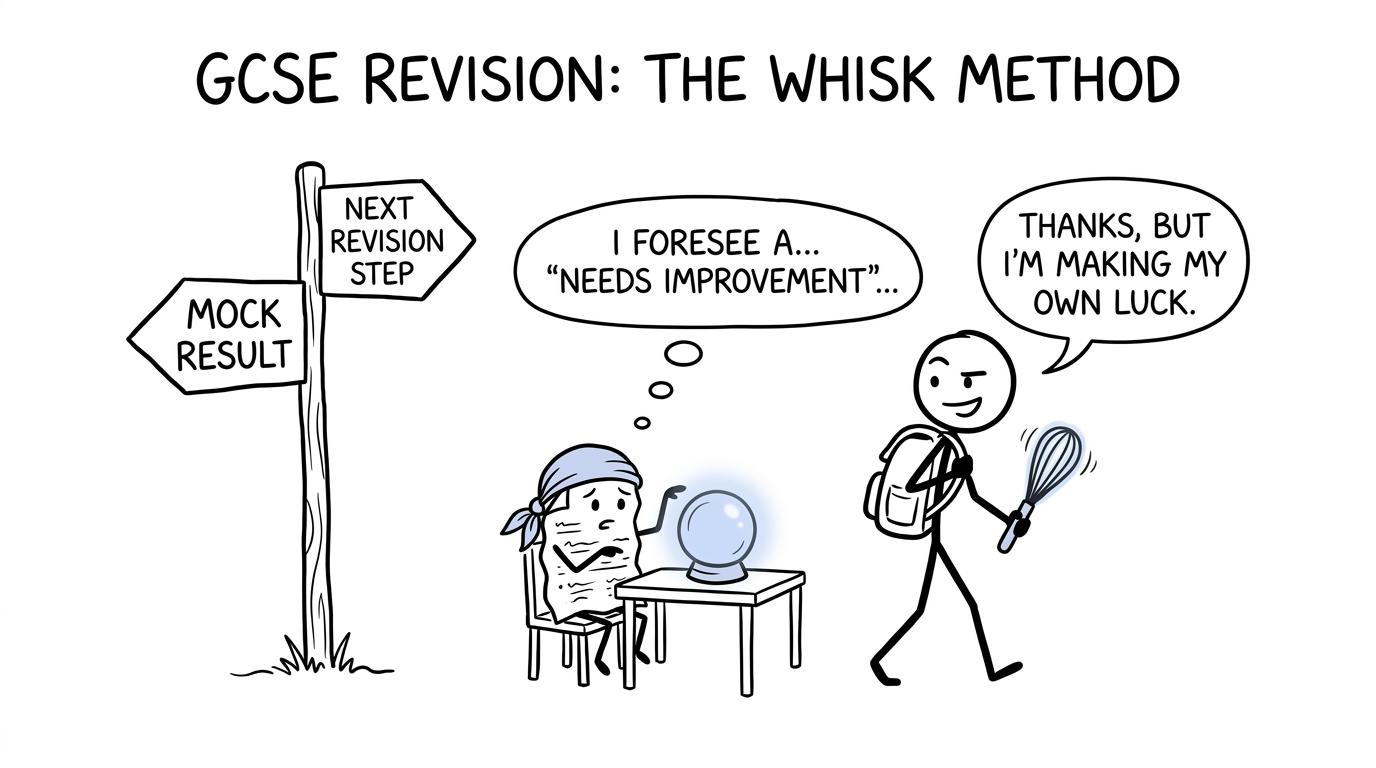 A mock paper poses as a fortune teller while the student follows the next-revision-step sign
Why predicted grades can be lower than results-day grades
Predictions can also miss improvement. They look backwards for evidence, while students continue moving forwards.
Early data may no longer represent you
A prediction influenced by Year 10 assessments may lag behind genuine progress in Year 11. Better subject knowledge, clearer written responses and stronger time management can all raise later performance.
The important test is whether improvement is visible in fresh, comparable assessments. Feeling more confident is encouraging; earning more marks repeatedly is stronger evidence.
Specific weaknesses can be repaired
A broad statement such as “I am working at grade 555” does not reveal what to practise. A marks-based diagnosis might show something more useful: weak evaluation, inaccurate scientific terminology, incomplete explanations or poor timing on extended responses.
MathsGenie uses the same repair principle for maths revision. Start in the GCSE maths revision hub, identify the precise skill costing marks, learn the method and practise it. The 20-minute maths revision routine is particularly useful when Food and Nutrition coursework is competing for revision time.
Exam performance can improve with rehearsal
Students often become better at showing what they know. Timed practice teaches you to interpret command words, allocate time and avoid leaving accessible marks unanswered.
For maths, Edexcel GCSE Maths past papers provide papers, mark schemes and worked solutions where available. Students taking another board can choose the appropriate route from the main GCSE hub. The habit transfers across subjects: attempt, mark, diagnose, repair and retest.
How to judge your own predicted grade
Instead of asking whether predictions are accurate in general, inspect the evidence behind yours.
| Evidence behind the prediction | What it tells you |
|---|---|
| Several recent theory assessments | Whether written performance is consistent |
| A timed mock covering broad content | How well knowledge survives exam conditions |
| Marked NEA sections | Current performance in assessed practical and analytical work |
| Teacher feedback linked to criteria | Which features are earning or losing marks |
| Repeated results over time | Whether the trend is stable, improving or declining |
| Distance from an estimated boundary | How sensitive the prediction is to a few marks |
Ask your teacher whether the number is a current working grade, an aspirational target or a forecast. Also ask whether it includes provisional NEA marks. Those distinctions make the prediction much easier to interpret.
If you are close to a boundary, think in marks rather than labels. A grade can change when only a modest part of the available evidence changes, but the exact relationship depends on that year's final boundary.
Turn uncertainty into a revision plan
You cannot make a prediction certain. You can make your preparation more measurable.
Separate controllable and uncontrollable factors
You cannot control future grade boundaries, moderation decisions or the precise questions on the paper. You can control your topic coverage, accuracy, timing and response to feedback.
Use this cycle:
- complete a timed assessment;
- mark it using the official criteria or mark scheme;
- classify each lost mark;
- revise the smallest relevant weakness;
- answer fresh questions;
- retest under timed conditions.
For maths, the guide to starting GCSE past papers explains why papers work best as diagnostic tools, not final judgements. GCSE predicted topics guidance also shows why predictions should supplement complete revision rather than encourage selective guessing.
Keep the evidence current
Record raw marks, percentages and the reason for each error. Where a percentage is useful, calculate it consistently:
Percentage score=marks achievedmarks available×100\text{Percentage score} = \frac{\text{marks achieved}}{\text{marks available}} \times 100Percentage score=marks availablemarks achieved×100Do not compare percentages from assessments with very different difficulty or coverage as if they were identical. Look for improvement across comparable tasks and pay attention to recurring weaknesses.
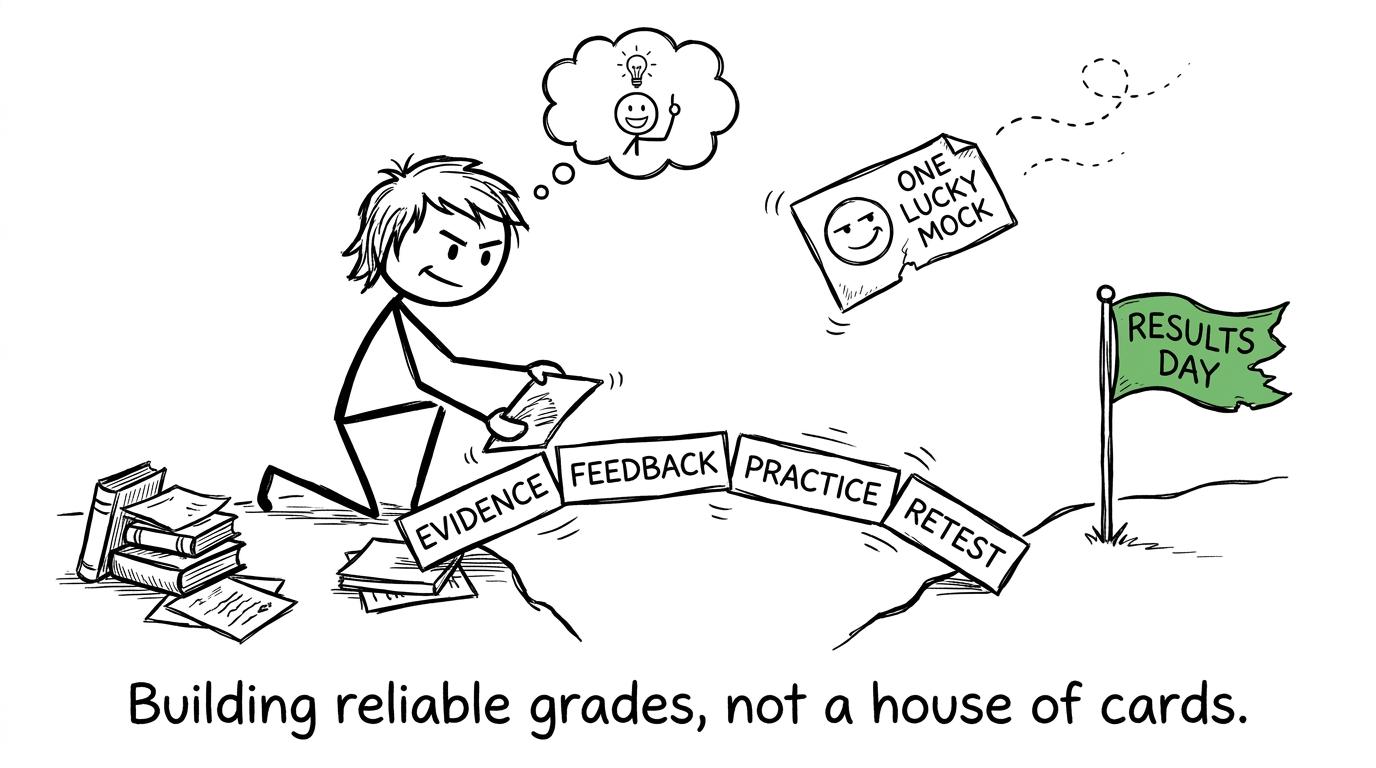 A student builds an evidence bridge towards results day while one lucky mock floats away
Common mistakes when interpreting predicted grades
Treating the prediction as a guaranteed result
It is an estimate based on available evidence. It is neither a minimum nor a maximum.
Confusing a target grade with a predicted grade
A target may be generated from earlier attainment or set to encourage progress. A prediction should reflect an informed judgement about likely performance. Ask which one appears on your report.
Looking only at the mock
The written exam is important, but it represents 50%50\%50% of GCSE Food Preparation and Nutrition. Your NEA evidence matters too.
Assuming every school predicts grades identically
Schools may use different assessment schedules, data systems and professional-judgement processes. Two predictions calculated from different evidence are not directly comparable.
Revising only what is predicted to appear
Neither a predicted grade nor a predicted paper knows the future. Cover the whole specification, then use predictions to focus additional practice. In maths, the best order to learn GCSE maths topics offers a structured route through content before mixed exam practice.
Chasing the label instead of the lost marks
The most useful question is not “How do I become a grade 777 student?” It is “Which marks am I repeatedly losing, and what will I do differently next time?” Specific action creates evidence. Evidence eventually changes the grade.
Your prediction is information, not a verdict
A carefully produced GCSE Food Preparation and Nutrition prediction can describe a plausible destination. It cannot account perfectly for unfinished NEA, moderation, future boundaries, revision quality or performance on one final day.
Use it as a dashboard light. Check the evidence behind it, identify whether the trend is rising or falling, and act on the weakest component. If the prediction is lower than you hoped, it shows where the work begins. If it is higher, it still needs to be earned.
For your maths exams, make MathsGenie your free revision base. Use the GCSE revision hub for revision lessons and practice questions, then build confidence with mini tests, past papers, predicted papers, mark schemes and video solutions. Predictions describe possibilities. Deliberate practice changes them.