GCSE Food and Nutrition Exam Cost: Private Entry
GCSE food and nutrition exam cost for private candidates explained: current fee examples, hidden NEA costs, booking steps and centre questions.
The difficult part of entering GCSE Food Preparation and Nutrition privately is rarely the written paper. It is discovering what the price includes. A search for the GCSE food and nutrition exam cost for a private candidate may reveal figures ranging from an exam board fee of under £50 to several hundred pounds charged by a private centre.
The short answer is that there is no single national price. The latest published fee schedules show an AQA summer 2026 entry fee of £45.70\pounds45.70£45.70 for UK centres, but that is the fee charged to the centre, not necessarily the amount a private candidate pays. Published centre prices for the same subject have ranged from about £165.70\pounds165.70£165.70 including administration to £200\pounds200£200 or more. OCR bookings involving non-exam assessment have been advertised at higher prices by specialist centres.
Your final cost depends on the exam board, the centre's administration charge, non-exam assessment support, practical facilities, ingredients, entry timing and travel. More importantly, you must find a centre able to supervise and authenticate the practical and written work. Booking the written examination alone is not enough.
Private candidate cost checklist
Before paying, confirm all of the following:
- the exact exam board and specification code
- whether the quote includes both the written paper and non-exam assessment
- whether kitchen facilities, supervision and marking are included
- whether ingredients must be supplied separately
- the centre's own booking deadline
- late-entry and cancellation charges
- travel costs for every required visit
- arrangements for access needs, where applicable
- when you will receive your statement of entry
A low headline price can become expensive when essential services are added later. A higher quote may be better value if it genuinely covers the whole qualification.
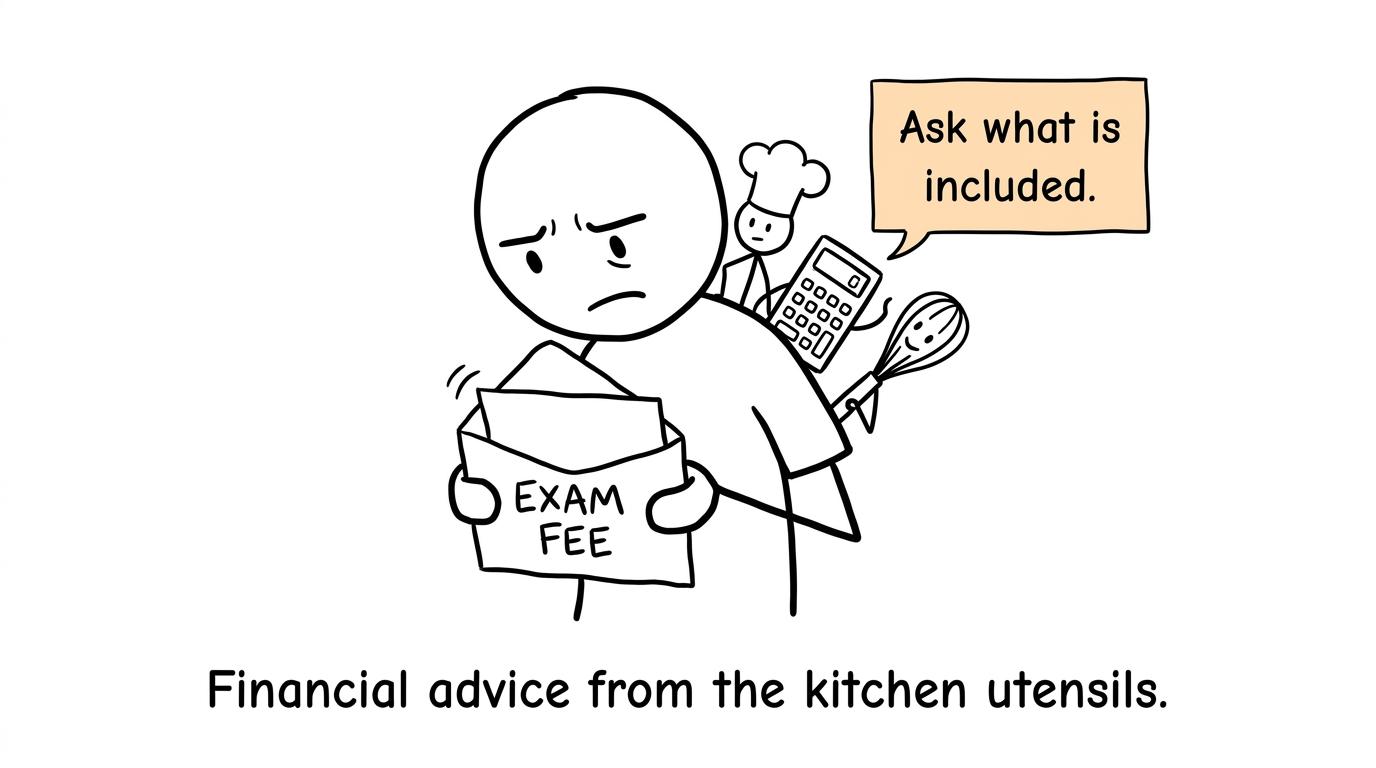 A worried student receives advice from a calculator, whisk and chef's hat about checking an exam fee
How much does GCSE Food Preparation and Nutrition cost privately?
The safest budget is built in layers. The awarding organisation charges an entry fee to the approved centre. The centre then decides what to charge you for administration, identity checks, invigilation, facilities and assessment work.
| Cost element | What it may cover |
|---|---|
| Awarding organisation entry fee | Registration, assessment and certification |
| Centre administration | Processing the entry, identity checks and communications |
| NEA assessment | Supervision, authentication, marking and moderation administration |
| Practical facilities | Kitchen space, equipment, staffing and health-and-safety arrangements |
| Ingredients | Food used during investigations, trials and the practical task |
| Travel | Visits for supervised work and the final written examination |
| Late fees | Extra charges after the board or centre deadline |
The total can be represented as:
Total cost=entry fee+centre charges+NEA costs+materials+travel\text{Total cost}=\text{entry fee}+\text{centre charges}+\text{NEA costs}+\text{materials}+\text{travel}Total cost=entry fee+centre charges+NEA costs+materials+travelThis is why the exam board fee should never be treated as the final private-candidate price.
Current published fee examples
For summer 2026, AQA published a UK centre entry fee of £45.70\pounds45.70£45.70 for GCSE Food Preparation and Nutrition, specification 858585858585. A school accepting private entries separately published a £120\pounds120£120 administration charge, producing a listed total of £165.70\pounds165.70£165.70 before any additional costs. Another private examination centre published a standard AQA subject price of £200\pounds200£200.
A specialist national centre's 2025/26 schedule listed OCR Food Preparation and Nutrition, code J309J309J309, from £261.60\pounds261.60£261.60, with higher amounts for later booking stages. These are useful illustrations, not universal tariffs. Each centre sets its own charges and may package services differently.
At the time of writing in August 2026, not every fee for the next summer series has necessarily been published. Treat 2025/26 figures as evidence of the likely structure rather than a guaranteed quote for 2027. Ask for a dated, itemised price in writing.
Why the NEA changes the price
Food Preparation and Nutrition is not a qualification that can normally be completed through one written paper alone. In the current AQA and OCR specifications, the written examination contributes 50%50\%50% of the qualification and non-exam assessment contributes the remaining 50%50\%50%.
For OCR J309J309J309, the assessment includes a food investigation task worth 15%15\%15% and a food preparation task worth 35%35\%35%. AQA 858585858585 similarly combines a written paper with assessed practical and investigative work. The centre must follow the relevant awarding organisation's rules for supervision, authentication, marking and moderation.
That creates work and responsibility for the centre. It may need to provide:
- an appropriate kitchen and equipment
- supervised sessions at specified stages
- secure access to assessment tasks
- a qualified person to assess the work
- evidence that the submitted work is yours
- photographs, records and assessment forms
- storage or electronic submission of moderation evidence
A centre offering ordinary written GCSEs may therefore decline Food Preparation and Nutrition. It might have invigilators and examination rooms but no suitable kitchen, assessor or process for the NEA.
Do not assume that home cooking can simply be photographed and submitted. Ask the prospective centre exactly where each assessed activity must happen and how the centre will meet the specification's supervision rules.
Where to book the examination
Private candidates cannot normally book a regulated GCSE directly with AQA, OCR or Eduqas. The entry must be made through an approved school, college or examination centre in the UK.
The official starting point is the Joint Council for Qualifications private-candidate centre finder. Search using your postcode, qualification level and awarding organisation. JCQ warns that its list is updated periodically and may not include every possible centre, so you must contact centres directly.
Contact centres with precise information
Do not begin with, “Can I sit a GCSE with you?” Give the centre enough detail to make a reliable decision:
- qualification: GCSE Food Preparation and Nutrition
- awarding organisation: for example, AQA or OCR
- specification code: for example, AQA 858585858585 or OCR J309J309J309
- examination series you require
- whether this is a first entry or resit
- whether you already hold any eligible NEA result
- any access arrangements you may need
Ask whether the centre accepts a candidate who has not received teaching there and whether it can supervise the entire NEA process. If the answer only mentions the written paper, it is incomplete.
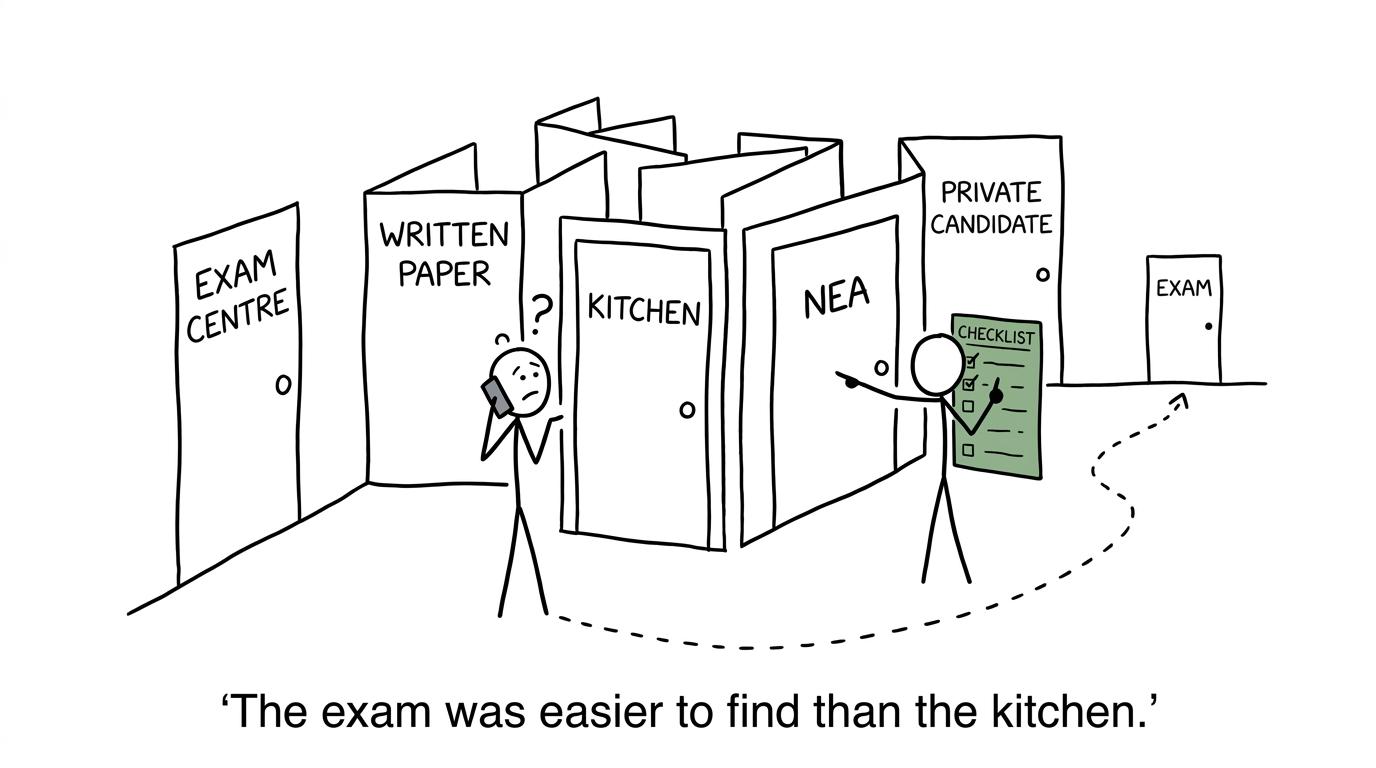 A student navigates exam-centre doors labelled written paper, kitchen and NEA
Questions to ask before paying
Request written answers to these questions:
- What is the full price, including the awarding organisation fee?
- Does it include both NEA tasks and the written examination?
- How many supervised visits are required?
- Are kitchen facilities, equipment and ingredients included?
- Who assesses the NEA?
- What are your internal deadlines?
- What happens if the centre later cannot provide an assessment session?
- Are fees refundable or transferable?
- How are access arrangements handled?
Once entered, check your statement of entry carefully. Your name, date of birth, awarding organisation, qualification and entry code must be correct.
Book early rather than cheaply
The official deadline is not always your practical deadline. Centres often set earlier internal dates so they can process documents, arrange staffing and plan NEA supervision. A centre may also close bookings when its kitchen or assessor capacity is full.
Late entry can increase the fee sharply. For summer 2026, the main awarding organisations applied staged late-fee arrangements after their standard entry deadlines. A centre may add its own late administration charge as well.
Begin contacting centres in the autumn before the summer examination series where possible. This gives you time to compare itemised quotations and check that the specification matches the course material you are using. For 2027 entry, ask centres for their current timetable and pricing rather than relying on a 2026 webpage.
Planning the cost alongside GCSE maths revision
Private entry involves more than money. Every centre visit, practical session and journey takes time from the rest of your GCSE preparation. Put confirmed dates into one calendar, then protect regular maths sessions around them.
The GCSE Maths revision hub gives you free board-specific lessons, exam questions, papers and solutions for Edexcel, AQA, OCR and Eduqas. If a practical week is busy, shorter GCSE Target Tests can keep your maths recall active without requiring a full paper.
As examination season approaches, use a measured progression. The guide to when to start GCSE past papers explains how to move from topic practice to timed papers. AQA students can then use AQA GCSE Maths past papers and mark schemes, while the advice on using Edexcel past papers properly helps Pearson students turn each lost mark into a specific revision action.
This matters because organisation has a hidden return. Paying an examination fee secures an opportunity; a revision system helps you use it well.
Common mistakes private candidates make
Comparing headline prices instead of full quotes
A centre advertising a low entry fee may charge separately for NEA supervision, kitchen use or marking. Compare the final payable amount and what it includes.
Booking only the written paper
The written examination is only part of the qualification. Unless valid NEA marks can be carried forward under the current rules, you need a centre that can administer all required components.
Choosing course materials before confirming the board
AQA 858585858585, OCR J309J309J309 and Eduqas specifications are not interchangeable. Confirm the board and code before committing to textbooks, tuition or assessment preparation.
Leaving the search until the entry deadline
A centre may reach capacity long before the awarding organisation's deadline. NEA subjects need facilities and specialist staff, so places can be more limited than for written-only subjects.
Forgetting travel and ingredients
The booking fee is only one part of the budget. Include repeat journeys, food, equipment required by the centre and possible accommodation if no suitable centre is nearby.
Paying without written confirmation
Keep the itemised quote, terms, deadlines and confirmation that the centre can administer the complete qualification. Verbal reassurance is not enough when several assessed components are involved.
Turn the booking into a clear plan
The realistic answer to the GCSE Food and Nutrition exam cost for a private candidate is that the board fee may be modest, but a complete private entry commonly costs much more once centre administration and NEA provision are included. Recent published examples run from around £165.70\pounds165.70£165.70 to above £260\pounds260£260 at the standard stage, with ingredients, travel and late charges potentially increasing the total.
Start with the JCQ centre finder, contact several centres and request an itemised quotation for the exact specification. Book only when the centre confirms that it can supervise and assess every required component.
Then bring the same clarity to your maths. Use MathsGenie's guide to finding your weakest GCSE topics, build a schedule with the one-week GCSE maths revision plan, and move through free revision lessons, practice questions, mini tests, past papers and predicted papers. Mark schemes and video solutions show you where marks were lost, and what to do next.
The booking creates the date. A calm, repeatable revision routine makes the date worthwhile.