GCSE Food and Nutrition Weak Topic: How to Fix It
GCSE food and nutrition weak topic? Use a practical revision plan to diagnose mistakes, improve exam answers and turn avoidance into lasting confidence.
A familiar revision trap begins with a single difficult chapter. You get a food science question wrong, promise to return to it later, then spend the next session revising nutrients because they feel safer. The difficult chapter remains untouched.
The best way to fix a GCSE food and nutrition weak topic is not to reread the entire textbook. Diagnose the precise reason you lose marks, relearn one small idea, practise questions that test it, mark them carefully and retest yourself without notes. Weakness becomes manageable when it is made specific.
This approach works whether the troublesome area is food science, nutrition, food safety, provenance, sensory analysis or the numerical skills hidden inside recipe and data questions.
Your weak-topic checklist
Use this sequence rather than avoiding the topic:
- Check the specification for your exam board.
- Gather evidence from marked questions, mocks or teacher feedback.
- Name the weakness precisely.
- Separate missing knowledge from application and exam technique.
- Relearn one small section.
- Answer questions without notes.
- Mark every response and record why marks were lost.
- Retest the same skill after a gap.
- Move to mixed practice only when the improvement survives.
The process is simple. The honesty required to follow it is the difficult part.
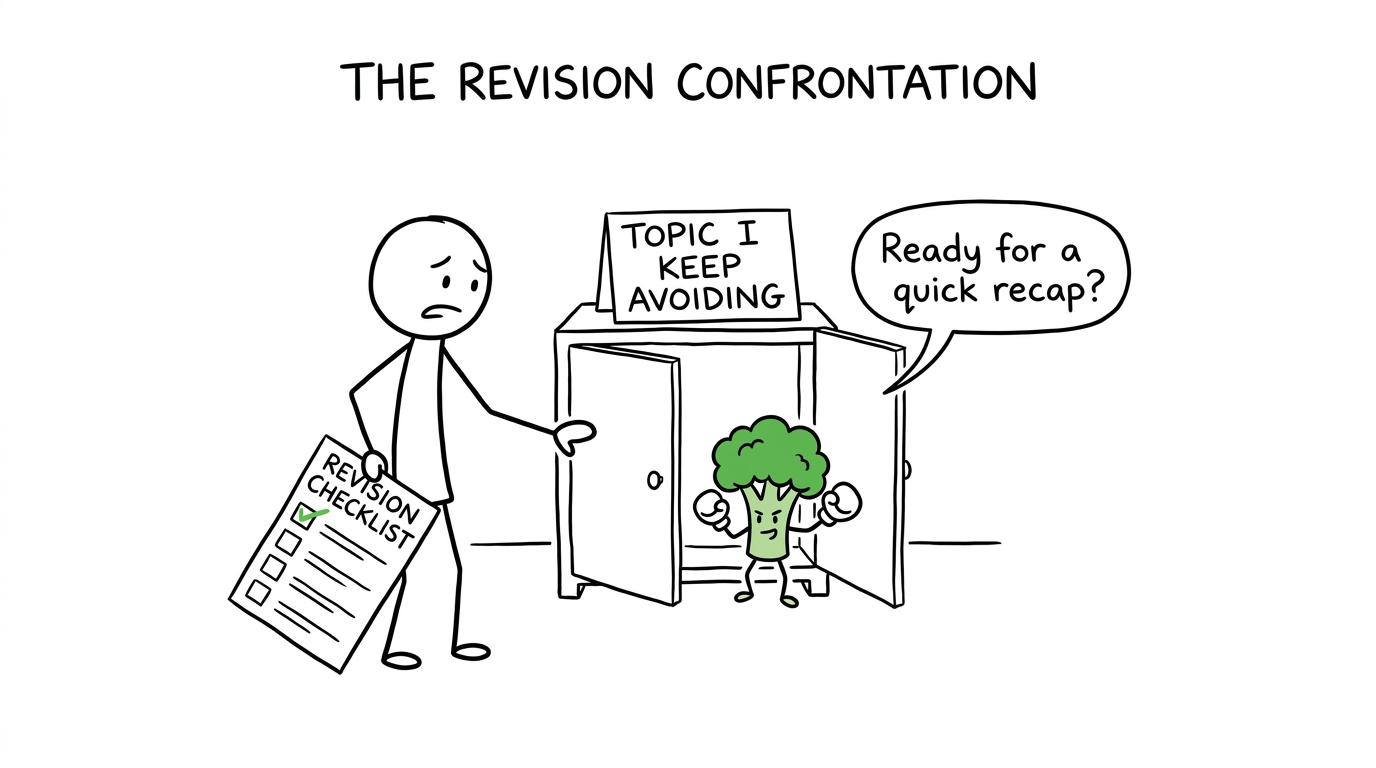 A student cautiously confronting the revision topic they keep avoiding
Define the topic before trying to fix it
“Food science” is too broad to revise effectively. So are “nutrition” and “food safety”. A useful weakness describes something you can actually practise.
For example, your real difficulty might be:
- explaining gelatinisation in the correct sequence;
- connecting a nutrient deficiency to its health consequence;
- applying food-safety knowledge to an unfamiliar situation;
- distinguishing denaturation from coagulation;
- interpreting sensory-analysis results;
- scaling ingredient quantities accurately;
- writing an evaluation supported by evidence.
Check the current specification and assessment guidance issued by your school’s exam board. AQA organises its content into food, nutrition and health; food science; food safety; food choice; and food provenance. OCR and Eduqas organise material differently, although the national subject content and assessment objectives create substantial common ground.
Do not revise from a generic online list without checking it against your own course. AQA, OCR and Eduqas may use different headings, wording and assessment structures. Your teacher can confirm the specification and any requirements relevant to your NEA.
Diagnose why you keep getting it wrong
A repeated error does not always mean that you lack knowledge. It may come from one of four different causes.
| Cause | What it looks like | Best response |
|---|---|---|
| Knowledge gap | You cannot recall the process, function or key term | Relearn a small section and use active recall |
| Application gap | You know the fact but cannot use it in a new context | Practise contextual questions and explain each link |
| Wording gap | Your answer is vague or misses the command word | Compare your response with the mark scheme |
| Numerical gap | Your method, units or interpretation is inaccurate | Rebuild the relevant maths skill and practise it separately |
Take three to five marked questions from the weak area. For every lost mark, write one short reason. “Careless” is rarely precise enough. Better diagnoses include “did not link the nutrient to the named life stage”, “described rather than evaluated” or “converted kilograms to grams incorrectly”.
This is the same evidence-led approach explained in MathsGenie’s guide to finding your weakest GCSE topics. Feelings can tell you that a topic is uncomfortable. Marked work tells you what needs changing.
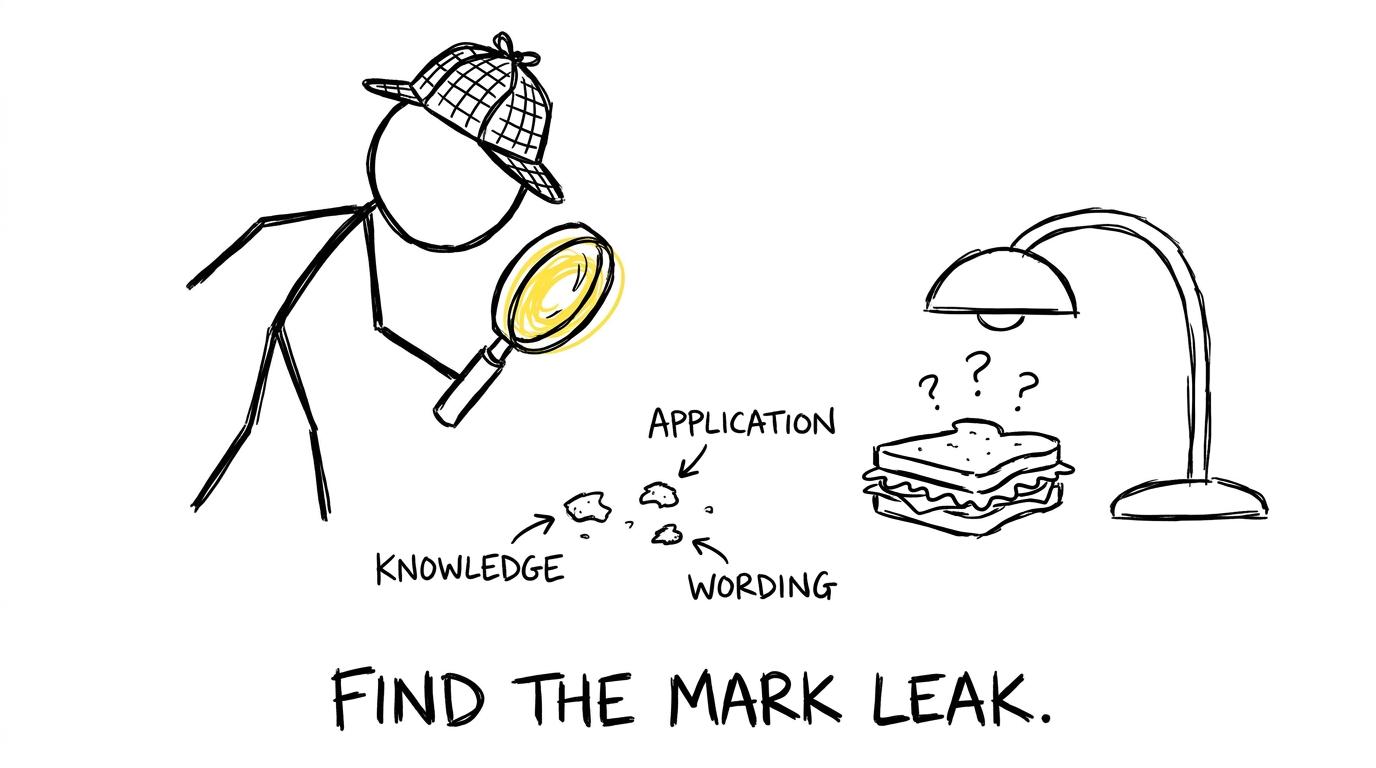 A revision detective searching for the source of lost marks
Use a short learn-practise-mark-retest cycle
Once the weakness is specific, resist the temptation to produce pages of attractive notes. Notes can organise information, but they do not prove that you can retrieve and apply it.
Learn one small idea
Spend a short session rebuilding the missing knowledge from your class materials, textbook and exam-board specification. Reduce it to a compact structure such as:
- what happens;
- why it happens;
- the conditions required;
- the effect on the finished food;
- where the idea applies.
For nutrition, you might organise recall around function, source, deficiency, excess and relevant dietary needs. For food safety, use hazard, cause, consequence and control. The structure should match the topic rather than forcing every chapter into the same template.
Practise retrieval before exam questions
Close your notes and reproduce the explanation from memory. Use a blank page, flashcards or verbal recall. Then check what you omitted.
Retrieval should feel slightly difficult. That difficulty is useful because the exam will also ask you to produce knowledge without seeing your notes. If you can only recognise an explanation when reading it, the topic is not secure yet.
Answer a small set of questions
Start with several questions focused on the same subtopic. Pay attention to command words such as state, describe, explain, analyse and evaluate. They ask for different kinds of response.
An explanation usually needs linked reasoning rather than a list of facts. An evaluation needs a supported judgement, not merely advantages followed by disadvantages. The exact marking approach depends on the question and board, so use the relevant mark scheme and teacher guidance.
Mark for causes, not just scores
Recording only a total such as 6/106/106/10 hides the useful information. Add the marks lost by category:
marks lost=knowledge+application+wording+numerical errors\text{marks lost}=\text{knowledge}+\text{application}+\text{wording}+\text{numerical errors}marks lost=knowledge+application+wording+numerical errorsThis is not an exam-board formula. It is a revision tool that shows where your next session should go. A student losing most marks through application needs different practice from one forgetting essential terminology.
Retest after a delay
Return to the topic after a day or two and answer fresh questions without notes. Then revisit it again during mixed revision. The aim is not to remember an answer immediately after reading it. The aim is to retrieve the idea after enough time has passed for forgetting to begin.
MathsGenie uses the same disciplined rhythm in its advice on revising efficiently for GCSE maths: learn, practise, mark, fix and revisit.
Repair the maths inside Food and Nutrition
Food Preparation and Nutrition includes numerical demands alongside written knowledge. Official subject content requires students to understand areas such as energy and nutritional values, while practical work also depends on accurate weighing, measuring and interpretation.
If calculations are the real obstacle, separate the maths skill from the food-science knowledge temporarily.
Percentages and nutritional information
A percentage compares a part with a whole:
percentage=partwhole×100\text{percentage}=\frac{\text{part}}{\text{whole}}\times 100percentage=wholepart×100Revise the relationship between fractions, decimals and percentages using MathsGenie’s fractions, decimals and percentages guide. Although the page supports Edexcel GCSE Maths, the underlying numerical skill transfers to food contexts.
Recipe scaling and proportion
When the number of portions changes, every scalable ingredient must be adjusted consistently:
new amount=original amount×new portionsoriginal portions\text{new amount}=\text{original amount}\times\frac{\text{new portions}}{\text{original portions}}new amount=original amount×original portionsnew portionsThe proportion revision guide focuses directly on scaling ingredients and identifying limiting ingredients. If comparisons between quantities cause confusion, revisit the ratio revision guide.
Units, averages and results
Always attach units to measurements and check whether a conversion is required. MathsGenie’s conversions and units guide helps rebuild that habit.
For investigation or sensory data, you may also need to summarise and compare results. The arithmetic mean is:
mean=total of all valuesnumber of values\text{mean}=\frac{\text{total of all values}}{\text{number of values}}mean=number of valuestotal of all valuesUse the averages revision guide if choosing or calculating averages is part of the problem. When presenting categories, the bar charts revision guide reinforces scales, labels and accurate comparisons.
Turn knowledge into mark-worthy explanations
Food and Nutrition questions often reward connected thinking. Knowing that a change occurs is only the first layer. You may need to explain the mechanism, the conditions and the consequence for the food or consumer.
A useful planning chain is:
cause, process, observable effect, relevance to the question
Before writing, underline the subject, context and command word. After writing, check that each sentence advances the answer. If a sentence merely repeats the question, it probably earns little.
For longer responses, select evidence before forming a judgement. Avoid memorising one generic answer and forcing it onto every context. The national assessment objectives include demonstrating knowledge, applying it, planning and preparing food, and analysing and evaluating. This is why recall alone cannot solve every weak topic.
Build the topic into your wider revision plan
A weak topic should receive more attention, but it should not occupy every session. Use a simple pattern:
- one focused relearning session;
- one closed-book recall session;
- one exam-question session;
- one delayed retest;
- later inclusion in mixed revision.
Keep the task small enough to begin. “Revise food science” invites delay. “Recall the stages of gelatinisation, then answer two questions” gives you a visible finish line.
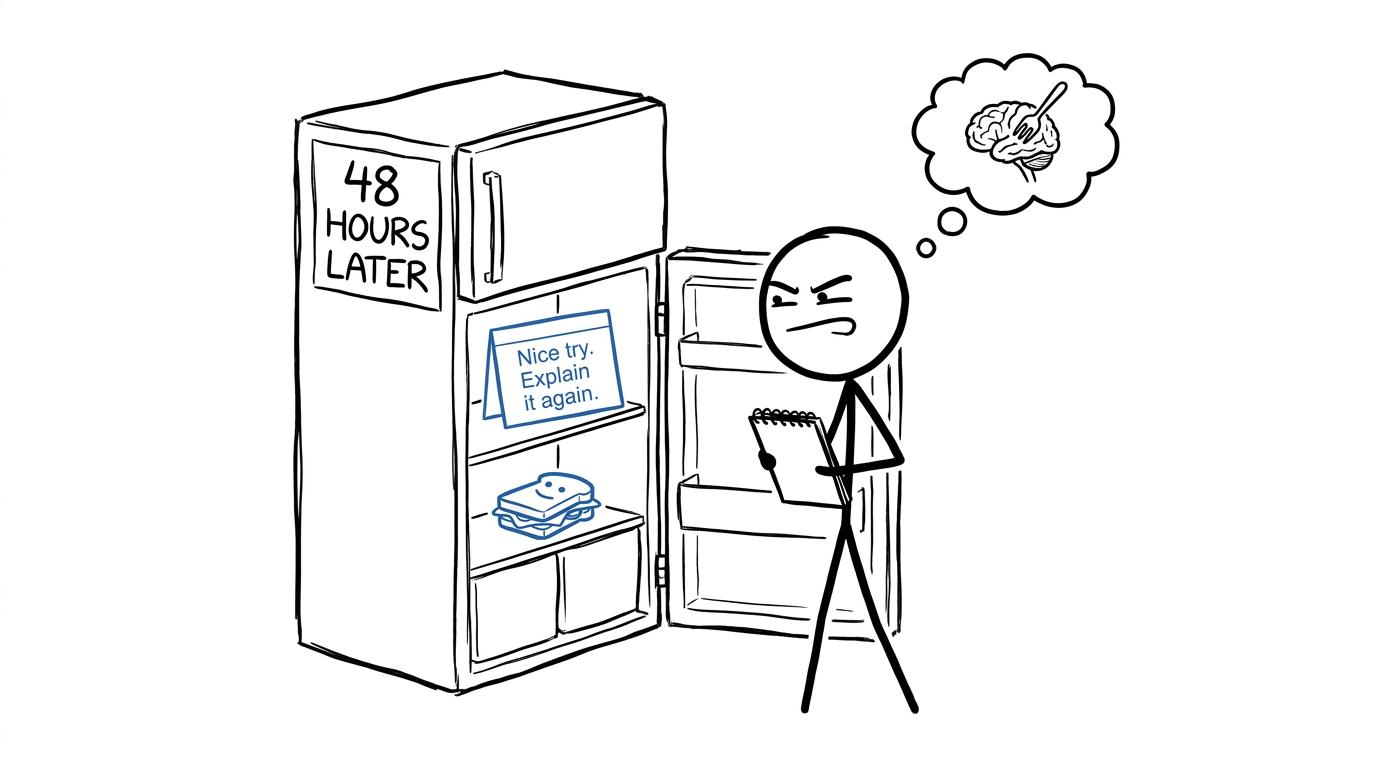 A determined student returning to a topic after a revision gap
Common mistakes when fixing a weak topic
Revising what feels comfortable
Confidence can create the illusion of progress. Begin with evidence from marked work, not the chapter you most enjoy.
Copying notes without testing recall
Rewriting may make material familiar, but familiarity is not retrieval. Close the notes and produce the explanation independently.
Treating every mistake as a content gap
If the issue is a missed command word, weak judgement or unit conversion, reading the chapter again will not directly fix it. Match the remedy to the cause.
Using the mark scheme as a script
A mark scheme shows what was creditworthy for that question. Learn the underlying idea and response structure rather than memorising isolated phrases.
Retesting with the identical question immediately
You may remember the wording rather than understand the concept. Use a fresh question after a delay, then include the topic in mixed practice.
Ignoring units and context
A correct calculation without the required unit can weaken an answer. A correct fact that is never connected to the named food, consumer or situation may also fail to address the question fully.
Make the next session specific
A topic you repeatedly get wrong can start to feel like part of your identity: “I am bad at food science” or “I cannot do nutrition calculations.” Usually, the evidence supports a smaller and more useful conclusion. One explanation is incomplete. One command word is being mishandled. One numerical method needs rebuilding.
Choose one subtopic today. Diagnose the mark leak, learn the smallest missing piece, practise it and schedule a retest. For the numerical skills that cross into Food and Nutrition, MathsGenie provides free revision lessons, practice questions, mark schemes, video solutions and mini tests. When preparing for your maths exams, you can then test those skills more broadly with GCSE predicted papers and past-paper practice.
Avoidance keeps a weak topic vague. Careful practice turns it into a list of solvable problems.