Revision notes for Edexcel GCSE Maths Averages. Open the guide for explanations and worked examples. Written against the Edexcel GCSE Maths (1MA1) specification, so the content matches what's examinable rather than general Maths background.
A set of numbers is often called data. Averages help us describe what is “typical” in the data.
At GCSE, the main averages are mode, median and mean. You will also often be asked for the range, which tells you how spread out the numbers are.
Key words for averages
Putting numbers in order means writing them from smallest to largest.
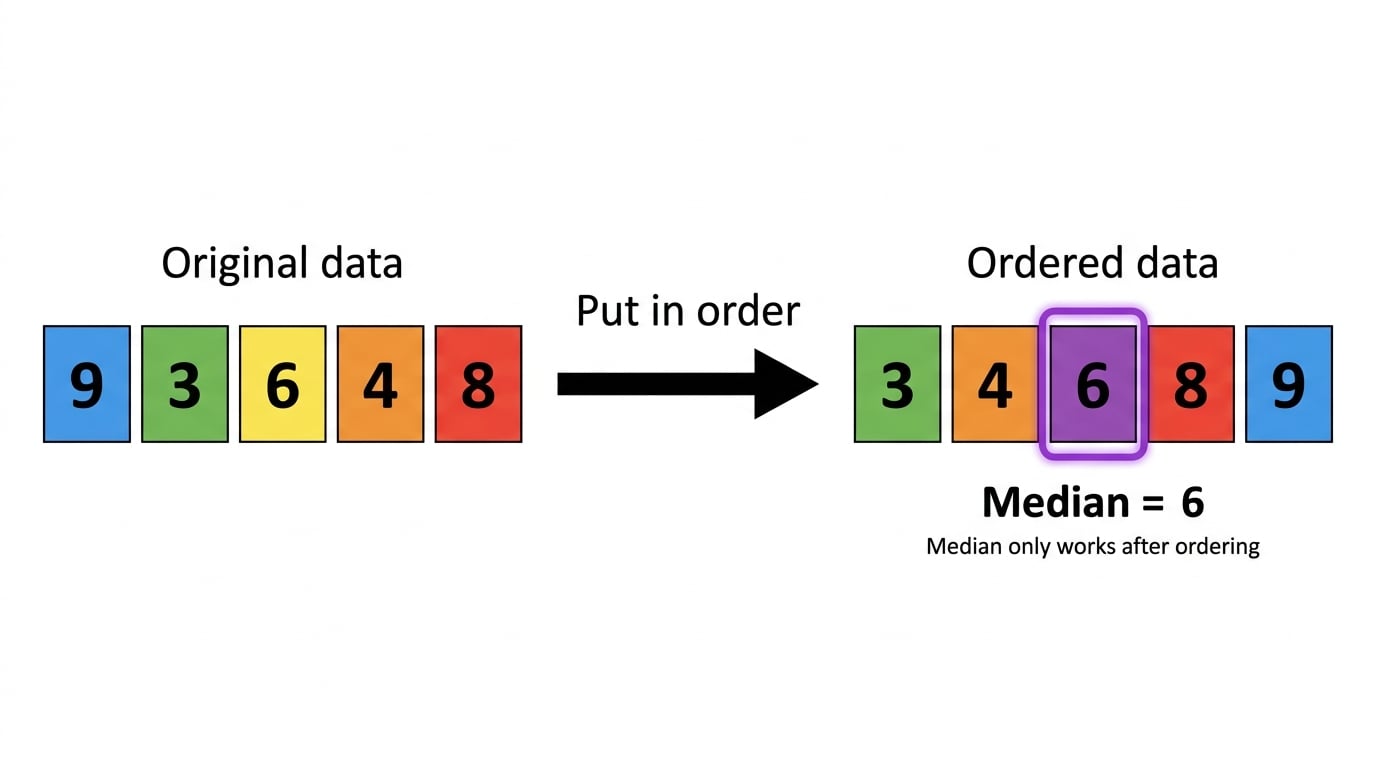
This is especially important for the median, because the middle number only works after the list has been ordered.
Ordering before finding the middle

Write them from smallest to largest: 3, 4, 6, 8, 9.
There are 5 numbers, so the middle one is the 3rd number.
The median is 6.
Middle of the original list
The median is not just the number in the middle of the list as it is written. You must put the numbers in order first.
The range tells you the gap between the smallest and largest values.
Range
To find the range, do largest value minus smallest value.
Finding the range of some heights

The smallest height is 152 cm and the largest height is 181 cm.
Subtract the smallest from the largest:
181−152=29181 - 152 = 29181−152=29The range is 29 cm.
Range is not the biggest number
The range is not the largest value. It is the difference between the largest and smallest values.
The mode is the value that appears most often.
A list can have one mode, more than one mode, or no mode if no value repeats.
Finding the mode

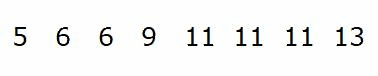
Count how often each number appears.
The number 8 appears three times.
No other number appears as often.
The mode is 8.
Quick mode check
Look for repeats. The mode is the number you see most often, not the biggest number.
The median is the middle value after the data is in order.
If there is an odd number of values, there is one middle value.
If there is an even number of values, there are two middle values. Add them together and divide by 2.
Finding the median with an even number of values

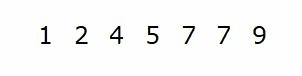
Put them in order: 118 g, 124 g, 126 g, 132 g, 140 g, 150 g.
There are 6 values, so there is no single middle value.
The two middle values are 126 g and 132 g.
Find the mean of these two middle values:
126+1322=129\frac{126+132}{2}=1292126+132=129The median weight is 129 g.
The mean is the average found by adding all the values and dividing by how many values there are.
The total means all the values added together.
mean=total of valuesnumber of values\text{mean}=\frac{\text{total of values}}{\text{number of values}}mean=number of valuestotal of valuesFinding the mean of numbers on cards

Add the numbers:
14+6+10+6+12+18=6614+6+10+6+12+18=6614+6+10+6+12+18=66Count how many numbers there are. There are 6 numbers.
Divide the total by 6:
66÷6=1166 \div 6=1166÷6=11The mean is 11.
Mean checklist
For the mean, you need two things: the total and the number of values.
Sometimes a question tells you the mean and asks you to find a missing number.
Work backwards by finding the total first.
total=mean×number of values\text{total}=\text{mean} \times \text{number of values}total=mean×number of valuesFinding one hidden number

Find the total needed for 7 numbers with mean 9:
9×7=639 \times 7=639×7=63Add the known numbers:
12+5+9+10+8+11=5512+5+9+10+8+11=5512+5+9+10+8+11=55Subtract to find the hidden number:
63−55=863-55=863−55=8The hidden number is 8.
Sometimes you are given both the mean and the mode. Use the mean to find the total, then use the mode clue to decide which number must repeat.
Finding two hidden numbers

Find the total needed for 6 numbers with mean 5:
5×6=305 \times 6=305×6=30Add the numbers you can see:
2+4+7+5=182+4+7+5=182+4+7+5=18The two hidden numbers must add to:
30−18=1230-18=1230−18=12The mode is 4, so one hidden number must be 4.
Find the other hidden number:
12−4=812-4=812−4=8The two hidden numbers are 4 and 8.
If a new value is added, do not just average the old mean and the new value. First turn the old mean back into a total.
Adding one more day to a mean

Find the total for the first 4 days:
12×4=4812 \times 4=4812×4=48Add the new distance:
48+17=6548+17=6548+17=65There are now 5 days, so divide by 5:
65÷5=1365 \div 5=1365÷5=13The new mean distance is 13 km.
If you know the mean of all the numbers and the mean of some of them, use totals.
Finding the mean of the other numbers
The mean of 6 numbers is 20. The mean of 2 of the numbers is 14.
Find the total of all 6 numbers:
20×6=12020 \times 6=12020×6=120Find the total of the 2 numbers:
14×2=2814 \times 2=2814×2=28Find the total of the other 4 numbers:
120−28=92120-28=92120−28=92Divide by 4 to find their mean:
92÷4=2392 \div 4=2392÷4=23The mean of the other 4 numbers is 23.
In the exam
Put the data in order before finding the median.
For the mean, write down the total and how many values there are.
If a number is hidden, work out the total the list should have first.
Include units in your final answer if the data has units, such as cm, g or km.
Check yourself
Can you explain the difference between mode and median?
If 6 numbers have mean 10, what total must they have?
Why is “the middle number” unsafe unless the list is in order?
Test yourself with 5 quick questions on this guide. Answer them all correctly to complete it.
Test yourself on this topic, or move on to the next guide.
How was this guide?