GCSE Food and Nutrition Study Group That Works
GCSE food and nutrition study group tips: choose the right people, run focused sessions, revise exam content and stop your group chat wasting revision time.

A group chat can look like a study group from a distance. It has the right people, an optimistic name and perhaps even a photograph of someone's revision guide. Yet no revision happens.
A GCSE food and nutrition study group works only when it has a small membership, a regular meeting time, a written agenda and an individual task for everyone to complete. Aim for 333 to 555 students, meet for about 454545 to 606060 minutes and finish each session with a specific next action. Keep the group chat for arranging meetings, not replacing them.
That is the short answer. The deeper lesson is that good groups are not powered by motivation. They are powered by structure; and the same structure can help you protect the maths revision that must continue alongside Food Preparation and Nutrition.
Your study group checklist
Before the first meeting, agree on these essentials:
- Invite 333 to 555 reliable students taking the same specification.
- Confirm whether you study AQA, OCR or Eduqas Food Preparation and Nutrition.
- Choose one recurring time and a quiet place.
- Plan one focused topic for each meeting.
- Bring specification-matched questions or teacher-approved materials.
- Assign a chair, timekeeper, question leader and progress recorder.
- Mark or review answers before leaving.
- Record individual next steps without sharing assessed work.
- Keep separate time for GCSE maths revision.
If several items are missing, you probably have a social group with revision intentions. That is not a moral failure. It simply means the system needs changing.
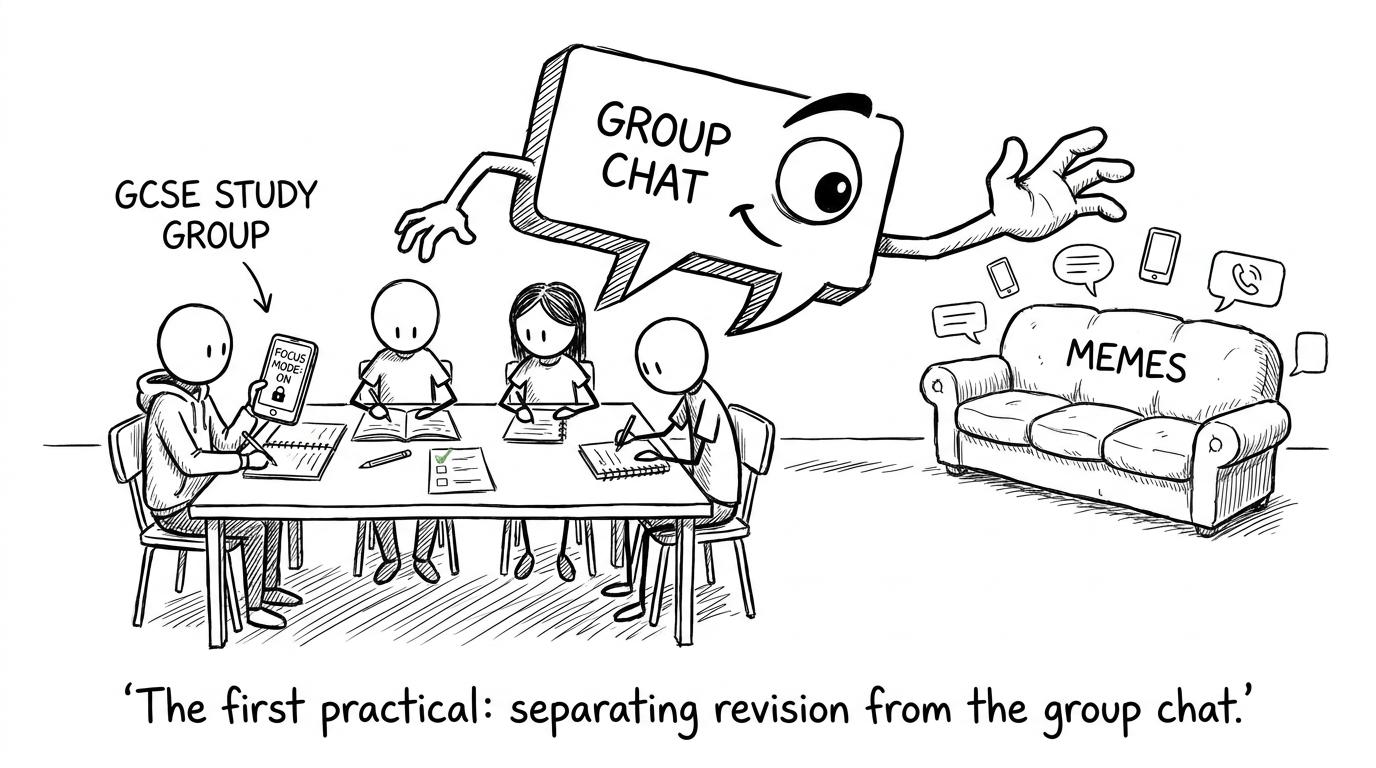 A study group resisting the lure of its group chat
Choose people for reliability, not just friendship
The best revision partner is not necessarily your closest friend. It is the person who turns up, attempts the questions and can disagree without turning the meeting into an argument.
A group of 444 is often practical: it is large enough for different strengths but small enough for everyone to speak. More important than the exact number is whether each person accepts the same purpose.
Before inviting anyone, ask:
- Are we preparing for the same exam board?
- Will this person complete preparation before meetings?
- Can we work without constantly checking our phones?
- Will everyone explain ideas rather than simply hand over answers?
- Are we comfortable saying, “I do not understand this yet”?
Students do not need matching target grades. A mixed-confidence group can work well when explanation goes both ways. However, nobody should become the permanent unpaid teacher while everyone else watches.
Start with the correct specification
Food Preparation and Nutrition is not organised identically by every awarding body. Official specifications for AQA, OCR and Eduqas differ in their topic organisation and written-paper format, so use the document for your board rather than a generic online checklist.
Across regulated GCSE Food Preparation and Nutrition qualifications, 50%50\%50% of the marks are allocated to examination assessment and 50%50\%50% to non-exam assessment. The common assessment objectives cover knowledge and understanding, application, practical planning and preparation, and analysis and evaluation.
This matters because an effective group should not spend every meeting making flashcards for factual recall. Students also need to apply knowledge, interpret information, justify choices and evaluate outcomes.
Build your topic list from the specification and your teacher's scheme of work. Depending on the board, this is likely to include areas such as:
- nutrition, diet and health;
- food science and the properties of ingredients;
- food safety and microbiology;
- food choice, provenance and sustainability;
- preparation methods and cooking techniques;
- analysis, application and evaluation.
Use past questions and official mark schemes where your teacher or awarding body provides them. A confident conversation is not proof that you could produce a precise answer under exam conditions.
Give every meeting a visible output
“Revise nutrition” is too vague. A useful meeting objective describes what will exist by the end.
For example, a session might aim to produce:
- a checked set of retrieval questions;
- a list of weak terms needing individual review;
- an improved plan for approaching extended responses;
- a comparison between answers and a mark scheme;
- three questions to take back to the teacher.
Notice the difference. The group is not measuring success by how long everyone sat together. It is measuring what changed.
A reliable 606060-minute structure is:
- First 555 minutes: settle, state the objective and remove distractions.
- Next 101010 minutes: complete closed-book retrieval individually.
- Next 202020 minutes: discuss difficult concepts and correct misunderstandings.
- Next 151515 minutes: attempt an exam-style question independently.
- Final 101010 minutes: review against available guidance and assign next steps.
Keep individual thinking before group discussion. If the most confident student answers first every time, everyone else can mistake recognition for understanding.
Assign roles that create accountability
Roles remove the awkward moment when everybody waits for somebody else to begin. Rotate them so that responsibility does not settle on one student.
Chair
The chair states the objective, keeps discussion relevant and makes sure quieter members contribute.
Timekeeper
The timekeeper protects each part of the agenda. Their job is not to rush learning, but to stop one minor disagreement consuming the meeting.
Question leader
This student prepares teacher-approved retrieval or exam-style questions. They should not reveal answers before everyone has attempted them.
Progress recorder
The recorder notes topics that remain uncertain, questions for the teacher and agreed actions. They should not create shared answers for assessed work.
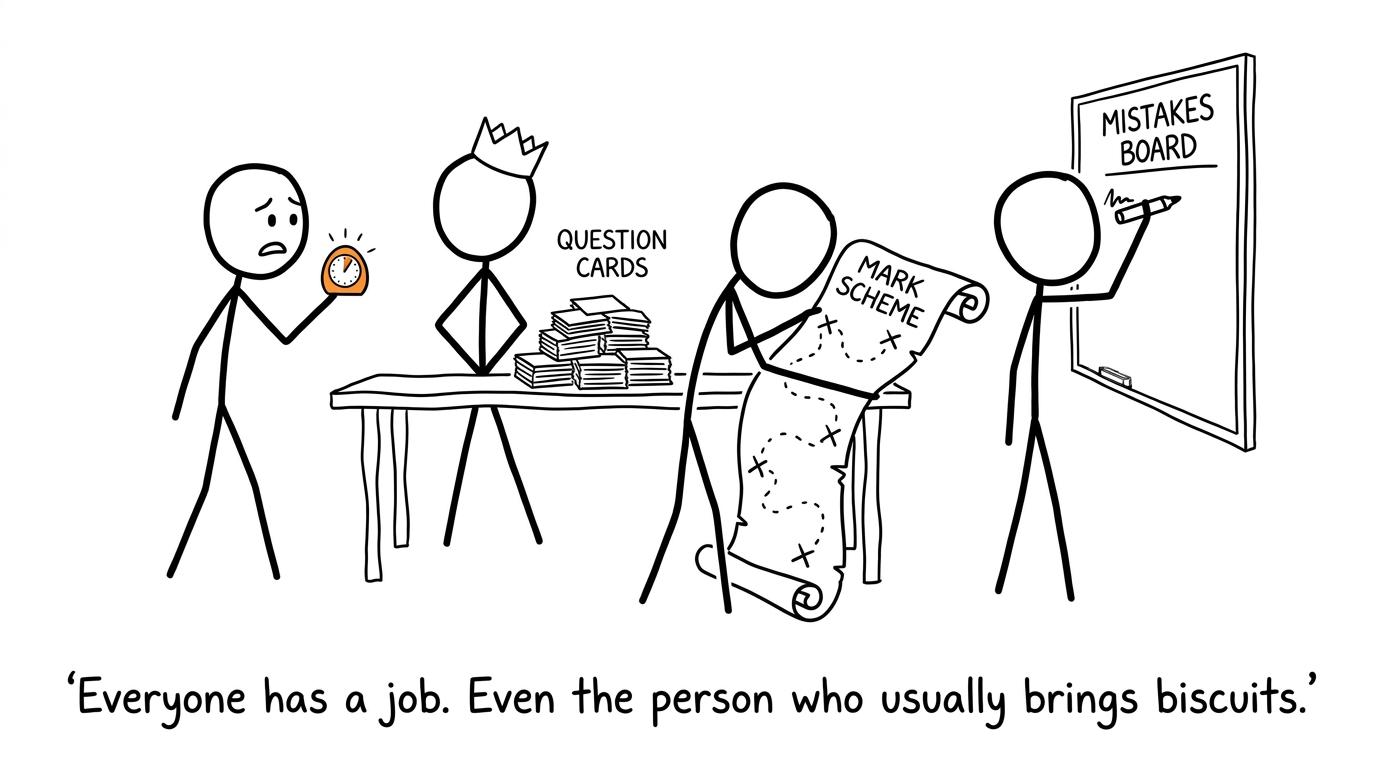 Four revision students taking their study-group roles very seriously
Keep collaboration separate from NEA work
A study group can discuss course concepts, practise retrieval and compare approaches to released practice questions. It must not become a way to produce somebody else's non-exam assessment.
NEA submissions must represent each student's own work and must be completed under the conditions set by the relevant board and school. Do not share written sections, portfolios, investigation results or files in a way that allows copying. Do not rewrite another student's assessed response for them.
If you are uncertain, ask your teacher before collaborating. A safe rule is that the group can help members understand a principle, but each student must independently generate and record assessed decisions, evidence, analysis and evaluation under the required conditions.
Connect food revision with GCSE maths skills
Although the group focuses on Food Preparation and Nutrition, parts of the subject depend on secure numerical reasoning. Ingredient quantities, nutritional information, costs, data and practical investigations may involve ratio, proportion, units, percentages, averages and graphs.
Useful relationships to recognise include:
scale factor=required quantityoriginal quantity\text{scale factor}=\frac{\text{required quantity}}{\text{original quantity}}scale factor=original quantityrequired quantity percentage change=new value−original valueoriginal value×100\text{percentage change}=\frac{\text{new value}-\text{original value}}{\text{original value}}\times 100percentage change=original valuenew value−original value×100 mean=sum of valuesnumber of values\text{mean}=\frac{\text{sum of values}}{\text{number of values}}mean=number of valuessum of valuesDo not let Food revision quietly replace maths revision, however. GCSE maths has its own specification, tier and examination demands. Use the GCSE maths topics by exam board and tier to confirm what you need for Edexcel, AQA, OCR or Eduqas maths.
If calculations expose a weakness, move it into a separate MathsGenie session. The best order for learning GCSE maths topics helps you place ratio, percentages and conversions within a sensible revision sequence. AQA students can also use the AQA GCSE Maths revision hub for lessons and exam-style questions.
Make the group chat serve the meeting
The group chat should do only four jobs:
- confirm the time and place;
- share the next meeting's topic;
- list what each person must bring;
- record brief actions after the session.
Set simple boundaries. One person posts the agenda. Members acknowledge it. Unrelated conversation moves elsewhere. Files should have clear names, and nobody should upload assessable NEA work.
If meetings are repeatedly cancelled, stop renegotiating every week. Choose a recurring slot and require advance notice from anyone who cannot attend. The purpose is not to punish people. It is to make attendance the default rather than a fresh decision.
Use evidence to choose the next topic
Groups often revise what feels comfortable because comfort creates the impression of progress. Choose topics using evidence instead:
- mistakes in class tests;
- questions you could not begin;
- vague or inaccurate technical vocabulary;
- teacher feedback;
- gaps revealed by specification checklists;
- weak application or evaluation responses.
The same principle works for maths. MathsGenie's guide to finding your weakest GCSE topics explains how to turn lost marks into a focused revision list. Short assessments such as Edexcel GCSE Maths mini tests can provide quicker feedback than repeatedly attempting full papers.
When examinations approach, build from topic practice towards timed work. The guide to when to start GCSE past papers explains how mini tests, paper sections and complete papers can play different roles. If time is tight, use the GCSE one-month maths revision plan to keep maths moving alongside your other subjects.
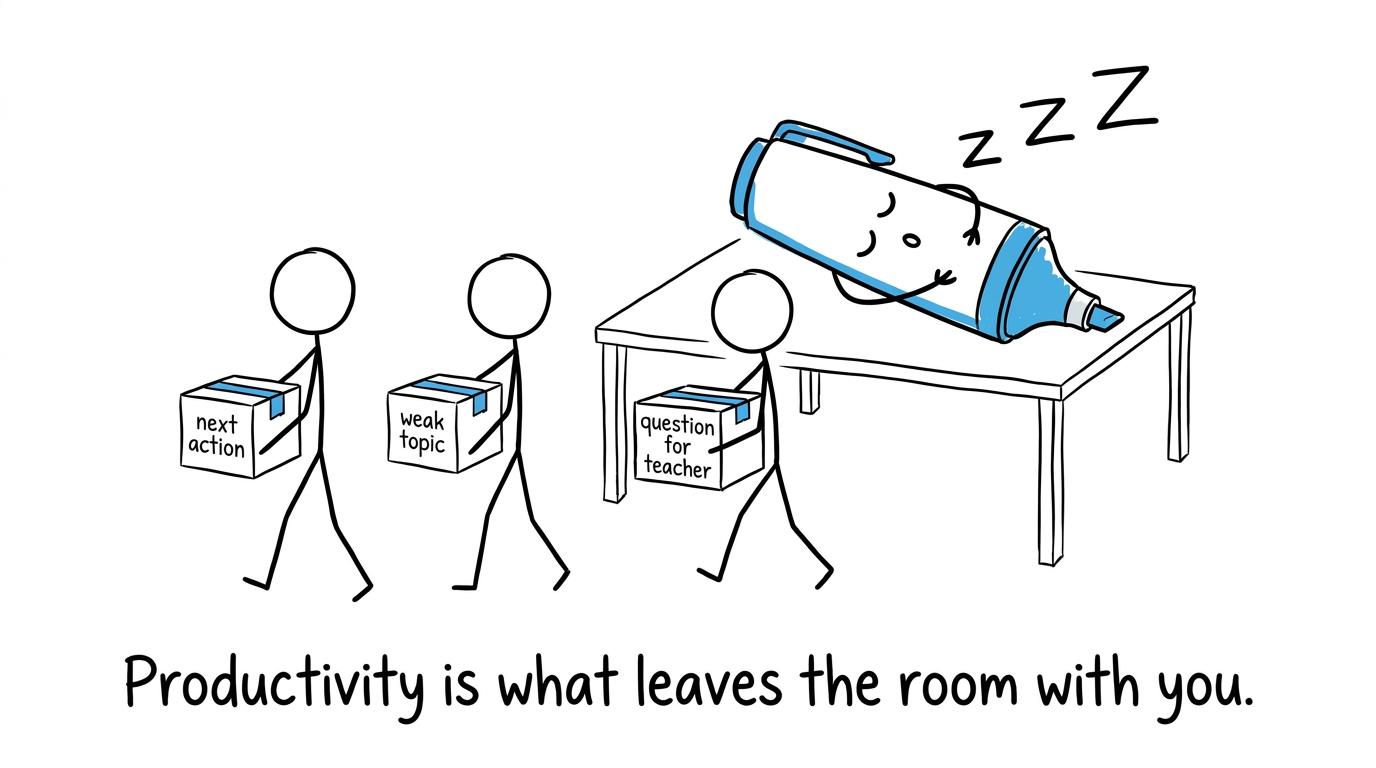 Students leaving revision with useful next actions while a highlighter sleeps
Common mistakes that stop study groups working
Inviting too many people
Large groups create more scheduling problems and less individual participation. Start small and expand only if there is a clear reason.
Meeting without an agenda
Without one defined topic and one intended output, conversation naturally drifts. Send the agenda before the meeting.
Letting one student do all the explaining
Explanation can strengthen understanding, but passive listening rarely reveals whether everyone else can answer independently. Require a silent attempt first.
Producing attractive notes instead of testing knowledge
Colourful notes may organise material, but they do not automatically build recall or exam technique. Include closed-book questions and timed responses.
Treating the mark scheme as a final judgement
A mark scheme should reveal missing knowledge, imprecise language and weak application. Record the reason for each lost mark and revisit it.
Sharing assessed NEA material
Collaboration must never undermine the requirement for authentic individual work. Ask your teacher where the boundary lies.
Allowing one subject to consume the timetable
A productive Food meeting can still damage your preparation if it displaces maths every week. Protect separate blocks for both subjects and track whether they actually happen.
Turn meetings into measurable progress
A GCSE food and nutrition study group succeeds when members leave with fewer uncertainties and clear individual actions. Keep it small. Meet regularly. Begin with retrieval, require independent answers, use specification-matched materials and end with recorded next steps.
Then give maths the same disciplined treatment. Visit MathsGenie to choose your exam board and tier, rebuild weak methods with free revision lessons, and practise using topic questions, mini tests, past papers and mark schemes. As the exams approach, add predicted papers and video solutions to test what has genuinely become secure.
The goal is not to create the busiest group chat. It is to make the next meeting useful; and eventually, unnecessary.