GCSE Food and Nutrition Grade 9 Meaning Explained
GCSE food and nutrition grade 9 meaning explained: learn what the grade represents, how assessment works and how it compares with old letter grades.
A grade can look like a single digit on results day, yet it carries two years of decisions: the investigation you refined, the practical techniques you practised and the written answers you learned to support with evidence.
The gcse food and nutrition grade 9 meaning is straightforward at its core: grade 9 is the highest available grade in England's GCSE Food Preparation and Nutrition qualification. It indicates exceptional performance across the assessed knowledge, application, practical work, analysis and evaluation required by the specification. It is not simply a reward for cooking an impressive final dish, nor is it awarded according to one permanent percentage boundary.
Here is the essential picture:
- Grade 9 is the highest grade on the GCSE scale from 9 to 1.
- It represents stronger attainment than the threshold for the old grade A*.
- It is based on your overall weighted result, including the written examination and non-exam assessment.
- Grade boundaries are set for each examination series, so the required raw mark can change.
- Food Preparation and Nutrition is not divided into foundation and higher tiers.
- Reaching grade 9 requires depth, accuracy, application and evaluation, not perfect performance in every task.
What does a grade 9 in GCSE Food and Nutrition mean?
A grade 9 shows that a student has demonstrated the highest band of attainment available in the qualification. Official specifications use the title GCSE Food Preparation and Nutrition, although students often shorten it to Food and Nutrition or Food Tech.
At this level, knowledge must be usable. Remembering that protein has particular functions is only one layer. A high-attaining student must also apply nutritional principles to different needs, explain the scientific behaviour of ingredients, make justified decisions and evaluate outcomes intelligently.
The qualification therefore brings together several kinds of ability:
- secure knowledge of nutrition, food safety, food provenance and food science;
- accurate use of subject terminology;
- effective planning and practical organisation;
- confident application of preparation and cooking techniques;
- analysis of experimental or practical evidence;
- justified conclusions and realistic improvements;
- clear written communication under examination conditions.
A grade 9 does not mean that the student is already a professional chef. GCSE assessment is broader than restaurant-style cooking. It measures how well the student connects theory, investigation, planning, practical execution and evaluation.
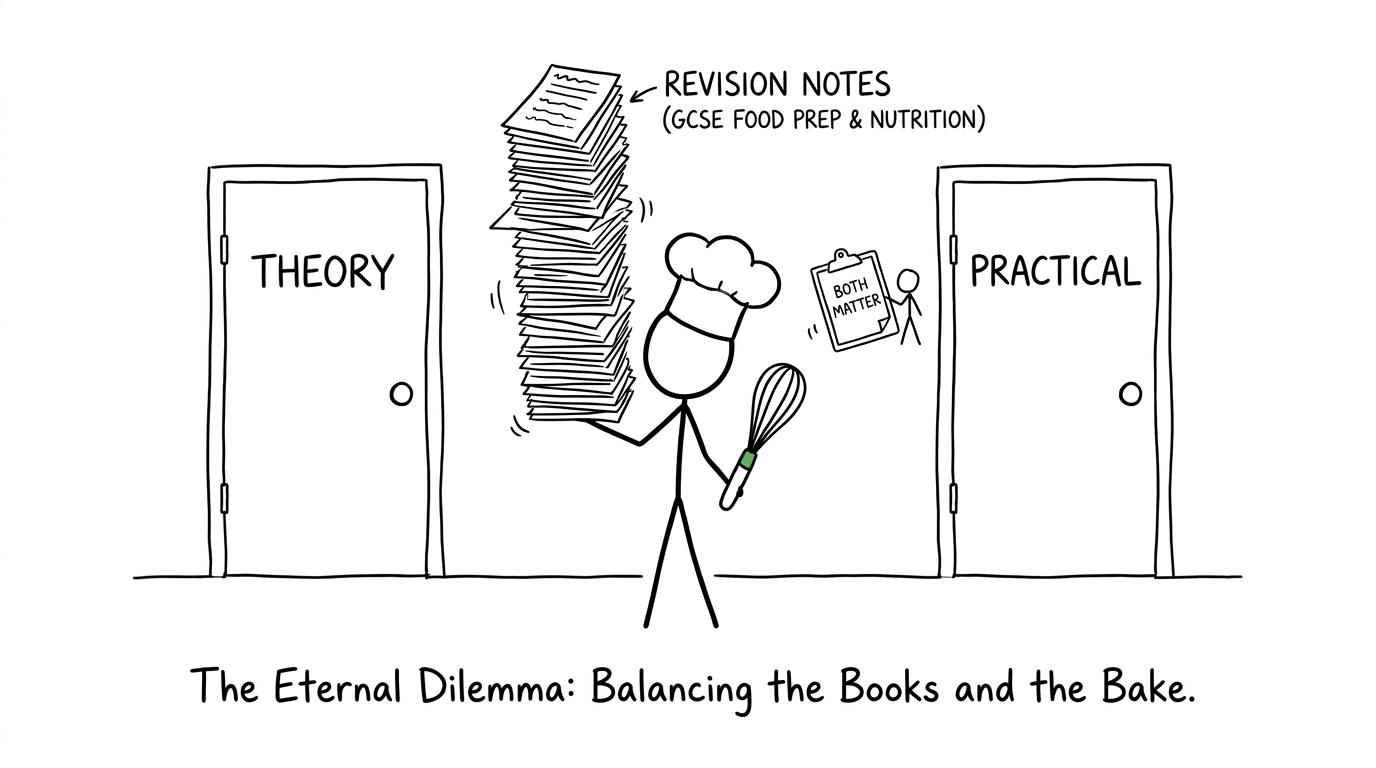 A student chef balancing theory notes and practical cooking
How the final Food Preparation and Nutrition grade is assessed
For current AQA, OCR and Eduqas GCSE Food Preparation and Nutrition specifications, the written examination contributes 50%50\%50% of the qualification and non-exam assessment contributes the other 50%50\%50%.
The precise component names, examination length and raw-mark arrangements vary by board, so students should always check their own specification. Broadly, the assessment has this structure:
| Assessment area | Typical weighting | What it measures |
|---|---|---|
| Written examination | 50%50\%50% | Knowledge, understanding, application, analysis and evaluation |
| Food investigation NEA | 15%15\%15% | Food science, investigation, evidence and conclusions |
| Food preparation NEA | 35%35\%35% | Planning, technical skills, practical execution and evaluation |
For example, AQA's written paper lasts 111 hour 454545 minutes and is worth 100100100 raw marks. Its two NEA tasks are worth 303030 and 707070 raw marks respectively. OCR also divides the qualification into a 50%50\%50% examination, a 15%15\%15% food investigation task and a 35%35\%35% food preparation task, although its examination and weighting arrangements differ. Eduqas uses the same broad 50%50\%50% examination and 50%50\%50% NEA balance.
This matters because the final result is an overall qualification grade. A student does not need a notional grade 9 in every separate component. Strong performance in one area can offset a weaker area, although consistently high marks make the final target more secure.
In general terms, the weighted result can be represented as:
overall mark=weighted examination mark+weighted NEA mark\text{overall mark}=\text{weighted examination mark}+\text{weighted NEA mark}overall mark=weighted examination mark+weighted NEA markNEA is marked by the centre and externally moderated according to the board's procedures. That is why careful evidence, authentic work and close attention to assessment criteria matter alongside the final food produced.
What grade 9 ability looks like in practice
The difference between a good response and an exceptional one is often not the amount written. It is the quality of the thinking.
Knowledge that can be applied
Grade 9 performance goes beyond recalling isolated facts. Students should be able to select relevant knowledge and use it in unfamiliar contexts. That may involve connecting dietary requirements to ingredient choices, explaining changes during cooking or considering food safety in a particular preparation process.
The principle is familiar from maths: knowing a formula is useful, but recognising when and why to use it is the deeper skill. The best order for learning GCSE maths topics follows the same progression from basic fluency towards application and exam technique.
Practical choices with reasons
A technically demanding dish does not automatically earn top marks. Choices must answer the task, demonstrate appropriate skills and be supported by a workable plan. Successful students understand why a technique is suitable, control the process safely and evaluate the result against relevant criteria.
Complexity without control is rarely impressive. A simpler decision, executed accurately and justified well, can provide stronger assessment evidence than unnecessary ambition.
Analysis rather than description
Description states what happened. Analysis explores why it happened and what the evidence suggests. Evaluation then judges the result, recognises limitations and proposes specific improvements.
This distinction is central to high-level performance. Comments such as “it tasted nice” are subjective and imprecise. Stronger evaluation refers to appropriate sensory qualities, nutritional aims, scientific expectations, trial results or the requirements of the brief.
How grade 9 compares with the old letter grades
The numerical and old letter scales do not have a complete one-to-one conversion. Ofqual established comparable points at three boundaries:
| Current GCSE boundary | Comparable old boundary |
|---|---|
| Bottom of grade 7 | Bottom of grade A |
| Bottom of grade 4 | Bottom of grade C |
| Bottom of grade 1 | Bottom of grade G |
Grades 7, 8 and 9 together provide more differentiation across the range previously occupied by grades A and A*. Grade 9 identifies the very highest attainment within that expanded top range.
It is common to describe grade 9 as a “high A*”, and that is a useful shorthand. However, it should not be treated as an exact conversion. There was no separate grade above A* under the old scale, and Ofqual does not provide a direct letter equivalent for every numerical grade.
The safest interpretation is this: a grade 9 represents performance at the very top of the present GCSE scale and above the minimum standard that would previously have secured an A*.
Why there is no fixed grade 9 percentage
Students understandably want one number: “What percentage do I need?” The difficulty is that the answer is not permanently fixed.
Exam boards set grade boundaries after the assessments have been taken and marked. Boundaries can vary between examination series because papers are not perfectly identical in difficulty. The aim is to keep the standard represented by the grade reasonably consistent, rather than making one raw percentage permanent.
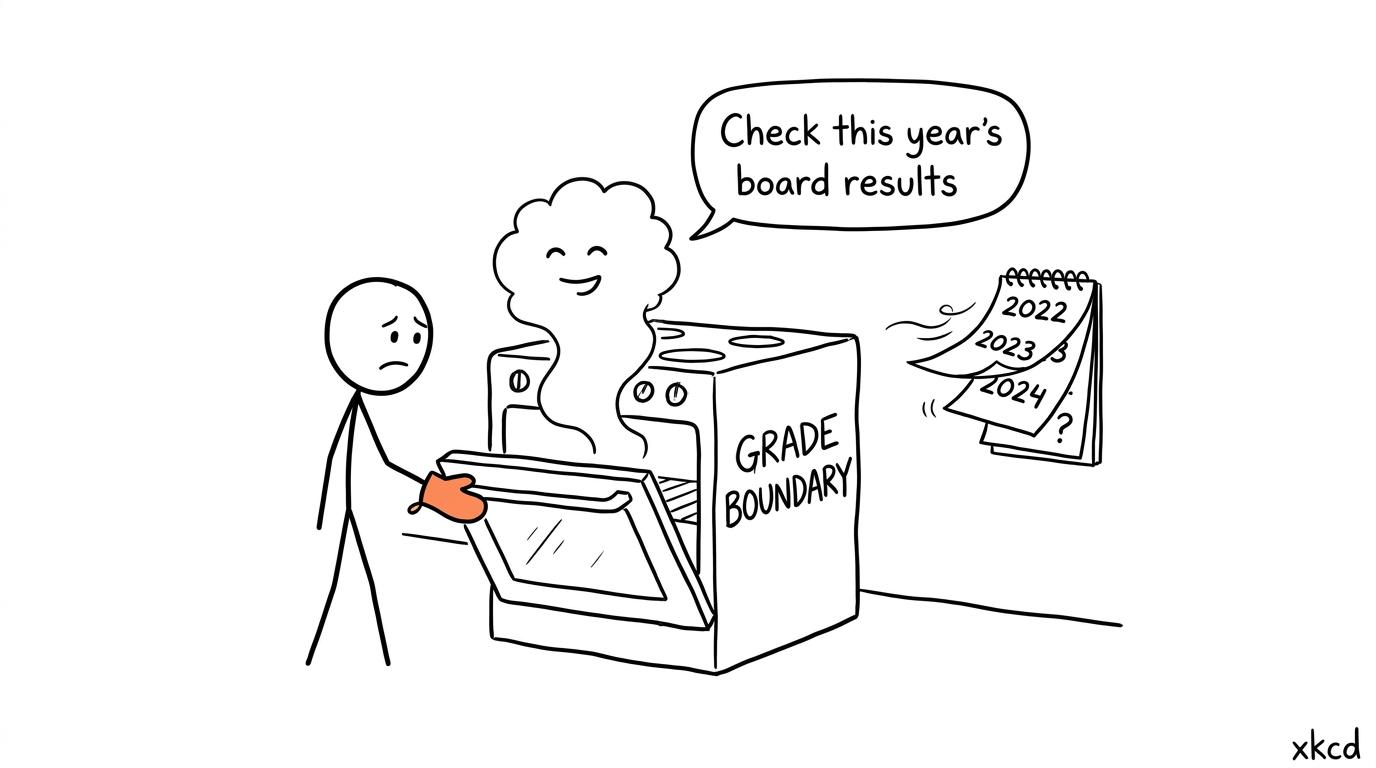 A student discovers that the grade-boundary oven changes each year
This leads to three sensible rules:
- Use historical boundaries only as a guide, not a promise.
- Do not assume that 90%90\%90% is automatically required because the top grade is 9.
- Focus on gaining as many marks as possible rather than trying to predict the exact boundary.
Past boundaries are useful for understanding broad standards, but the mark scheme gives more practical information. It shows what creditworthy knowledge, application and evaluation actually look like.
The same lesson applies in maths. Use GCSE predicted papers to rehearse likely demands, but use official-style past-paper practice to understand how marks are awarded. MathsGenie's guide to redoing GCSE past papers effectively explains how marking, repairing and retesting create progress.
The maths skills hidden inside Food and Nutrition
Food Preparation and Nutrition is not a maths qualification, but numeracy quietly appears throughout it. Students may need to interpret nutritional information, compare values, scale quantities, work with proportions, read graphs or use units accurately.
The central percentage relationship is:
percentage=partwhole×100\text{percentage}=\frac{\text{part}}{\text{whole}}\times 100percentage=wholepart×100Recipe scaling relies on proportional reasoning, while nutritional comparisons require attention to the stated basis, such as per serving or per 100 g100\text{ g}100 g. Data from an investigation is only useful when units, measurements and presentation are consistent.
If these skills feel uncertain, revisit GCSE percentages revision and use the GCSE maths topics by exam board and tier guide to find connected ratio, statistics and measures topics.
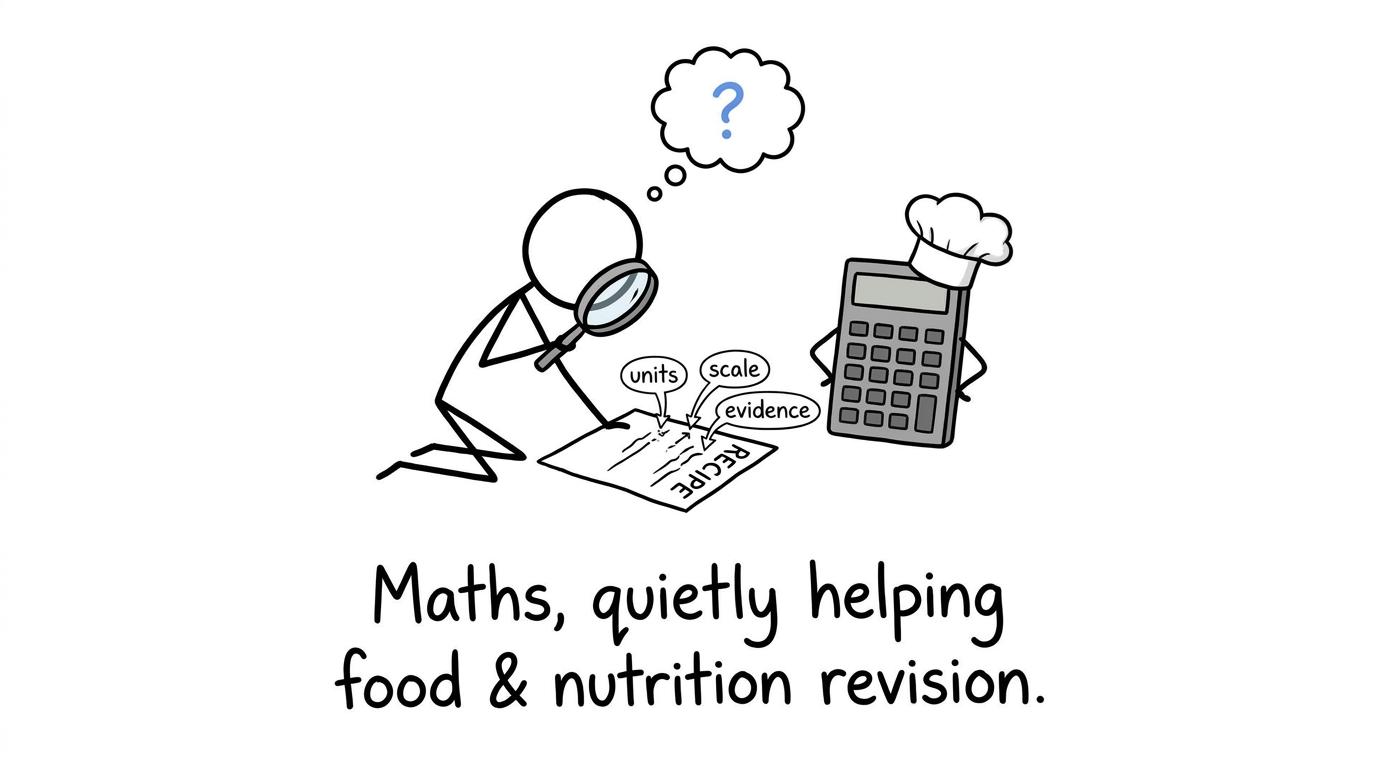 A calculator in a chef hat helps investigate hidden clues in a recipe
A sensible route towards top-grade performance
Grade 9 revision works best as a cycle rather than a final burst of memorisation.
- Check your exam board and read its current specification.
- Separate knowledge gaps from weaknesses in application or evaluation.
- Use mark schemes and teacher feedback to understand why marks were lost.
- Revisit weak content before attempting more questions.
- Practise concise explanations using accurate terminology.
- Review NEA decisions against the published assessment criteria.
- Complete timed written questions and improve them after marking.
- Keep maths skills such as percentages, proportion and data interpretation secure.
The GCSE one-month maths revision plan offers a useful learn, practise, mark and revisit structure that can support revision across subjects. For maths specifically, the weak-topic diagnostic approach helps turn lost marks into precise next steps.
Common mistakes when aiming for grade 9
Treating practical complexity as the whole assessment
An elaborate menu cannot replace weak planning, limited technical control or superficial evaluation. Every decision should serve the task and create useful evidence against the criteria.
Describing instead of explaining
Naming a nutrient, process or result may earn limited credit. Higher-level answers establish connections using clear reasoning: what happened, why it happened and why it matters in the stated context.
Assuming the boundary is always the same
A previous boundary is historical information, not a target guaranteed for the next series. Build a margin by pursuing every available mark.
Ignoring units and the basis of comparison
A value per serving is not automatically comparable with a value per 100 g100\text{ g}100 g. Measurements, graph scales and units must be read carefully before drawing conclusions.
Writing more instead of writing precisely
Long answers can still lack analysis. Strong responses select relevant knowledge, follow the command word and make each sentence contribute to the judgement or explanation.
Grade 9 is evidence, not perfection
The real meaning of a grade 9 in GCSE Food Preparation and Nutrition is not that every dish was flawless or every sentence sounded sophisticated. It means the combined evidence reached the highest standard recognised by the qualification: secure knowledge, thoughtful application, controlled practical work and convincing analysis.
That is also a useful way to approach maths. Do not chase the appearance of being a grade 9 student. Build the evidence one skill and one corrected mistake at a time.
Start at MathsGenie and combine free revision lessons with practice questions, mini tests and video solutions. Then use past papers, mark schemes and predicted papers to make your remaining gaps visible. A top grade is only one digit on results day, but the route towards it is much more practical: learn, practise, check, improve and repeat.