GCSE Food and Nutrition Grade 7 Meaning Explained
GCSE food and nutrition grade 7 meaning explained: understand the ability it represents, how assessment works and how it compares with an old grade A.
A result can look wonderfully precise while still leaving you unsure what it means. You open the envelope, see a grade 777, and immediately wonder whether it is good, how close it is to the old grades, and what it says about your actual ability.
The short answer to gcse food and nutrition grade 7 meaning is this: a grade 777 is a strong GCSE result. Its lower boundary is aligned with the lower boundary of the old grade A. It shows that your combined performance across the written examination and non-exam assessment demonstrated secure knowledge, capable practical work, effective application and thoughtful analysis.
It does not mean you achieved a fixed percentage, and it does not mean every part of your work was at exactly the same standard. It is an overall judgement based on your total weighted mark.
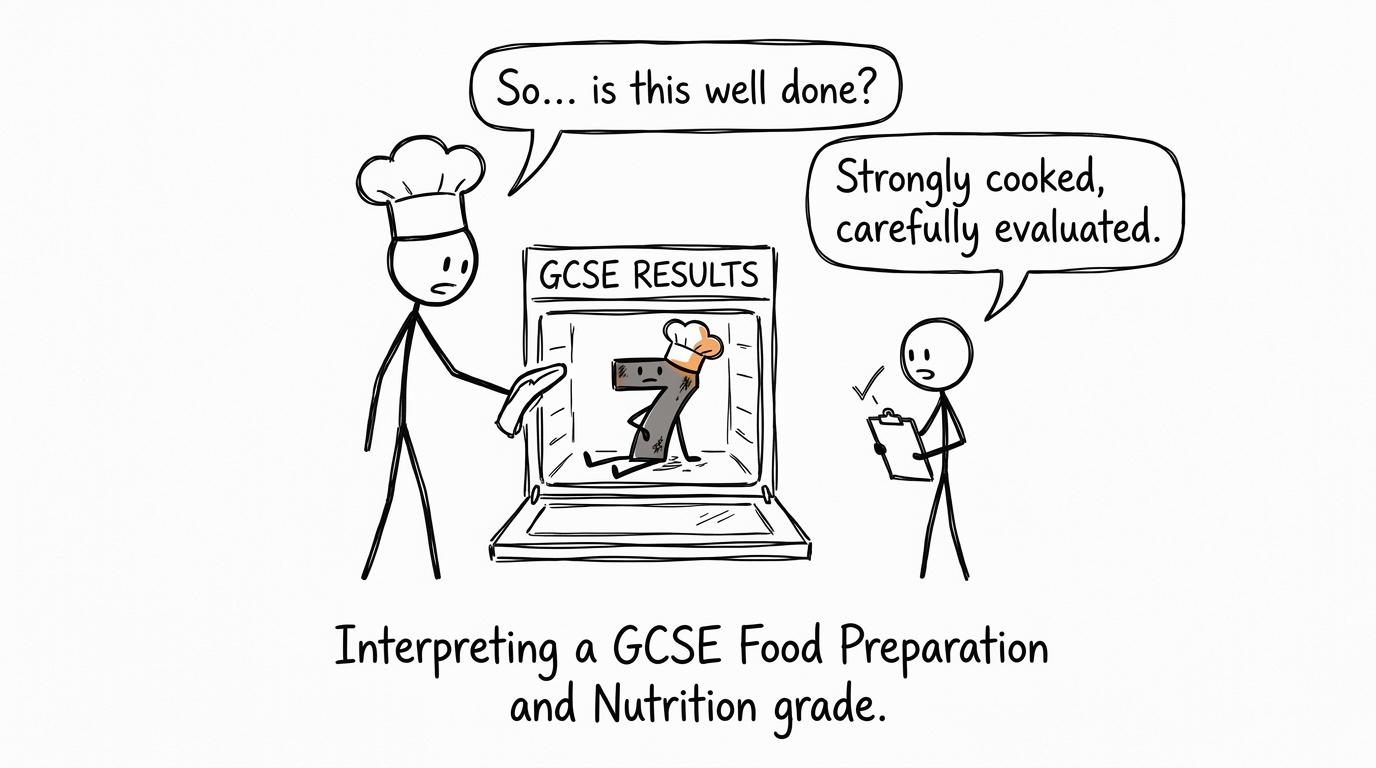 A student chef discovers what a GCSE grade 7 means
The meaning of a grade 7 at a glance
A grade 777 in GCSE Food Preparation and Nutrition generally means:
- you achieved a strong result near the upper end of the GCSE scale;
- the bottom of grade 777 is comparable with the bottom of the old grade A;
- you performed well across both theoretical and practical assessment;
- you could apply food science and nutrition knowledge rather than merely recall facts;
- you showed competent planning, preparation, cooking and presentation;
- you could analyse findings, justify decisions and evaluate outcomes;
- your grade came from the boundary for your exam board and examination series, not from a permanent percentage rule.
The qualification is usually called GCSE Food Preparation and Nutrition, although students often shorten this to Food and Nutrition or Food Technology.
What does the GCSE food and nutrition grade 7 meaning tell you about ability?
A grade is not a personality test. It cannot tell you that you are always an excellent cook, that every dish succeeded or that you remembered every nutrient. What it can do is summarise the standard of evidence produced across the course.
Across current AQA, OCR and Eduqas specifications, students are assessed through four broad abilities:
- demonstrating knowledge and understanding of food, nutrition, cooking and preparation;
- applying that knowledge in relevant situations;
- planning, preparing, cooking and presenting dishes using appropriate techniques;
- analysing and evaluating food, investigations and practical outcomes.
A grade 777 therefore represents more than confident factual recall. A student working at this level is likely to explain why ingredients behave as they do, connect nutritional choices to a given need, select suitable techniques and support conclusions with relevant evidence.
That final step matters. At lower levels, an answer may identify what happened. Stronger work explains why it happened and judges how the result could be improved.
Secure subject knowledge
You should be able to handle substantial content covering areas such as nutrition and health, food science, food safety, food choice, food provenance, commodities and preparation techniques. The organisation varies between specifications, so your own exam board document remains the definitive checklist.
Grade 777 performance does not require perfection. It does suggest that knowledge is sufficiently secure to be used across unfamiliar questions rather than reproduced only in familiar wording.
Effective practical performance
Practical ability is not judged solely by whether the final plate looks attractive. Assessment can consider planning, choice of dishes, technical skills, organisation, food safety, use of time, presentation and how well the finished menu meets the task.
A visually impressive dish cannot automatically compensate for weak planning or limited justification. Equally, one imperfect outcome does not automatically prevent a strong grade if the wider evidence demonstrates skill, understanding and honest evaluation.
Analysis rather than description
A food investigation produces observations, measurements and results. Strong work turns those results into a conclusion. It identifies patterns, relates them to the scientific properties of ingredients and considers the reliability or limitations of the investigation.
This is where mathematical confidence becomes surprisingly useful. Percentages, ratios, tables, graphs and averages help you communicate evidence clearly. MathsGenie's free lessons on fractions, decimals and percentages and averages can strengthen the numerical skills sitting underneath this analysis.
How grade 7 compares with the old letter grades
England's reformed GCSEs use grades 999 to 111, with grade 999 as the highest. The numerical and letter systems are not directly interchangeable at every point, so it is misleading to give each number one exact letter equivalent.
Official comparisons use key boundary points:
| Current GCSE grade | Comparison with the old scale |
|---|---|
| Grade 999 | The highest grade, providing greater differentiation above the old A* standard |
| Grades 999 to 777 | Together cover the region previously associated with A* and A |
| Bottom of grade 777 | Comparable with the bottom of old grade A |
| Bottom of grade 444 | Comparable with the bottom of old grade C |
| Bottom of grade 111 | Comparable with the bottom of old grade G |
The clearest summary is that grade 777 begins at the old grade A benchmark. It is reasonable to describe it as an A-level standard of GCSE performance in everyday conversation, but not as a perfect one-to-one conversion.
The new scale was designed partly to create more distinction among the highest-performing candidates. Grades 777, 888 and 999 divide the territory that used to be represented by A and A*.
If you are also thinking about your maths result, the same national comparison points apply. The MathsGenie GCSE maths revision hub lets you choose your exam board and build towards the grade you need with topic lessons, questions and papers.
How the final Food Preparation and Nutrition grade is formed
For the current AQA, OCR and Eduqas qualifications, the broad assessment balance is:
- a written examination worth 50%50\%50% of the qualification;
- non-exam assessment, usually called NEA, worth the remaining 50%50\%50%;
- within the NEA, a food investigation worth 15%15\%15% overall;
- a food preparation assessment worth 35%35\%35% overall.
The exact component names, examination timings, raw marks and administrative arrangements differ by board. Always check whether you are following AQA, OCR or Eduqas rather than borrowing details from another specification.
The course is linear, so the evidence is brought together for the final qualification. Teacher-marked NEA is externally moderated, while the written paper is externally marked.
This balance explains why grade 777 represents a broad form of ability. Half of the qualification depends on the written examination, but practical and investigative work carries equal overall weight. A student cannot sensibly revise only recipes or only theory and assume the other half will take care of itself.
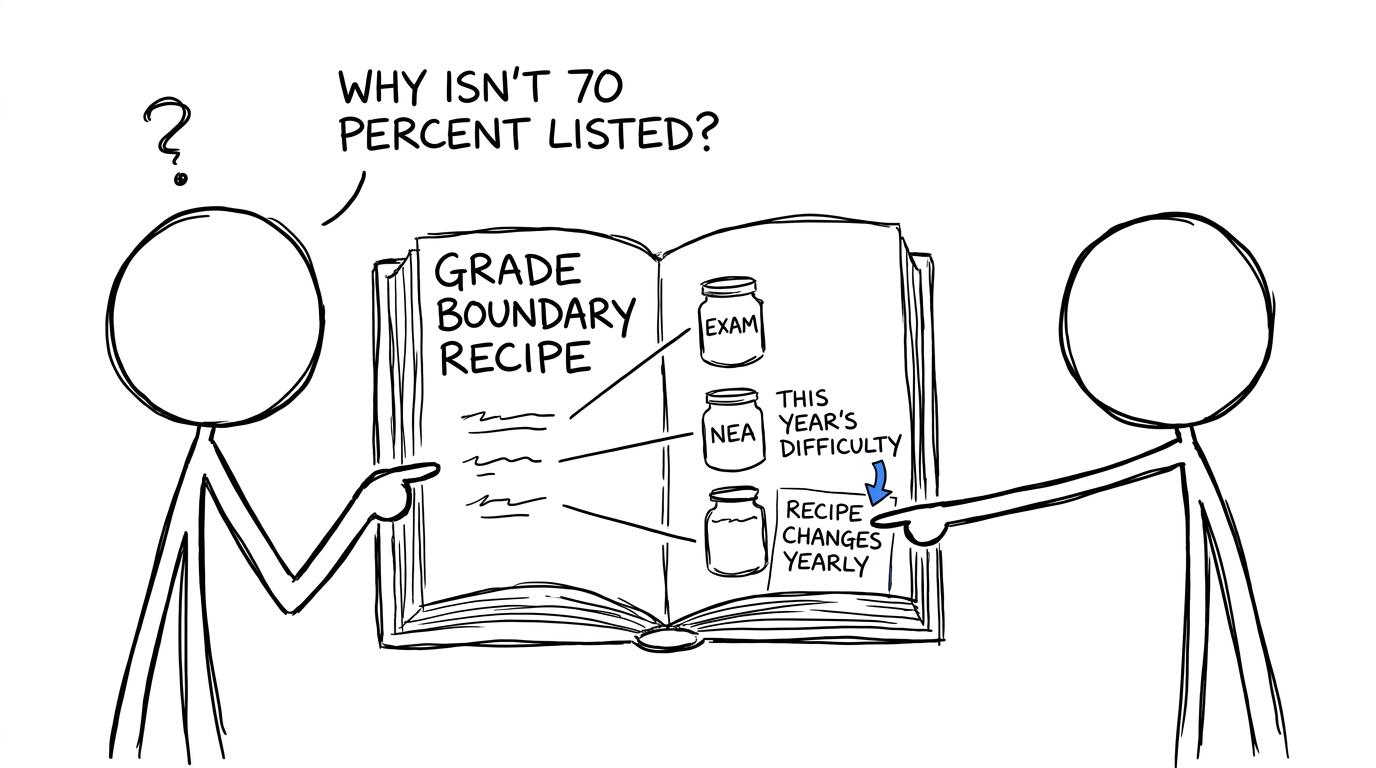 Students discover that the grade-boundary recipe changes
Why a grade 7 is not a fixed percentage
One of the most persistent GCSE myths is that a particular percentage always produces a particular grade. It does not.
Exam boards set grade boundaries after papers have been marked. Boundaries can move to reflect differences in paper difficulty while maintaining the expected standard between examination series. The minimum raw mark for grade 777 can therefore vary by year and exam board.
Your final outcome depends on your combined weighted performance. A strong NEA can support the overall result, but it does not make the examination irrelevant. The reverse is also true.
Past boundaries are useful for interpreting an old paper, but they are not promises about a future series. Treat them as historical reference points rather than predicted targets.
This is the same principle students meet when using GCSE predicted papers for maths. Predicted papers help expose gaps and improve technique; they cannot guarantee the exact content or boundary of the real examination.
What separates grade 7 work from merely knowing the content?
The distinction is often found in the quality of decisions.
A weaker response may name a cooking method. A stronger response selects a method suited to the ingredients, nutritional requirement and intended result, then justifies that selection. A weaker investigation may list results. A stronger one identifies a pattern, uses food science to explain it and evaluates whether the evidence supports the conclusion.
Think of the progression as a set of questions:
- What do I know?
- Where does that knowledge apply?
- Why is this choice appropriate?
- What does the evidence show?
- How reliable is the conclusion?
- What would I improve and why?
This approach also strengthens extended written answers. Relevant terminology matters, but terminology without a clear chain of reasoning rarely creates a convincing explanation.
Maths skills that support a strong Food and Nutrition grade
Food Preparation and Nutrition is not a maths GCSE, but several familiar numerical skills appear naturally within it:
- scaling ingredient quantities using ratio and proportion;
- interpreting nutritional information and reference values;
- calculating percentages or comparing quantities;
- recording measurements consistently;
- finding averages from repeated trials;
- presenting investigation results in tables and graphs;
- judging whether differences are meaningful or may reflect inconsistency.
The aim is not to add complicated mathematics where it is unnecessary. It is to make evidence accurate and readable. Units, labels, sensible scales and appropriate precision all help.
If these skills feel uncertain, start with the full GCSE maths topic map, then use MathsGenie's lessons and practice questions to repair the particular gap. The guide to finding your weakest GCSE topics provides a practical way to diagnose recurring errors rather than revising everything equally.
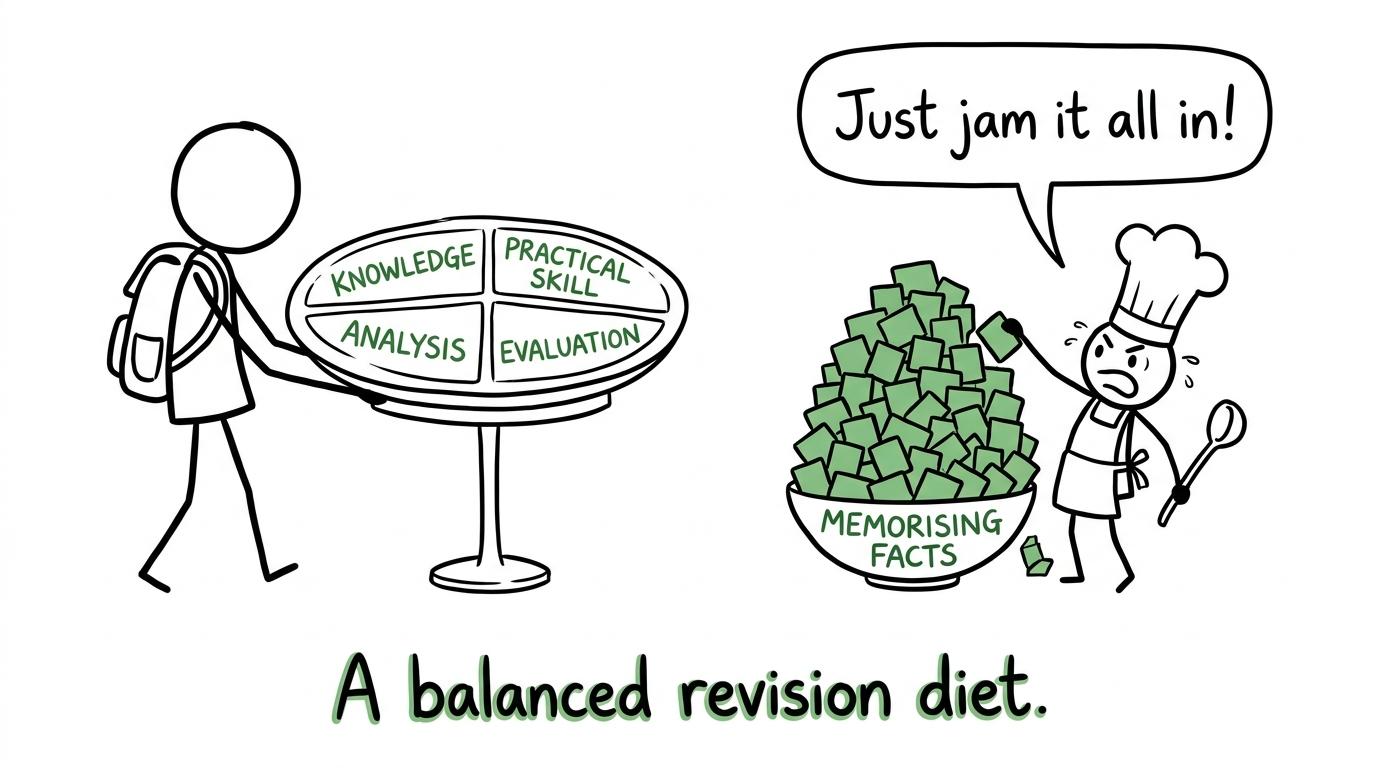 A balanced revision diet of knowledge, skill and evaluation
A focused checklist for aiming at grade 7
Use this checklist alongside your specification and teacher feedback:
- Learn the required nutrition, food science, safety, choice and provenance content.
- Practise applying facts to particular people, dietary needs and food contexts.
- Use accurate subject terminology, but always connect it to the question.
- Plan practical work around the task rather than choosing dishes for appearance alone.
- Demonstrate a suitable range of techniques safely and independently.
- Record investigation variables, observations and results clearly.
- Analyse evidence rather than repeating what a table already shows.
- Evaluate specific strengths and limitations, then propose justified improvements.
- Read command words carefully and match the depth of your answer to the available marks.
- Review feedback from both written assessments and NEA preparation.
For your wider exam preparation, MathsGenie's one-month GCSE maths revision plan shows how to combine retrieval, focused practice and timed papers without turning every evening into an unfocused revision marathon.
Common mistakes when interpreting or targeting grade 7
Assuming grade 7 always requires the same percentage
Boundaries change between examination series. Do not build your revision around an unofficial universal percentage.
Treating grade 7 as an exact old A
The bottom of grade 777 is aligned with the bottom of the old A boundary. The full numerical scale does not map neatly onto individual letters.
Focusing only on the final dishes
The practical outcome matters, but so do planning, technical execution, nutrition, justification, food safety and evaluation. Follow the assessment criteria rather than judging work through appearance alone.
Describing results without explaining them
Repeating that one sample was firmer, larger or more highly rated is description. Analysis connects the observation to relevant food science and the purpose of the investigation.
Using another exam board's details
AQA, OCR and Eduqas share the broad 50%50\%50% examination and 50%50\%50% NEA structure, but timings, marks, wording and component arrangements can differ. Use the correct specification and mark scheme.
Revising comfortable topics repeatedly
Familiar revision feels productive because it is easy. Improvement usually begins with the errors you would rather avoid. Maths students can use MathsGenie's guide to the best order for learning GCSE topics to turn the same principle into a structured plan.
A grade is evidence, not a limit
A grade 777 in GCSE Food Preparation and Nutrition is a strong achievement. It begins at the benchmark associated with the old grade A and reflects capable performance across knowledge, application, practical work, analysis and evaluation.
Still, the number is a summary, not the whole story. The useful question is not simply, “Am I a grade 777 student?” It is, “Which evidence would make my next answer, investigation or practical decision stronger?”
Apply that same calm question to maths. Begin at the MathsGenie GCSE revision hub, learn weak topics through free revision lessons, practise with exam questions and mini tests, then test your progress using past papers, predicted papers, mark schemes and video solutions. Strong grades are rarely built by one dramatic revision session. They are built by noticing the next correct step and taking it.