GCSE Food and Nutrition 6 to 9: A Practical Guide
GCSE food and nutrition 6 to 9: build deeper knowledge, precise practical evidence, stronger evaluation and an exam-ready revision routine.
A grade 6 often means you know a good deal about food, nutrition and cooking. The difficulty is that a grade 9 asks you to do more with that knowledge. You must apply it precisely, connect cause to effect, choose demanding practical skills and evaluate evidence rather than simply describe what happened.
That is the central answer for anyone searching for a GCSE food and nutrition 6 to 9 strategy: stop treating improvement as a matter of learning more isolated facts. Build accurate knowledge, then make every fact earn its place through application, analysis or justification.
There is no single number of marks that always guarantees a particular grade. Grade boundaries can change between exam series and specifications. Nor is there an official descriptor for every individual grade: published GCSE subject descriptors use benchmark grades, including grades 8, 5 and 2. Nevertheless, they reveal what higher-level performance looks like: comprehensive knowledge, precise and sophisticated practical work, and critical evaluation supported by evidence.
Your grade 6 to 9 checklist
The most useful changes are specific:
- replace broad statements with accurate food-science explanations;
- connect nutrients and food choices to the person or context in the question;
- explain why ingredients behave as they do;
- select practical techniques for complexity, suitability and control;
- collect useful evidence during investigations;
- analyse patterns instead of narrating results;
- justify conclusions and improvements;
- practise timed exam answers with the correct command word;
- use calculations, tables and graphs accurately.
A grade is not transformed by one spectacular answer. It usually changes through fewer vague explanations, fewer unsupported conclusions and fewer avoidable errors across the whole course.
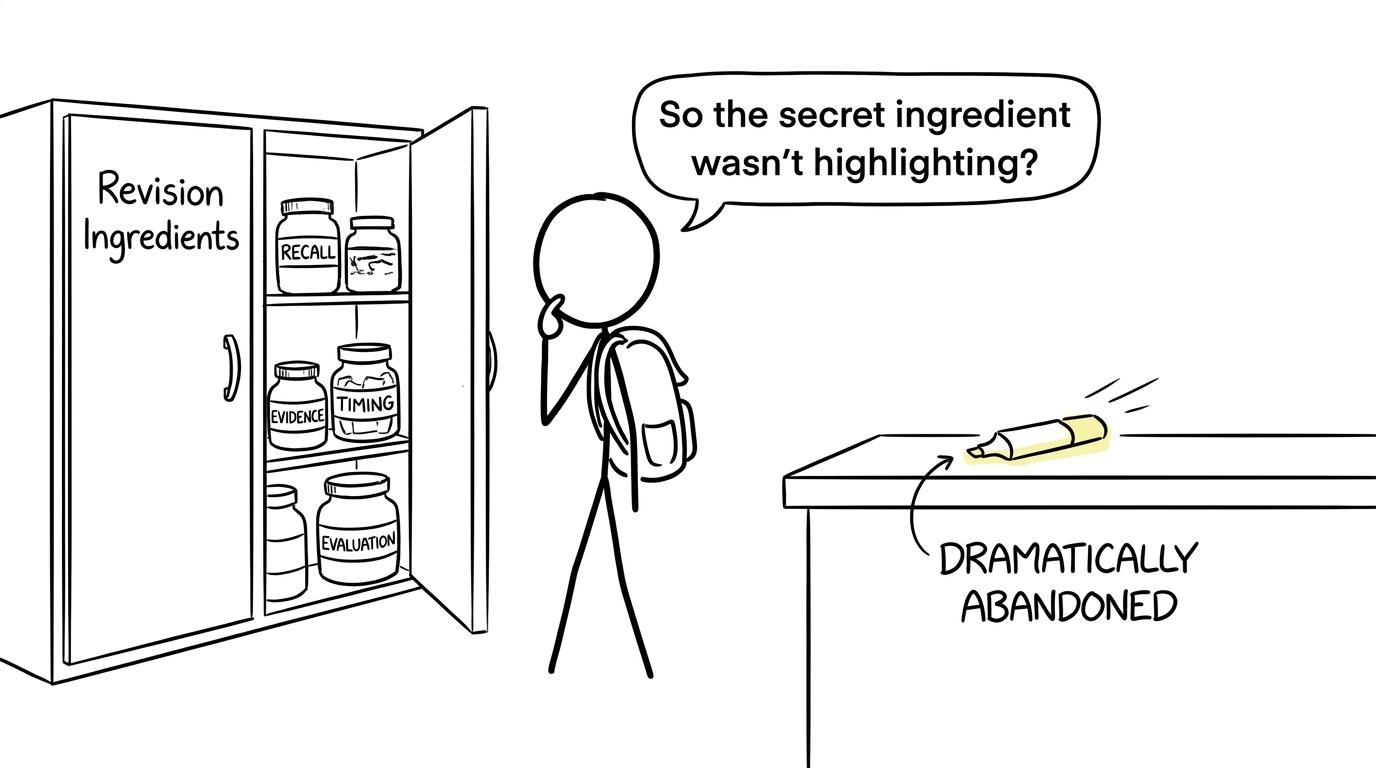 A student discovers that recall, evidence, timing and evaluation are the real revision ingredients
What separates a grade 6 from a grade 9?
A student working around grade 6 may show mostly accurate knowledge, competent practical skills and coherent analysis. Those are real strengths. However, the response may become general when detail is needed: a nutrient is identified but its function is not applied, a practical result is described but not explained, or an improvement is suggested without showing why it would make the evidence better.
Performance near the top of the grade range is more controlled. Knowledge is broad but also relevant. Technical vocabulary is accurate. Practical decisions are justified before, during and after cooking. Evaluation recognises limitations and draws conclusions that follow from the evidence.
| Grade 6 tendency | Grade 9 direction |
|---|---|
| States a correct fact | Selects the most relevant fact and applies it |
| Describes what happened | Explains why it happened using food science |
| Identifies a suitable dish | Justifies suitability for the task and user |
| Uses several practical skills | Uses demanding skills precisely and safely |
| Gives a conclusion | Gives a conclusion supported by results |
| Suggests a general improvement | Explains how a controlled change improves validity or reliability |
| Revises whole topics | Diagnoses and repairs narrow weaknesses |
The difference is not longer writing for its own sake. Concise scientific reasoning can be stronger than a page of repetition.
Understand where the marks come from
Across regulated GCSE Food Preparation and Nutrition qualifications, the assessment objectives have common weightings:
- AO1: knowledge and understanding, 20%20\%20%;
- AO2: application of knowledge and understanding, 30%30\%30%;
- AO3: planning, preparation, cooking and presentation, 30%30\%30%;
- AO4: analysis and evaluation: 20%20\%20%.
The qualification is split equally between examination and non-exam assessment, so the written exam contributes 50%50\%50% and the NEA contributes 50%50\%50%. Exact paper timings, task mark totals and administrative arrangements depend on the specification, so check the current information for your own board, such as AQA, OCR or Eduqas, and follow your teacher's instructions for live NEA tasks.
This weighting exposes a common weakness in grade 6 revision. Memorising notes mainly strengthens AO1, yet AO1 represents only 20%20\%20% of the qualification. Knowledge is essential, but most marks require you to apply, perform, analyse or evaluate.
Turn knowledge into chains of reasoning
Build explanations around a clear chain:
property or nutrient →\rightarrow→ process or function →\rightarrow→ observable effect →\rightarrow→ relevance to the question
For food science, that may involve explaining how heat, mechanical action, acidity or an ingredient changes structure, texture, colour or volume. For nutrition, it means linking a nutrient to its function and then to the needs of the named person or group.
Avoid memorising impressive terms without relationships. Examiners reward understanding, not a technical-word collection.
Make the written exam more precise
Higher-grade answers respond closely to command words.
- State requires a brief, accurate fact.
- Describe requires relevant characteristics or a clear account.
- Explain requires reasons and linked consequences.
- Analyse requires you to examine information, relationships or effects.
- Evaluate requires a supported judgement considering strengths, weaknesses or alternatives.
- Justify requires reasons showing why a choice is appropriate.
Before writing, identify the topic, command word, context and available marks. A question about a teenager, older adult, dietary requirement or food manufacturer needs an applied answer. A generic paragraph copied from memory may be scientifically correct but still fail to address the context.
For longer responses, plan a small number of distinct points. Develop each one fully, then finish with a judgement when the command word requires it. Do not give six versions of the same idea.
Use past questions from your own exam board because wording and paper structure differ. The broader MathsGenie past-paper approach is useful here: work under time pressure, mark honestly and record what caused each lost mark. Predicted material can support practice, but it cannot guarantee the content of a future examination, as the guide to using predicted topics without guessing explains.
Raise the standard of your NEA
High-level NEA work is not simply polished presentation. It shows that decisions grew from research, results and the task.
Design investigations that answer a focused question
Change one meaningful independent variable, identify what will be measured and control other important conditions. Measurements should be relevant and repeatable. If appropriate, repeated results can be summarised using a mean:
mean=total of resultsnumber of results.\text{mean}=\frac{\text{total of results}}{\text{number of results}}.mean=number of resultstotal of results.Graphs and tables should make patterns easier to detect, not merely decorate the report. Strengthen these transferable skills with MathsGenie's averages practice and scatter graph revision.
When evaluating, distinguish reliability from validity. Repeating a test may help you identify inconsistent results. Controlling variables helps ensure that the change you observe is attributable to the factor being investigated. Neither idea should be claimed automatically: explain how it applies to your method.
Make practical choices visible
Choose dishes and techniques because they suit the brief and let you demonstrate control. Complexity is not the same as unnecessary decoration. A demanding process completed precisely is more persuasive than several ambitious elements executed poorly.
Planning should account for sequencing, food safety, dovetailing, equipment and presentation. During practical work, follow the task rules and your teacher's supervision. Photographic and written evidence should clearly show your own progress and the skills being assessed.
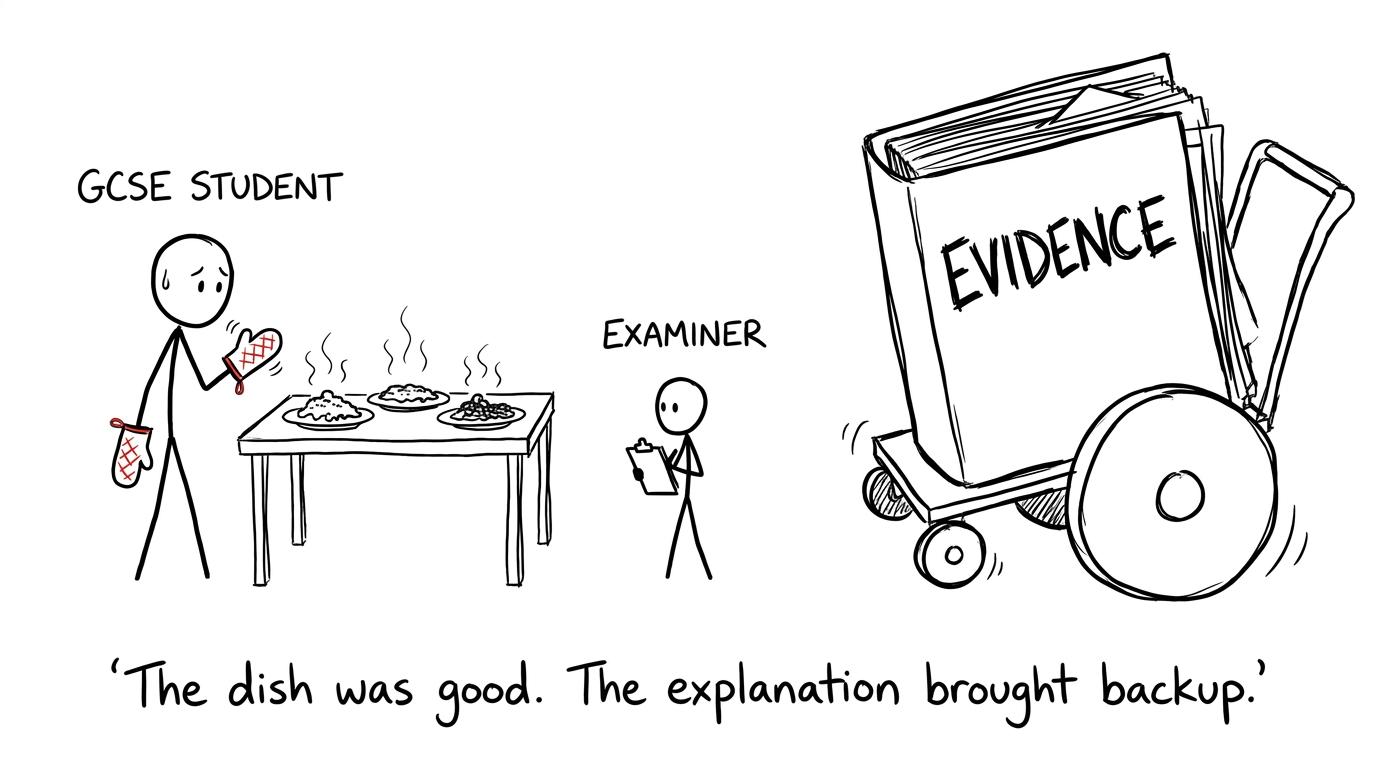 A strong explanation arrives to support a carefully prepared dish
Use maths to strengthen food and nutrition answers
Food preparation naturally uses proportion, percentages, measurement and data. Small calculation errors can weaken an otherwise strong investigation or plan.
For recipe scaling, use a scale factor:
scale factor=required number of portionsoriginal number of portions.\text{scale factor}=\frac{\text{required number of portions}}{\text{original number of portions}}.scale factor=original number of portionsrequired number of portions.Multiply every ingredient quantity by the same factor and retain the correct unit. The MathsGenie ratio revision guide helps with proportional thinking, while the GCSE maths topic map can direct you to percentages, graphs and statistics resources.
When comparing products or experimental results, check whether you are comparing equal masses, portions or sample conditions. A percentage can be calculated using:
percentage=partwhole×100.\text{percentage}=\frac{\text{part}}{\text{whole}}\times 100.percentage=wholepart×100.Always give units where needed and consider whether the result is sensible. A calculator answer is not evidence of sound reasoning if the wrong quantities were compared.
Build a revision routine that changes performance
Passive rereading feels fluent because the page is familiar. The exam, however, asks you to retrieve and apply knowledge without the page.
Use a repeating weekly cycle:
- retrieve one narrow topic from memory;
- check omissions against your specification or class materials;
- answer short and extended questions;
- mark them using the official mark scheme where available;
- classify each error as knowledge, application, command word, evidence or timing;
- rewrite one weak answer more precisely;
- revisit the same weakness several days later.
Create revision prompts around mechanisms and decisions: what changes, why it changes, what evidence would show it, and why it matters. This is more demanding than copying notes, which is precisely why it works as useful preparation.
If maths accuracy is one of your mark leaks, use the MathsGenie revision planner to schedule short sessions on ratio, percentages, averages and graphs. The best order for learning GCSE maths topics also provides a sensible sequence when several numerical skills need attention.
Common mistakes that keep students near grade 6
Describing instead of explaining
“The texture changed” reports an observation. A stronger response identifies the relevant process, explains what caused the structural change and connects it to the result.
Writing generic nutrition advice
Do not list nutrients without applying them to the person's age, activity, health, dietary requirement or life stage. Use only relevant claims and avoid presenting broad assumptions as facts.
Confusing complexity with quantity
More components do not automatically mean more marks. Technique selection, precision, independence, safety and the final result matter.
Evaluating from memory rather than evidence
A conclusion must follow the recorded results. Do not ignore anomalous findings or claim that a hypothesis was proven when the evidence only supports it.
Making vague improvements
“Be more accurate” is not an actionable improvement. Name the measurement, control or procedure that should change and explain how this would improve the investigation.
Losing control of units and proportions
Check conversions, serving sizes and graph scales. Use consistent units before comparing values, and show calculation steps so errors can be found.
From capable to exceptional
Moving from grade 6 towards grade 9 is not about becoming a different student overnight. It is about changing the quality of small decisions: selecting a relevant fact rather than every fact, explaining a mechanism rather than naming it, and allowing evidence rather than hope to shape a conclusion.
Start by auditing one recent exam answer or NEA practice task. Find the precise place where your reasoning stops. Then improve that link.
For the numerical skills supporting food investigations and recipe calculations, make MathsGenie your free revision base. Use revision lessons to rebuild methods, practice questions and mini tests to check them, and past papers, predicted papers, mark schemes and video solutions to make weaknesses visible. Grade 9 progress becomes far less mysterious when every lost mark gives you a specific next action.