GCSE English Literature Topics Breakdown
GCSE English Literature topics breakdown by exam board, with approximate weightings and a practical plan to focus revision where it can earn most marks.
Revision time rarely feels evenly distributed. One evening disappears into poetry quotations, while a maths paper waits unopened on the desk. The answer is not to revise every English Literature text for the same number of hours. This GCSE English Literature topics breakdown shows that most boards assess five broad areas: Shakespeare, a nineteenth-century text, a modern text, anthology poetry and unseen poetry. However, their weightings and question styles differ.
Your best strategy is to confirm your exam board, identify the areas carrying the most marks, and then give extra time to topics where your current performance is weakest. That protects your English Literature marks without allowing one subject to consume your entire GCSE revision timetable.
Your quick revision checklist
Before planning another English Literature session:
- Confirm whether you take AQA, Edexcel, OCR or Eduqas.
- Write down your exact set texts and poetry cluster.
- Check how many marks and how much time each section receives.
- Complete one question from every major area before deciding what is weak.
- Prioritise large, weak sections rather than revising favourite texts again.
- Practise analysis and essay planning, not just quotation recall.
- Keep protected sessions for maths and your other GCSE subjects.
The percentages below are based on the current published specifications. They are a guide to allocating time, not a prediction of which character, poem or theme will appear.
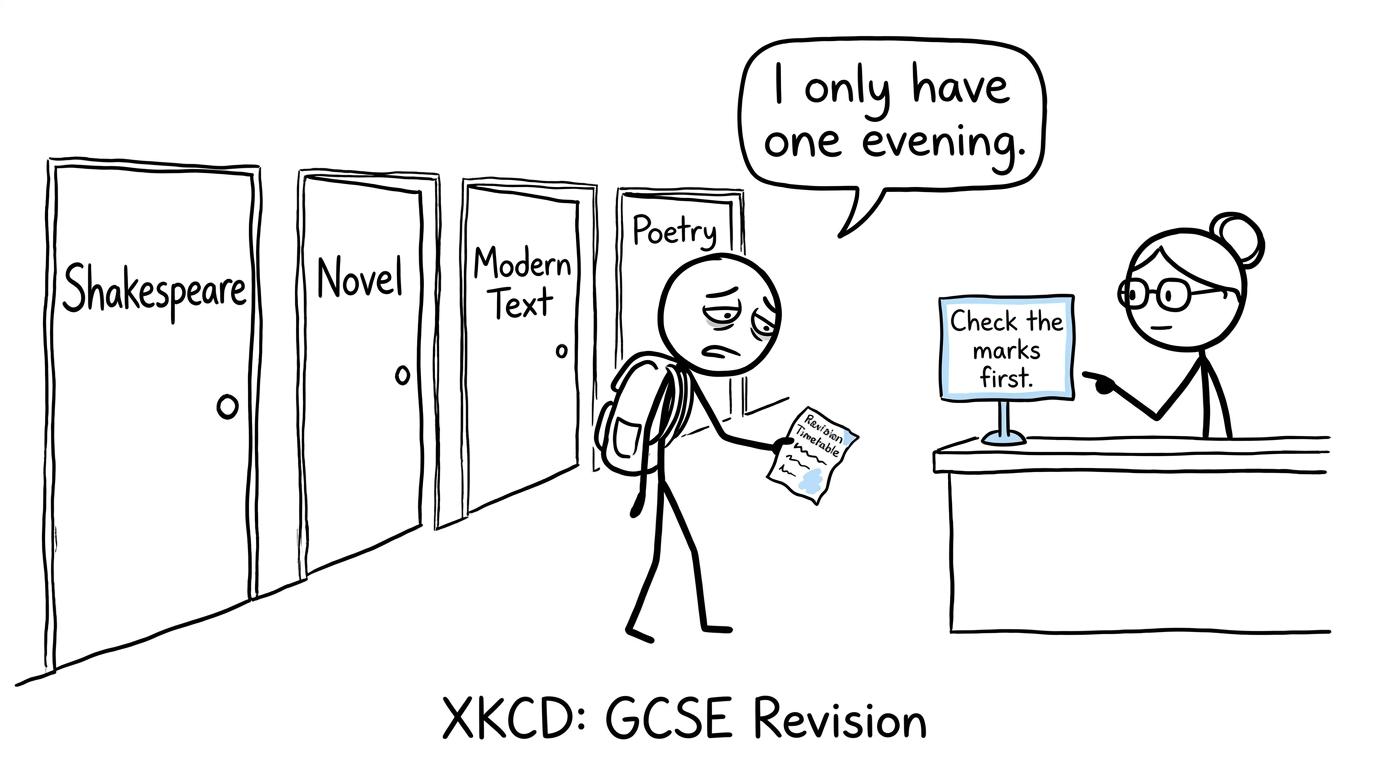 A student choosing between four English Literature revision doors while a librarian recommends checking the marks
GCSE English Literature topics breakdown by exam board
English Literature is not tiered into foundation and higher papers. Students on each board take the same qualification, although schools choose different set texts. Always match your revision to the specification and texts confirmed by your teacher.
| Exam board | Broad assessment structure | Approximate topic weighting |
|---|---|---|
| AQA | Shakespeare and nineteenth-century novel; modern text, anthology poetry and unseen poetry | Shakespeare 20%20\%20%; novel 20%20\%20%; modern text about 21%21\%21%; anthology poetry about 19%19\%19%; unseen poetry 20%20\%20% |
| Edexcel | Shakespeare and post-1914 literature; nineteenth-century novel, anthology poetry and unseen poetry | Shakespeare 25%25\%25%; modern text 25%25\%25%; novel 25%25\%25%; anthology poetry 12.5%12.5\%12.5%; unseen poetry 12.5%12.5\%12.5% |
| OCR | Modern prose or drama, nineteenth-century prose, poetry and Shakespeare | Each of the four areas is worth 25%25\%25% |
| Eduqas | Shakespeare and anthology poetry; post-1914 prose or drama, nineteenth-century prose and unseen poetry | Each of the five areas is approximately 20%20\%20% |
These figures explain why generic revision plans can be misleading. An Edexcel student has three individual texts worth approximately one quarter of the qualification each. An AQA or Eduqas student faces a more even five-way split. OCR gives equal weight to four broad areas, but its modern-text and poetry sections include comparison with unseen material.
AQA English Literature
AQA Paper 1 is worth 40%40\%40% and covers Shakespeare and the nineteenth-century novel. Paper 2 is worth 60%60\%60% and covers a modern prose or drama text, anthology poetry and unseen poetry.
That does not mean you should automatically spend 60%60\%60% of your revision time on Paper 2. It contains more separate material and is a longer paper. A better decision depends on your evidence. If your Shakespeare response is secure but unseen poetry repeatedly stalls, the unseen section deserves more immediate attention.
AQA students should also remember that the modern-text response includes marks for spelling, punctuation and grammar. Technical accuracy represents only a small proportion of the qualification, but it should not be treated as optional.
Edexcel English Literature
Edexcel divides the qualification equally between two components, each worth 50%50\%50%. Shakespeare, post-1914 literature and the nineteenth-century novel are each substantial areas. Together, they account for approximately 75%75\%75% of the GCSE.
Poetry still matters, but its structure changes the revision calculation. Anthology poetry and unseen poetry are each worth approximately 12.5%12.5\%12.5%. This makes secure knowledge of the three main set texts particularly valuable, while regular shorter poetry sessions can preserve comparison and analysis skills.
Do not interpret the smaller individual poetry percentages as permission to ignore them. A blank poetry response sacrifices marks unnecessarily, and unseen practice develops analytical skills that transfer to extract questions elsewhere.
OCR English Literature
OCR has two papers worth 50%50\%50% each. Across them, modern prose or drama, nineteenth-century prose, poetry and Shakespeare each carry approximately 25%25\%25% of the qualification.
This creates a simple starting point: divide content revision broadly into quarters. Then adjust according to performance. OCR also places significant emphasis on connections and comparison, including work with unseen material. Knowing a text is not enough if you cannot select evidence and connect ideas under exam conditions.
Eduqas English Literature
Eduqas Component 1 is worth 40%40\%40% and covers Shakespeare and anthology poetry. Component 2 is worth 60%60\%60% and covers post-1914 prose or drama, nineteenth-century prose and unseen poetry.
Each broad area contributes roughly 20%20\%20%. A balanced plan therefore works well initially, but equal exam weight does not necessarily mean equal revision need. Set texts require long-term knowledge, anthology poetry needs organised comparison routes, and unseen poetry needs repeated independent practice rather than memorisation.
Where should you spend the most revision time?
Marks matter, but marks alone do not make a revision plan. A large topic you already handle confidently may need maintenance, while a slightly smaller section where you regularly produce incomplete answers may offer faster improvement.
Use three factors:
- Weight: How much of the qualification does the area represent?
- Weakness: How many marks are you currently losing there?
- Transfer: Will improving this skill help elsewhere?
Language analysis, evidence selection and clear argument have high transfer value. Improving them can strengthen Shakespeare, prose and poetry responses at once. Across the four specifications, AO1 and AO2 together account for about 80%80\%80% of the qualification, or very close to it. Broadly, these objectives reward understanding, a supported response, and analysis of language, form and structure.
This is why another hour spent copying contextual facts may be less useful than planning two focused arguments and selecting evidence for each. Context matters, but it must illuminate the text and answer the question.
For a practical diagnosis, borrow the same evidence-led approach used in finding your weakest GCSE topics. Attempt a question, mark it carefully, name the weakness and revisit it later. The subject changes; the feedback loop does not.
A sensible way to divide your English revision
Begin with the exam weighting as your baseline. Then change it using recent timed work.
A useful weekly pattern is:
- one session on your weakest major set text;
- one session on a second set text or Shakespeare;
- one anthology poetry comparison session;
- one short unseen poetry response;
- one mixed session for quotation retrieval and essay planning.
Keep sessions specific. “Revise Macbeth” is too broad. “Plan two arguments about responsibility and retrieve six flexible references” gives you a finish line.
Set texts benefit from a compact bank of adaptable evidence connected to character, theme, structure and writer’s purpose. Poetry benefits from comparison routes: identify poems that connect through ideas but differ in voice, form or method. Unseen poetry benefits from timed reading, annotation and argument-building.
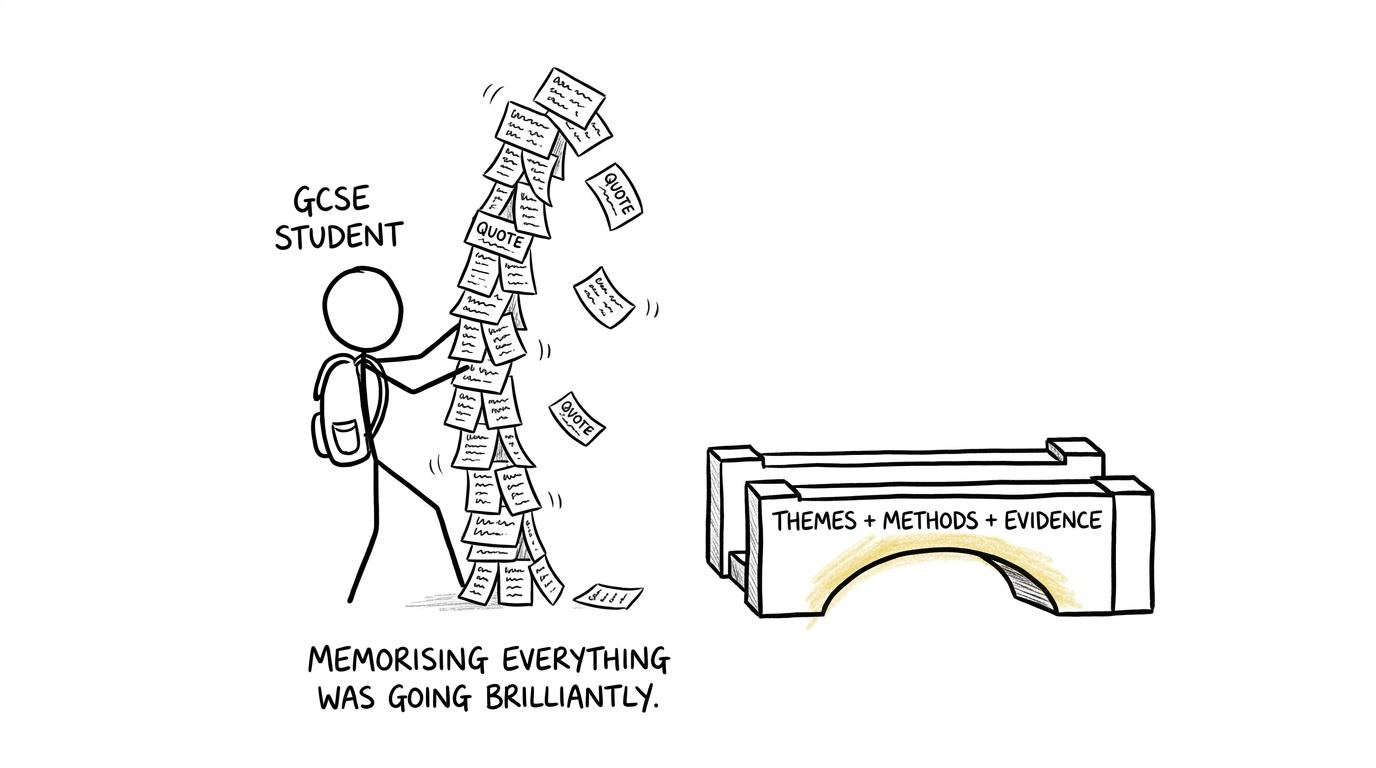 A wobbly tower of quotation cards beside a sturdy bridge built from themes, methods and evidence
Do not let English Literature displace maths
The hidden problem with Literature revision is that it can expand indefinitely. There is always another quotation, interpretation or contextual detail to learn. Maths gives clearer stopping signals: a set of questions is finished, marked and corrected.
Create those boundaries for English too. Use a timer and decide the output before starting: one essay plan, one timed paragraph or one quotation retrieval grid. Then switch subject.
For maths, begin at the GCSE Maths revision hub, where revision lessons and practice questions are organised by board and topic. A short Edexcel GCSE Maths mini test can sit neatly beside an English essay-planning session.
When longer practice is appropriate, use Edexcel GCSE Maths past papers under timed conditions. The guide to using mark schemes as a revision coach also explains a principle that works across subjects: marking should tell you what to do next, not merely what score you received.
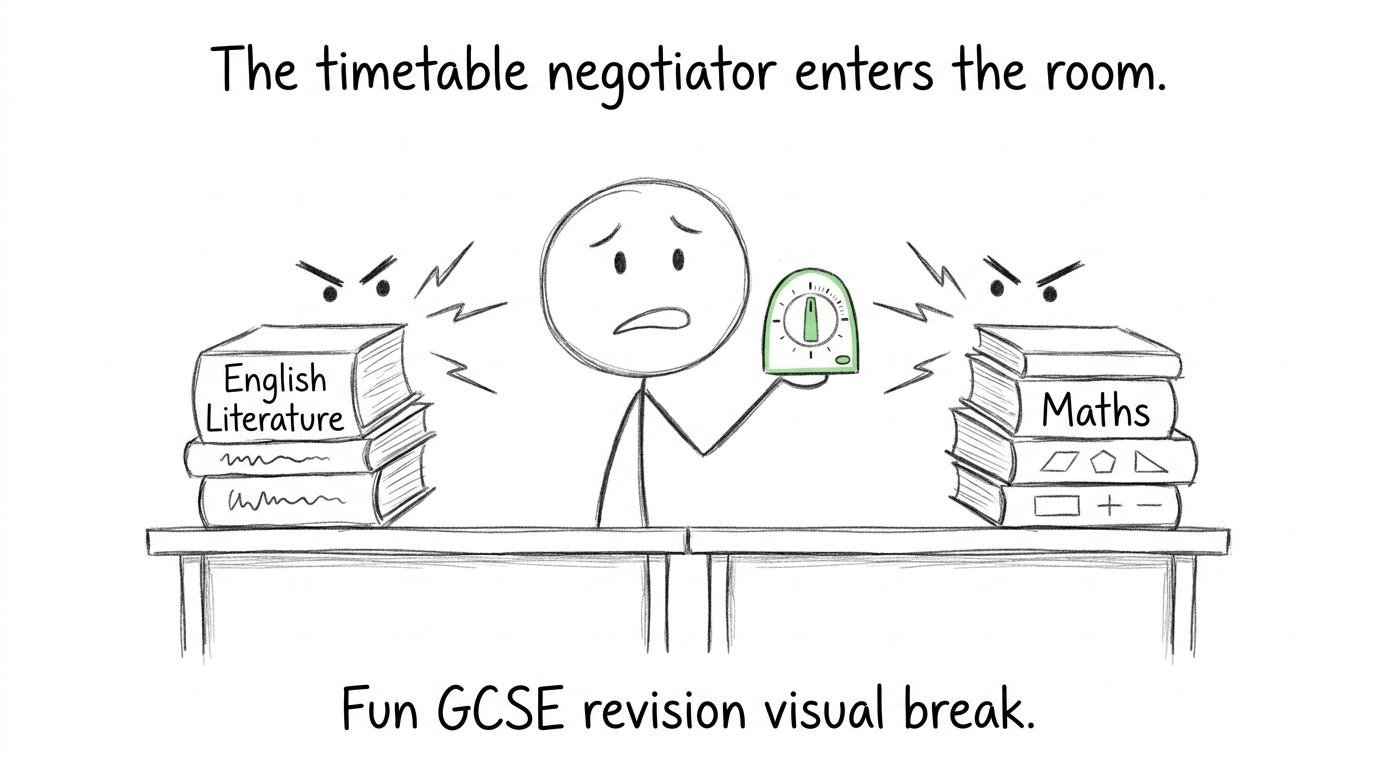 A student uses a timer between jealous piles of English Literature and maths revision
Common English Literature revision mistakes
Dividing time equally without checking the board
The broad content looks similar across exam boards, but the assessment structure is not identical. Edexcel gives more individual weight to its three main set texts, while OCR divides the qualification into four equal areas. Use your own specification, not a friend’s timetable.
Revising the favourite text repeatedly
Familiar revision feels productive because recall comes easily. It can also conceal the section where marks are leaking. Let timed answers and teacher feedback choose the next topic.
Memorising quotations without arguments
A quotation is evidence, not a complete interpretation. Connect each selected reference to several themes, methods or character developments. Small, flexible evidence banks are usually more manageable than pages of isolated lines.
Treating context as a separate history essay
Context should sharpen your interpretation of the text. Avoid attaching memorised facts that do not answer the question or explain the writer’s choices.
Ignoring unseen poetry until the final week
Unseen poetry cannot be memorised, but it can be practised. Regular short attempts build confidence in reading, selecting methods and forming a defensible interpretation quickly.
Completing answers without reviewing them
Use the relevant mark scheme and assessment objectives. Identify whether the main weakness was knowledge, analysis, evidence, comparison, relevance or timing. The same disciplined process is central to using Edexcel maths past papers properly.
Turn the breakdown into a workable plan
A topic breakdown is useful only when it changes the next revision session. Confirm your board, map the marks, test each area and give the next block of time to the largest genuine weakness. Keep quotation learning selective, practise unfamiliar questions and review every attempt against the assessment objectives.
Most importantly, keep the plan balanced. English Literature needs sustained reading and writing, but maths needs regular retrieval and problem-solving too. If exams are close, MathsGenie’s one-week GCSE maths revision plan can help organise that side of your timetable.
Make MathsGenie your free maths revision base: relearn methods through revision lessons, practise with topic questions and mini tests, and then test your progress using past papers, predicted papers, mark schemes and video solutions. Give every subject a defined job, and revision becomes less about doing everything and more about doing the next useful thing.