GCSE English Literature Group Chat Study Guide
GCSE English literature group chat study tips for retrieval, quotation checks and essay plans, without letting memes take over your revision time.
A class group chat can make revision feel productive long before anything has been learnt. Twenty messages arrive. Someone posts a Macbeth meme. Someone asks which paper is tomorrow. Everyone replies, yet nobody has tested what they can remember.
Effective GCSE English literature group chat study is different. Give the chat one clear task, ask everyone to recall before checking notes, correct mistakes promptly and finish with an individual piece of writing. The conversation should lead to evidence of learning, not merely evidence that everyone was online.
This matters when you are balancing English with maths revision. English Literature is untiered, while GCSE maths has foundation and higher tiers, but both subjects reward accurate knowledge, independent thinking and practice under exam conditions. Your chat should help with the first two without stealing time from the third.
The quick group chat revision checklist
Before the next session, agree to these rules:
- Keep the active revision group small, ideally around three to five people.
- Choose one text, theme, character or poem comparison.
- Set a start time, finish time and shared outcome.
- Answer from memory before opening notes.
- Label uncertain quotations rather than guessing confidently.
- Challenge ideas politely by asking for evidence.
- End with an individual paragraph or essay plan.
- Move unresolved questions to your teacher.
- Mute the chat when the session ends.
Small-group collaboration is more likely to help when everybody participates and works towards a shared outcome. A large class chat can still distribute prompts, but a smaller temporary revision group is usually easier to manage.
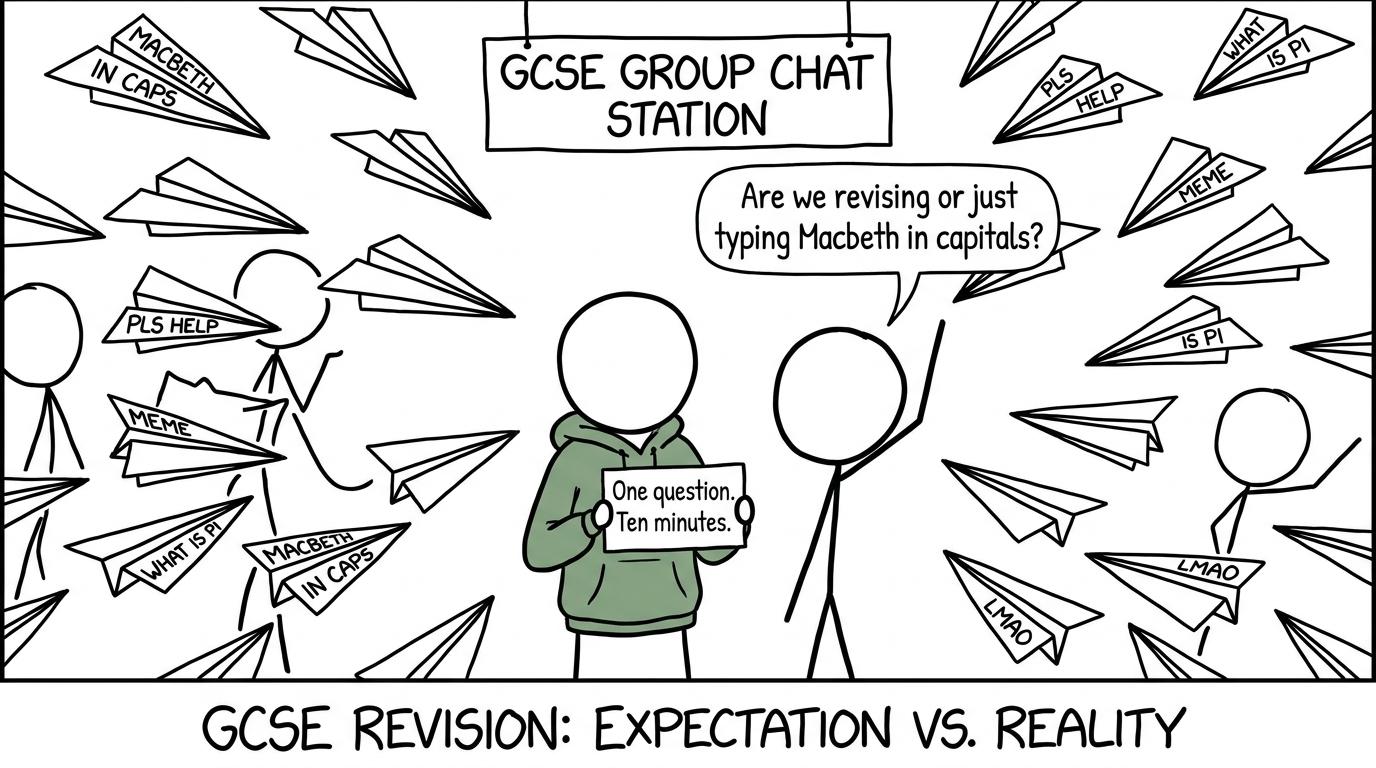 A chaotic class group chat becomes a focused ten-minute revision session
Give the chat a job before giving it your attention
A group chat without a task follows the easiest available path. Usually, that path is jokes, rumours or an argument about whether a quotation contains “the” or “a”. Structure changes the direction.
Post a session brief before starting:
- Focus: one precise area, such as responsibility in An Inspector Calls
- Task: retrieve five relevant moments, then choose the strongest three
- Output: one essay plan created individually
- Time limit: a short, fixed session
- Checker: one person verifies disputed details afterwards
Do not simply announce “Let’s revise English”. That is too broad to create action. A useful prompt asks for something observable: recall, selection, analysis, comparison or planning.
The same principle protects your maths schedule. If English chat notifications are cutting into planned practice, mute them while using the GCSE Maths Revision hub. Your timetable should decide what you revise next; the loudest notification should not.
Use retrieval rather than shared-note copying
Retrieval means attempting to recall something without looking at the answer first. Research on retrieval practice indicates that the attempt should involve genuine effort, be repeated after a delay and receive feedback. Copying a polished quotation list into the chat misses the most useful part: trying to remember.
Run closed-notes quotation rounds
The quizmaster posts a character, theme or moment. Everyone replies privately to themselves first, then sends one short quotation or precise textual reference. Only after all responses are posted should the group check the text or trusted class materials.
A useful response contains:
- the quotation or reference;
- where it appears;
- the idea it could support;
- one word, image or structural choice worth analysing.
Short quotations are often easier to use flexibly than large memorised passages. However, quotations are not ornaments. GCSE English Literature assessment objectives require students to respond to texts, support interpretations with textual references, and analyse language, form and structure. The important question is not just “Can we remember this?” but “What could it help us argue?”
If somebody recalls a quotation inaccurately, correct it clearly. Repeatedly retrieving an incorrect version can strengthen the mistake, which is why feedback matters.
Revisit difficult prompts later
Do not retire a question because everyone answered it once. Save the prompts that caused hesitation and post them again after a gap. This turns the chat into a simple spaced-revision system rather than an archive nobody rereads.
That rhythm transfers neatly to maths. MathsGenie’s guide to finding your weakest GCSE topics uses the same principle: diagnose a gap, practise it, then retest it instead of assuming one successful attempt has fixed it.
Turn opinions into exam-ready interpretations
Literature discussions become useful when ideas move beyond agreement. “Lady Macbeth is powerful” may begin a conversation, but it is not yet a developed interpretation.
Ask four follow-up questions:
- What moment supports that claim?
- Which word, form or structural choice matters?
- Is there another plausible interpretation?
- How does the idea change elsewhere in the text?
This reflects the assessment objectives shared across GCSE English Literature specifications. Students must understand and respond to texts, analyse writers’ methods, consider relevant relationships between texts and contexts, and write accurately. Exact question formats and assessment-objective weightings vary, so check the current specification for AQA, Edexcel, OCR or Eduqas rather than trusting a forwarded screenshot.
Context should illuminate the text, not replace analysis. A message containing a historical fact is useful only if the group can explain how it sharpens an interpretation of the writer’s choices or ideas.
Give everyone a role
Unstructured collaboration can allow one confident person to produce all the ideas while everyone else reacts with a thumbs-up. Roles create responsibility.
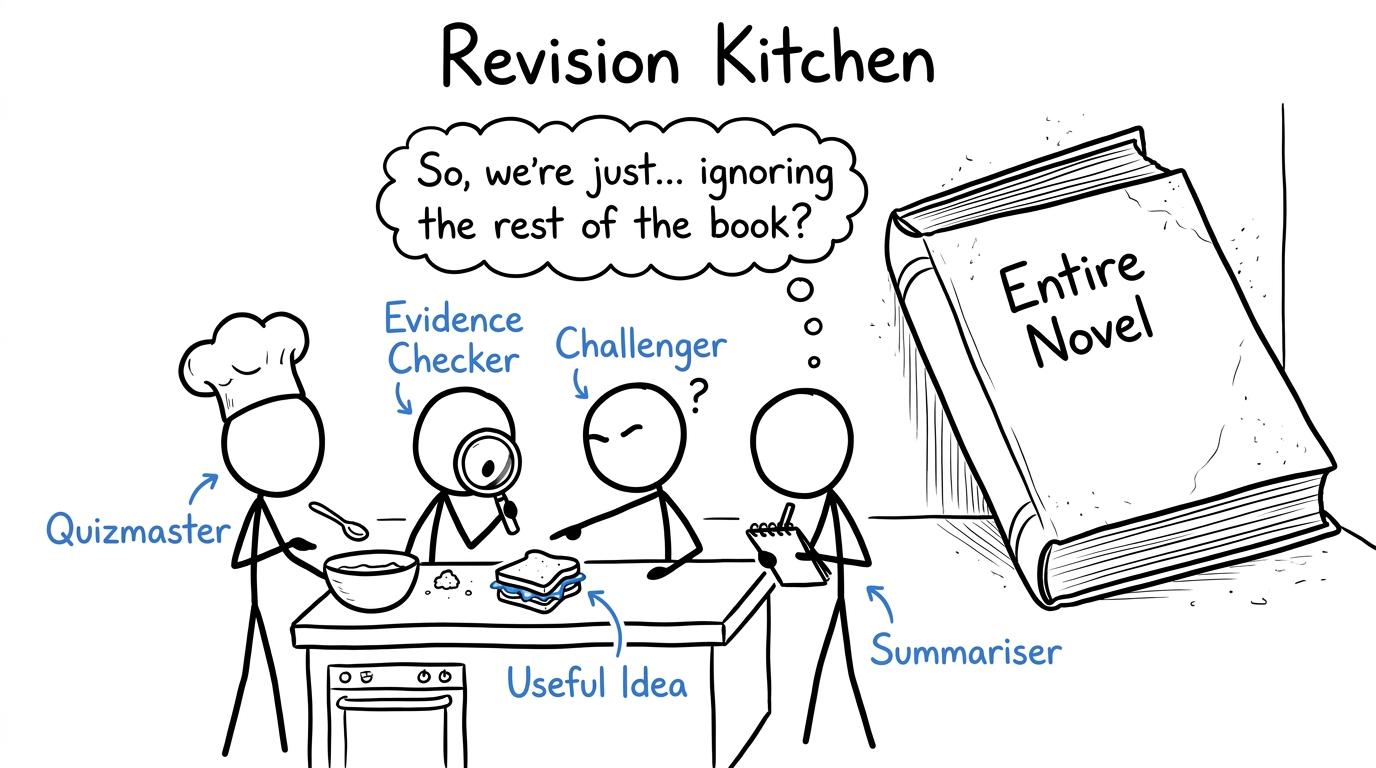 Four group-chat roles prepare one useful idea instead of consuming the entire novel
Quizmaster
Posts closed-notes prompts and keeps the session moving. Questions should include both recall and analysis, not just plot facts.
Evidence checker
Checks quotations, speaker, location and relevant exam-board information against the text, school materials or current specification. This person should flag uncertainty rather than pretend to know.
Challenger
Politely tests interpretations: “What evidence supports that?”, “Could the reader see this differently?” or “Are you analysing the writer rather than retelling the plot?”
Summariser
Ends the session with the agreed insights, unresolved questions and next task. This is not permission for everyone else to avoid taking their own notes.
Rotate the roles. Explaining, checking and questioning are all valuable forms of practice, and no student should become the permanent supplier of answers.
Use the chat to start writing, not avoid it
Conversation feels easier than an empty page. That is precisely why it can become a hiding place.
After discussing a prompt, leave the chat and complete one independent output:
- a thesis statement;
- a paragraph outline;
- links between three moments in a text;
- a poetry comparison plan;
- a timed analytical paragraph;
- or a full response when appropriate.
Do not compose one shared paragraph and assume everyone can reproduce the thinking alone. The exam assesses your response, not the collective intelligence of the chat.
When you return, compare decisions rather than copying sentences. Which evidence was most flexible? Which interpretation was clearest? Where did analysis become plot summary? If the group disagrees about quality, take the question to your teacher or compare the work with official assessment materials supplied by your exam board.
This practice-first habit is equally important in maths. The GCSE revision guide for efficient practice explains why learning, practising, marking and fixing form a stronger cycle than passive rereading.
Keep English chat revision from consuming maths time
Students preparing for several GCSEs do not have unlimited attention. A useful English session can still become harmful if it expands across the evening and replaces planned maths practice.
Set a finish time. Then close or mute the chat and switch subjects deliberately. For maths, use a defined task such as an Edexcel GCSE Maths mini test, a topic lesson or a timed paper section. A concrete next action reduces the temptation to remain in the conversation.
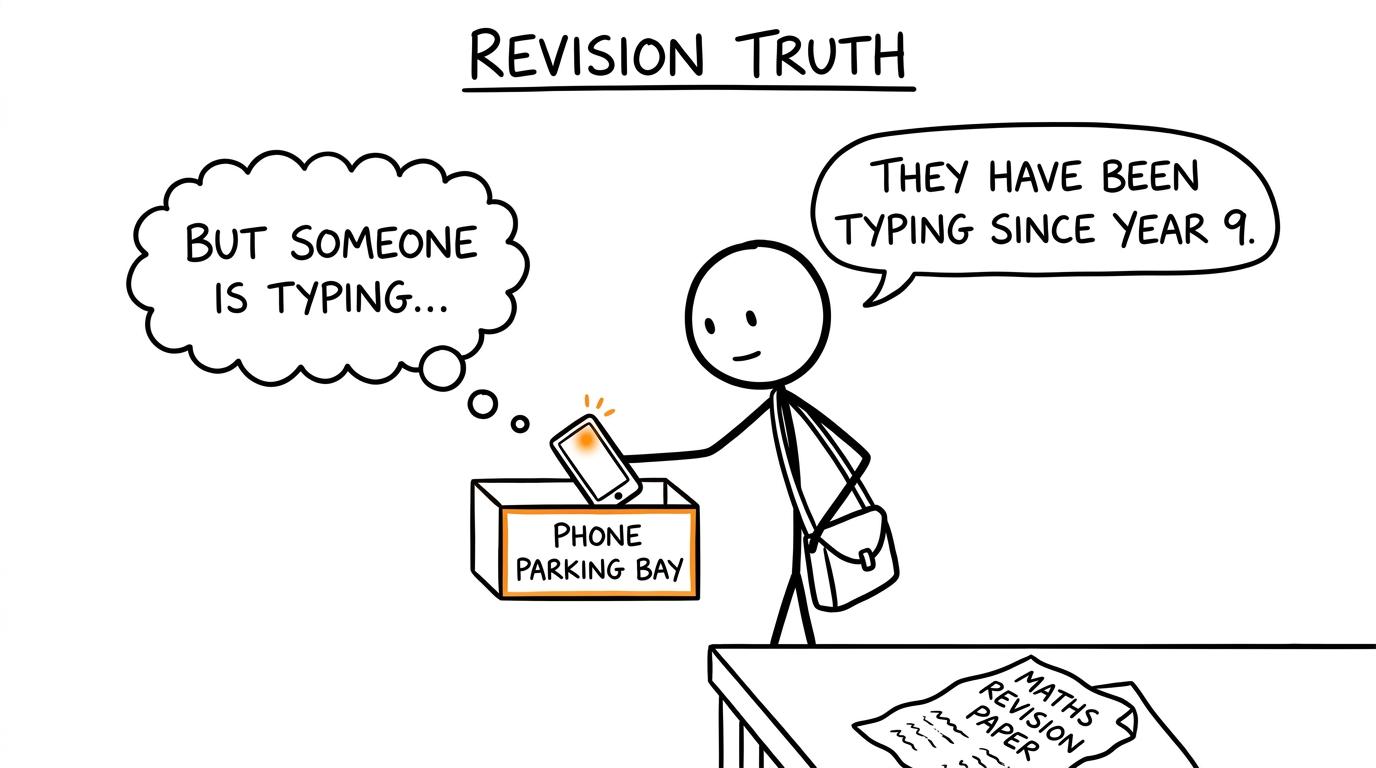 A student parks the group-chat phone before beginning focused maths revision
If you need a wider timetable, adapt the structure in MathsGenie’s one-month GCSE maths revision plan. Give English and maths their own blocks, outcomes and review points. Avoid revising both simultaneously with a paper open beside a constantly moving chat.
Protect accuracy, privacy and attention
A class chat is not an official source. Exam dates, permitted materials and question formats should be checked with your school and current exam-board information. GCSE English Literature papers differ between boards, and specifications can change over time.
Keep personal information, candidate details and school documents out of casual chats. Do not circulate leaked material or present predictions as fact. If a message claims to reveal the exam question, do not build revision around it.
Set boundaries too. Nobody should be expected to answer late at night, and students who leave a session should not return to hundreds of irrelevant messages. Use a separate temporary revision thread if the main class chat cannot stay focused.
Common group chat revision mistakes
Sharing answers before everyone attempts the question
The fastest respondent removes everybody else’s opportunity to retrieve. Use a short thinking period or agree that all answers will be posted together.
Memorising quotations without knowing their purpose
Connect each quotation to an interpretation, a method and another moment in the text. Recall without application will not build an essay.
Treating the most confident message as correct
Confidence is not verification. Check wording, speaker, plot location and exam information before saving anything.
Turning every disagreement into a debate
A useful challenge needs textual evidence. If the disagreement cannot be resolved quickly, record it and ask your teacher.
Producing beautiful shared notes but no independent writing
The chat should create a prompt for individual work. If nobody writes alone, the session has not tested exam readiness.
Letting English discussion replace planned maths practice
Finish on time. When maths is next, choose a resource matched to your board and tier. You might use Edexcel predicted papers near the examination period or follow MathsGenie’s guidance on when to start GCSE past papers.
Make the group chat a doorway, not a destination
The best revision chat is surprisingly quiet. It poses a good question, gives everyone time to think, checks the answer and sends each student away to practise independently.
Use your English Literature chat for retrieval, evidence checking, interpretation and essay planning. Then close it. For maths, make MathsGenie your free revision base: learn through revision lessons, build accuracy with practice questions and mini tests, and test yourself using past papers, predicted papers, mark schemes and video solutions.
A message can begin revision. The work you complete after putting down the phone is what makes it count.