GCSE English Literature Grade 4 Meaning Explained
GCSE English Literature grade 4 meaning explained: discover what the grade shows, how it compares with an old C and what it means for your next steps.
A result can look like a single digit while carrying several questions. Is it a pass? Is it equivalent to the old grade C? Will a college accept it? And does it mean you are genuinely capable at English Literature, or that you narrowly survived the exam?
The short answer to the GCSE English Literature grade 4 meaning is this: grade 4 is officially recognised as a standard pass in England. Its lower boundary is comparable with the lower boundary of the old grade C. It represents a reasonable understanding of literary texts, supported by some analysis, textual references, relevant context and comparison.
That is a credible achievement. But it is not the whole story.
Grade 4 at a glance
Here is the essential checklist:
- Grade 4 is a standard pass in the reformed GCSE grading system.
- The bottom of grade 4 is comparable with the bottom of the old grade C.
- Grade 5 is described by the Department for Education as a strong pass.
- A grade 4 does not correspond perfectly to every part of an old C.
- The mark needed for grade 4 changes between exam series because grade boundaries reflect the difficulty of the papers.
- In English Literature, it indicates reasonable understanding, developing analysis and some effective use of textual evidence.
- Colleges, sixth forms, universities and employers can set their own entry requirements.
- English Literature and English Language are separate GCSEs, so always check which one an entry requirement specifies.
What does a grade 4 represent in English Literature?
Official GCSE grade descriptors describe the typical performance of students working at a particular grade. They are not a checklist requiring every sentence in every answer to display the same quality.
At grade 4, a student will typically be able to develop a reasonable personal response that shows understanding of the texts. They can recognise and discuss some of the ways writers use language, form and structure, support ideas with textual references, explain relevant contextual points and make clear, relevant comparisons.
In practical terms, this means the student is doing more than retelling the plot. Their response should contain an interpretation, even if it is not consistently detailed or perceptive. They can usually identify a writer's choice and say something meaningful about its effect. They may use quotations or precise references, although these might not always be smoothly integrated or explored in depth.
The word reasonable matters. Grade 4 work does not need to be flawless, unusually original or packed with complicated terminology. It needs to show that the student understands the text and can build a relevant response with evidence.
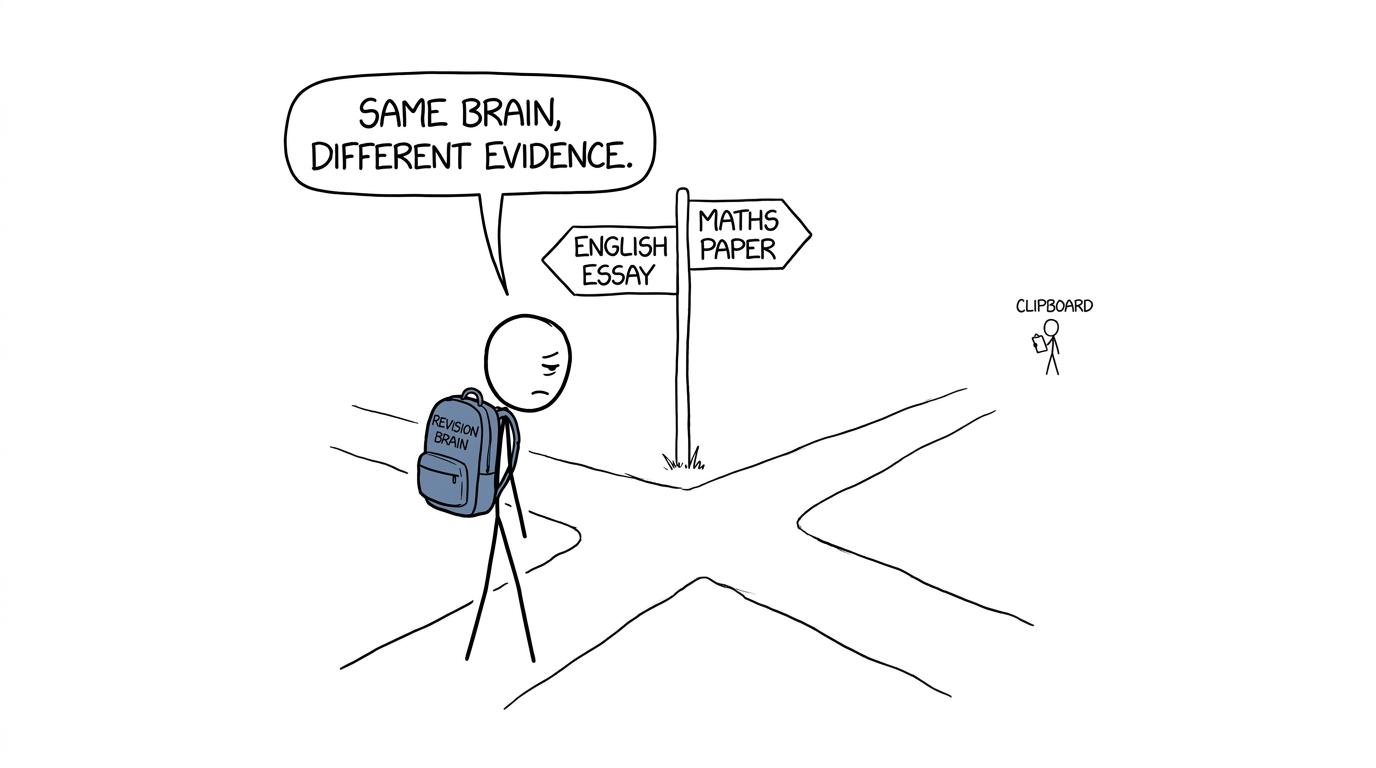 A student carrying one revision brain between English and maths
How English Literature is assessed
Across GCSE English Literature specifications in England, the official subject content requires students to read, understand and respond to texts; analyse writers' methods; understand context; and communicate accurately.
The national assessment objectives give these skills the following weightings:
- AO1, responding to texts and using textual references: 35%35\%35% to 40%40\%40%
- AO2, analysing language, form and structure: 40%40\%40% to 45%45\%45%
- AO3, understanding relationships between texts and their contexts: 15%15\%15% to 20%20\%20%
- AO4, vocabulary, sentence structure, spelling and punctuation: 5%5\%5%
Across a specification, between 20%20\%20% and 25%25\%25% of the marks must assess comparison through relevant combinations of AO1, AO2 and AO3.
This explains why knowing the plot alone is not enough. Knowledge provides the material, but marks are earned by using that knowledge to answer the question. A grade 4 response typically begins to connect a claim, a reference and an explanation of the writer's choices.
The exact papers, texts and mark allocations differ between Edexcel, AQA, OCR and Eduqas specifications. Your teacher and exam board specification should therefore be the final guide for what you will sit.
Is grade 4 equivalent to an old grade C?
Broadly, yes, but the careful wording is important.
Ofqual explains that the bottom of grade 4 is comparable with the bottom of the former grade C. This means a requirement that previously asked for at least a C would normally translate to at least a grade 4.
It does not mean the new scale can be converted perfectly, grade by grade. Grades 4, 5 and 6 together provide more differentiation across the area previously occupied by grades C and B. Similarly, grades 7, 8 and 9 divide achievement around the old A and A* range more finely.
So it is sensible to say:
- grade 4 is broadly comparable with an old C at the key pass threshold;
- grade 5 is a strong pass and sits above that threshold;
- grade 6 represents stronger performance within the wider old B/C region.
It is less accurate to claim that every grade 4 is identical to every old C. The two systems were designed differently.
Why there is no permanent grade 4 mark
Students often search for the exact percentage needed for grade 4. Unfortunately, there is no universal percentage that applies to every board and every year.
Exam boards set grade boundaries after papers have been marked. They consider evidence about the difficulty of the assessments and the quality of student work so that a more difficult paper does not automatically make the qualification harder to achieve.
A boundary is the minimum total mark required for a grade in that particular exam series and specification. It can move from one year to another. A boundary from a previous paper is useful context, but it is not a promise about your own exams.
This principle also applies to maths. A previous Edexcel boundary cannot reliably predict a future AQA, OCR or Eduqas boundary. When revising, use the correct board and specification through the GCSE Maths revision hub, rather than treating one historical mark as a permanent target.
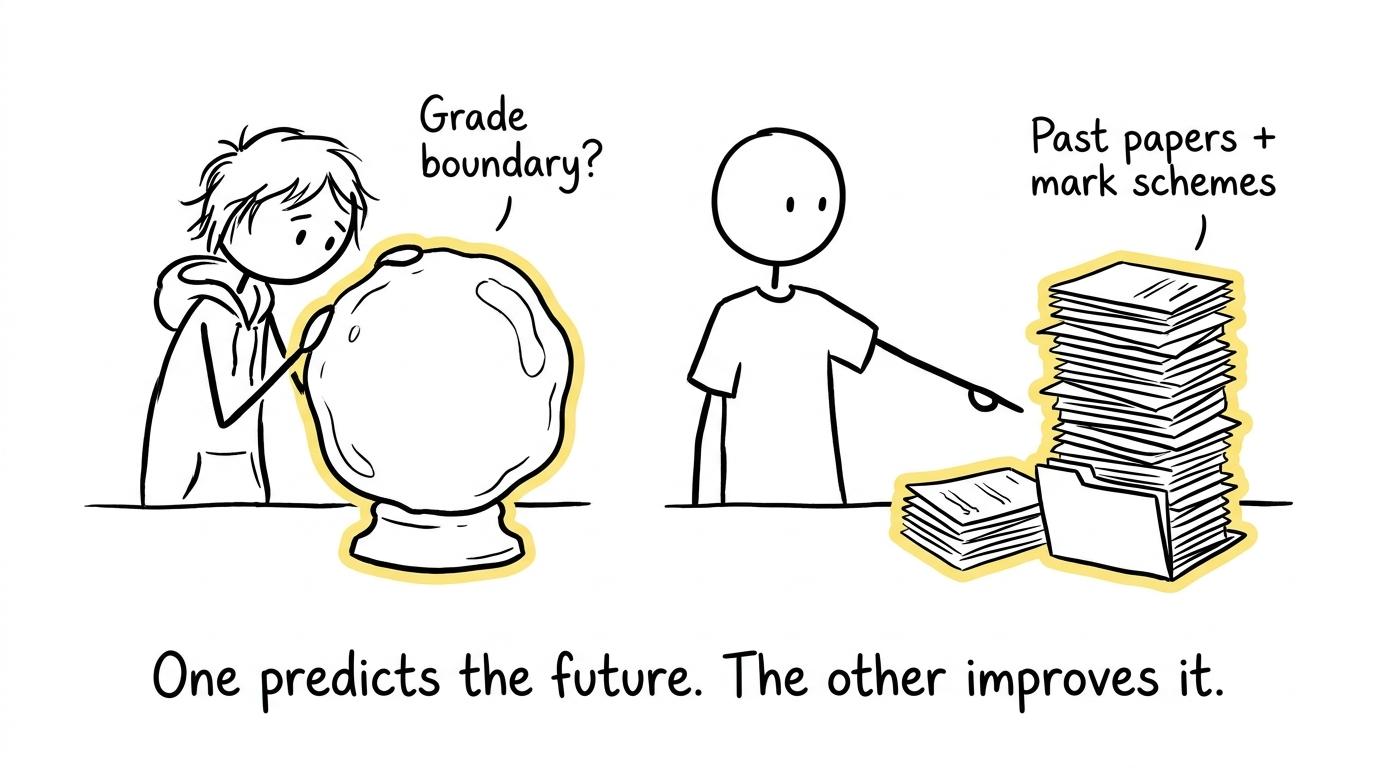 A crystal ball competing with past papers and mark schemes
What a grade 4 means for your next step
A grade 4 shows that you have crossed the nationally recognised standard-pass threshold. That can support progression to further education, training or employment, but each institution remains free to set its own requirements.
There are two distinctions to check carefully.
English Literature is not English Language
An application may ask for “English”, “English Language” or a particular grade in either English GCSE. These phrases are not always interchangeable. A grade 4 in Literature does not alter your separate Language result.
Current government funding rules for post-16 education may recognise qualifying achievement in either GCSE English Language or English Literature in particular circumstances. However, that does not force a sixth form, university or employer to accept Literature wherever it specifically requests English Language. Read the published entry criteria and ask the institution if the wording is unclear.
A pass may not meet every course requirement
Grade 4 is a pass, but some courses ask for grade 5 or 6 in English. Competitive courses may set higher subject-specific requirements. The safest question is not simply, “Did I pass?” It is, “Does this result meet the written requirement for my chosen next step?”
That same distinction matters in maths. Passing and meeting a particular sixth-form requirement are separate issues, especially if you hope to take A Level Maths.
What maths students can learn from a Literature grade
English Literature and maths reward different knowledge, but both examinations expose the same revision mistake: confusing familiarity with performance.
Recognising a quotation is not the same as using it to answer a question. Recognising a formula is not the same as selecting it, substituting accurately and showing a valid method.
A useful revision cycle for both subjects is:
- identify the exact skill being assessed;
- complete a question without notes;
- compare the response with the mark scheme or teacher feedback;
- record one specific weakness;
- practise that weakness;
- return to it later without support.
MathsGenie's guide to the best order for learning GCSE maths topics can help turn a vague revision list into a sequence. When you are ready to test whole-paper performance, use the correct collection of Edexcel GCSE Maths past papers or AQA GCSE Maths past papers.
Do not just total the marks. Use the mark scheme and available video solutions to find out why marks disappeared. The guide to using Edexcel past papers properly explains how to turn each error into targeted practice.
Common mistakes when interpreting a grade 4
Calling it a fail
Grade 4 is officially a standard pass. Grade 5 is a strong pass, but that does not turn grade 4 into a failure.
Treating it as a perfect conversion to grade C
The accurate comparison is between the lower boundaries of grade 4 and the old grade C. The complete grading scales are not directly equivalent.
Assuming the same mark always earns grade 4
Grade boundaries can change by board, specification and exam series. Historical boundaries are guides, not fixed targets.
Confusing a grade descriptor with a mark scheme level
A whole-qualification grade is not the same thing as “Level 4” on one question's mark scheme. Similar labels can describe different things.
Assuming Literature automatically meets every English requirement
Some institutions specifically require English Language. Always check the precise wording rather than relying on the general label “English”.
Revising only until you reach a predicted boundary
Aiming at the exact boundary leaves no room for an unusually difficult question, lost time or an avoidable mistake. Build a margin by strengthening weak areas. The advice on when to start GCSE past papers can help you move from topic practice to timed work without rushing.
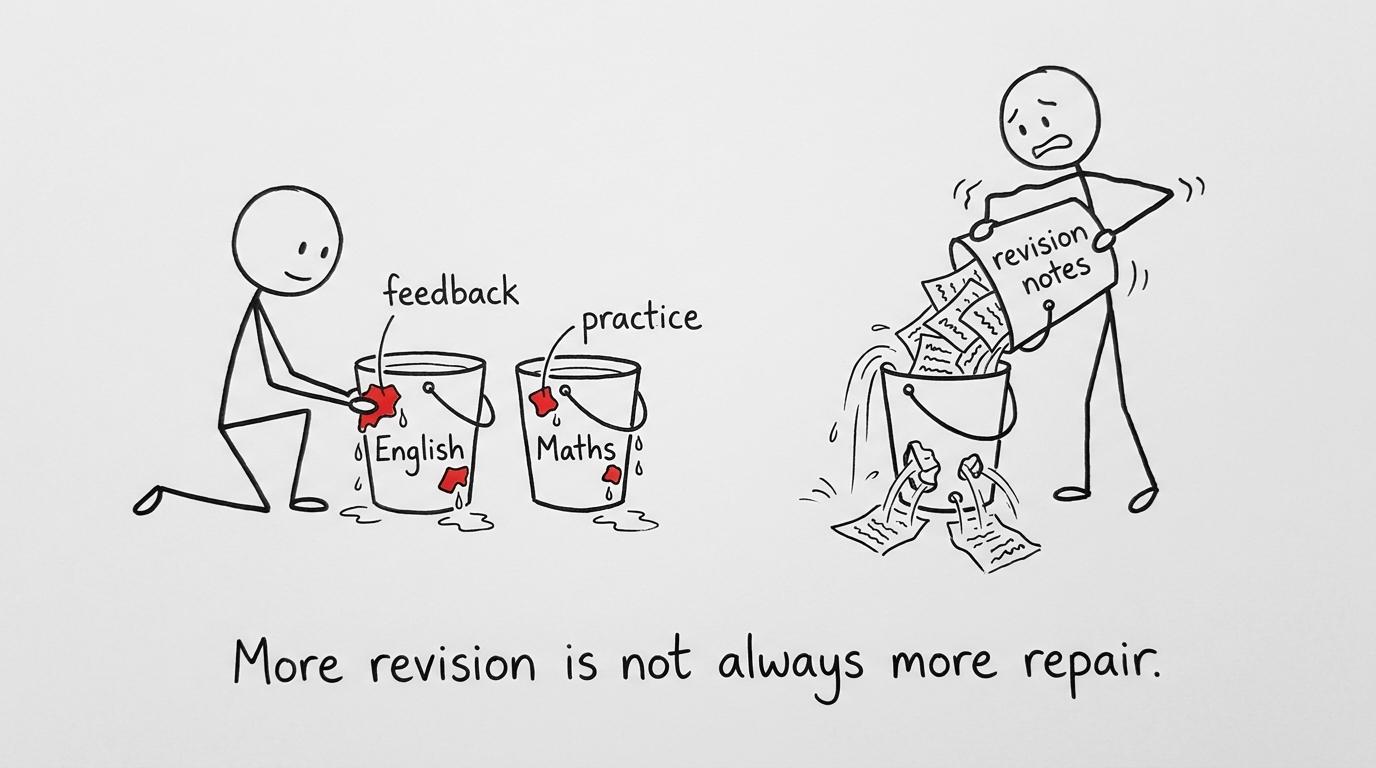 Students repairing leaking English and maths revision buckets
A grade is a threshold, not a verdict
A grade 4 in GCSE English Literature means you have achieved a standard pass and demonstrated a reasonable ability to understand texts, form a relevant response, use evidence and discuss some effects of writers' choices. It is broadly comparable with the old grade C at the key lower boundary, but it is not a perfect one-to-one conversion.
Most importantly, the grade describes performance in a particular assessment. It does not set a ceiling on what you can learn next.
For your maths exams, make the next action concrete. Open the MathsGenie GCSE Maths revision hub, choose your board and tier, and combine free revision lessons and practice questions with mini tests, mark schemes and video solutions. Then build towards past papers and predicted papers. If time is short, use the GCSE one-week revision plan to decide what to do first.
A result tells you where one performance landed. Good revision decides where the next one can go.