GCSE English Literature 5 to 7: A Practical Guide
GCSE English Literature 5 to 7 advice: build stronger arguments, analyse methods precisely, integrate context and improve timed exam responses.
A grade 5 essay can contain accurate quotations, relevant ideas and several correctly identified techniques. Yet it may still feel as though it has reached a ceiling. The problem is rarely a lack of effort. More often, the analysis stops just before the most valuable thinking begins.
Moving from GCSE English Literature 5 to 7 is mainly about changing the quality of your argument. You need to move beyond explaining what happens and identifying methods towards exploring how a writer constructs meaning, why particular choices matter and how evidence supports an informed interpretation.
The short version is:
- answer the precise question rather than retelling the text;
- establish a clear interpretation that runs through the essay;
- analyse language, form and structure as deliberate choices;
- select concise evidence and examine it closely;
- integrate relevant context instead of adding historical facts;
- compare writers' ideas and methods throughout comparison tasks;
- practise planning and writing under timed conditions.
This is not a promise that using one paragraph structure automatically produces a grade 7. Grades are awarded for performance across the qualification, grade boundaries change between exam series, and each board applies its own question-specific mark schemes. It is, however, a practical account of the improvements associated with stronger responses.
What separates a grade 5 from a grade 7?
Official GCSE English Literature grade descriptors define likely performance at grades 2, 5 and 8 rather than giving a standalone national descriptor for grade 7. A sensible way to understand grade 7 performance is therefore to look beyond the grade 5 standard towards the more sustained, perceptive qualities described at grade 8, while also reading your own exam board's mark schemes.
At grade 5, a student is expected to develop a generally coherent and engaged response, show clear understanding of language, form and structure, use apt textual references, apply contextual understanding and make credible comparisons. Those are already substantial skills.
The movement upwards is not from “wrong” to “right”. It is from clear to developed, from relevant to selective, and from occasional analysis to a sustained critical argument.
| A secure grade 5 tendency | The direction towards grade 7 |
|---|---|
| A relevant answer with clear understanding | A focused argument sustained across the whole response |
| Accurate explanation of a quotation | Close analysis of how its details create and complicate meaning |
| Identification of language techniques | Exploration of language, form and structure as purposeful choices |
| Relevant contextual information | Context used to deepen an interpretation of the text |
| Suitable textual references | Concise, well-integrated evidence selected for analytical value |
| Credible comparison | Developed comparison of both ideas and writers' methods |
Grade 7 writing is not necessarily longer. It is usually more deliberate.
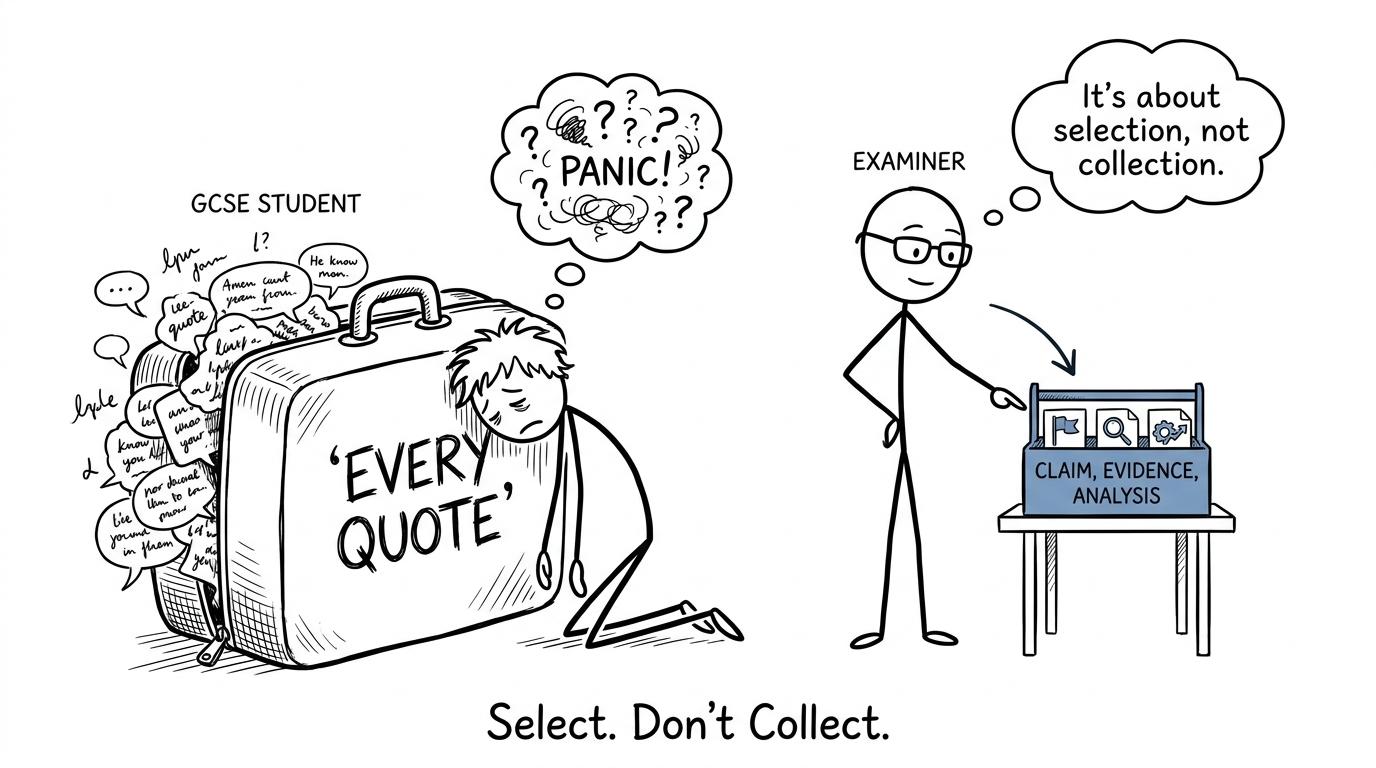 A student choosing a useful analytical toolkit instead of carrying every quotation
Understand what the assessment objectives reward
Across AQA, Edexcel, OCR and Eduqas, the nationally defined assessment objectives share the same core demands. Exact weightings and the questions on which each objective is assessed vary by specification, so always check the materials supplied by your school and exam board.
AO1: develop an informed response
AO1 rewards understanding, a critical style, a personal interpretation and supporting textual references. “Personal” does not mean informal or based only on whether you liked a character. It means that your essay presents an interpretation you can justify.
Before writing, complete this sentence:
The writer presents the theme or character as... in order to...
That gives your essay a direction. Each paragraph can then develop, qualify or challenge the central idea rather than becoming a separate collection of notes.
AO2: analyse the writer's choices
AO2 covers language, form and structure. Across the national subject requirements, it carries more weight than context, so technique spotting alone is a poor use of revision time.
After selecting evidence, ask:
- Why this word rather than a possible alternative?
- What associations or implications does it create?
- Does its meaning change because of its position in the text?
- How does the genre or form shape the audience's response?
- Does the structure reveal, conceal, repeat or contrast an idea?
- How does this choice support my interpretation?
Subject terminology is useful when it makes analysis precise. Naming a metaphor earns little by itself. Explaining how its imagery reshapes the reader's understanding is the valuable part.
AO3: make context part of the reading
Context should inform interpretation, not interrupt it. Avoid attaching a memorised history paragraph to an otherwise unrelated essay.
A stronger approach is to connect context to the writer's choice and purpose. Consider which assumptions a contemporary audience might have brought to the text, how social conditions influence a character's options, or how modern readers might respond differently. Only include knowledge that helps answer the question.
AO4: write accurately where it is assessed
AO4 concerns vocabulary, sentence structures, spelling and punctuation. It represents a small proportion of the qualification overall, but clear expression also helps an examiner follow your AO1 and AO2 thinking. Check your board because AO4 is attached to particular sections rather than every answer in the same way.
Turn each paragraph into an argument
Paragraph acronyms can help you begin, but they can also make every paragraph mechanical. The examiner is assessing the reasoning, not whether you followed “PEE”, “PETAL” or another classroom formula.
A developed paragraph should normally do four jobs:
- make a claim that answers the question;
- use carefully chosen textual evidence;
- analyse how the writer creates meaning;
- connect that analysis back to the wider argument.
The important change is to keep interpretation ahead of terminology. Begin with what the writer is communicating, then examine how the writing creates that idea.
Tentative language can support thoughtful analysis. Phrases such as “this may imply”, “alternatively” and “the contrast suggests” create room for interpretation. They should not make the argument vague. Use them when the evidence genuinely supports more than one reading.
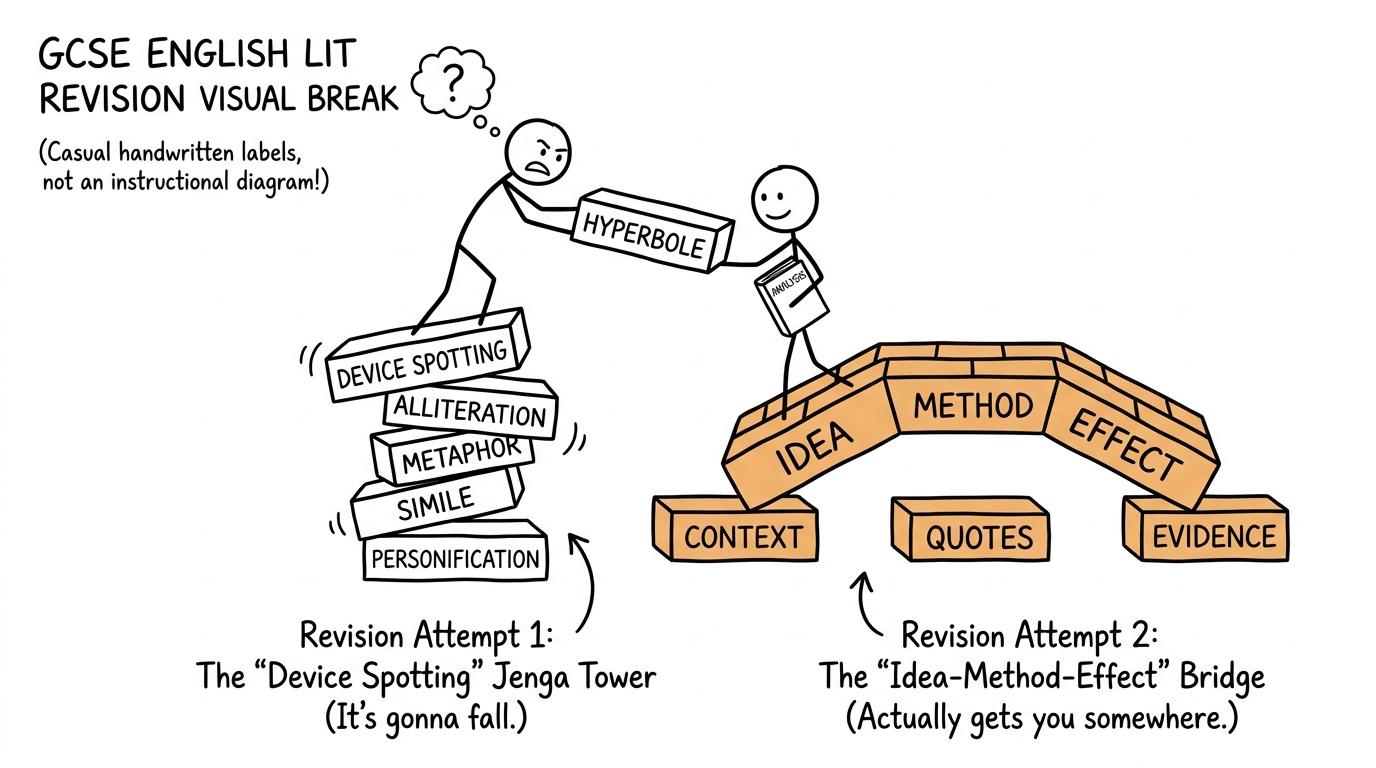 A wobbly device-spotting tower beside a stronger analytical bridge
Select quotations for flexibility, not quantity
Trying to memorise dozens of long quotations creates an impressive-looking revision task but not always an effective one. Build a smaller bank of short, adaptable references organised by character and theme.
For each quotation, record:
- the speaker and moment;
- two or three themes it could support;
- one important word or structural feature;
- where it fits within the character's or theme's development;
- relevant context, if context is assessed in that task.
Short quotations are easier to integrate into your own sentences and easier to analyse closely. You may also use accurate textual references where appropriate, but precise quotation gives you more language to examine.
Retrieve quotations from memory rather than repeatedly highlighting them. Cover the quotation, write it down, check it and revisit it later. The same principle supports maths revision: recall and application reveal more than rereading. Maths students can use the GCSE Maths revision hub for flashcards, lessons and topic practice built around active work.
Improve comparison without writing two separate essays
A comparison answer should compare both what writers communicate and how they communicate it. Writing everything about one poem and then everything about another often leaves the relationship between them underdeveloped.
Choose one comparative idea at a time. Within that idea:
- state the important similarity or difference;
- support it with evidence from both texts;
- compare the writers' methods;
- explain why the distinction matters.
Useful connectives include “similarly”, “whereas”, “in contrast” and “both writers”. But comparison is a way of thinking, not a list of linking words. “Both poems use imagery” is technically comparative but not developed. Compare the kinds of imagery, their effects and the perspectives they reveal.
Use timed practice as a feedback system
Knowledge does not automatically become an exam response. You must practise selecting and organising it under pressure.
Start with short plans. Give yourself a question, formulate a thesis and choose three lines of argument. Then write one paragraph. Later, build towards complete responses using your board's time allowance.
Afterwards, review the response using the question-specific mark scheme:
- Did every paragraph answer the question?
- Was there a sustained interpretation?
- Did evidence support rather than replace analysis?
- Did you discuss effects and meanings, not merely name methods?
- Was context integrated and relevant?
- If comparison was required, did it continue throughout?
This feedback loop also matters in maths. MathsGenie's guide to using Edexcel past papers properly explains how marking, diagnosing and reattempting convert a completed paper into improvement. Students on other boards can use the AQA GCSE Maths past papers, OCR GCSE Maths past papers or the wider revision hub to follow the same process.
A simple weekly English Literature routine could include:
- two quotation-retrieval sessions;
- two essay plans;
- one analytical paragraph;
- one timed section or complete response;
- one review using teacher feedback and a mark scheme.
If you are balancing English with maths, use the principles in MathsGenie's best order for learning GCSE maths topics to sequence your work instead of attempting every weakness at once.
Common mistakes that hold responses at grade 5
Retelling the plot
Plot knowledge is essential, but narration does not analyse the writer's construction. Include only enough detail to establish the point, then move quickly to interpretation and method.
Beginning with a quotation
A quotation is evidence, not an argument. Establish what the writer presents before introducing the words that support your view.
Listing techniques
Finding a noun, adjective and metaphor is not the same as analysing them. Select the detail that contributes most to your argument and explore it properly.
Bolting on context
A paragraph of historical facts can be accurate yet irrelevant. Connect context directly to the text, question and interpretation.
Forcing an alternative interpretation
A second reading adds value only when the wording or structure supports it. One well-developed interpretation is better than several speculative claims.
Ignoring form and structure
Students often focus exclusively on individual words. Revise turning points, contrasts, entrances and exits, narrative viewpoint, stanza arrangements, endings and changes across the whole text.
Treating predicted questions as certainty
No prediction removes the need for broad preparation. Revise transferable themes, methods and evidence. MathsGenie's discussion of predicted topics and sensible prioritisation makes the same point: predictions are tools for practice, not guarantees.
 A revision alarm clock being outvoted by an overenthusiastic committee of highlighters
Your final route from grade 5 towards grade 7
Improvement often looks less dramatic than students expect. It is a series of small changes: a sharper thesis, a shorter quotation, one more precise comment on structure, and context that explains meaning instead of displaying memory.
Ask your teacher to identify the most important recurring weakness in your essays. Work on that weakness deliberately, complete another timed response and compare the difference. Do not simply write more essays in the same way.
Then apply the same disciplined loop across your subjects. For maths, begin with MathsGenie's free GCSE Maths revision resources, use revision lessons and practice questions to repair individual gaps, and test those improvements with mark schemes, video solutions, mini tests, past papers and predicted papers. The guide to starting GCSE past papers can help you plan when to introduce timed practice.
A higher grade is rarely produced by one clever phrase. It comes from making better decisions repeatedly: what to revise, what evidence to select, what the writer's choice suggests and what to improve next. Start with one essay plan today, then make every paragraph earn its place.