

GCSE English Language Weekend Revision Plan
GCSE English language weekend revision made simple: follow a calm two-day plan for timed reading, writing, marking, corrections and proper rest.
The final weekends before an English Language exam can feel strangely difficult. There is no novel to reread, no quotation bank to memorise and no single list of facts that guarantees success. You know you should revise, but deciding what to do can consume the time available.
A useful GCSE English Language weekend revision routine is much simpler: complete timed reading and writing practice, mark it carefully, correct a small number of weaknesses and stop early enough to recover. You are training performance, not attempting to relearn the entire course in two days.
This plan is designed for students balancing English with GCSE maths and other exams. It gives English the focused attention it needs without allowing one subject to take over the whole weekend.
Your weekend revision checklist
Before looking at the detailed routine, here is the complete plan:
- Confirm your exam board, paper and current question format.
- Choose one past paper or school-approved practice paper.
- Complete a timed reading section on Saturday morning.
- Mark and improve selected responses before doing more questions.
- Practise one writing task under controlled conditions.
- Complete a longer paper simulation on Sunday.
- Create a one-page reminder sheet from your mistakes.
- Include a separate, contained maths revision block.
- Finish heavy revision well before bedtime.
The important word is contained. A weekend plan should have edges. Without them, revision expands until it fills every available hour while becoming less useful as the day continues.
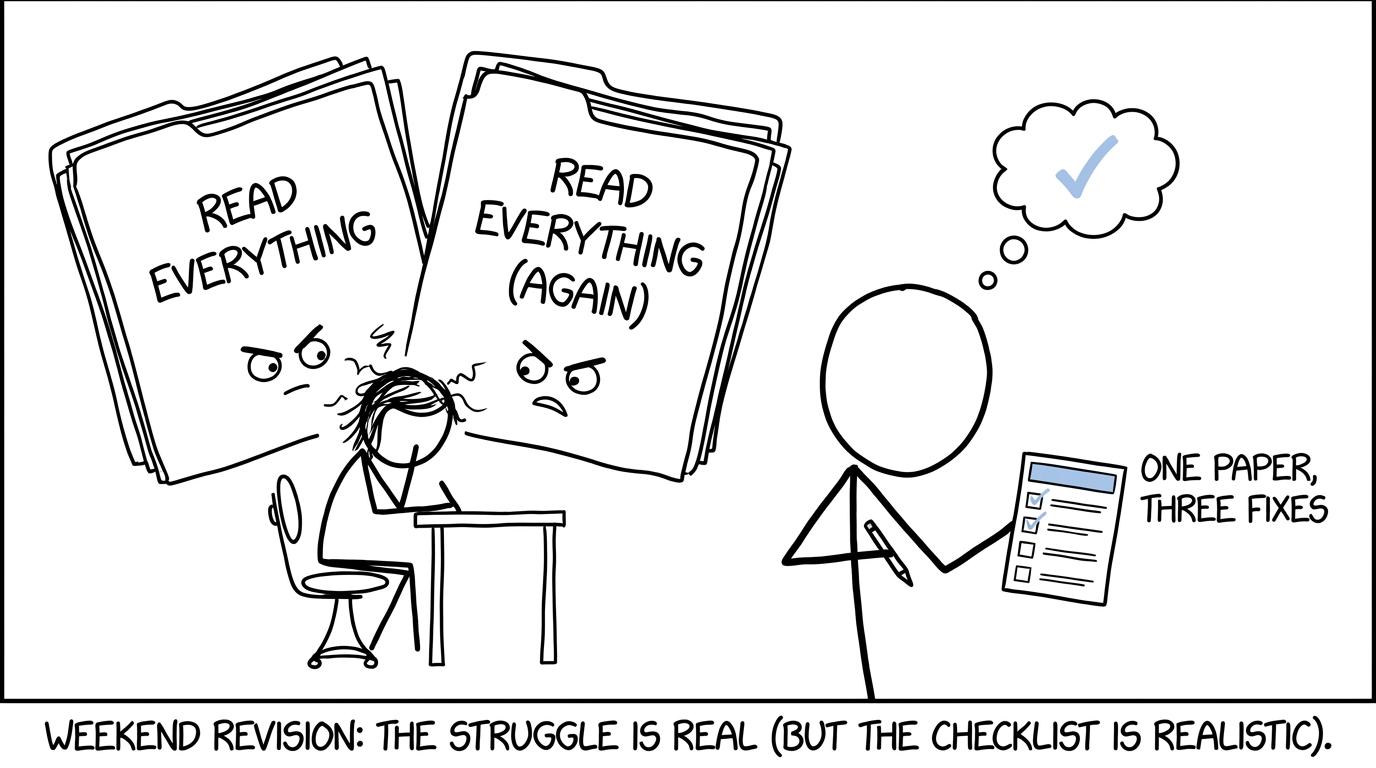 A student wisely chooses one useful revision checklist instead of two enormous folders
Check your exam board before you begin
English Language is assessed differently by AQA, Edexcel, OCR and Eduqas. The common assessment objectives cover retrieving and interpreting information, analysing language and structure, comparing or evaluating texts, communicating effectively and writing accurately. However, paper lengths, question sequences, mark totals and writing choices differ.
English Language also has no foundation or higher tier. Every student on the same specification sits the same written papers, with grades awarded on the grades 999-111 scale.
Before starting your weekend:
- Find the exact specification and paper code used by your school.
- Read the front page of a recent official paper.
- Check which questions require comparison, evaluation or analysis.
- Confirm the recommended or total examination time.
- Use current materials rather than an old generic question guide.
This last point matters particularly for AQA students. For examinations from summer 202620262026, AQA updated parts of Paper 111. Question 111 now consists of four multiple-choice items, Question 333 directs students towards a named structural effect, and the writing instructions have been clarified. The broad skills and mark totals remain familiar, but your practice materials should reflect the current wording.
Do not borrow timings from a friend on another exam board. A routine becomes useful only when it matches the paper you will actually sit.
Saturday morning: diagnose before you revise
The purpose of Saturday morning is to discover what needs attention. Begin when you are reasonably alert, remove your phone and prepare only the paper, source booklet, pen and timer.
Complete one timed reading section
Use the reading section from a current paper for your board. Work without notes and follow the timing guidance given by your teacher or printed on the paper.
Treat the exercise as a rehearsal:
- Read every question carefully before answering it.
- Mark the lines or source specified in the question.
- Notice the command word: identify, explain, analyse, compare or evaluate.
- Select brief, relevant textual evidence.
- Move on when the time allocated to a question has passed.
Do not pause the timer to search for a technique or check a model response. The small discomfort of working independently is what makes the practice diagnostic.
Mark for patterns, not merely a total
After a proper break, use the official mark scheme, teacher feedback or an approved model answer. A total mark can be interesting, but the pattern behind it is more useful.
Classify each problem as one of the following:
- Reading accuracy: you misunderstood the source or selected weak evidence.
- Analysis: you identified a feature but did not explain its effect.
- Structure: you discussed isolated words rather than movement across the text.
- Comparison: you covered both sources without connecting their perspectives.
- Evaluation: you made an assertion without testing it against evidence.
- Timing: an unfinished answer prevented you from showing what you knew.
Choose no more than three priorities. “Improve English” is too broad to guide your next session. “Use shorter quotations in comparison answers” is an action.
The same principle works in maths: a paper becomes valuable when mistakes lead to targeted repair. MathsGenie’s guide to using GCSE past papers properly explains this attempt, mark, fix and retest cycle.
Saturday afternoon: practise one writing task
Writing improves through production and editing, not through collecting increasingly elaborate vocabulary lists.
Choose one writing task appropriate to your paper. Depending on the specification, this may involve imaginative, descriptive, narrative, transactional or viewpoint writing. Check whether your exam offers a choice before you practise.
Use a controlled session:
- Spend a short period identifying purpose, audience, form and tone.
- Plan the direction of the response rather than scripting every sentence.
- Write for the amount of time recommended for your paper.
- Reserve a final check for sentence boundaries, spelling and punctuation.
When reviewing the response, ask specific questions. Is the opening purposeful? Does each paragraph develop rather than repeat? Is the register suitable for the audience? Are sentence lengths controlled? Have you used punctuation accurately rather than decoratively?
Select one paragraph to improve. Rewriting the entire response often consumes time without teaching much. A focused redraft lets you practise the exact change you want to carry into the examination.
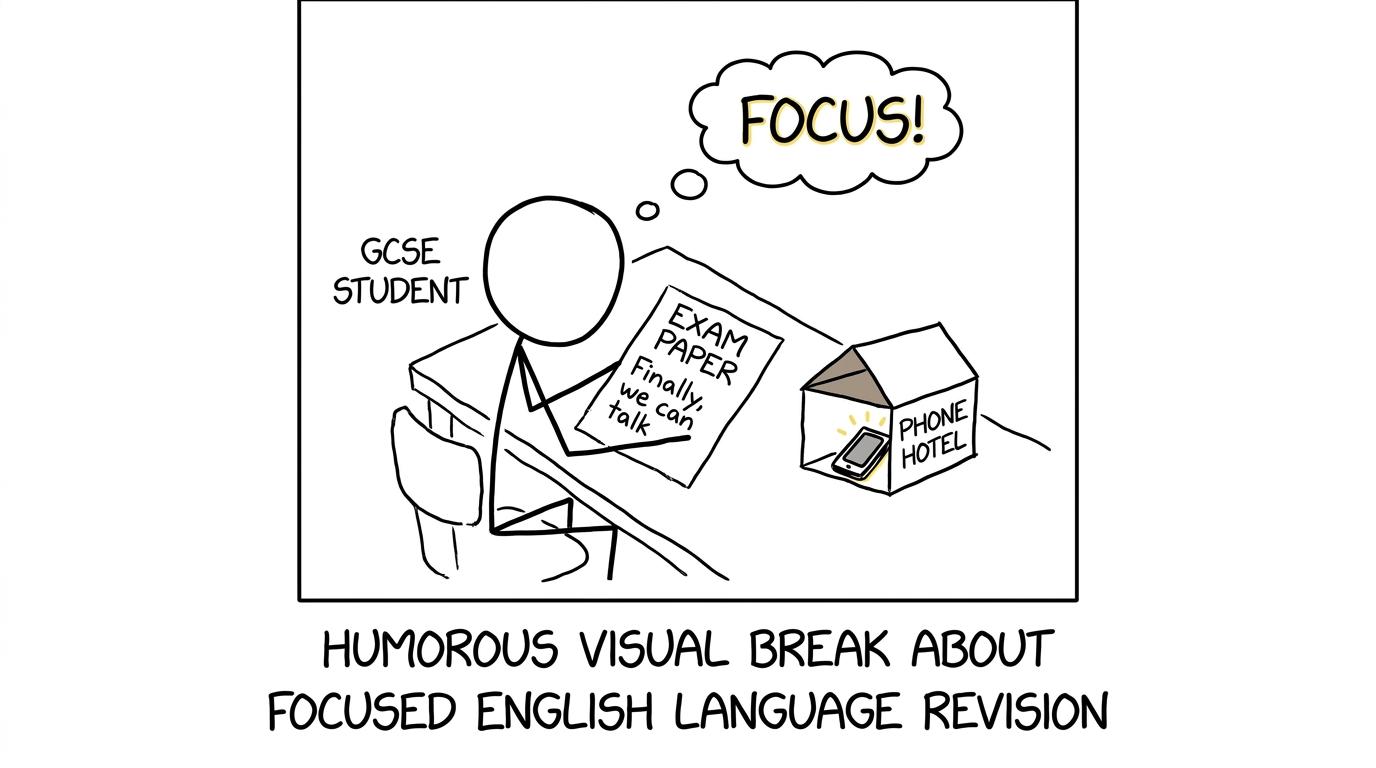 A phone waits in its hotel while a practice paper finally gets the student's attention
Keep maths revision in a separate block
Students preparing for GCSE English Language are usually preparing for maths at the same time. Switching constantly between subjects, however, makes both sessions feel fragmented.
Give maths its own block later on Saturday or early on Sunday. Start from the GCSE Maths revision hub, choose one weak topic and complete a short lesson followed by practice questions. If school has been especially busy, the twenty-minute GCSE maths routine provides a compact alternative.
Keep the subjects separate:
- English block: reading, writing and textual evidence.
- Maths block: methods, calculations and exam questions.
- Break: leave the desk rather than changing browser tabs.
This reduces the temptation to abandon a difficult English response for a comfortable maths topic, or vice versa.
Sunday morning: create realistic exam pressure
Sunday is the rehearsal day. If the examination is still several weeks away, complete one full section. In the final weeks, complete a whole paper under the exact time printed for your specification.
Set up realistic conditions:
- Work at a clear desk in silence.
- Put your phone in another room.
- Use only the materials permitted by your school.
- Start and finish at fixed times.
- Do not read the mark scheme until the session has ended.
A full paper tests more than English knowledge. It reveals whether you preserve enough time for writing, whether your concentration slips and whether one difficult question disrupts everything that follows.
Afterwards, take a substantial break before marking. Tired marking often becomes either too generous or unnecessarily harsh.
Sunday afternoon: turn feedback into a final-week plan
Do not complete another full paper immediately. Revision improves when feedback changes the next attempt.
Create a one-page “next paper” sheet containing:
- the question type that needs most attention;
- two reminders about selecting evidence;
- one writing organisation target;
- two recurring spelling or punctuation corrections;
- your planned timing checkpoints;
- one instruction for what to do if you get stuck.
Keep the page brief enough to reread before your next practice session. It is a set of decisions, not a replacement textbook.
If you also need to organise maths, the GCSE maths revision timetable can help you distribute paper practice and topic repair across the week. The MathsGenie resources collection also brings together mini tests, predicted papers and shorter revision papers, while the GCSE maths exam-week checklist is useful once several examinations begin competing for attention.
Adjust the routine as the exam approaches
Three or four weekends before the examination, spend more time diagnosing and repairing individual skills. A timed reading section followed by careful corrections may be more valuable than repeatedly sitting full papers.
In the final two weekends, increase realism. Complete a full paper, follow the correct timings and practise recovering when a question feels difficult. The final weekend should not become an endurance challenge. One strong simulation, one careful review and a shorter correction session are enough.
On the day before the examination, avoid writing multiple full responses. Review your one-page sheet, inspect a familiar mark scheme, check the paper details and stop. Confidence grows from recognising a process you have already rehearsed.
Common GCSE English Language revision mistakes
Rereading notes instead of producing answers
Notes can remind you what analysis means, but only writing reveals whether you can select evidence, develop an interpretation and manage time.
Memorising a response
Unseen sources and changing tasks require adaptation. Memorised descriptions or persuasive paragraphs can sound forced and may not address the actual audience, purpose or form.
Naming techniques without discussing meaning
A technique is not an explanation. Focus on what the selected language suggests, how it shapes the reader's response and why it suits that moment in the text.
Ignoring the mark scheme after practice
Finishing a paper is only the attempt. The learning happens when you compare the response with the criteria, identify what was missing and make a correction.
Using the wrong board's format
AQA, Edexcel, OCR and Eduqas do not organise their papers identically. Revise the shared reading and writing skills, but rehearse the question order and timings for your own specification.
Revising late into the night
An extra exhausted response is unlikely to outweigh the value of arriving rested. Set a stopping time and treat it as part of the plan.
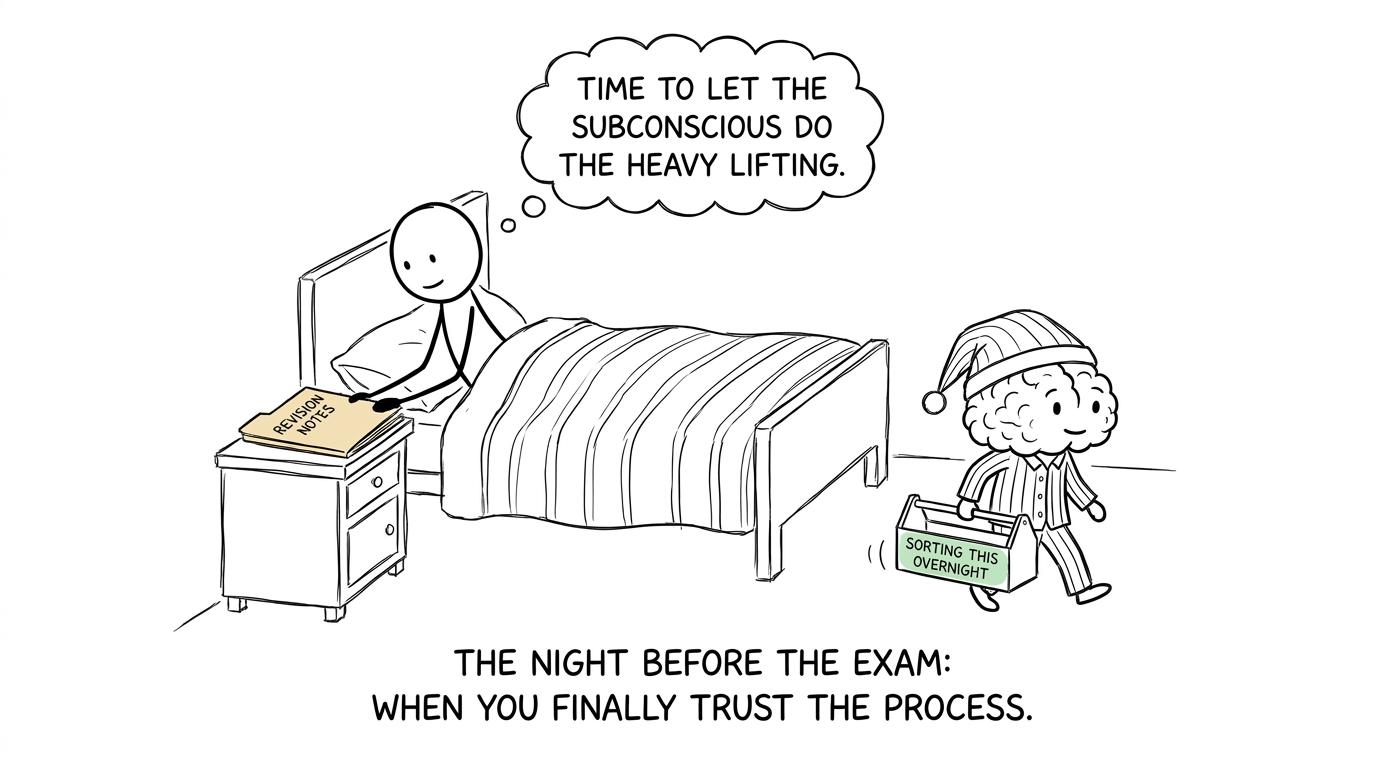 A helpful brain in pyjamas promises to organise the day's revision overnight
Finish the weekend with a clear next step
A successful revision weekend does not end with the feeling that you covered everything. It ends with evidence: a timed paper, honest marking, three precise corrections and a plan for the next session.
Use the same discipline across your examinations. For English Language, practise the exact reading and writing demands set by your board. For maths, let MathsGenie remove the unnecessary decisions. Open the free GCSE Maths revision area, choose a revision lesson, answer the practice questions and then test the skill through past papers, predicted papers, mini tests, mark schemes and video solutions.
The weekend is not a last-minute rescue mission. It is a rehearsal. Make it calm, specific and repeatable, then arrive at the exam knowing what you will do first.










