

GCSE English Language vs Language and Literature
GCSE English Language and Literature similar to GCSE English Language? Compare the genuine overlap, key differences and skills before making your choice.
There is an easy trap hidden inside this question. A course title sounds familiar, so it feels as though the content must be familiar too. But qualification names do not always tell the whole story.
So, is GCSE English Language and Literature similar to GCSE English Language? Yes, there is meaningful overlap in close reading, analysing writers' methods, selecting evidence and communicating clearly. However, standalone English Language places much more emphasis on unseen texts, comparison, evaluation and producing your own creative or transactional writing. Enjoying an integrated or combined course is therefore a positive sign, but it does not guarantee that every part of standalone Language will feel the same.
There is also an important qualification detail. In England, GCSE English Language and GCSE English Literature are normally two separate GCSEs. Schools sometimes refer to them collectively as “English Language and Literature”, which can make it sound like one combined qualification. In Wales, learners beginning the reformed course from September 2025 may take an integrated WJEC GCSE English Language and Literature single or double award. Always check the exact qualification title, nation, exam board and specification before deciding anything.
The quick answer
Before comparing the courses, establish what you are actually taking:
- Check the qualification title. Is it standalone English Language, standalone English Literature, or an integrated Language and Literature award?
- Check your nation and exam board. Arrangements differ across England, Wales and Northern Ireland.
- Ask whether you already receive an English Language grade. If you do, taking “English Language too” may simply duplicate your existing qualification.
- Compare assessment rather than course names. Look at unseen reading, set texts, creative writing, transactional writing, spoken language and examination structure.
- Consider your complete GCSE workload. An additional subject only makes sense if your school offers it and you can prepare without weakening priorities such as maths.
The practical answer is not automatically “yes” or “no”. It is: yes, the skills transfer, but first confirm that the second course is genuinely a different qualification.
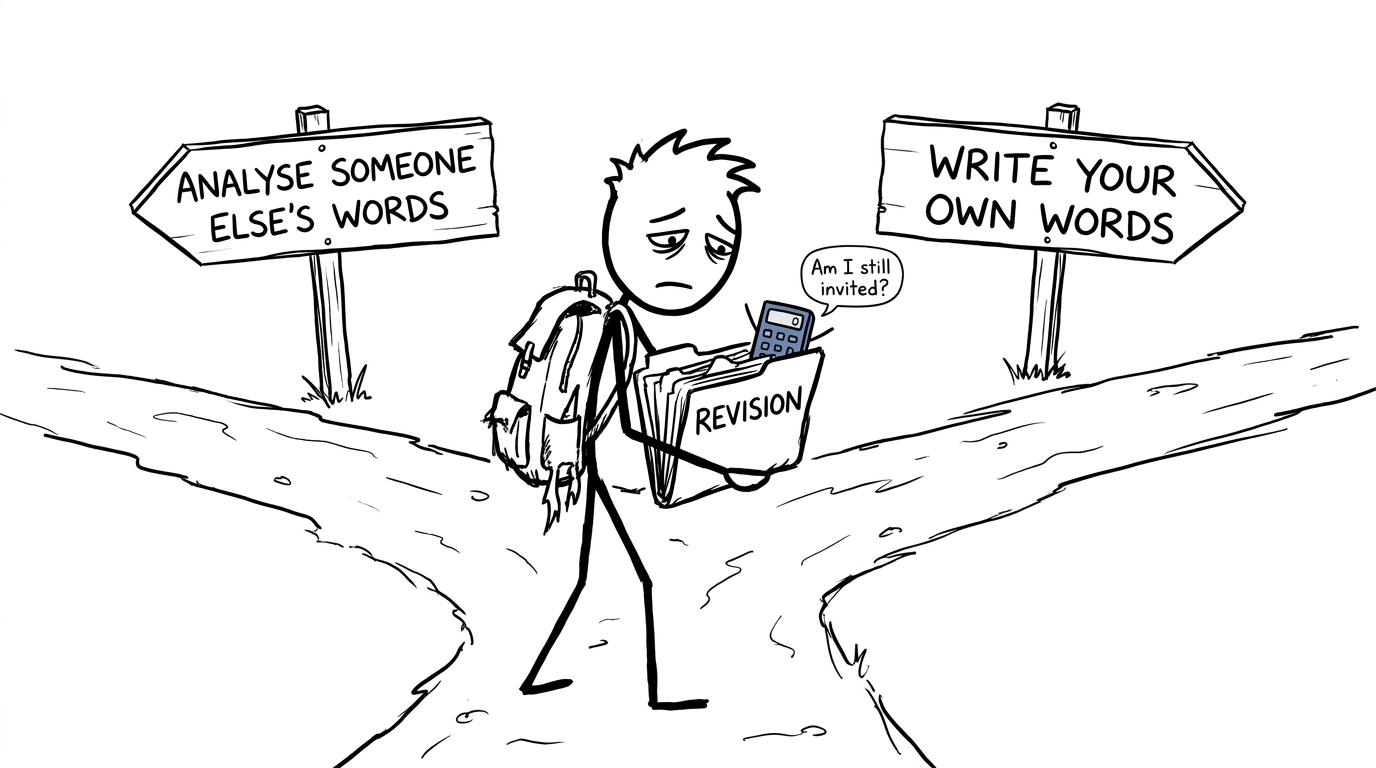 A GCSE student choosing between analysing words and writing their own
Are these actually separate GCSE qualifications?
In England
GCSE English Language and GCSE English Literature are separate qualifications with separate specifications and results. A student may be taught both during the same English lessons, so the experience can feel like one course. Nevertheless, the examinations assess different balances of knowledge and skills.
Standalone GCSE English Language is untiered. It assesses reading and writing, usually through unseen fiction, non-fiction and literary non-fiction. It also includes a spoken-language endorsement that is reported separately and does not contribute to the written GCSE grade.
English Literature focuses on studied literary works. Depending on the exam board, these can include Shakespeare, a nineteenth-century novel, modern prose or drama, anthology poetry and unseen poetry. Exact texts, paper structures and timings vary between AQA, Pearson Edexcel, OCR and Eduqas.
If an English school describes its programme as “GCSE English Language and Literature”, it will often mean that students are working towards both separate GCSEs. In that situation, you are probably already taking English Language.
In Wales
The wording has a different significance in Wales. Learners beginning Year 10 from September 2025 may follow the new integrated WJEC GCSE English Language and Literature qualification, available as a single or double award. Language and literary study are deliberately connected within the qualification rather than being treated only as two adjacent GCSEs.
That does not mean every Welsh student can simply add a separate English Language GCSE. Qualification availability and entry decisions depend on the school, cohort and current WJEC arrangements. Ask your teacher or examinations officer what your course awards and what alternatives are genuinely available.
In Northern Ireland
Northern Ireland has its own qualification arrangements, with CCEA offering separate GCSE English Language and English Literature qualifications. Do not assume that an AQA or Eduqas paper structure applies to a CCEA course simply because the subject name looks similar.
How much genuine overlap is there?
The overlap is substantial at the level of reading habits. It is smaller when you examine the complete assessments.
Close reading and inference
Both routes expect you to read beyond the surface. You need to identify explicit information, infer what is suggested and support an interpretation with carefully selected evidence.
A student who enjoys noticing changes in tone, patterns of imagery or the significance of a particular word already has useful foundations for English Language. The source may be unfamiliar, but the habit of attentive reading transfers well.
Analysis of language and structure
Both Language and Literature ask how writers create meanings and effects. Relevant terminology can help, but technique spotting is not enough. Strong responses explain the connection between a writer's choice, the meaning it creates and its possible effect on the reader.
Literature may also require analysis of form and connections to context. Language more often asks you to investigate how an unseen source is organised, how a viewpoint is constructed or how structural choices guide the reader.
Evidence and coherent argument
In both subjects, an assertion becomes persuasive when it is supported. You must choose relevant references, explain them and organise your response logically.
This is also surprisingly useful in GCSE maths. A written conclusion without working is often less convincing than a method whose stages can be followed. English trains you to justify an interpretation; maths trains you to justify a result. The subject matter differs, but disciplined communication matters in both.
Comparison
Comparison appears in both areas, although its form varies. Literature may ask you to compare poems, themes or writers' presentation of ideas. Language may ask you to compare viewpoints and how those viewpoints are conveyed across unseen sources.
The transferable skill is not merely finding a similarity and a difference. It is selecting a meaningful point of comparison and supporting it with evidence from both texts.
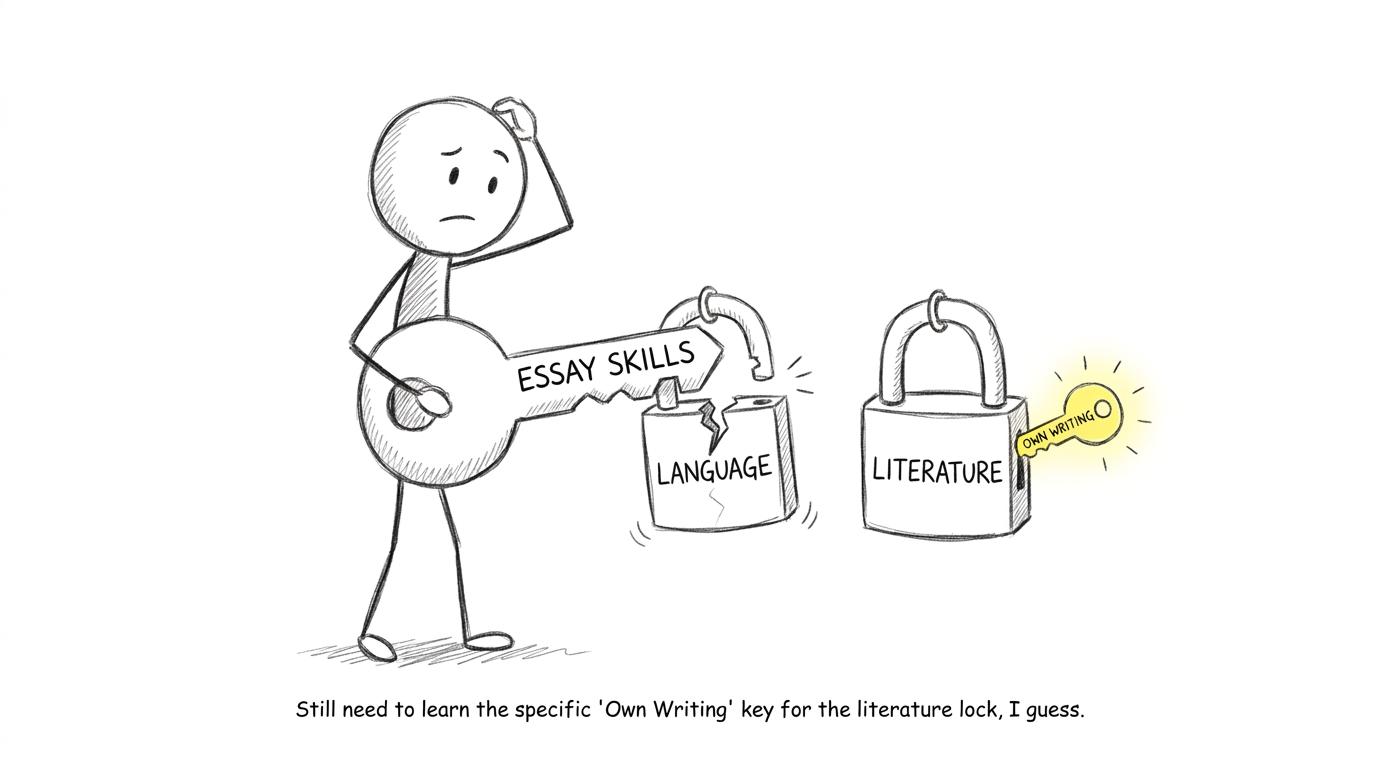 One essay-skills key only partly opening the Language and Literature locks
Where the similarity ends
The shared skills are real, but treating the courses as interchangeable would be misleading.
English Language requires substantial original writing
Standalone Language normally gives significant weight to writing. Depending on the board, tasks may include description, narrative, articles, letters, speeches or other forms of writing for a particular purpose and audience.
This changes the nature of revision. In Literature, you generally develop interpretations of texts written by somebody else. In Language, you must also become the writer: selecting vocabulary, controlling tone, organising ideas and using spelling, punctuation and grammar accurately.
If you enjoy creative or persuasive writing, this difference may make Language especially appealing. If you mainly enjoy discussing characters, themes and historical context, you may find the writing component less familiar.
Language examinations rely heavily on unseen material
Literature rewards detailed knowledge of studied works, even when an extract or unseen poem appears. Language reading sources are unseen. You cannot memorise an interpretation in advance because you do not know the exact text you will receive.
Preparation therefore centres on adaptable routines: reading the question precisely, locating evidence efficiently, analysing methods and managing time. The uncertainty can feel uncomfortable, but some students prefer it because there is less dependence on remembering quotations from several set texts.
Literature gives context a more prominent role
Literature specifications assess understanding of relationships between texts and the contexts in which they were written. Context should illuminate an interpretation rather than become a detached history paragraph.
Standalone Language can still involve texts from different periods and requires sensitivity to audience, purpose and viewpoint. Yet it does not reproduce the same sustained study of literary context, characters and themes.
The assessments vary by board
AQA, Edexcel, OCR and Eduqas meet national subject requirements, but they package questions differently. Paper timings, source combinations, mark allocations and task wording are not interchangeable.
Before choosing or preparing for a course, read the current specification and inspect an official specimen or past paper. The paper itself often reveals more than the subject title.
Would enjoying the combined course make Language a good choice?
It is encouraging if you enjoy:
- analysing unfamiliar passages rather than only recalling set texts;
- explaining how language and structure shape meaning;
- comparing viewpoints with precise evidence;
- writing stories, descriptions, speeches or articles;
- revising skills through repeated timed practice;
- responding independently when there is no single memorised answer.
Be more cautious if the part you enjoy is almost entirely learning set texts, exploring characters or discussing historical context. Those interests align strongly with Literature, while standalone Language requires broader writing and unseen-reading confidence.
Your current performance also matters less than the reason behind it. A lower mark caused by weak timing can often be addressed. Disliking the central activity of producing original writing is a more fundamental consideration.
Protecting your maths revision while making the decision
An extra course has an opportunity cost. Every hour assigned to English is an hour unavailable for algebra, geometry or a timed paper. That does not make the choice wrong; it means the decision needs a realistic timetable.
Start with the GCSE maths revision hub and identify the topics that genuinely need attention. If your week is already crowded, the 20-minute maths revision routine can keep mathematical skills active without demanding a long daily session.
A useful decision test is to plan an ordinary week rather than an ideal one. Include school, homework, sleep and other subjects. Then add one English practice task and one maths topic session. MathsGenie's GCSE revision timetable guide can help you build a schedule that survives busy days.
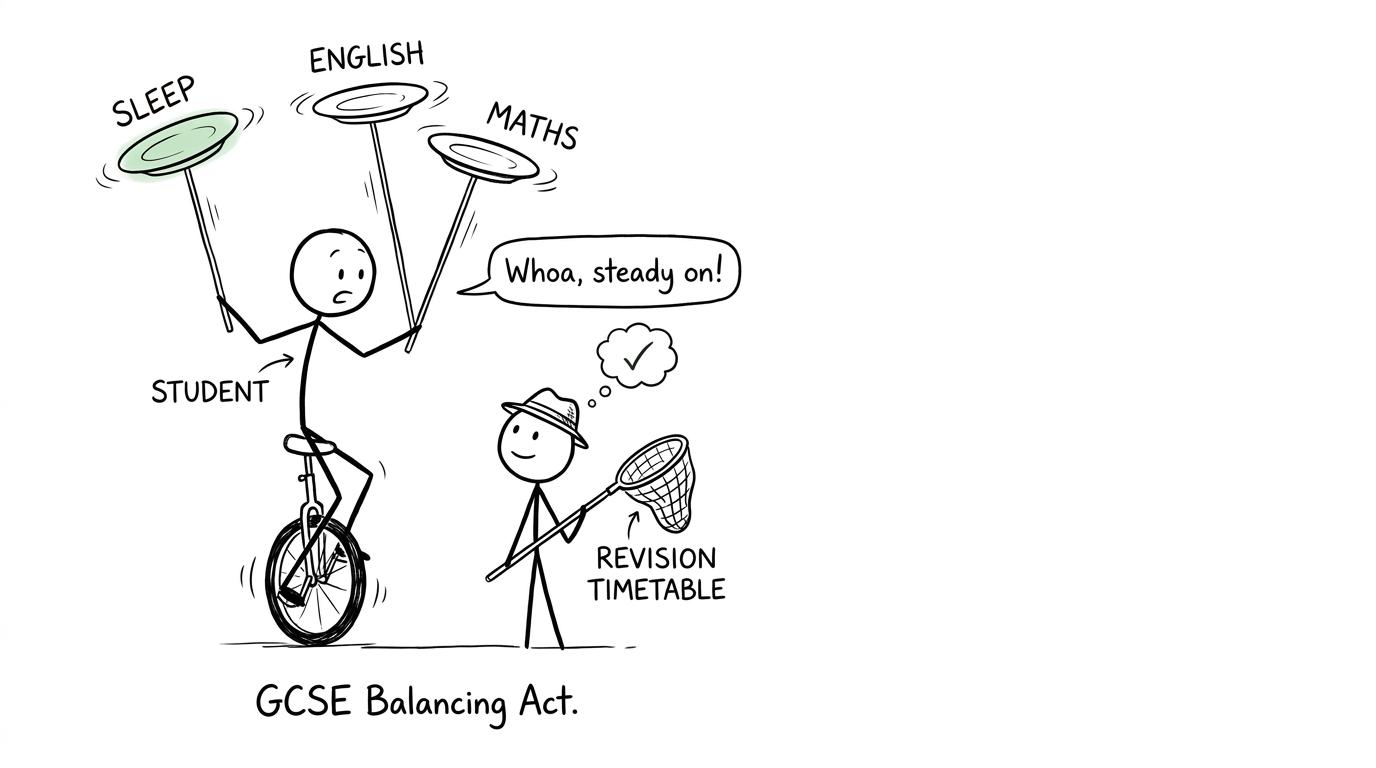 A student balancing English, maths and sleep above a timetable safety net
Common mistakes when comparing the courses
Assuming the school course name is the certificate title
“English Language and Literature” may be an informal name for two separate GCSEs in England. Check your entry information before assuming you need another Language qualification.
Looking only at reading questions
The reading overlap can make the courses appear almost identical. Original writing, technical accuracy, set-text knowledge and contextual analysis reveal the more important differences.
Comparing different exam boards as though they were identical
AQA, Edexcel, OCR, Eduqas and CCEA organise assessment differently. Use the specification and papers for your own board.
Choosing solely because one subject feels easier
Familiarity is not the same as fit. Consider which activities you enjoy, which assessment style suits you and how the course affects your wider revision load.
Revising passively
Rereading notes can feel productive in English and maths while revealing very little about exam readiness. In maths, use mini tests for focused retrieval, then mark and correct them. The same principle applies to English: attempt a real task, seek feedback and improve the response.
For full-paper preparation, follow the past paper revision cycle: complete, mark, diagnose, repair and retest. You can also use the weak-topic diagnostic method to stop confident topics taking revision time from fragile ones.
The sensible next step
There is genuine overlap between GCSE English Language and Literature and standalone GCSE English Language. Close reading, inference, evidence, comparison and analysis all transfer. The decisive differences are Language's emphasis on unseen sources, original writing, audience, purpose and technical accuracy.
First, ask your teacher for the exact qualification title, exam board and specification code. Confirm whether you already receive a standalone English Language result and whether another course is actually available. Then inspect its assessments and decide whether you enjoy the tasks, not merely the name.
While you make that choice, keep maths moving. Use MathsGenie's free revision lessons and practice questions to repair individual topics, mini tests to check recall, and Edexcel GCSE maths papers and predicted papers or the matching section for your board to build exam confidence. Mark schemes and video solutions turn each mistake into a clear next action. That is the purpose of good revision: not doing more for its own sake, but knowing exactly what to do next.










