GCSE English Language and Literature Revision Environment
GCSE English language and literature revision environment advice: discover what genuinely improves focus, memory and effective exam practice at home.
Revision advice often makes the room sound magical. Find the perfect desk, buy the right lamp, arrange colour-coded pens and concentration will apparently follow.
But the honest answer is less decorative. Your GCSE English language and literature revision environment does matter because noise, interruptions and easy access to your phone can compete for your attention. However, the room cannot make ineffective revision effective. A quiet desk used for passive rereading is usually less valuable than an ordinary kitchen table used for focused recall, essay planning and timed practice.
The goal is not to create a flawless study space. It is to remove enough friction that you can think carefully, retrieve knowledge and complete the work you intended to do.
The short answer: how much does your environment matter?
Your surroundings can influence how easily you concentrate, but revision method remains decisive. Use this checklist:
- Reduce speech, notifications and avoidable interruptions.
- Keep only the materials needed for the current task within reach.
- Choose a specific English Language or Literature target before starting.
- Practise producing answers rather than only consuming information.
- Use quieter conditions for close reading, quotation recall and timed writing.
- Make your space comfortable enough to continue, not so comfortable that you drift.
- Test changes against completed work, not against how productive the room looks.
A useful environment protects attention. A useful revision method then turns that attention into something you can retrieve and apply.
Why surroundings can change how much sticks
Attention is limited. When part of it is following a conversation, checking a message or anticipating the next interruption, less is available for understanding an extract or constructing an argument.
Research on distraction and memory consistently indicates that irrelevant speech can disrupt verbal tasks, including reading and short-term recall. This is particularly relevant to English because the material itself is verbal. Song lyrics, nearby conversations and television dialogue may compete with the language you are trying to process.
That does not mean every student needs absolute silence. A predictable background sound may be easier to ignore than an unpredictable conversation. Individual responses also vary. The practical test is simple: can you accurately recall, analyse and write after working in that setting?
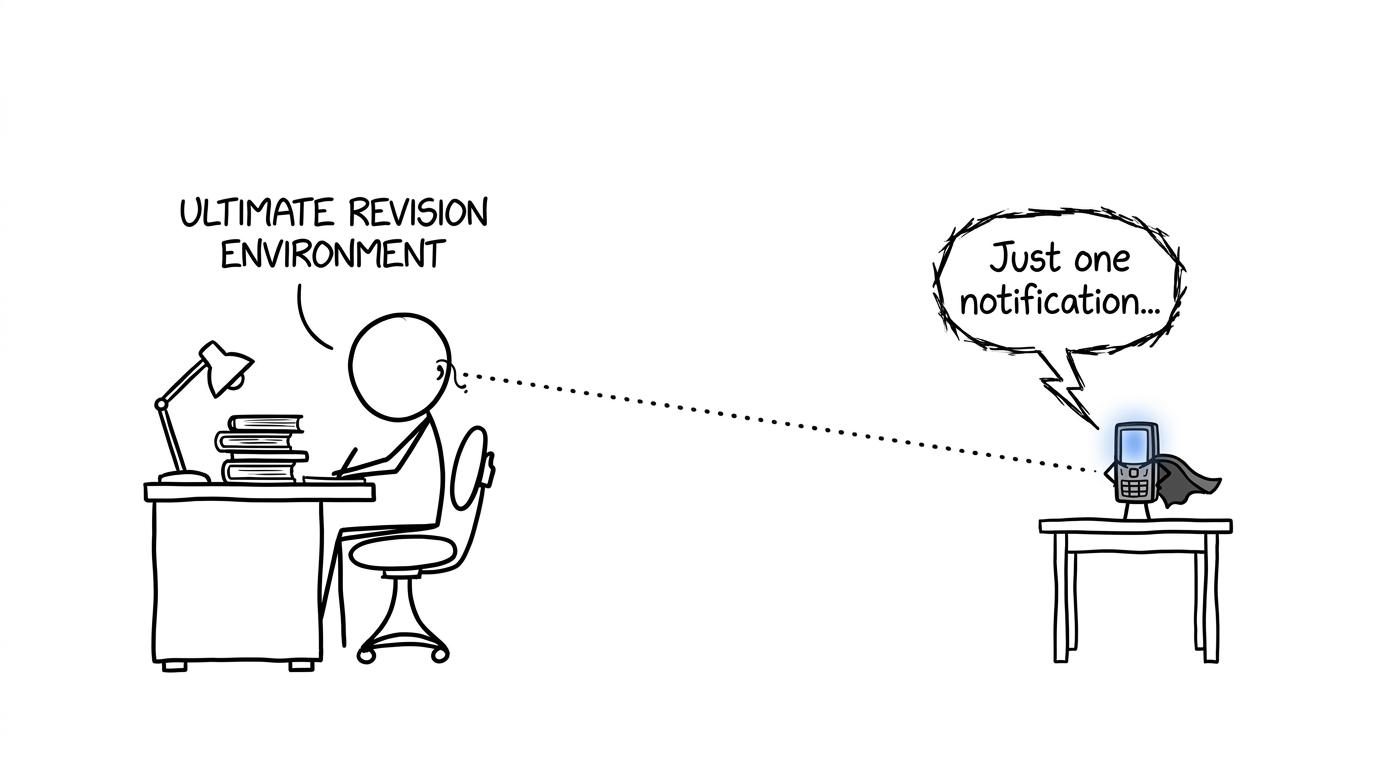 A supposedly perfect revision desk faces its greatest enemy: one notification
Your phone creates two kinds of interruption
The obvious interruption is using it. The quieter interruption is waiting to use it.
A screen beside your book offers a continuous alternative: messages, videos, music controls and searches that become unrelated browsing. Even brief switches can break the thread of an interpretation or paragraph.
For demanding sessions, put the phone outside arm's reach, activate Do Not Disturb and use a separate timer if possible. If you need the device for a text or lesson, close unrelated apps and decide in advance what you are opening.
This does not require a dramatic digital detox. It requires a boundary that survives one revision session.
Clutter matters mainly when it asks for attention
A desk does not need to resemble a showroom. Some students work comfortably among books; others find visible piles distracting. The important distinction is between harmless mess and objects that prompt another activity.
Before beginning, place the relevant text, question, paper and pen in front of you. Move unrelated homework, gaming equipment and unopened post aside. This small reset reduces decisions once the session has started.
English Language and Literature need different conditions
GCSE English Language and English Literature overlap, but their revision demands are not identical. Your environment should support the task rather than follow one rigid rule.
Revising GCSE English Language
English Language rewards reading, interpretation, comparison and controlled writing. Depending on your exam board, such as AQA, Edexcel, OCR or Eduqas, the precise papers and question structures differ. Check your specification and teacher guidance rather than borrowing another board's routine.
Useful Language revision includes:
- annotating unseen extracts without assistance;
- planning responses to specific question types;
- writing under an appropriate time limit;
- checking whether each paragraph answers the question;
- editing for clarity, spelling, punctuation and sentence control.
For these tasks, a quiet environment is valuable because it allows close attention to unfamiliar wording. When completing timed work, make the setting more exam-like: sit at a table, remove notes and avoid pausing the timer.
Revising GCSE English Literature
Literature revision involves secure knowledge of texts, characters, themes, methods, contexts and carefully selected references. Requirements vary by specification, so confirm which texts you study and what material is supplied in the examination.
Your environment should help you move between learning and retrieval. You might first review a theme, then close the notes and reconstruct an essay plan or quotation map from memory. This act of retrieval is more revealing than reading the same page again.
Applied research generally supports retrieval practice as a useful learning strategy. It is not guaranteed to outperform every alternative in every situation, but regularly trying to recall material exposes gaps that familiarity can hide.
The same principle supports maths revision. MathsGenie's guide to using GCSE past papers properly follows a comparable cycle: attempt, mark, diagnose, repair and retest.
The best place is one you can use consistently
A silent library may be excellent, but not if reaching it consumes the only time you had available. A bedroom may be convenient, but not if the bed and games console reliably end the session.
There is no universally correct location. Consider:
- A school or public library: usually structured and relatively quiet, although opening times and travel matter.
- A classroom or school revision space: useful when available, especially if home is busy.
- A desk at home: convenient and easy to personalise, but digital and household distractions need managing.
- A kitchen or dining table: less private, yet often better for accountability and upright written work.
- A shared space: workable when you agree on a protected period with other people.
If your home is noisy or crowded, that is not a personal failure. Ask your school whether supervised revision rooms or library access are available. Earplugs or headphones without lyrics may help where safe and appropriate, but they cannot remove every interruption.
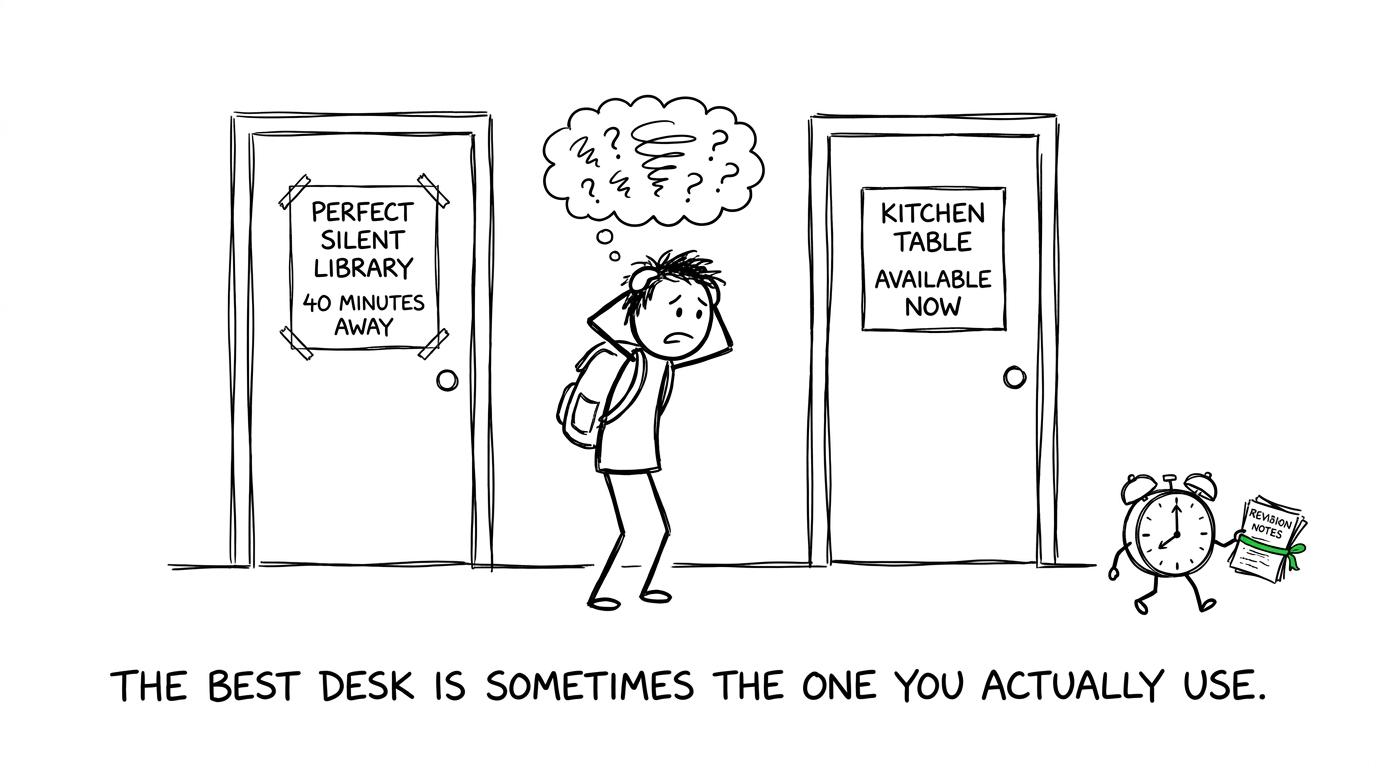 A student loses revision time while choosing between a distant perfect library and an available kitchen table
Consistency also reduces the effort of beginning. A regular place, approximate start time and opening routine can become a cue to work. The GCSE maths revision timetable guide explains how repeatable sessions can fit around school and other subjects without relying on heroic bursts of motivation.
Build a revision environment that produces work
The quality of a session should be judged by its output. Did you retrieve quotations? Complete an essay plan? Analyse an unseen extract? Finish and review a timed response?
Set one visible target
Write down one outcome before you begin. Avoid vague targets such as “revise English”. Choose a bounded task such as planning a Literature essay, recalling evidence for one character or completing a Language reading question.
This approach is equally important when English competes with maths for revision time. Use the GCSE Maths revision hub to select a particular topic, board or paper rather than opening several resources without a plan. Edexcel students can narrow this further through the Edexcel GCSE Maths revision area.
Prepare before the timer starts
Gather the question, text, notes and mark scheme first. Fill a drink and tell other people when you would prefer not to be interrupted. Preparation should be brief; otherwise, arranging the environment becomes procrastination wearing sensible clothes.
Separate learning from testing
Notes belong in the learning phase. They should disappear during the testing phase.
If every quotation, interpretation or method is copied while visible, you measure recognition rather than recall. Close the book, produce what you can, then reopen it to check. For maths, MathsGenie's self-study guidance uses the same progression from lessons to questions, marking and later retesting.
Practise in exam-like conditions sometimes
Not every session needs silence and a timer. Early learning can be supported, collaborative and exploratory. However, some practice should resemble the conditions under which you must eventually perform.
Complete occasional English responses without notes or interruptions. For maths, choose the correct board and tier, then use questions under realistic conditions. The OCR GCSE Maths revision plan shows how shorter timed sections can build towards longer papers.
Test whether your environment is actually helping
Do not rate a space by mood alone. Run a simple comparison across several sessions.
Keep the task difficulty and session length broadly similar, then record:
- whether you started on time;
- how often you switched tasks;
- what you completed;
- what you could recall afterwards;
- what the marking or feedback revealed.
If instrumental music feels helpful but your written analysis becomes less precise, the output matters more than the feeling. If moderate background sound helps you settle and your work remains accurate, complete silence may not be necessary.
Change one feature at a time. Move the phone, reduce lyrical music or try a different chair. Changing everything at once makes it impossible to know what helped.
Common revision environment mistakes
Designing the desk instead of revising
Tidying can support focus, but repeated rearranging is not preparation once the materials are usable. Set a short limit for setup and begin the task.
Assuming quiet automatically means effective
Silence cannot repair passive revision. Rereading notes may feel fluent because the material is familiar, yet the examination asks you to produce ideas without seeing those notes.
Revising on the bed by default
Reading on a bed is not forbidden. However, extended writing is usually easier at a stable surface, and separating rest from demanding work may make both activities clearer.
Keeping notifications visible
Turning the phone face down still leaves it within reach. For difficult reading or writing, increase the physical distance.
Making every session exam-like
Constant timed work can identify weaknesses without teaching them. Alternate between learning, retrieval, deliberate practice and realistic assessment.
The best order for learning GCSE Maths topics applies this balance by moving from lessons and topic questions towards mini tests, past papers and predicted papers.
Copying someone else's perfect routine
One student may thrive in a library; another may spend the whole session feeling watched. Build around your task, practical circumstances and evidence from your completed work.
Your environment matters, but your actions matter more
A better revision environment does not insert quotations into memory or turn an empty page into a strong argument. It creates the conditions in which those things become easier to practise.
Start modestly. Choose a usable table. Remove one predictable distraction. Set one clear task. Produce something without notes, check it and record what needs improvement. That is enough to discover whether your surroundings are helping rather than merely looking helpful.
Then carry the same discipline into maths. Open the MathsGenie GCSE Maths revision hub, choose your exam board and tier, and begin with one weak topic. Use free revision lessons and practice questions to rebuild it, mini tests to check recall, and past papers or predicted papers to practise under pressure. Mark schemes and video solutions then show you exactly what to repair.
The perfect room is optional. A repeatable cycle of focused work, honest feedback and retesting is not.