

GCSE English Language and Literature Revision Burnout
GCSE English Language and Literature revision burnout can derail May. Spot the early signs, pace your workload and protect time for GCSE maths.
The dangerous moment in revision is not always the night before an exam. Sometimes it arrives quietly in April: you reread the same page, remember almost nothing and decide the solution must be another two hours at your desk.
GCSE English Language and Literature revision burnout is best avoided by noticing changes early, reducing unproductive work and following a sustainable routine. Use short, specific sessions; alternate recall with exam practice; protect sleep and breaks; and keep enough energy for maths and your other GCSE subjects. You do not need to revise everything every day.
That matters because May is not one exam. It is a sequence of them. Spending all your energy memorising quotations can leave very little concentration for algebra, geometry or the next English paper.
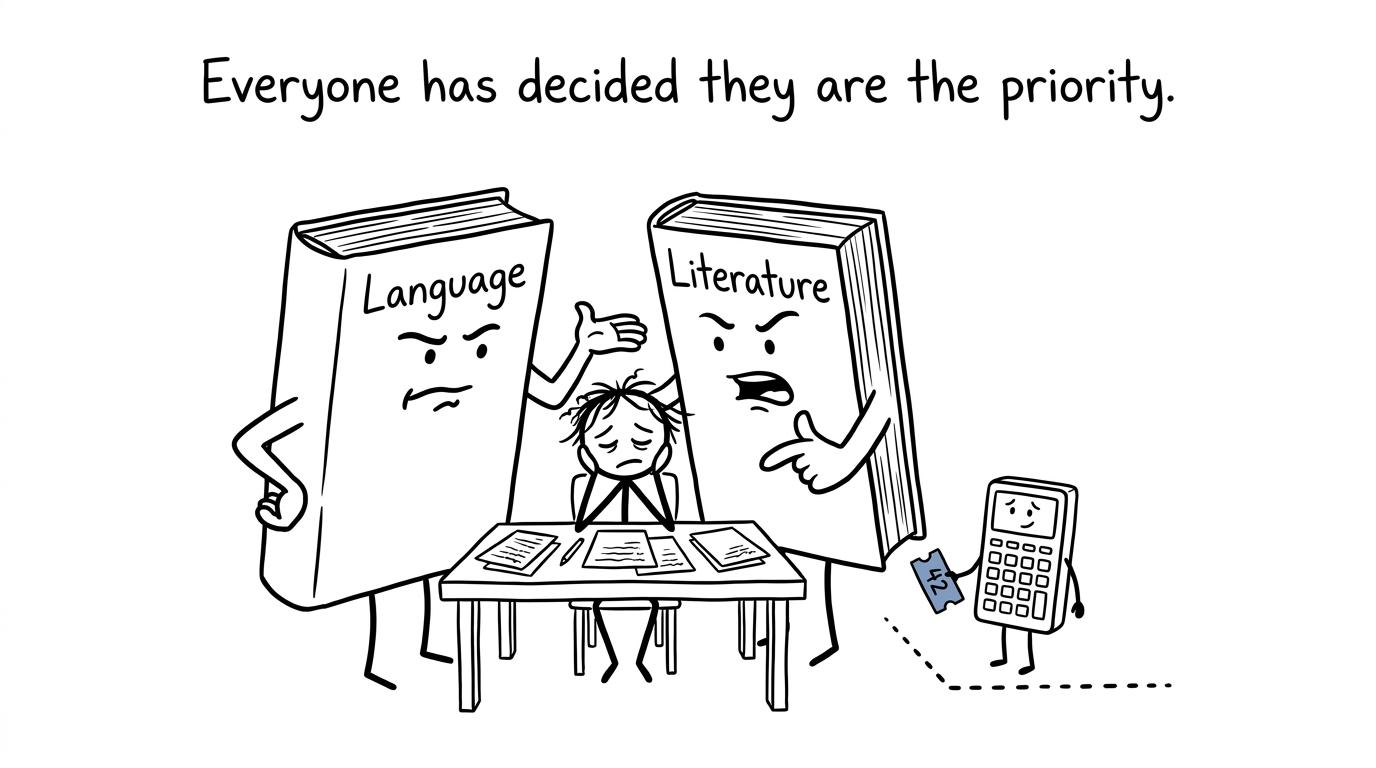 A calculator waits behind English Language and Literature books in the revision priority queue
Your anti-burnout checklist
Use this as a simple starting point:
- Check the specification for your own exam board and revise only what you need.
- Turn vague goals into small tasks with a clear finish.
- Mix quotation recall, planning and timed writing instead of repeatedly reading notes.
- Schedule maths separately so English does not consume the entire evening.
- Take regular breaks away from your desk and screen.
- Protect a consistent sleep routine, especially as exams approach.
- Keep some time for exercise, meals, friends and ordinary life.
- Reduce the plan when concentration or wellbeing begins to deteriorate.
- Speak to a trusted adult if stress is persistent or affecting daily life.
The principle is simple: a revision plan should preserve your ability to return tomorrow. If today’s schedule makes tomorrow impossible, it is too heavy.
Early signs that revision pressure is becoming too much
Burnout is often used informally rather than as a precise diagnosis. What students commonly notice is an accumulation of stress, tiredness and disengagement. The NHS lists possible signs of exam stress including irritability, persistent worry, poor sleep, headaches or stomach pains, difficulty concentrating, changes in appetite, low mood and losing enjoyment in usual activities.
One difficult evening does not automatically mean you are burning out. Look for a pattern.
Your work takes longer but produces less
You may spend an hour highlighting a chapter without being able to explain its central idea afterwards. A practice response that would normally take a manageable amount of effort begins to feel impossible. You remain at the desk because leaving feels guilty, not because useful learning is happening.
Treat that as information. Stop, rest and make the next task smaller.
You avoid starting or cannot stop
Avoidance and overworking can be different expressions of the same pressure. One student may delay every essay plan. Another may revise late into the night because stopping feels unsafe. Neither pattern creates reliable preparation.
A sustainable session has boundaries: a defined task, a reasonable duration and a stopping point.
Every subject begins to feel like an emergency
English Literature can feel endless because there are always more quotations, themes and interpretations to revisit. English Language can create a different worry: unseen texts make some students feel that they must practise every possible question.
Then maths appears, followed by science and the rest of the timetable. When everything feels urgent, prioritisation disappears. The answer is not to work on all subjects simultaneously. It is to decide what deserves attention today and what can wait.
Stress is affecting ordinary life
Pay attention if revision is consistently disrupting sleep, eating, relationships or activities you normally enjoy. Talk to a parent, carer, teacher, form tutor or another adult you trust. If anxiety or low mood is severe, persistent or interfering with everyday life, NHS guidance recommends seeking further support; a GP is one appropriate place to begin.
Revision advice is not a substitute for mental health support.
Why English revision can expand without limit
English tasks often lack an obvious finish. You can always learn another quotation or improve another paragraph. Maths usually offers firmer boundaries: complete a topic set, mark it and record the errors.
Borrow that clarity for English.
Instead of writing “revise Macbeth”, choose one outcome:
- retrieve quotations for one character without notes;
- plan one response to a theme;
- analyse how one quotation supports two interpretations;
- complete one timed Language question;
- compare your response with the relevant mark scheme.
Check your own specification first. AQA, Pearson Edexcel, OCR and Eduqas use different paper structures, prescribed texts and timings. English Language and English Literature are separate qualifications, and unlike GCSE maths they are not divided into foundation and higher tiers. Your teacher and current exam-board specification should determine what you revise.
In England, GCSE English Language examinations assess reading through unseen material, so memorising model answers cannot cover every text. The more durable preparation is learning how to identify ideas, select evidence, analyse language and structure, evaluate writing, compare perspectives where required, and communicate accurately.
Pace English revision so you still have energy in May
A good plan is not the maximum amount you could survive on your best day. It is an amount you can repeat during an ordinary week.
Work in focused blocks
Choose one task for a block of roughly 252525 to 454545 minutes, depending on your concentration and the task. Follow it with a genuine break. A complete timed paper needs longer, but it should not be the default every evening.
During the break, move away from the work. Get water, stretch, walk or speak to somebody. Scrolling through revision videos while worrying about revision is not much of a recovery period.
NHS guidance encourages realistic schedules, manageable chunks and regular short breaks. It also says that most teenagers need around 888 to 101010 hours of sleep and warns that all-night cramming is generally a poor trade for rest and concentration.
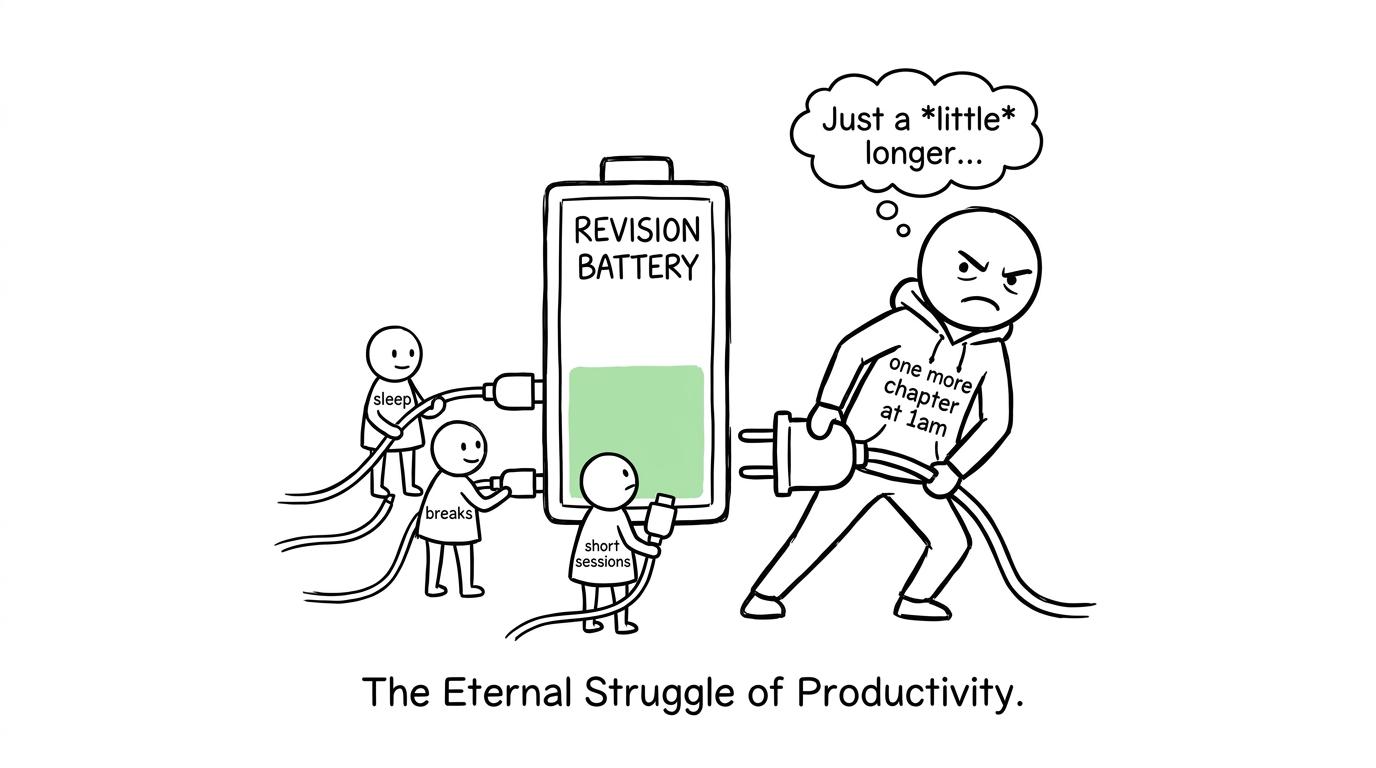 Sleep, breaks and short sessions recharge a student's revision battery
Rotate the type of English work
Do not ask one revision method to carry the whole subject. A balanced English cycle might include:
- Recall: retrieve quotations, themes or terminology without notes.
- Planning: organise arguments and select evidence without writing a full response.
- Analysis: explain precisely how evidence supports an interpretation.
- Timed practice: answer a suitable question under controlled conditions.
- Feedback: use teacher comments or a mark scheme to identify one improvement.
- Revisit: return to that improvement in a later session.
This is active enough to reveal gaps, but varied enough to prevent every session becoming another exhausting essay.
Leave space between demanding tasks
If you have completed a timed Literature response, the next task need not be a full maths paper. Switch to a shorter activity: quotation retrieval, a maths mini test or reviewing previous corrections.
MathsGenie’s GCSE maths revision hub helps you choose a board-specific lesson or question set without spending energy searching. On a crowded evening, a focused task is often more useful than opening an entire paper.
The one-month GCSE maths revision plan also shows how diagnostic work, retrieval and targeted practice can fit into a repeatable week.
Balance English with GCSE maths
The goal is not to give every subject identical time. It is to stop the loudest subject taking all of it.
At the start of each week, look at school commitments, upcoming assessments and weaknesses. Allocate sessions before the week becomes busy. You might give English Literature more attention before its first paper while preserving shorter maths sessions to maintain fluency.
For maths, use evidence rather than anxiety. The guide to finding your weakest GCSE topics explains how to turn lost marks into a focused revision list. That list reduces decision fatigue: instead of “do maths”, your task becomes “review one weak topic and answer a short set”.
When concentration is limited, use a mini test, revision lesson or a section of a paper. Save full papers for planned sessions when you can mark and review them properly. MathsGenie’s past-paper library brings papers and official mark schemes together, while the guide to using GCSE past papers properly explains the paper, mark, fix and retest cycle.
Edexcel students can go directly to Edexcel GCSE maths past papers. Whatever your board, match the paper to your specification and, for maths, your foundation or higher tier.
Build a lighter plan for difficult days
Your schedule needs a reduced version. Without one, a tired day can become either a marathon or a complete collapse.
Create three levels:
- Normal day: one focused English block and one focused maths or science block.
- Busy day: one short retrieval task plus one small set of questions.
- Recovery day: organise materials, review a few corrections, then stop and rest.
A recovery day is not a failed revision day. It is part of pacing. You are protecting the attention that later sessions require.
Before bed, write down the first task for tomorrow. Make it concrete and small. This removes the morning decision and makes starting easier.
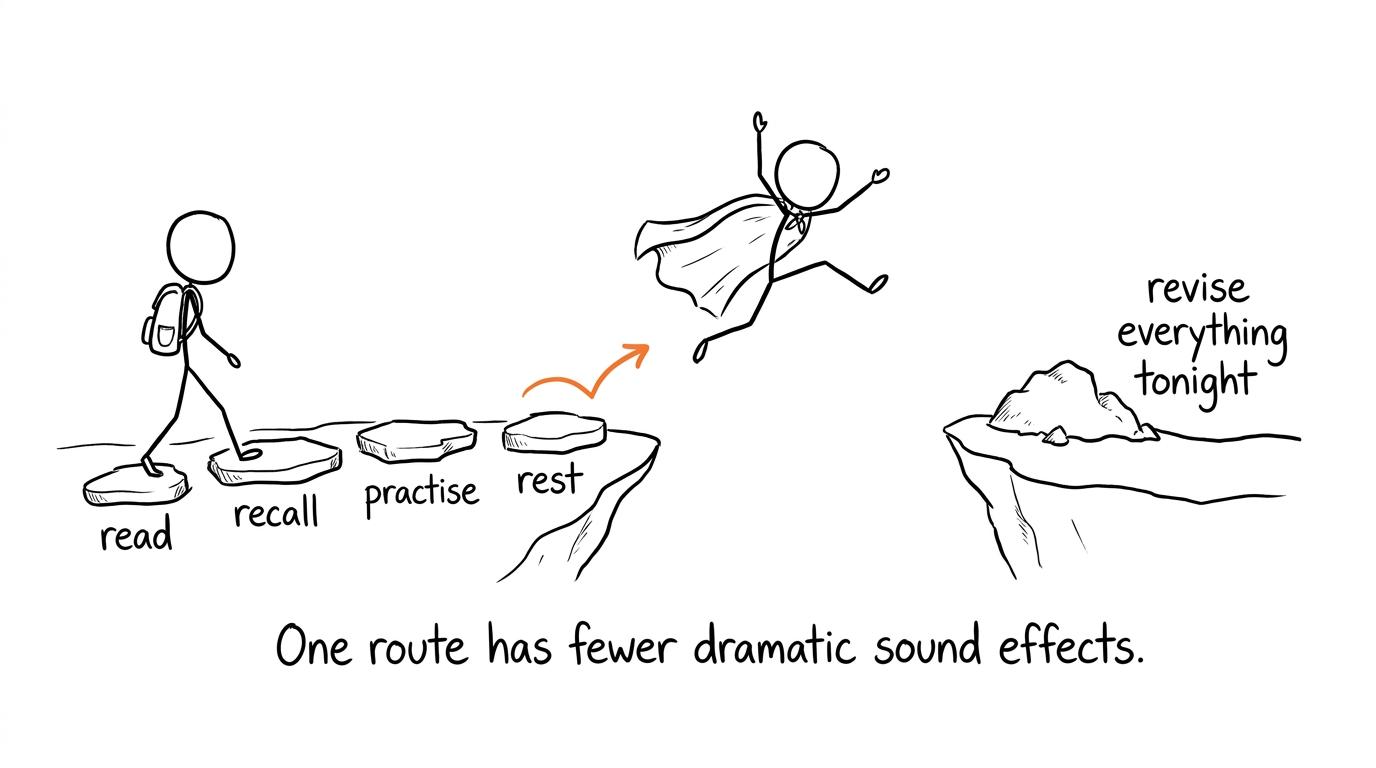 A student uses small revision stepping stones instead of attempting one enormous leap
Common mistakes that increase revision burnout
Measuring progress by hours alone
Time at a desk is not the same as learning. Measure completed retrieval, marked practice and corrected misunderstandings. A focused half-hour can be more valuable than an unfocused evening.
Making a timetable with no spare capacity
Plans fail when every minute is assigned. Homework takes longer, family plans change and tiredness happens. Leave some sessions unallocated so one disruption does not destroy the week.
Writing full essays every time
Timed responses matter, but plans, introductions, evidence selection and paragraph-level practice can target particular skills with less fatigue. Follow your teacher’s guidance on the right balance.
Sacrificing sleep to catch up
Late-night work can feel productive because it is visible. The cost arrives the next day through poorer concentration and greater irritability. Set a stopping time. The GCSE maths night-before plan applies the same principle: choose a little useful work, prepare properly and stop.
Using predicted papers as predictions of certainty
Predicted papers provide fresh exam-style practice, not guaranteed exam content. Use MathsGenie’s GCSE predicted papers after topic revision and official past-paper work, then study the mark scheme and repair the weaknesses they expose.
Comparing workloads with friends
A friend’s revision hours reveal little about their concentration, starting point or other commitments. Build a plan from your own evidence and wellbeing. Consistency is more useful than competing over exhaustion.
Arrive in May with something left
The purpose of revision is not to prove how much discomfort you can tolerate. It is to make useful knowledge and habits available in the exam hall.
Spot the warning signs early. Shrink vague English goals into finishable tasks. Rotate recall, planning, practice and feedback. Protect sleep, breaks and ordinary life. Most importantly, leave enough attention for every paper still ahead of you.
MathsGenie can make the maths side of that balance simpler. Start with the free GCSE revision hub, use revision lessons and practice questions to repair individual gaps, check your work with mark schemes and video solutions, then build stamina through mini tests, past papers and predicted papers. Choose one manageable task today, and finish while you still have the energy to return tomorrow.










