

GCSE English Language and Literature Grade 5 Meaning
GCSE English Language and Literature grade 5 meaning explained: ability, old letter-grade comparisons, progression and what to do next.
A results slip can compress two years of reading, writing and revision into a single digit. That makes the digit look simpler than it is. If you are searching for the GCSE English Language and Literature grade 5 meaning, the short answer is this: a grade 5 is officially described as a strong pass. It sits above the grade 4 standard pass and spans part of the territory covered by the old grades C and B.
But English Language and English Literature are separate GCSEs. A grade 5 in Language reflects secure reading, analysis and writing skills. A grade 5 in Literature reflects a generally clear, engaged understanding of studied texts, supported by relevant references and awareness of writers’ methods and contexts.
Neither result means perfection. Both show that you can communicate and interpret ideas beyond the minimum pass standard.
Grade 5 at a glance
- Grade 5 is called a strong pass in England.
- Grade 4 is the standard pass and is aligned with the bottom of the old grade C.
- Grade 5 broadly covers the upper part of the old grade C and lower part of the old grade B.
- English Language and English Literature receive separate grades.
- Grade boundaries change between exam series, subjects and exam boards.
- A grade is based on your total assessed performance, not one isolated strength or mistake.
- Colleges, sixth forms, apprenticeships and employers set their own entry requirements, so always check the exact wording.
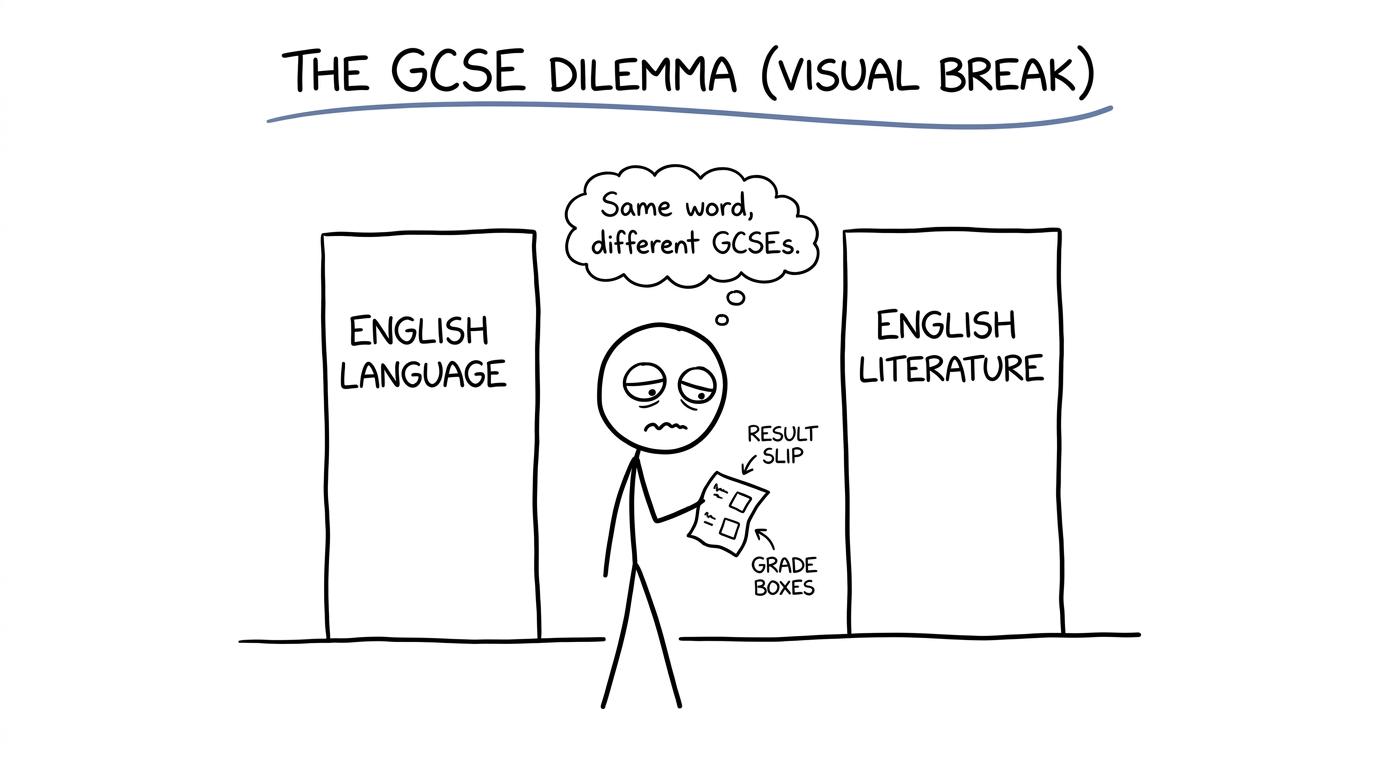 A student choosing between separate English Language and English Literature result doors
What does a grade 5 mean in the current GCSE system?
GCSEs in England use grades 9 to 1, with grade 9 being the highest. The numbered system replaced the former A* to G scale for English Language, English Literature and maths in 2017.
The scales do not match grade for grade. Official guidance gives three firm comparison points: the bottom of grade 7 aligns with the bottom of the old grade A, the bottom of grade 4 with the bottom of grade C, and the bottom of grade 1 with the bottom of grade G.
Grade 5 lies between those fixed points. When the system was designed, it was positioned across the top third of the old C range and the bottom third of the old B range. That is why it is commonly summarised as a high C or low B.
| Current grade | Official or broad interpretation | Old-scale comparison |
|---|---|---|
| Grade 7 | Strong achievement | Bottom aligned with old grade A |
| Grade 6 | Above a strong pass | Within the old B range broadly |
| Grade 5 | Strong pass | Upper C to lower B broadly |
| Grade 4 | Standard pass | Bottom aligned with old grade C |
| Grade 3 | Below the standard-pass threshold | Below old C threshold broadly |
The comparison is deliberately approximate. Saying that grade 5 simply “equals a B” or “equals a C” removes the distinction the numbered scale was created to provide.
What ability does grade 5 represent in English Language?
English Language assesses how well you understand and respond to unfamiliar texts, as well as how effectively and accurately you write. The precise paper structure differs across AQA, Edexcel, OCR and Eduqas specifications, but the regulated qualification assesses common reading and writing objectives.
Official grade descriptors indicate that a typical grade 5 candidate can:
- summarise and evaluate texts with accuracy and clear understanding;
- respond validly to both explicit information and implied meanings;
- analyse relevant choices in language, grammar and structure;
- support interpretations with suitable textual references;
- make credible comparisons and links between texts;
- write coherent, purposeful and well-structured responses;
- sustain the reader’s interest;
- adapt vocabulary and sentence structures to purpose and effect; and
- use spelling, punctuation and grammar accurately, although occasional errors may remain.
In ordinary terms, a grade 5 reader does more than retrieve facts. They can recognise a viewpoint, explain how a writer creates an effect and select evidence that genuinely supports an interpretation.
A grade 5 writer can usually organise ideas into a controlled response and make choices suited to the form, audience and purpose. The writing may not have the precision or sophistication associated with the highest grades, but it communicates effectively.
These descriptors describe typical performance across the qualification. They are not a checklist used mechanically on every answer, nor do they mean that every grade 5 student has exactly the same profile. One student may be stronger in creative writing; another may gain more marks through analytical reading.
If English Language is approaching, the GCSE English Language exam-week checklist offers a calm way to protect English preparation while keeping maths active.
What ability does grade 5 represent in English Literature?
English Literature is different. You are assessed on your response to literary texts rather than your ability to produce transactional or creative writing.
At grade 5, official descriptors indicate that a candidate can generally:
- develop a coherent and engaged response to explicit and implicit meanings;
- show clear understanding of how writers use language, form and structure;
- use apt references from the text;
- use contextual understanding to inform an interpretation; and
- make credible comparisons where the question requires them.
The important word is develop. A grade 5 response normally moves beyond naming a technique or retelling the plot. It begins to explain how evidence supports an idea about a character, theme or writer’s purpose.
However, a grade 5 does not require every quotation to be perfectly recalled or every interpretation to be unusually original. Examiners reward the quality of the response actually written: a relevant argument, appropriate evidence and clear analysis matter more than pages of memorised material that do not answer the question.
Why Language and Literature grades must be read separately
The phrase “English grade” can cause unnecessary confusion. Most students receive one grade for GCSE English Language and another for GCSE English Literature. You might therefore earn grade 5 in Language and grade 4 in Literature, or the reverse.
Those results describe different performances:
- English Language focuses on reading unseen material, comparing viewpoints, evaluating writing and producing effective original responses.
- English Literature focuses on interpreting studied prose, drama and poetry through textual evidence, writers’ methods and relevant context.
A combined average is not normally printed as your GCSE English grade. When a course asks for English, check whether it specifies English Language, English Literature or accepts either qualification.
For the current 16-to-19 funding condition in England, an eligible grade 4 or above in either GCSE English Language or English Literature can meet the English prior-attainment requirement. That funding rule should not be confused with an individual course requirement: a college, apprenticeship or employer may specifically request English Language.
Does grade 5 count as a pass?
Yes. Grade 5 is a strong pass, while grade 4 is the standard pass.
The practical distinction matters. A requirement that previously asked for an old grade C should generally be read as grade 4 under official comparison guidance. An organisation may choose to ask for grade 5 or above, but that is its own entry threshold rather than proof that grade 4 is a failure.
A grade 5 can satisfy many progression requirements, but there is no universal rule covering every sixth form, A Level course, apprenticeship, employer or university. Some courses ask for grade 4 in English Language; others require grade 5 or 6. More selective courses may set higher subject-specific conditions.
Read the published requirement carefully and ask the provider if it is ambiguous. The words “English”, “English Language” and “English Language or Literature” are not always interchangeable.
Grade boundaries are not fixed percentages
A grade 5 does not permanently correspond to one percentage. Exam boards set qualification-level grade boundaries after the papers have been taken and marked, maintaining comparable standards while accounting for differences in paper demand.
Boundaries can therefore vary between AQA, Edexcel, OCR and Eduqas, between Language and Literature, and from one exam series to another. Before results day, any claimed boundary is only an estimate. The official boundary is the minimum total mark required for that grade in that particular qualification and series.
If you are interpreting a Language result, use the correct board, specification and series. The GCSE English Language grade boundaries guide explains why an overall mark must be compared with the matching official boundary rather than a generic percentage found online.
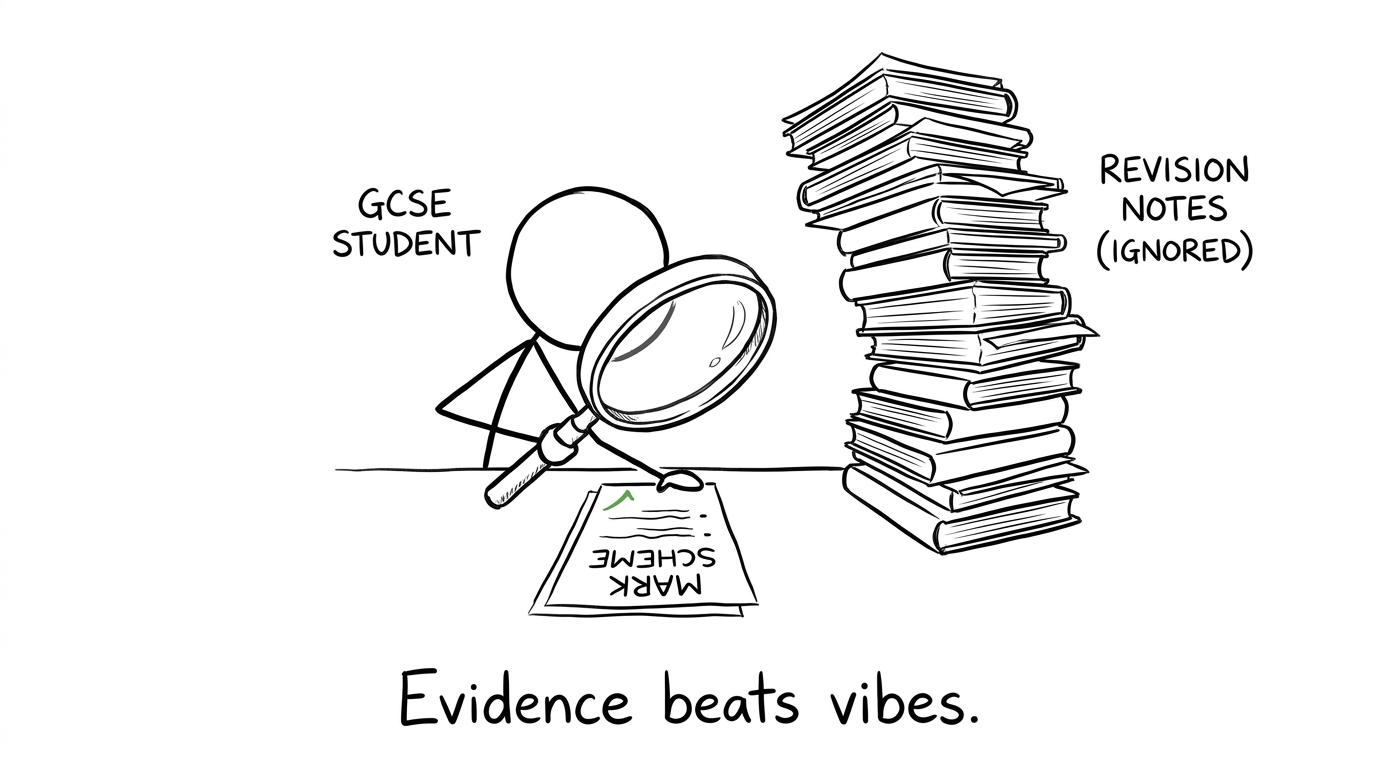 A student inspecting a mark scheme while ignoring a huge pile of notes
What should you do if you are currently working at grade 5?
First, decide what the grade means for your next step. If your intended course requires grade 4, a secure grade 5 gives you useful headroom. If it requires grade 6, treat grade 5 as evidence that the foundations are present and identify where the next marks are being lost.
Avoid revising “all of English” at once. Use marked work to separate the problem:
- Is your argument answering the exact question?
- Are quotations or references relevant and well integrated?
- Does analysis explain effects rather than merely identify techniques?
- In Language, are you adapting register and structure to the task?
- Are accuracy errors reducing the clarity of your writing?
- Are timing problems leaving responses unfinished?
Then practise the smallest skill that addresses the pattern. A mark scheme is useful because it turns a disappointing mark into information.
The same principle works in maths. Start from the GCSE Maths revision hub, choose your exam board and tier, and use GCSE mini tests to locate specific gaps. The GCSE revision guides can then rebuild the relevant methods before you return to exam questions.
Balancing English and maths revision
English can expand to fill every available evening because there is always another quotation to revisit or response to plan. Maths can do the same with another worksheet. A sensible timetable gives each subject a defined purpose.
For example, one English session might focus only on planning a Literature argument. One maths session might focus only on a topic exposed by a mini test. Clear endpoints reduce the temptation to reread notes indefinitely.
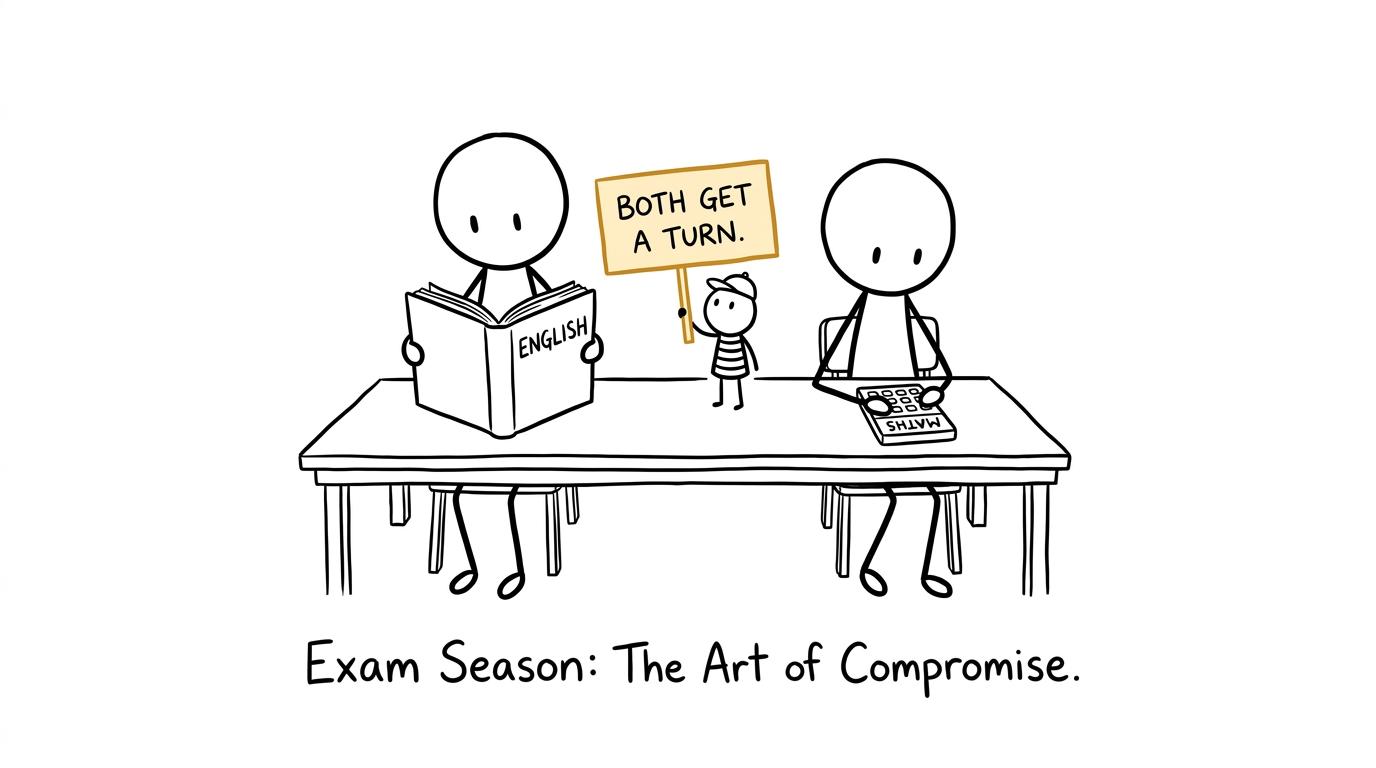 English and maths calmly taking turns at a shared revision desk
Use the GCSE maths revision timetable to create repeatable sessions rather than relying on last-minute motivation. When you move into full-paper preparation, follow the process in how to use GCSE past papers properly: attempt, mark, diagnose, repair and retest.
English and maths reward different forms of expression, but their revision logic is similar. Evidence beats guesswork. Specific practice beats vague effort.
Common mistakes when interpreting a grade 5
Calling it exactly equivalent to an old B
Grade 5 crosses part of the old C and B territory. “High C or low B” is a useful broad description, not an exact conversion for every candidate.
Treating grade 4 as a fail
Grade 4 is the official standard pass. Grade 5 is a strong pass. An institution may require grade 5, but that does not redefine grade 4 nationally.
Combining Language and Literature into one result
They are separate qualifications with separate assessments and grades. Always check which one a progression requirement names.
Assuming a fixed percentage guarantees grade 5
Grade boundaries vary by board, qualification and series. Only the official boundary for the paper set you completed can interpret your total accurately.
Believing grade 5 means the same skill profile for everyone
A final grade combines performance across the assessment. Two students can reach the same grade through different strengths and weaknesses.
Letting one result consume the whole revision timetable
If you are preparing for several GCSEs, respond proportionately. Maintain stronger subjects while giving targeted time to the skills that need improvement. The GCSE Maths topics by board and tier guide can help prevent maths revision becoming an unfocused list.
A strong pass is a platform, not a label
A grade 5 in GCSE English Language or Literature represents secure, credible performance above the standard-pass threshold. Broadly, it sits between the upper part of the old C and lower part of the old B. In Language, it signals effective reading, analysis and purposeful writing. In Literature, it signals a coherent understanding of texts supported by relevant evidence and analysis.
The digit tells you where the assessed performance landed. It does not tell you what you can become next.
Keep that perspective across your GCSE preparation. Use MathsGenie’s free revision lessons and practice questions to repair individual maths skills, mini tests to check whether they have stuck, and past papers, predicted papers, mark schemes and video solutions to develop exam confidence. Choose one specific next action today; then let the evidence from your work decide the one after that.











