GCSE English Language 4 to 6: A Practical Guide
GCSE English Language 4 to 6 guidance: improve analysis, comparison, writing accuracy and exam timing with a focused, repeatable revision plan.
A grade 4 often means you understand the text and can communicate a sensible response. The problem is that sensible is not always developed. You may identify a technique without exploring it, choose evidence without using it closely, or write clearly without shaping the reader’s reaction.
Moving GCSE English Language from 4 to 6 is therefore less about learning impressive words and more about becoming consistently precise. You need to explain implicit meanings, analyse deliberate choices, select stronger evidence and control your own writing. Most importantly, you must do those things under timed conditions.
The same principle applies in maths revision: improvement comes from diagnosing the exact reason marks disappear, practising that skill and checking whether the repair worked. MathsGenie’s guide to finding your weakest GCSE topics explains this evidence-led approach.
The grade 4 to grade 6 checklist
Focus on these changes:
- Move from spotting information to interpreting what it suggests.
- Move from naming techniques to analysing their effects in context.
- Select short, precise quotations rather than copying long sections.
- Compare writers throughout a response, not only in the conclusion.
- Make evaluative judgements and support them with evidence.
- Plan writing around purpose, audience and form.
- Organise ideas so that the whole response develops deliberately.
- Vary vocabulary and sentences with control, not for decoration.
- Leave time to correct spelling, punctuation and grammar.
- Practise the exact question styles used by your exam board.
This is not a guaranteed formula for a grade 6. Grade boundaries change between exam series, and examiners award marks across the complete set of assessment objectives. It is, however, a practical description of the habits that tend to separate a secure but straightforward response from a more developed one.
What separates a grade 4 from a grade 6?
There is no national checklist saying that one feature automatically earns a grade 4 or grade 6. GCSE English Language is assessed holistically through questions linked to particular assessment objectives.
Across AQA, Edexcel, OCR and Eduqas, the regulated written assessment objectives cover the same broad abilities: retrieving and interpreting information, analysing language and structure, comparing perspectives, evaluating texts, communicating effectively and writing accurately. Paper structures and question wording differ, so always use the current specification and materials for your board.
Official subject requirements give reading and writing equal weighting at 50%50\%50% each. Technical accuracy under AO6 accounts for 20%20\%20% of the qualification. English Language is untiered, so every candidate is assessed on the same grade scale rather than entering foundation or higher tier.
In broad terms, the difference looks like this:
| Grade 4 tendency | Grade 6 tendency |
|---|---|
| Understands the main idea | Explores explicit and implicit meanings |
| Identifies a method | Analyses how and why the method works |
| Uses relevant evidence | Selects concise evidence and examines it closely |
| Gives a reasonable opinion | Develops a clear, evidence-based judgement |
| Compares obvious content | Connects ideas, perspectives and methods |
| Writes clearly | Writes purposefully with impact on the reader |
| Uses some varied vocabulary | Chooses vocabulary precisely for purpose and tone |
| Shows generally understandable accuracy | Controls sentences and punctuation more consistently |
The key word is control. A grade 6 response does not need to sound like a university essay. It needs to make clear decisions and develop them convincingly.
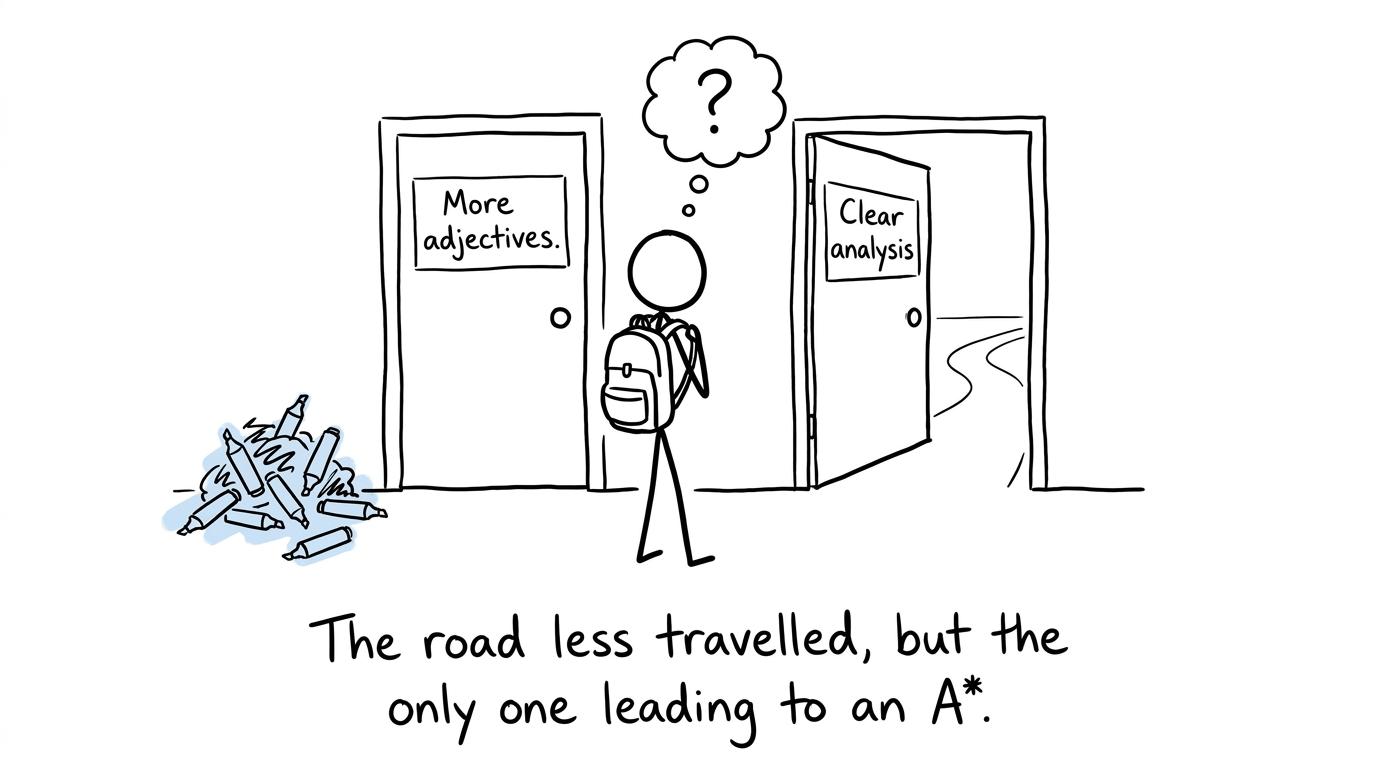 A student chooses clear analysis over a pile of highlighters
Develop interpretations instead of retelling the text
A grade 4 reader can usually explain what happens or what a writer thinks. To move higher, ask what the details imply.
After identifying an idea, use questions such as:
- What does this suggest beyond the literal meaning?
- What attitude is the writer revealing?
- Why might the reader feel sympathy, concern or distrust?
- Does the meaning change elsewhere in the extract?
- Is another interpretation possible?
This prevents your answer from becoming a plot summary. The examiner already knows what happens. Your task is to show what you understand about the meaning beneath the events or statements.
Do not force an unusual interpretation merely to appear sophisticated. A convincing interpretation begins with the text and remains supported by it.
Analyse language and structure precisely
Technique spotting is one of the most common grade 4 habits. A student identifies a metaphor, adjective or short sentence, states that it interests the reader and moves on.
A stronger response treats terminology as the beginning of analysis, not the destination. Examine the specific word or structural decision, explain its associations, connect it to the writer’s purpose and consider the resulting reader response.
The word effectively matters. Avoid claiming that every short sentence “creates tension” or every rhetorical question “makes the reader think”. Effects depend on context. A short sentence might signal shock, finality, certainty, interruption or emotional restraint.
Structure also means more than paragraph length. Consider shifts in focus, perspective, setting, pace, chronology, tone and the order in which information is revealed. Explain how the reader’s understanding changes as the text develops.
Use evidence economically
Long quotations often hide weak analysis. They take time to copy and leave the examiner guessing which words matter.
Select the smallest useful piece of evidence. Then examine it closely. A short quotation can support a developed paragraph if you explain its implications and relationship to the wider text.
Evidence should also match the claim. If your point concerns uncertainty, choose wording that genuinely conveys uncertainty. Do not select the first quotation you notice and build an unrelated interpretation around it.
This resembles choosing the relevant information in a maths problem. More information is not automatically better. Precision makes the reasoning visible.
Compare ideas and methods together
Comparison questions vary between boards, but comparison should normally be sustained rather than bolted onto the end.
Begin with a meaningful connection: perhaps both writers discuss danger, but one presents it as exciting while the other presents it as avoidable. Then explore how each writer constructs that perspective through language, tone, structure or selection of detail.
Useful comparisons address both what the writers communicate and how they communicate it. Avoid producing two separate mini-essays with a brief sentence saying they are different.
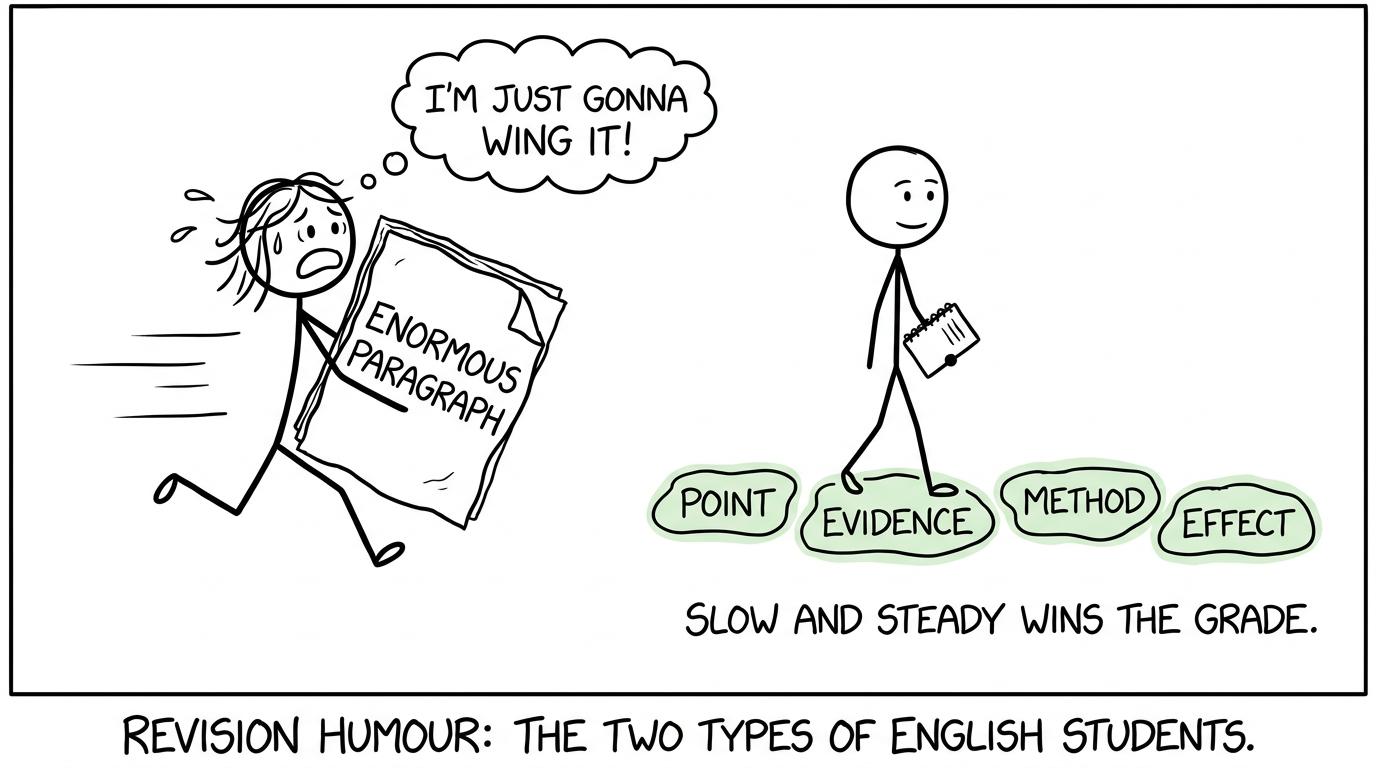 A student crosses an English response using Point, Evidence, Method and Effect stepping stones
Make evaluation sound like a judgement
Evaluation is not simply analysis with the words “I agree”. It requires a judgement about how convincingly or effectively the text presents an idea.
Decide the extent to which you agree with the statement in the question. Support that position with well-selected references, analyse the writer’s choices and consider whether the impression is consistent or changes across the extract.
Qualified judgements are often stronger than absolute ones. A character may initially appear powerless but later reveal quiet control. Recognising that development shows more secure understanding than repeatedly insisting on one simple description.
Turn clear writing into purposeful writing
For creative and transactional tasks, a grade 6 response usually feels designed. It has a clear voice, an appropriate register and an identifiable effect on its intended reader.
Before writing, establish:
- the required form, such as an article, speech, letter, description or narrative;
- the audience and what they are likely to value;
- the purpose, such as persuading, informing, arguing or entertaining;
- the tone you need to sustain;
- the direction in which the response will develop.
Planning does not need to become another essay. A short sequence of ideas can prevent repetition and protect the ending from being rushed.
For narrative writing, control a manageable event rather than attempting an entire lifetime. For description, create movement through shifts in focus or atmosphere. For persuasive writing, develop a reasoned line of argument instead of assembling disconnected rhetorical questions.
Improve technical accuracy strategically
Because AO6 contributes 20%20\%20% of the qualification, spelling, punctuation, vocabulary and sentence control cannot be treated as finishing touches.
Variety only earns credit when it improves clarity or effect. A semicolon used incorrectly is not more impressive than a full stop used accurately. An obscure word that clashes with the tone may weaken the response.
Build reliability first:
- Write complete sentences and control boundaries between them.
- Use full stops, commas and apostrophes accurately.
- Check common homophones and frequently misspelt words.
- Vary sentence openings and lengths deliberately.
- Use paragraphs to signal a genuine shift in idea or focus.
- Reserve the final few minutes for a technical check.
When checking, read for one issue at a time. Look first for sentence boundaries, then punctuation, then spelling. A general reread often misses familiar errors.
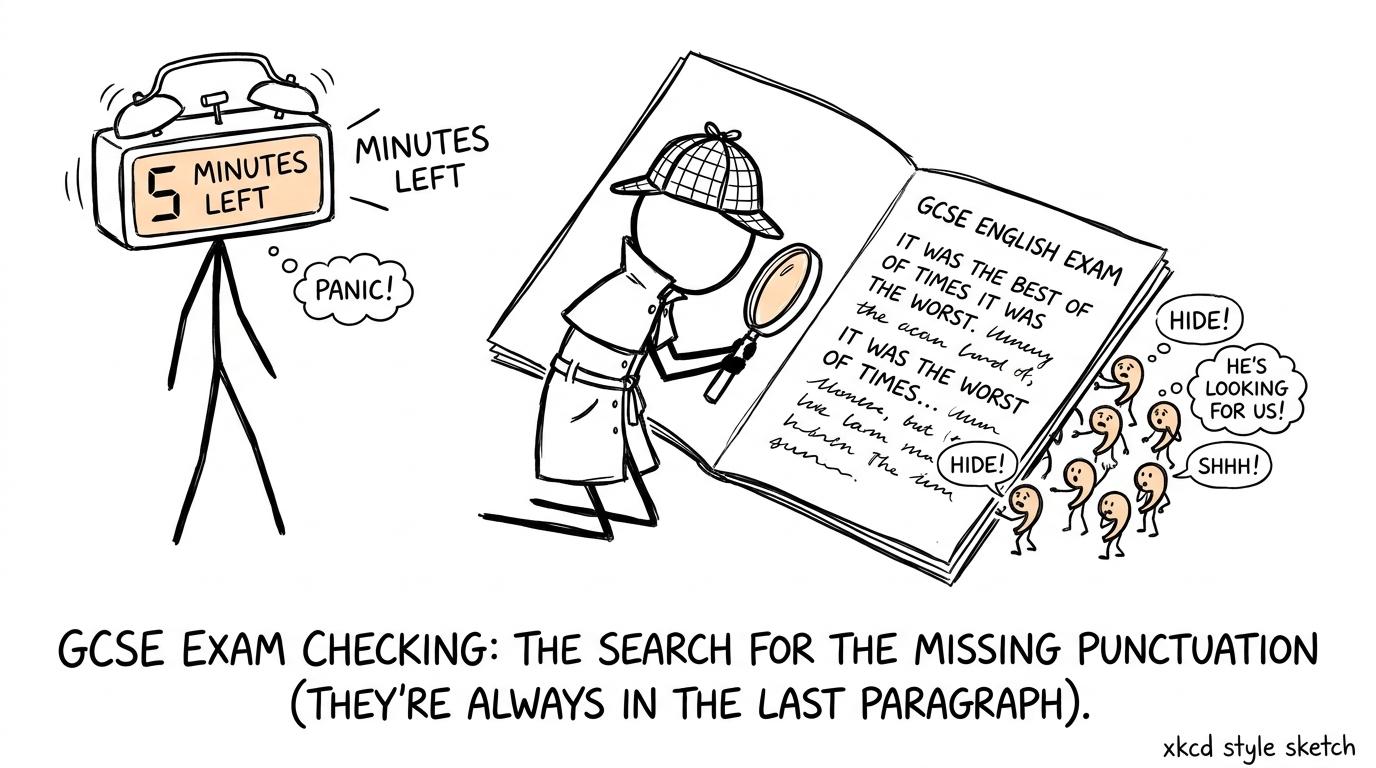 A student detective searches for punctuation errors before time runs out
Build a revision loop that changes your marks
Repeatedly completing full papers can make you busier without making you better. The improvement happens after the attempt.
Use this cycle:
- Attempt one question under a realistic time limit.
- Mark it using your exam board’s current mark scheme.
- Identify the assessment objective being tested.
- Record one precise weakness.
- Rewrite or repair only that weakness.
- Attempt a fresh question testing the same skill.
For example, your diagnosis should not say “analysis was bad”. It should say “I named methods but did not examine individual words” or “my comparison covered ideas but not how they were conveyed”. Specific errors create specific revision tasks.
Maths students may recognise this from the MathsGenie guide to using past papers properly: attempt, mark, diagnose, repair and retest. You can also adapt the short sessions in the twenty-minute GCSE revision routine or build a sustainable week using the GCSE revision timetable guide.
Use official English Language papers and mark schemes from your own exam board. AQA, Edexcel, OCR and Eduqas do not use identical question sequences or timings, so copying another board’s plan can create avoidable problems.
Common mistakes that keep responses at grade 4
Memorising generic analysis
Phrases such as “this paints a picture in the reader’s mind” rarely explain the actual effect. Replace generic comments with analysis tied to the quotation and context.
Using terminology without meaning
Correct terminology can support analysis, but naming devices does not earn high marks by itself. Explain the choice that the writer made and why it matters.
Writing everything you notice
A long response containing several undeveloped observations is not necessarily stronger than a shorter, selective one. Choose evidence that supports a clear line of thought.
Ignoring the question’s key words
An otherwise thoughtful answer can drift away from the task. Return to the precise focus throughout your response.
Treating ambitious vocabulary as a substitute for control
Vocabulary should sound natural and suit the audience. Accuracy, clarity and tone matter more than squeezing in a memorised list of complicated words.
Practising without feedback
If you complete answers but never compare them with the mark scheme or teacher feedback, the same habits survive. The MathsGenie guide to turning notes into active recall offers a useful wider principle: retrieve, check, correct and repeat.
Your next step towards grade 6
The journey from grade 4 to grade 6 is not a leap from ordinary writing to brilliance. It is a collection of smaller changes: a more precise quotation, a developed interpretation, a clearer comparison, a controlled paragraph and a final punctuation check.
Choose one past response today. Identify the assessment objective, find one repeated weakness and repair it before attempting a similar question. Then place that process inside a weekly routine. MathsGenie’s GCSE maths revision guides and GCSE mini tests demonstrate the same focused approach for maths: learn, practise, mark and retest.
For your maths exams, continue with MathsGenie’s free revision lessons, practice questions, past papers, predicted papers, mark schemes and video solutions. For English Language, apply that disciplined revision loop to the current materials from your own exam board. Grades tend to move when feedback stops being a verdict and becomes the plan for the next attempt.