GCSE English Language 3 to 5: A Practical Plan
GCSE English Language 3 to 5: learn the reading, writing and practice changes that turn simple responses into clear, developed and accurate work.
Moving from GCSE English Language 3 to 5 is rarely about discovering a secret technique or memorising more terminology. It is about making a handful of visible changes: answering the precise question, explaining rather than identifying, selecting useful evidence, organising writing deliberately and controlling basic accuracy.
A grade 3 response often shows relevant understanding but develops it inconsistently. A grade 5 response is more secure. It deals with implicit meanings, analyses choices, makes credible comparisons and communicates with enough control to sustain the reader's interest.
That is encouraging because these are trainable behaviours. You do not need to become a different kind of student. You need a better practice loop.
The grade 3 to grade 5 checklist
Focus your revision on these changes:
- move from spotting techniques to explaining their effects;
- move from broad comments to precise textual evidence;
- move from retelling content to interpreting meaning;
- compare viewpoints directly rather than discussing texts separately;
- plan writing around purpose, audience and form;
- build controlled paragraphs with deliberate openings and endings;
- improve sentence boundaries, punctuation and spelling;
- practise timed questions, mark them and rewrite weak sections.
Start with the resources for your own exam board. The AQA GCSE English Language revision hub, for example, organises lessons, questions and papers around the correct specification rather than offering generic advice.
What separates a grade 3 from a grade 5?
Official national grade descriptors describe likely performance at grades 2, 5 and 8 rather than defining every individual grade. They are also not grade boundaries. Boundaries are set after each examination series, so there is no permanent mark that guarantees a grade 5.
However, the official grade 5 description gives a clear destination. A student working at this level can generally:
- understand explicit and implicit meanings and viewpoints;
- summarise and evaluate with clear understanding;
- analyse relevant aspects of language, grammar and structure;
- support ideas using apt textual references;
- make credible links and comparisons;
- produce purposeful, coherent writing;
- vary vocabulary and sentences appropriately;
- spell, punctuate and use grammar accurately, with occasional errors.
The difference is not simply “more writing”. A long, repetitive answer can remain limited. The important shift is from relevant but straightforward to clear, supported and developed.
| A response around grade 3 may... | A response moving towards grade 5 should... |
|---|---|
| identify a metaphor or adjective | explain how a precise choice shapes meaning |
| select a quotation without using it closely | analyse a short, relevant part of the quotation |
| describe what happens | infer what the details suggest |
| make a general claim about the reader | explain a credible effect in the context of the text |
| discuss two sources separately | connect similarities or differences directly |
| write continuously without a clear journey | use paragraphs and structural shifts purposefully |
| attempt ambitious vocabulary inaccurately | choose appropriate vocabulary and retain control |
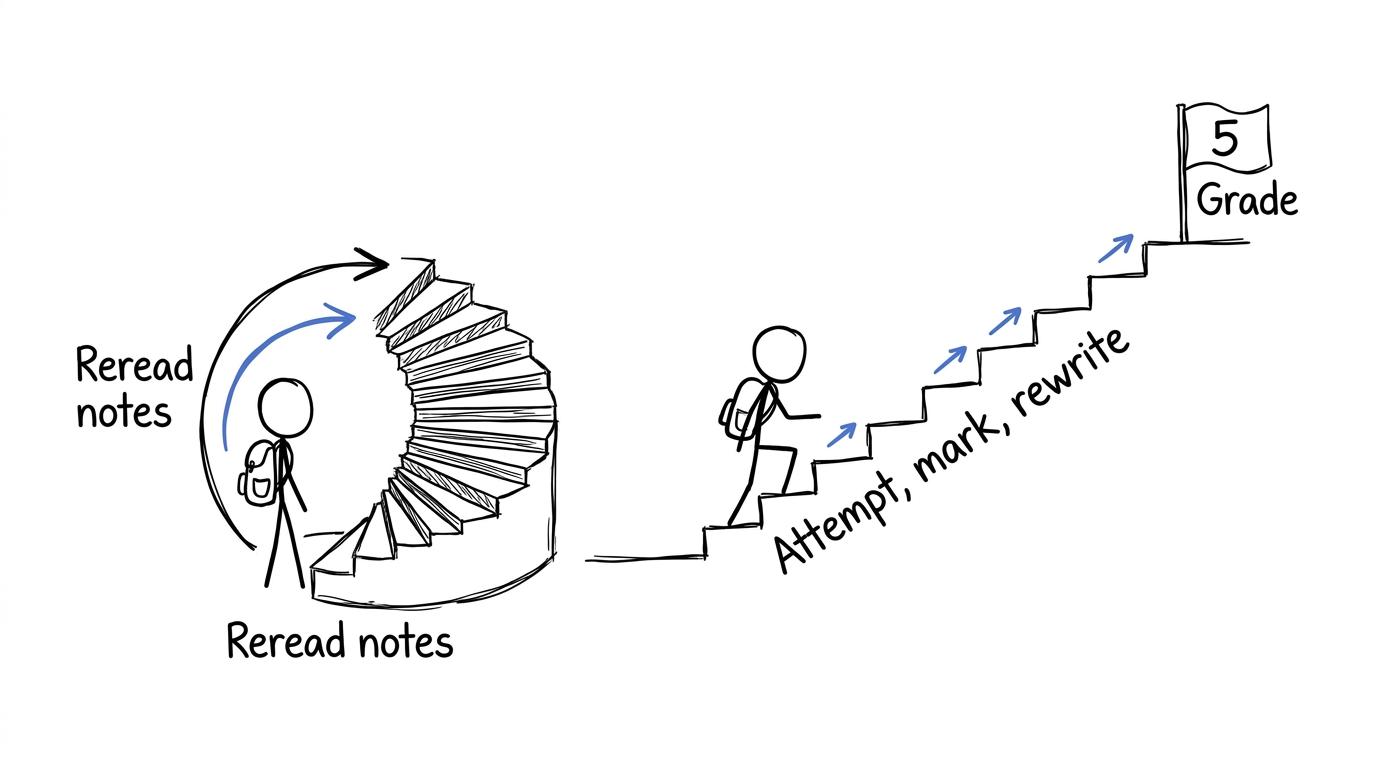 A looping staircase of rereading compared with a steady attempt, mark and rewrite route
Improve reading by explaining the writer's choices
Across AQA, Edexcel, OCR and Eduqas, the shared assessment objectives reward identifying and interpreting information, analysing language and structure, comparing perspectives and evaluating texts. Question order and paper format vary, so always follow your board's specification.
Turn identification into analysis
A technique is only the beginning of an answer. Naming alliteration, a metaphor or a short sentence does not explain why the choice matters.
For each useful detail, ask:
- What does this word or structural choice suggest?
- Why is it effective at this moment?
- How does it shape the viewpoint, atmosphere or reader's understanding?
- How does that explanation answer the question?
Subject terminology can make analysis precise, but terminology is not a substitute for thought. “The writer uses an adjective” earns little unless the response investigates the adjective's associations and contribution to the text.
Use shorter, sharper evidence
Grade 3 responses often copy a large section of the source and then make a broad comment. Grade 5 responses tend to select evidence that can be examined closely.
Choose a short quotation containing the exact word or phrase you want to discuss. Introduce it as part of your sentence, then spend more time explaining it than copying it. The quotation is evidence; your interpretation earns the analytical credit.
Make inferences without inventing ideas
An inference is a conclusion supported by textual detail. It is not a guess detached from the source.
Build an inference by connecting:
- what the text states;
- what a specific detail implies;
- what that implication reveals about an attitude, situation or viewpoint.
Keep returning to the evidence. If your interpretation cannot be traced back to the text, it has probably travelled too far.
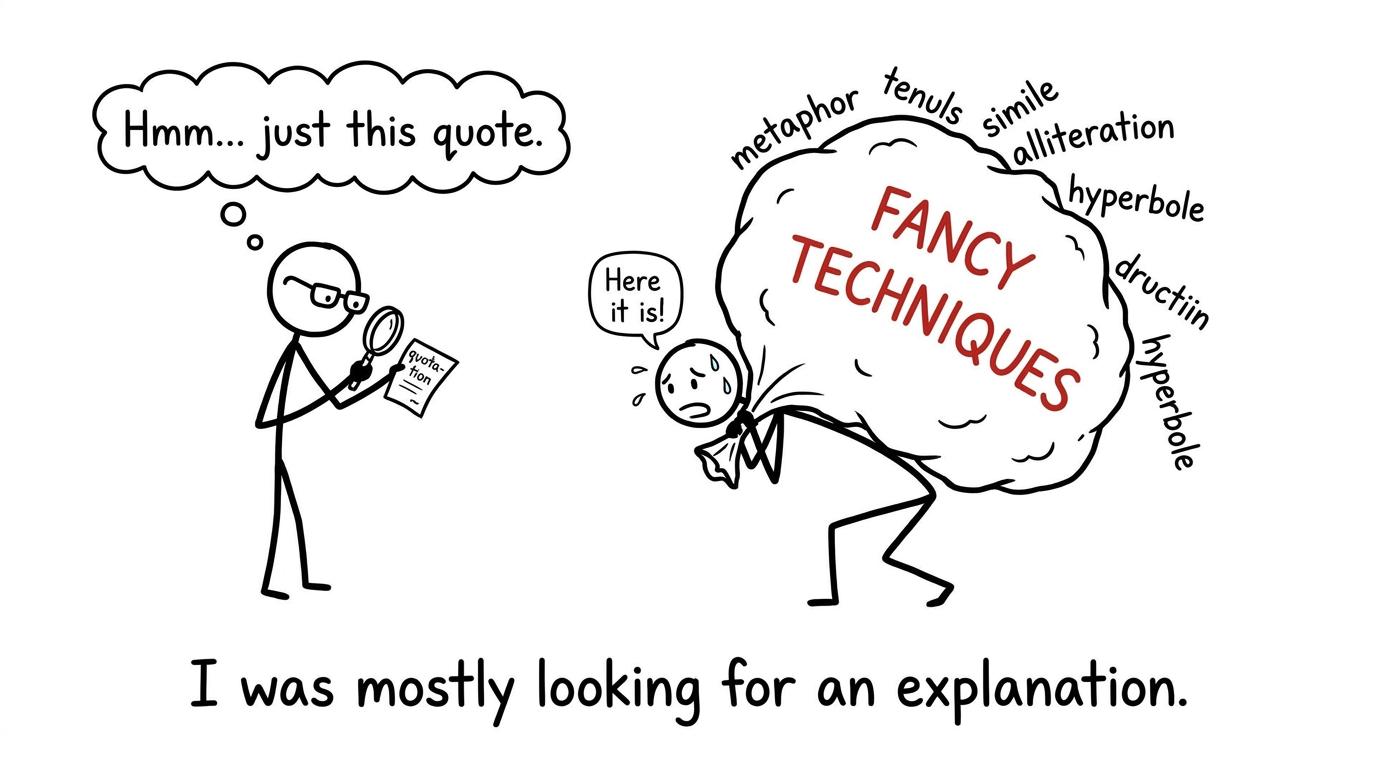 An examiner looking for explanation while a student carries a sack of fancy techniques
Compare ideas rather than placing texts side by side
Comparison becomes stronger when it happens throughout the response. Writing several paragraphs on one source followed by several on the other can leave the connection implied rather than demonstrated.
Choose a shared point of comparison, such as the writers' attitudes towards danger, education or change. Then connect the texts directly:
- identify a meaningful similarity or difference;
- support it with evidence from both sources;
- explain how each writer conveys the perspective;
- return to the comparison.
The aim is not to count techniques. Two writers may use different methods to express a similar attitude, or similar methods to produce contrasting effects. That relationship is where the strongest comparison lies.
The guide to revising English Language without wasting time explains how reusable paragraph structures and focused timed practice can make this process more efficient.
Make writing purposeful before making it impressive
Reading and writing each account for half of GCSE English Language under the national assessment framework. Technical accuracy alone accounts for a substantial part of the qualification, so the writing section cannot be treated as whatever time remains after reading.
Decide purpose, audience and form first
Before writing, establish three things:
- Purpose: are you describing, narrating, arguing, explaining or persuading?
- Audience: who is expected to read or hear the response?
- Form: is it a story, description, article, letter or speech?
These decisions control tone, vocabulary, paragraphing and structure. A persuasive speech should sound designed for listeners, while a narrative needs controlled development rather than a list of dramatic events. AQA students preparing persuasive writing can use the speech revision guide to review form, register and organisation.
Build a deliberate overall shape
Grade 5 writing should be coherent and purposeful. Plan a clear route before beginning:
- an opening that establishes voice or viewpoint;
- a small number of developed ideas;
- a deliberate shift, contrast or turning point;
- an ending that resolves, reflects or calls the audience to act.
Planning briefly is not lost writing time. It reduces repetition and prevents the response from running out of direction halfway through.
Prefer control over decoration
Ambitious vocabulary helps only when it is accurate and appropriate. An unusual word used incorrectly can blur meaning, while a precise familiar word can strengthen it.
The same principle applies to sentences. Variety means choosing sentence structures for purpose, not forcing every paragraph to contain a checklist of devices. Secure full stops, controlled clauses and intentional shorter sentences are more valuable than uncontrolled complexity.
Use feedback like a maths student
Maths students improve by attempting a question, checking the method and correcting the error. English should be revised through the same loop:
- attempt one question under a realistic time limit;
- check the assessment objective and mark scheme;
- identify the exact weakness;
- rewrite the weakest paragraph;
- try the same skill with a different source later.
Do not record “analysis was bad”. Make the diagnosis usable: “I named the method but did not explain the selected word,” or “I compared topics but not the writers' viewpoints.”
MathsGenie's guide to using GCSE mark schemes to improve shows how to turn assessment language into a specific next action. The English Language retrieval and spacing guide can also help you revisit skills before they fade.
A revision routine that protects your maths preparation
Because you are preparing for maths exams as well, English revision needs boundaries. Endless highlighting can consume an evening without producing evidence of improvement.
A balanced weekly routine might include:
- one short reading response;
- one writing plan or timed section;
- one mark-and-rewrite session;
- one longer paper section when the individual skills become secure.
Keep an error log with four headings: question type, marks lost, reason and next action. Return to repeated weaknesses first.
Meanwhile, maintain maths with a short task from the GCSE Maths revision hub. If a full paper is unrealistic during a busy English week, an Edexcel GCSE Maths mini test can preserve recall and momentum without taking over the evening.
Common mistakes that keep students at grade 3
Writing about the text without answering the question
Underline the command word and focus before reading closely. Every paragraph should make its relevance visible.
Listing techniques
Three named devices with vague effects are usually weaker than one carefully explained choice. Analyse what the method does in this particular context.
Repeating “this makes the reader want to read on”
Effects should be specific and defensible. Explain what the reader understands, expects, questions or feels, and identify the textual reason.
Using quotations that are too long
Long evidence makes close analysis harder. Select the smallest useful phrase and examine its details.
Treating comparison as two separate answers
Use direct comparative language and connect the writers' ideas, perspectives and methods within each section.
Forgetting technical accuracy
Leave time to check sentence boundaries, capital letters, apostrophes, common spellings and paragraphing. Accuracy is assessed directly, not treated as an optional extra.
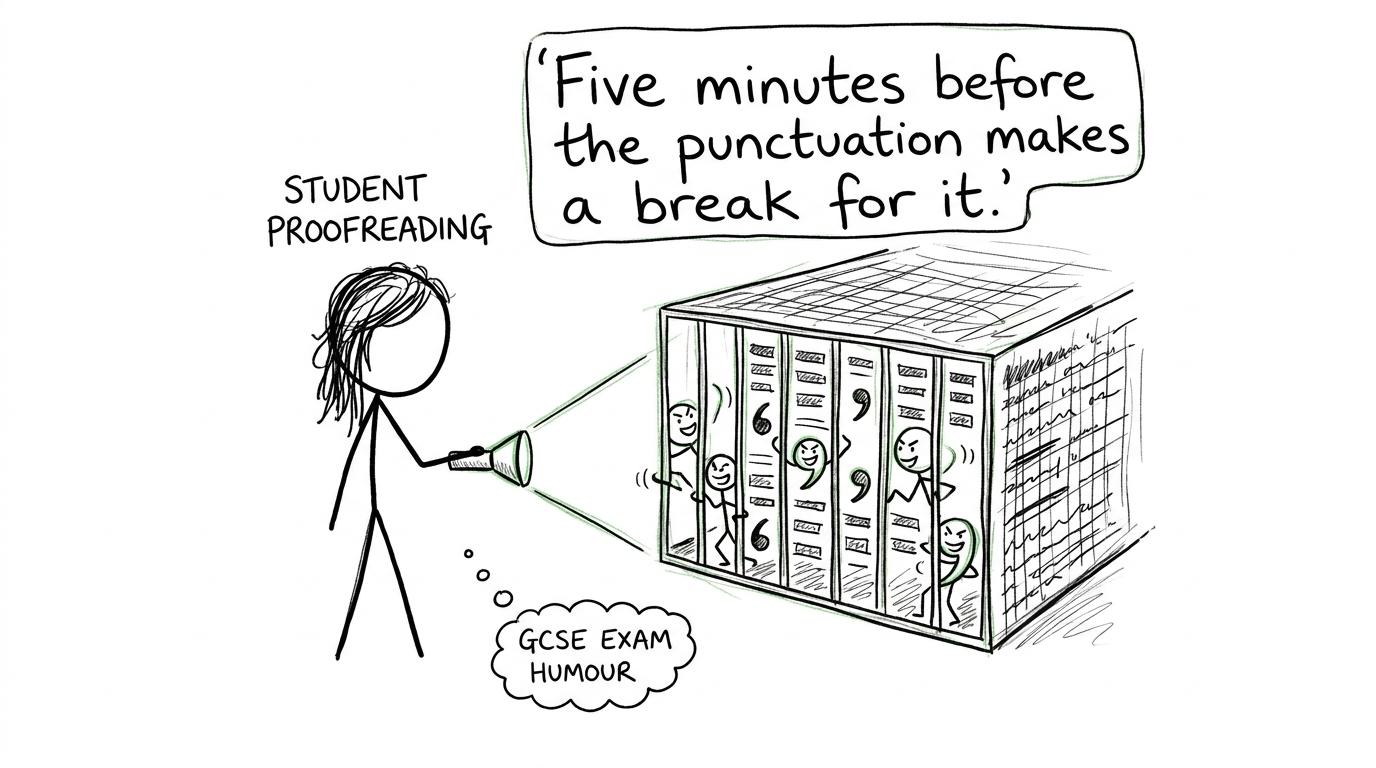 A student catching escaping punctuation during a final proofread
Completing papers without correcting them
A finished paper is evidence, not improvement by itself. Mark it, diagnose the lost marks and rewrite. If you are approaching the exam, use the GCSE English Language exam-week checklist to keep practice focused and manageable.
From a grade 3 to a grade 5, one paragraph at a time
The move from grade 3 to grade 5 is built from modest improvements repeated consistently. Select evidence more carefully. Explain one layer further. Compare directly. Plan before writing. Proofread with a purpose. Then use the mark scheme to decide what changes next.
Begin with MathsGenie's free English Language resources for your exam board and complete one focused question today. Mark it and rewrite the weakest paragraph. If you are preparing for a resit, the GCSE English Language resit revision plan provides a structured route from diagnosis to full papers.
Keep your maths moving at the same time through MathsGenie's revision lessons, practice questions, mini tests, mark schemes and video solutions. As the exams approach, add past papers and predicted papers. Progress in both subjects comes from the same quiet habit: attempt, check, correct and return.