GCSE Engineering Grade 7 Meaning: What It Shows
GCSE engineering grade 7 meaning explained clearly: ability, old-grade comparison, assessment, changing boundaries and maths skills to lift your result.

A grade can look like a simple verdict. One number, printed beside one subject, apparently summarising two years of decisions, calculations and practical work.
But the GCSE engineering grade 7 meaning is more useful than that. A grade 7 indicates strong performance across engineering knowledge, practical application, problem-solving, analysis and evaluation. Its lower boundary is officially comparable with the lower boundary of the old grade A, although the numbered and letter scales are not exact translations.
It does not mean that you answered a fixed percentage correctly, and it does not mean that every part of your work was at grade 7. It means your total mark reached the grade 7 boundary set for that examination series.
Grade 7 in GCSE Engineering at a glance
Here is the short version:
- Grade 7 is a high GCSE grade, below grades 8 and 9.
- The bottom of grade 7 is comparable with the bottom of the former grade A.
- It reflects your overall result, combining the written examination and non-exam assessment where the specification requires both.
- It suggests secure engineering knowledge and an ability to apply, analyse and evaluate that knowledge.
- The required mark can change from year to year because grade boundaries are set after the assessments have been taken.
- It is not the same as scoring 70%70\%70%, and it is not automatically equivalent to an old A in every possible sense.
This article uses AQA GCSE Engineering specification 8852 for the detailed assessment information. If your school uses another engineering qualification, check its exact specification and grading arrangements.
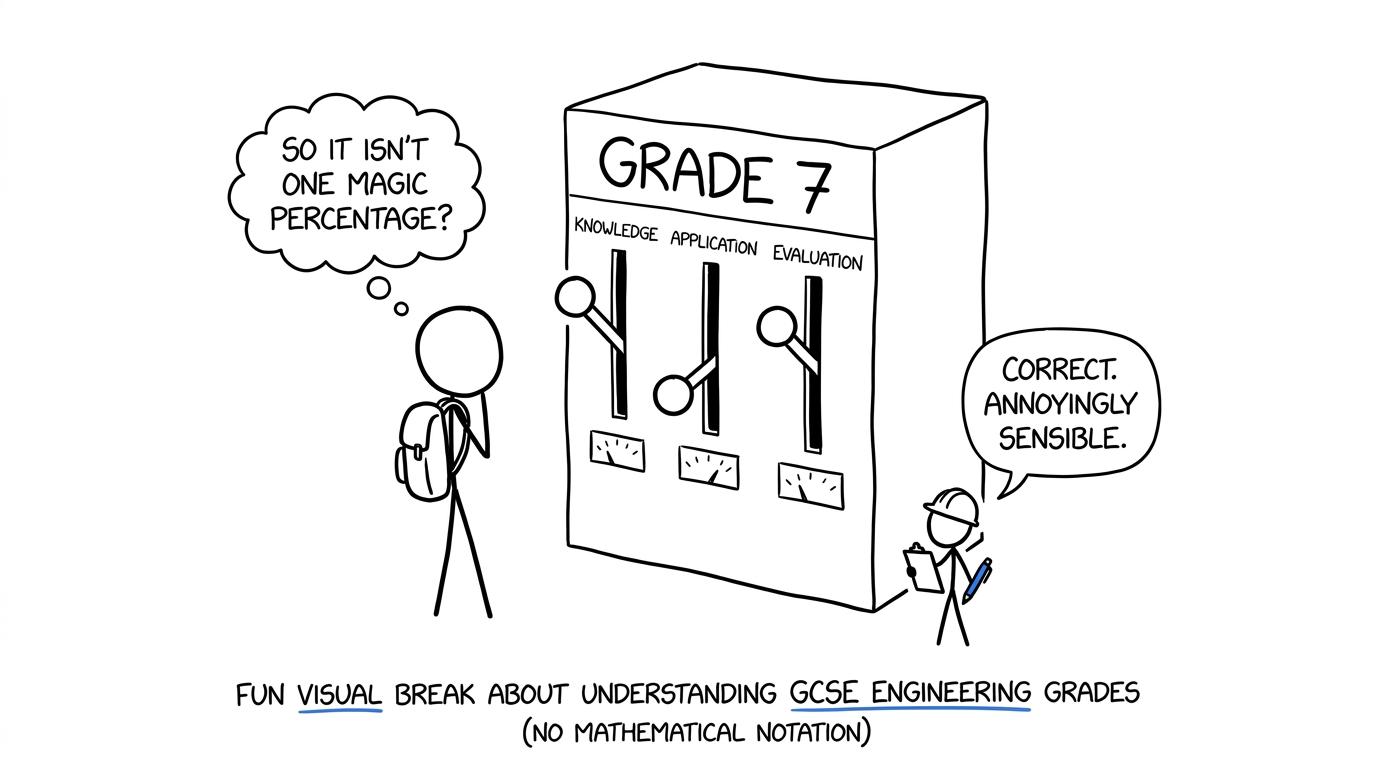 A student discovers that a grade 7 measures several engineering abilities rather than one magic percentage
What ability does a grade 7 actually represent?
A grade 7 represents more than remembered facts. Engineering is concerned with whether knowledge survives contact with a real problem.
On the AQA specification, students are assessed on three broad objectives:
- AO1: demonstrating knowledge and understanding of engineering principles and processes
- AO2: applying knowledge, understanding and practical skills in different contexts
- AO3: analysing and evaluating evidence in engineering contexts
The overall weightings are 25%25\%25% for AO1, 50%50\%50% for AO2 and 25%25\%25% for AO3. Application therefore carries half of the available weighting. Knowing a definition matters, but choosing and using the right idea matters more.
A student working around grade 7 will typically show several connected strengths:
Secure technical understanding
You can recall relevant principles, materials, processes and systems accurately. More importantly, you can distinguish between ideas that sound similar and select the one that fits the context.
Confident application
You can take familiar knowledge and use it in an unfamiliar design, manufacturing or systems problem. This includes interpreting information, selecting processes, applying formulae and making justified decisions.
Effective analysis and evaluation
You can examine evidence rather than merely describe it. A stronger response explains why a result matters, compares possible choices and reaches a conclusion supported by engineering reasoning.
Accurate practical work
In non-exam assessment, strong performance may include careful planning, appropriate use of tools and processes, attention to tolerances, quality control, testing and thoughtful evaluation. A polished prototype alone is not enough if the supporting decisions are unclear.
This is why grade 7 is best understood as consistent high-level performance across different forms of engineering thinking, not as perfection.
How GCSE Engineering is assessed
For AQA GCSE Engineering, the final result combines:
| Component | Maximum mark | Overall weighting |
|---|---|---|
| Written paper | 120120120 marks | 60%60\%60% |
| Non-exam assessment | 808080 marks | 40%40\%40% |
| Total | 200200200 marks | 100%100\%100% |
The written examination lasts two hours and includes multiple-choice, short-answer, calculation and extended-response questions. The non-exam assessment tests the application of engineering skills in a practical context, including analysis, planning, manufacture, testing and evaluation.
That balance explains an important feature of the grade. A strong examination can support weaker practical work, and strong coursework can support a less successful paper, because the grade comes from the combined total. However, relying heavily on one component makes the result fragile.
Think of the final grade as a structure supported by two beams. Both do not need to carry exactly the same load, but neither should be ignored.
What mark is needed for a grade 7?
There is no permanent grade 7 percentage.
In the June 2025 AQA GCSE Engineering series, the grade 7 boundary was 152152152 marks out of 200200200, equivalent to 76%76\%76%. That is a historical boundary, not a prediction or guaranteed target for another year. You can check the published figures on the AQA GCSE Engineering grade boundaries page.
Grade boundaries move because papers and assessment tasks are not identical each year. If an assessment proves more demanding, the boundary may be lower; if it is more accessible, the boundary may be higher. Exam boards use boundaries to maintain comparable standards between examination series.
For revision, the sensible response is to build a margin of safety. Do not plan to land on one remembered boundary. Aim to produce work that is securely above it, while remembering that practice-paper marks are evidence of progress rather than a guaranteed final grade.
How grade 7 compares with the old letter grades
The clearest official comparison is this: the bottom of grade 7 is comparable with the bottom of the old grade A.
That wording matters. The government does not provide a complete one-to-one conversion table between every numbered grade and every former letter grade. The official comparison points are:
| Current scale | Former scale comparison point |
|---|---|
| Bottom of grade 7 | Bottom of grade A |
| Bottom of grade 4 | Bottom of grade C |
| Bottom of grade 1 | Bottom of grade G |
Grades 7, 8 and 9 provide greater differentiation across the achievement range previously covered by grades A and A*. It is therefore reasonable to describe grade 7 as broadly comparable with an old A at the boundary, but misleading to claim that every grade 7 is simply a renamed A.
The numbered scale gives more information at the top. A grade 7 is excellent, while grades 8 and 9 recognise progressively stronger performance within that upper range.
The maths behind a grade 7 in Engineering
Engineering maths is rarely presented as a page of isolated calculations. It appears inside decisions about dimensions, loads, materials, circuits, gears, costs and performance.
The AQA specification includes arithmetic, standard form, ratio, percentages, significant figures, averages, algebra, graphs, Pythagoras and trigonometry. It also expects students to use engineering relationships such as:
ρ=mV\rho = \frac{m}{V}ρ=Vmfor density,
P=FAP = \frac{F}{A}P=AFfor pressure, and
I=VRI = \frac{V}{R}I=RVfor current using Ohm's law.
The challenge is often not the formula itself. It is recognising the correct quantities, using consistent units, rearranging accurately and judging whether the answer is sensible.
MathsGenie can help you strengthen those foundations. Begin with writing and simplifying ratio revision, then use the GCSE Maths topics by exam board and tier guide to identify relevant work on algebra, graphs, area, volume and trigonometry.
Engineering itself is not divided into Foundation and Higher tier on the AQA specification discussed here. Your GCSE Maths course may be tiered, however, so choose maths resources that match your Edexcel, AQA, OCR or Eduqas paper and your teacher's guidance.
 Maths and Engineering discover that they were supposed to build the grade 7 bridge together
How to move towards grade 7 performance
A grade improves when the quality of your feedback loop improves. Reading more notes may feel productive, but the examination rewards what you can retrieve, apply and communicate without those notes.
Use this revision cycle:
- Learn: revisit one precise topic through a revision lesson.
- Practise: answer questions without copying a model response.
- Mark: use the mark scheme carefully, including method and communication requirements.
- Diagnose: label each lost mark as knowledge, application, calculation, evaluation or exam technique.
- Repair: practise the exact weakness rather than repeating everything.
- Retest: return to the skill after a short gap.
For the maths supporting Engineering, the best order to learn GCSE Maths topics provides a sensible route from number and ratio through algebra, graphs and geometry. If exams are close, adapt the structured GCSE one-month revision plan.
Past papers become useful once they produce a specific repair list. MathsGenie's guide to redoing GCSE past papers effectively explains why marking, fixing and retesting matter more than racing through paper after paper.
Predicted papers can also sharpen exam technique, but they should not replace specification coverage. Use Edexcel GCSE Maths predicted papers for relevant mathematical practice if Edexcel is your maths exam board, then return to your Engineering specification for subject-specific preparation.
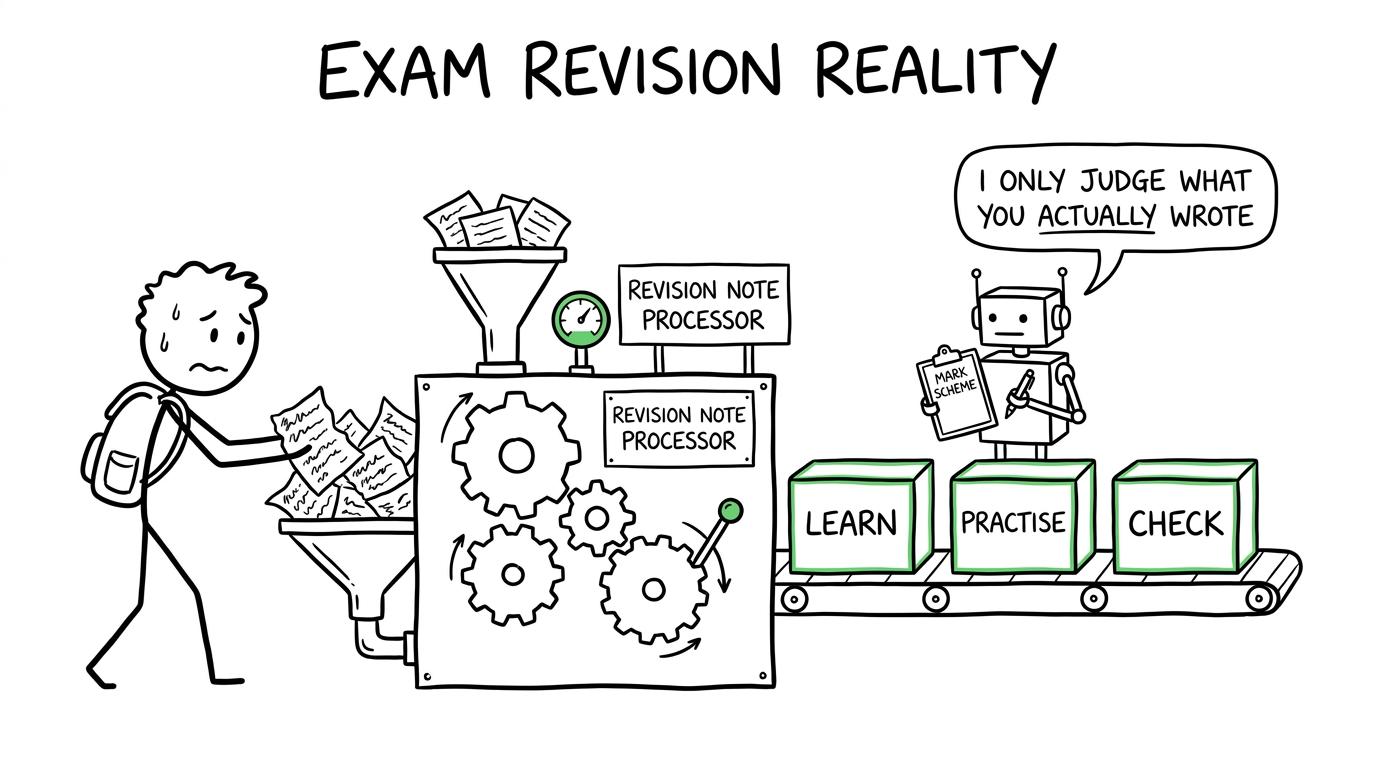 A revision workshop turns messy notes into a learn, practise and check routine
Common mistakes when interpreting or aiming for grade 7
Treating grade 7 as a fixed percentage
A previous boundary is useful context, not a permanent rule. Boundaries are set for each examination series.
Assuming grade 7 means every response was grade 7 quality
Your grade is based on the total mark. Individual questions and sections can vary considerably in quality.
Calling it an exact old grade A
The precise official statement is that the bottom of grade 7 is comparable with the bottom of the former grade A. The scales do not convert perfectly grade by grade.
Revising knowledge but not application
Engineering questions frequently place familiar ideas in practical contexts. Practise selecting information, applying formulae and justifying decisions rather than only memorising definitions.
Ignoring units and tolerances
A correct method can be weakened by inconsistent units, premature rounding or an answer that does not match the required tolerance. Show substitutions clearly and check the scale of every result.
Treating the NEA as only a finished product
Planning, modelling, process selection, quality control, testing and evaluation all matter. Document why decisions were made and connect testing back to the specification.
A grade is a signal, not a ceiling
A grade 7 in GCSE Engineering signals strong attainment. It shows that you can do more than remember engineering content: you can apply ideas, work practically, use mathematical relationships and evaluate evidence with purpose.
It is also only a compressed summary. The useful detail sits underneath: the formula you can now rearrange, the graph you can interpret, the manufacturing decision you can justify and the mistake you no longer repeat.
Use MathsGenie's free GCSE and A Level maths revision resources to strengthen the mathematical side of that performance. Work through revision lessons, answer practice questions, check mark schemes and video solutions, and use mini tests, past papers and predicted papers to make your progress visible.
Grade 7 becomes less mysterious when you stop chasing the number directly. Build the abilities it represents, one reliable skill at a time.