Writing and Simplifying Ratio
x

Revision notes for Edexcel GCSE Maths Writing and Simplifying Ratio. Open the guide for explanations and worked examples. Written against the Edexcel GCSE Maths (1MA1) specification, so the content matches what's examinable rather than general Maths background.

Writing and Simplifying Ratio

What you'll learn

  • What a ratio compares, and why the order matters.
  • How to simplify ratios using common factors.
  • How to turn fractions like 38\frac{3}{8}83​ into ratios.
  • How to build two-part and three-part ratios from word clues.

What a ratio means

A ratio is a way to compare amounts. It tells you how much of one thing there is compared with another thing.

Definition

Ratio

A ratio compares amounts in a fixed order. Each number in a ratio is called a part. For example, in 2:52:52:5, there are 2 parts of the first thing for every 5 parts of the second thing.

The order is very important. “Red to blue” is not the same as “blue to red”.

Example

Writing a ratio in the correct order

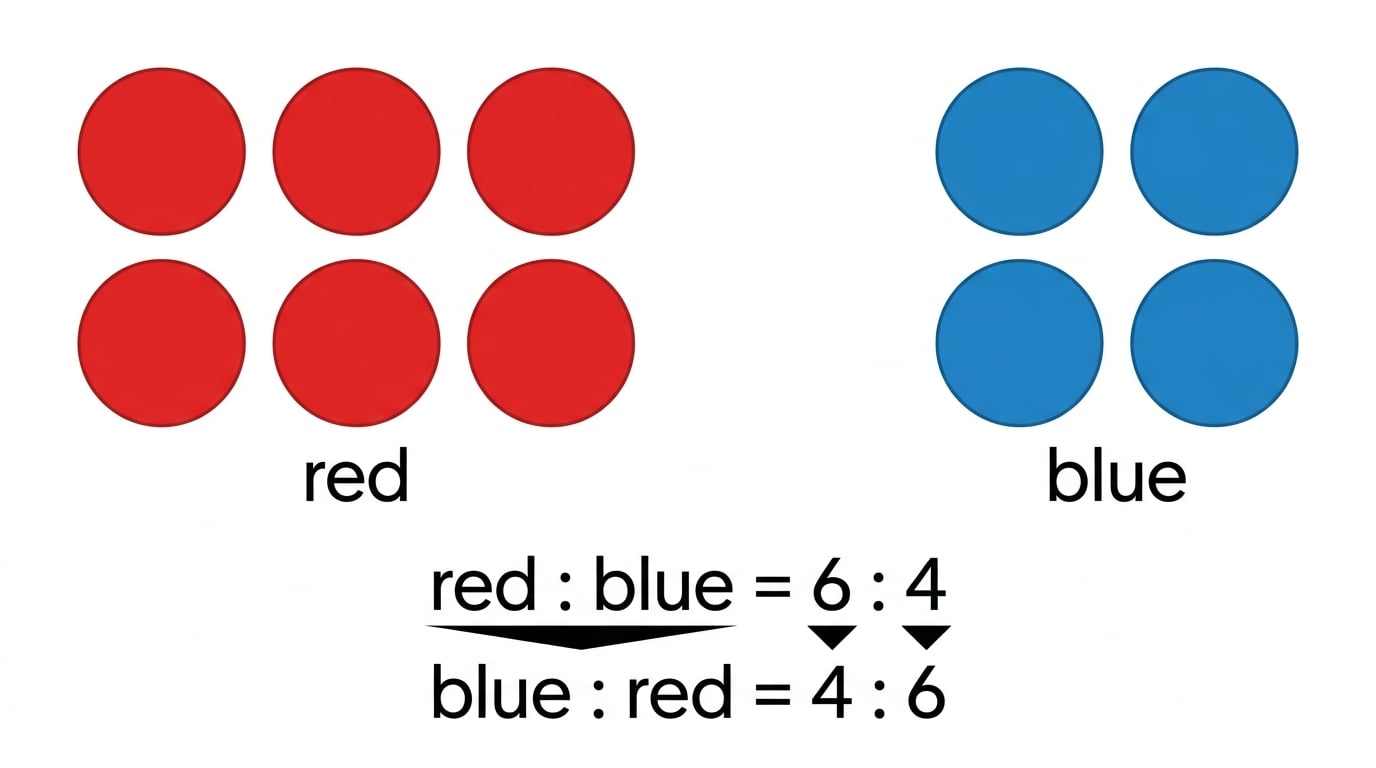
  1. Suppose there are 6 red counters and 4 blue counters.

Six red counters and four blue counters show that the ratio red to blue is written in the same order as the words.

  1. The question asks for the ratio of red counters to blue counters, so red goes first.

  2. Write the amounts in that order: 6:46:46:4.

  3. If the question asks for simplest form, you would simplify this next.

Common Mistake

Swapping the order

If the question asks for boys to girls, do not write girls to boys. Always underline or notice the order in the sentence.

Simplifying a two-part ratio

To simplify a ratio, divide each part by the same number.

Definition

Simplest form

A ratio is in simplest form when the parts are whole numbers with no common factor bigger than 1. A common factor divides exactly into each part; the biggest one is the highest common factor, or HCF.

Key Idea

Same action to every part

Whatever you do to one part of a ratio, you must do to every part. To simplify, divide all parts by the same common factor.

Example

Simplifying a ratio of lengths

  1. Write the ratio of 450 cm to 30 cm as 450:30450:30450:30.

Two lengths in the same unit can be compared directly before simplifying the ratio.

  1. Both amounts are already in cm, so no unit conversion is needed.

  2. Divide both parts by 30:

    450:30=15:1450:30=15:1450:30=15:1
  3. The ratio in simplest form is 15:115:115:1.

Tip

Check the units first

Only simplify after the amounts are in the same unit. For example, 1 m to 50 cm should become 100 cm to 50 cm before simplifying.

Using the amount asked for

Sometimes the ratio is about value, not just the number of objects. If coins are involved, work out the total value of each type first.

Example

Ratio of coin values

  1. Mia has three 20p coins and two 50p coins.

The picture separates counting the coins from comparing their total values.

  1. The value of the 20p coins is 60p.

  2. The value of the 50p coins is 100p.

  3. The ratio of the value of the 20p coins to the value of the 50p coins is 60:10060:10060:100.

  4. Divide both parts by 20 to simplify: 60:100=3:560:100=3:560:100=3:5.

Common Mistake

Counting instead of valuing

If the question asks for the value of the coins, do not just count the coins. Three 20p coins are worth 60p, not 3p.

From a fraction to a ratio

A fraction of a group can be turned into a ratio. The bottom number tells you the total number of equal parts. The top number tells you how many of those parts are the named group.

Key Idea

Fraction to rest

If ab\frac{a}{b}ba​ of a group are one type, then aaa parts are that type and b−ab-ab−a parts are the rest.

Example

Fraction of people in a class

  1. In a class, 38\frac{3}{8}83​ of the students are left-handed.

An eight-part bar shows 3 parts left-handed and the remaining 5 parts right-handed.

  1. This means 3 parts out of 8 are left-handed.

  2. The right-handed students are the rest: 8−3=58-3=58−3=5 parts.

  3. The ratio of left-handed students to right-handed students is 3:53:53:5.

Writing ratios in the form n : 1 or 1 : n

Sometimes you are told to write a ratio in a special form. The letter nnn just means the number you need to find.

To get a ratio in the form n:1n:1n:1, make the second part equal to 1.
To get a ratio in the form 1:n1:n1:n, make the first part equal to 1.

Example

Writing with one part equal to 1

  1. Write 8.4:2.18.4:2.18.4:2.1 in the form n:1n:1n:1.

Scaling both parts by the same factor makes the second part equal to 1 for the form n : 1.

  1. Divide both parts by 2.1, because the second part needs to become 1.

  2. 8.4÷2.1=48.4 \div 2.1=48.4÷2.1=4, so 8.4:2.1=4:18.4:2.1=4:18.4:2.1=4:1.

  3. Now write 16:4016:4016:40 in the form 1:n1:n1:n.

  4. Divide both parts by 16, because the first part needs to become 1.

  5. 40÷16=2.540 \div 16=2.540÷16=2.5, so 16:40=1:2.516:40=1:2.516:40=1:2.5.

Three-part ratios

A three-part ratio compares three amounts in order, such as blue : red : yellow.

For “twice as many”, multiply by 2.
For “half as many”, divide by 2.

Example

Building a three-part ratio

  1. In a bag, the number of red beads is three times the number of blue beads.

Using blue as 1 part helps build the three-part bead ratio before converting to whole numbers.

  1. The number of yellow beads is half the number of red beads.

  2. Let blue be 1 part.

  3. Red is three times blue, so red is 3 parts.

  4. Yellow is half of red, so yellow is 1.5 parts.

  5. The ratio blue : red : yellow is 1:3:1.51:3:1.51:3:1.5.

  6. Ratios are usually written using whole numbers, so multiply every part by 2.

  7. The ratio is 2:6:32:6:32:6:3.

Using ratios with totals and percentages

A ratio gives parts. If you know the real total, you can work out real amounts. Add the ratio parts to find the total number of parts.

A percentage means “out of 100”.

Example

Using a total to find a missing ratio value

  1. There are 90 people in a canteen.

A 90-person total can be split into Year 11, Year 10 and the rest, then Year 9 and Year 10 can be compared.

  1. Half of them are in Year 11, so there are 45 Year 11 students.

  2. The number of Year 11 students is three times the number of Year 10 students, so Year 10 has 15 students.

  3. The rest are Year 9 students: 90−45−15=3090-45-15=3090−45−15=30.

  4. The ratio Year 9 : Year 10 is 30:1530:1530:15.

  5. Simplify by dividing both parts by 15: 30:15=2:130:15=2:130:15=2:1.

  6. So if Year 9 : Year 10 is n:1n:1n:1, then n=2n=2n=2.

Example

Finding a percentage from ratio parts

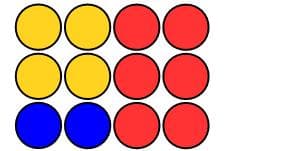
  1. Blue counters are twice as many as yellow counters.

Equal part boxes show yellow as 1 part, blue as 2 parts and red as 1 part, making 4 parts in total.

  1. Red counters are half as many as blue counters.

  2. Let yellow be 1 part, so blue is 2 parts.

  3. Red is half of blue, so red is 1 part.

  4. The total number of parts is 1 + 2 + 1 = 4.

  5. Yellow is 1 out of 4 parts, so 14×100%=25%\frac{1}{4}\times 100\%=25\%41​×100%=25%.

Exam technique

In the exam

  1. Read the order carefully: the first word in the comparison usually gives the first part of the ratio.

  2. Check whether you are comparing counts, values, lengths or masses, and make the units match before simplifying.

  3. For “the rest”, subtract from the total parts; for n:1n:1n:1 or 1:n1:n1:n, divide by the part that must become 1.

Self review

Check yourself

  • Can you simplify 54:1854:1854:18 by dividing both parts by the same number?
  • If 29\frac{2}{9}92​ of counters are red, how many parts are “the rest”?
  • In a three-part ratio, have you kept the groups in the order asked?

Recap questions

Test yourself with 5 quick questions on this guide. Answer them all correctly to complete it.

You've reached the end

Test yourself on this topic, or move on to the next guide.

Practice questionsTake a quick quiz on this topicFlashcardsSelf-test with active recall
RatioUp next

How was this guide?

Writing and Simplifying Ratio Revision Guide

  1. GCSE
  2. /Maths
  3. /Writing and Simplifying Ratio