GCSE Engineering Exam Time of Day: Does It Matter?
GCSE engineering exam time of day: discover whether morning or afternoon affects performance and how to arrive alert, calm and ready for every mark.
A morning exam can feel brutally early. An afternoon paper brings a different problem: hours in which nerves can gather momentum. So, does the GCSE engineering exam time of day genuinely affect performance?
The honest answer is: it can make a small difference, but it does not determine your result. Research suggests that alertness and test performance can vary across the day, particularly for teenagers. Yet findings are mixed across different ages, assessments and settings. Sleep, preparation, food, stress management and familiarity with exam conditions are more useful factors to control.
You usually cannot choose the session anyway. Your best strategy is to confirm the official time, practise at that time beforehand, and build a routine that makes you ready for whichever session appears on your timetable.
The short answer
Use this checklist:
- Check your school’s timetable rather than assuming the start time.
- Treat neither a morning nor an afternoon sitting as automatically better.
- Practise demanding questions during your scheduled exam window.
- Protect your sleep instead of revising late into the night.
- Eat familiar food and drink enough water.
- Use the waiting time before an afternoon exam calmly.
- Prepare engineering calculations as well as written knowledge.
- Arrive early with the equipment permitted by your school.
The timetable is a condition of the exam. Your routine is your response to it.
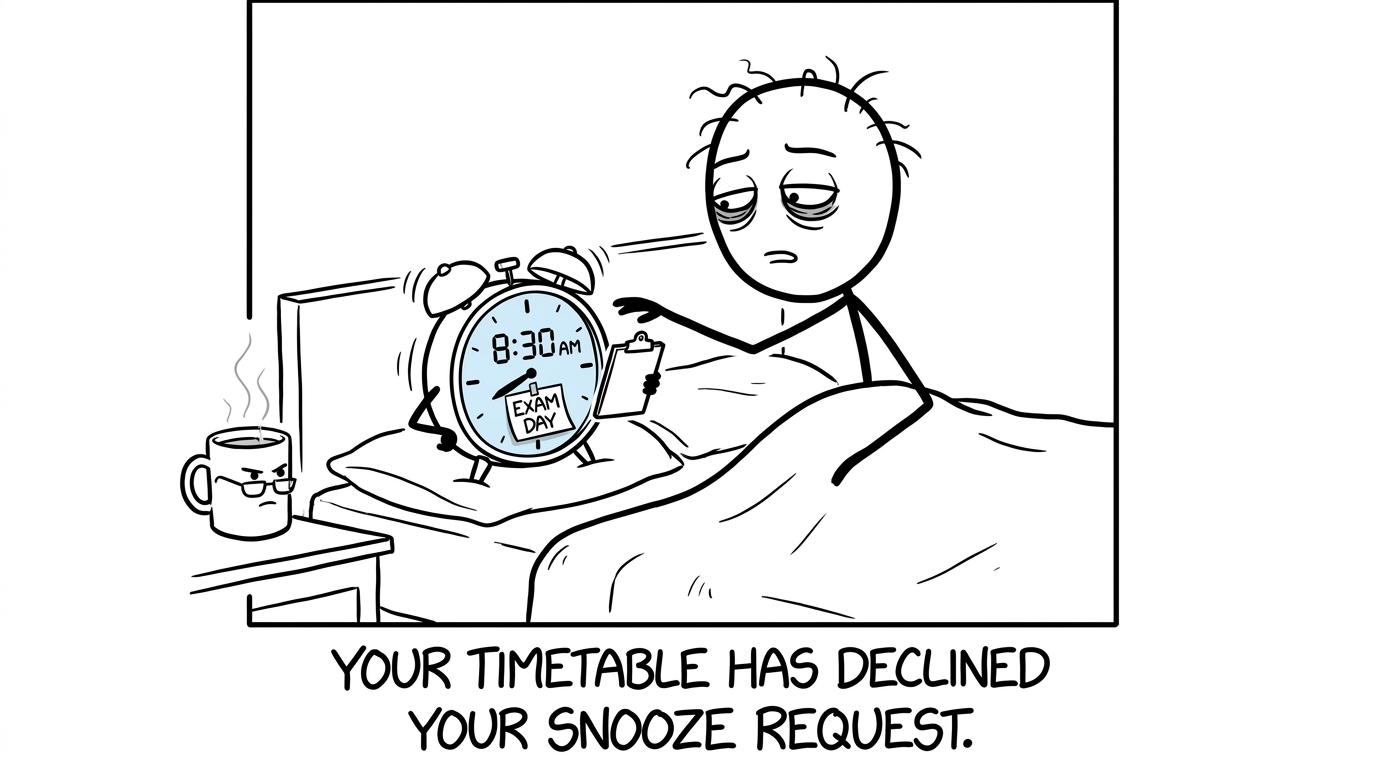 A sleepy student negotiates unsuccessfully with an exam-day alarm clock
What time do GCSE engineering exams start?
For the 2025/26 academic year, the Joint Council for Qualifications lists the published UK starting times for its awarding bodies as 9.00 am for morning examinations and 1.30 pm for afternoon examinations. CCEA’s published morning time is different.
JCQ rules allow UK centres some flexibility: schools may normally begin a session up to 303030 minutes before or after its published time. Timetable clashes, access arrangements and supervised scheduling can also affect an individual student’s arrangements.
That means the national timetable is not the final instruction you should follow. Check the date, arrival time and start time issued by your school or college. If anything appears unclear, ask the exams officer before exam day.
It is also important to confirm the exact qualification. “Engineering” may refer to AQA GCSE Engineering or to a different engineering or manufacturing qualification. The board, specification and assessment structure may therefore differ.
For example, AQA GCSE Engineering currently includes a written paper lasting two hours, worth 120120120 marks and 60%60\%60% of the qualification. It includes multiple-choice, short-answer, calculation and extended-response questions. The remaining assessment is non-exam assessment. Those details should not be assumed for another qualification.
Does morning versus afternoon affect performance?
There is evidence that time of day can influence cognitive performance, but there is no reliable rule saying every GCSE student will score better in the afternoon.
One study of secondary-school pupils found that early and late chronotypes performed differently in morning examinations, with the difference disappearing in the early afternoon. Research using university examinations has also found stronger average performance around early afternoon. However, those students, assessments and circumstances were not identical to a UK GCSE Engineering paper.
Other large studies have found that performance can decline later in the school day as mental fatigue builds, while breaks may restore some alertness. More recent research has also produced different peak times depending on the population and test setting.
The sensible conclusion is not “afternoons are best”. It is this:
- biological rhythms may affect alertness;
- fatigue and breaks may affect concentration;
- individual sleep patterns differ;
- research from one setting cannot predict one student’s GCSE mark;
- preparation remains more controllable than the timetable.
A student who naturally wakes late may initially feel slower in a morning session. Another student may become restless while waiting for an afternoon paper. Neither response is fixed. A stable routine and realistic timed practice can reduce the surprise.
Why engineering can feel sensitive to alertness
Engineering papers ask you to switch between different modes of thinking. You may recall information about materials, interpret a design, complete a calculation, apply practical knowledge and construct an extended response within the same sitting.
That switching can expose tiredness. A sleepy student may know the relevant content but misread a unit. An anxious student may rush through a calculation before identifying what the question asks.
The maths behind engineering commonly draws on:
- ratio and proportion;
- percentages;
- measurement and tolerances;
- area, surface area and volume;
- unit conversions;
- graphs and data;
- speed, density and other compound measures;
- rearranging formulae.
MathsGenie’s GCSE Maths revision hub lets you select your exam board and strengthen these foundations through lessons, questions and papers. For measurement-based work, the conversions and units revision guide covers length, area, volume and speed conversions. The speed and density topic resources are also useful for compound measures.
These skills are not made irrelevant by a difficult start time. Quite the opposite: well-practised methods demand less mental effort when you are nervous or not yet at your sharpest.
How to prepare for a morning engineering exam
Move your routine before the exam
Do not attempt to transform your sleep schedule in one night. During the days beforehand, wake at roughly the time you will need to wake on exam day. If possible, complete one or two demanding revision sessions during the actual morning window.
This is rehearsal, not fortune-telling. Use a mini test, a section of a paper or mixed calculation questions. The aim is to make serious thinking at that hour feel ordinary.
The NHS advises that most teenagers need around eight to ten hours of sleep and warns that an all-night revision session is usually counterproductive. Plan backwards from your required waking time and give yourself time to wind down.
Remove morning decisions
Pack permitted equipment, check your journey and prepare your clothes the evening before. Use your school’s instructions to confirm whether you need items such as a calculator, ruler or drawing equipment.
Eat a familiar breakfast if you normally do. Exam morning is not the moment for a dramatic new routine or an unfamiliar energy drink. If you use caffeine, avoid suddenly consuming much more than usual.
For the previous evening, follow a restrained GCSE night-before revision plan: repair a small number of gaps, organise your equipment and stop in time to sleep.
How to prepare for an afternoon engineering exam
Protect your attention before lunch
An afternoon session offers more waking time, not necessarily more useful revision time. Trying to relearn the specification all morning can leave you mentally tired before the paper begins.
Choose a short warm-up instead. Recall key facts, inspect your error log or complete a few familiar questions. Avoid a full paper unless that is already part of a tested routine.
A simple preparation split might be:
- brief retrieval in the morning;
- a normal break away from revision;
- familiar food and water;
- a short review of methods and units;
- arrival with enough time to settle.
If you have lessons or another examination first, conserve attention where possible. Follow your school’s supervision arrangements exactly, particularly when there is a timetable clash.
Do not let waiting become the exam
The danger of an afternoon paper is often psychological. Every conversation can become a prediction about what will appear. Every unfamiliar detail can feel like evidence that you are unprepared.
Step away from speculative group revision if it raises your anxiety. A quiet walk, calm conversation or small set of familiar prompts may be more useful than collecting ten new worries.
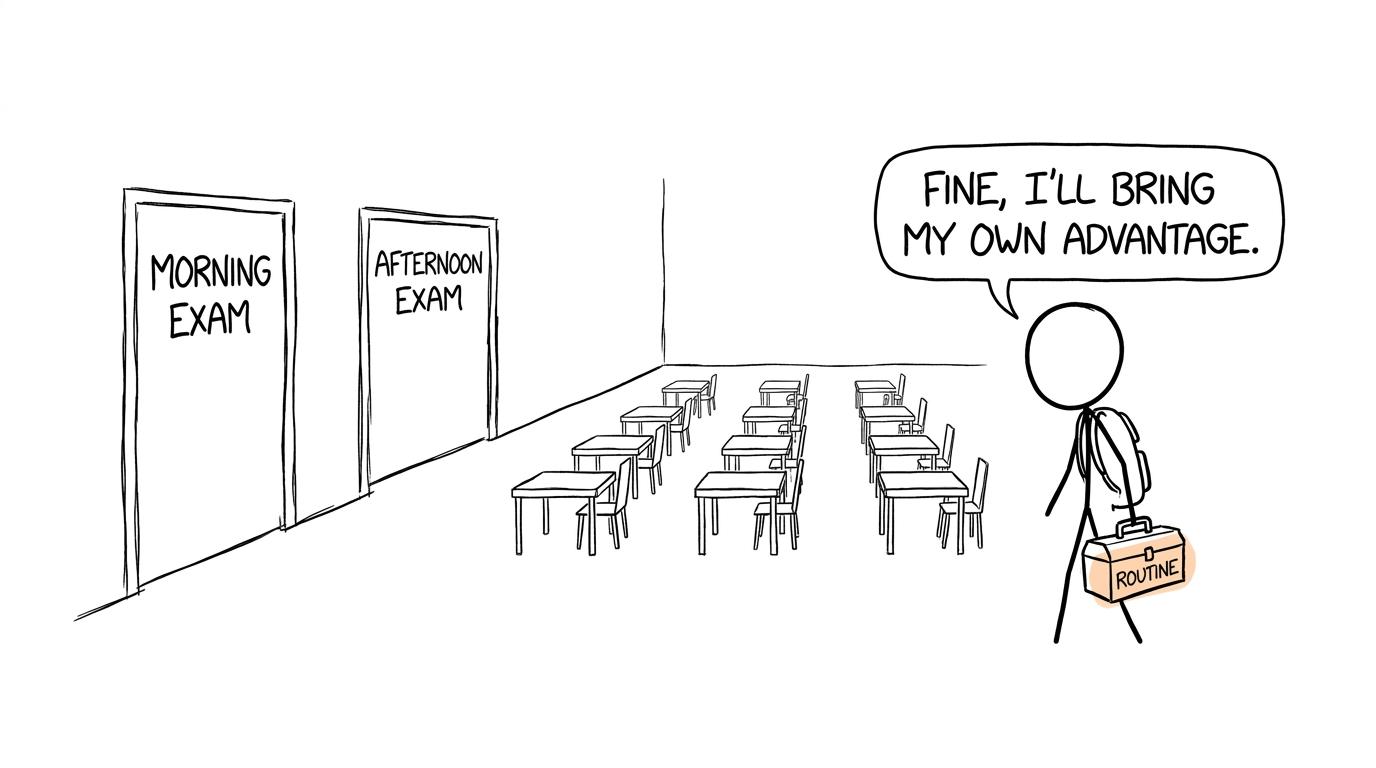 A student carries a routine toolbox towards morning and afternoon exam doors
Train at the time you will perform
Once your timetable is confirmed, place some timed practice in the same session. This does not require every revision session to happen at that hour. One or two realistic rehearsals can reveal practical problems:
- Are you slow to focus first thing?
- Does lunch leave you uncomfortable or sleepy?
- Do you rush when you have waited all morning?
- At what stage does concentration fade?
- Which calculations become unreliable under time pressure?
Mark the work afterwards and classify each lost mark as knowledge, method, accuracy, units, interpretation or timing. Then repair the cause.
For maths-specific exam conditioning, use GCSE past papers by exam board, or build shorter sessions with MathsGenie revision lessons and topic questions. Edexcel students can add GCSE Maths predicted papers, while the guidance on when to start GCSE past papers explains how to progress from short diagnostic work to complete timed papers.
Predicted papers should complement official past papers, not replace them. Mark schemes and video solutions matter because completing a paper only measures performance; reviewing it is what improves performance.
Common mistakes when thinking about exam time
Deciding the session has already determined your mark
A timetable slot may affect how alert you feel, but it does not assign your grade. Treating a morning paper as doomed can become a distraction more powerful than the time itself.
Staying up late because the exam is in the afternoon
An afternoon start does not refund lost sleep. Keep a broadly normal bedtime and waking time so that you arrive rested rather than disorientated.
Over-revising while waiting
More revision is not always better revision. Several frantic hours can crowd working memory and increase anxiety. Use a small, pre-planned set of prompts and then stop.
Changing food or caffeine habits suddenly
Exam day should be predictable. Large meals, skipped meals or unfamiliar amounts of caffeine may make concentration less reliable. Follow familiar habits and any medical guidance relevant to you.
Ignoring calculations during engineering revision
Knowing engineering theory is not enough if units, proportional reasoning or formula manipulation remain fragile. Use the full GCSE maths topic checklist to identify gaps, then practise the exact skill rather than vaguely rereading notes.
Following the national time instead of your school’s instructions
Your centre may use an allowed adjusted start or make individual arrangements. The timetable issued by your school, together with its arrival instructions, is the one you must follow.
Make the timetable smaller than your preparation
Morning and afternoon exams feel different. Research gives good reasons to take those differences seriously, but not to fear them. Your engineering result is built across months of knowledge, practical understanding and repeated problem-solving, not created by the position of the clock on one day.
Confirm your session. Rehearse it. Sleep properly. Keep the hours beforehand calm and familiar.
Then use MathsGenie to strengthen the part you can control: begin with free revision lessons, practise engineering-related maths through topic questions and mini tests, and develop timing with past papers, predicted papers, mark schemes and video solutions. The aim is simple: whether the paper begins in the morning or afternoon, it should feel like work you have already learned how to do.