

GCSE Engineering Early Entry: Is It a Good Idea?
GCSE engineering early entry: weigh readiness, coursework, maths and Year 11 workload before deciding whether taking the qualification early is wise.
A year can look like a small difference on a timetable. In practice, it may mean hundreds of lessons, another design cycle and much greater confidence under exam conditions. That is why GCSE engineering early entry should not be treated simply as a chance to get one subject out of the way.
The short answer is that taking Engineering early can be sensible when you have completed the full course, your practical work is secure, your teacher has strong evidence that you are ready and the preparation will not damage your maths or other GCSEs. It is less convincing when the decision is based mainly on being quick, keen or ahead of your year group.
Early entry is not automatically good or bad. Readiness matters more than age.
Your early-entry checklist
Before agreeing, make sure you can answer these questions:
- What is the exact qualification, awarding body and specification?
- Have you completed all the required content rather than merely started it early?
- What proportion is examined and what proportion is non-exam assessment?
- Is your design and practical work genuinely finished to a strong standard?
- What grades are you currently achieving in secure, timed assessments?
- How will Engineering preparation affect GCSE maths, English and science?
- What happens if your first result is lower than expected?
- What will replace Engineering lessons after the qualification is completed?
- Do you personally want to enter early, or do you simply feel expected to agree?
If several answers are uncertain, the sensible response is not necessarily “no”. It is “not yet”.
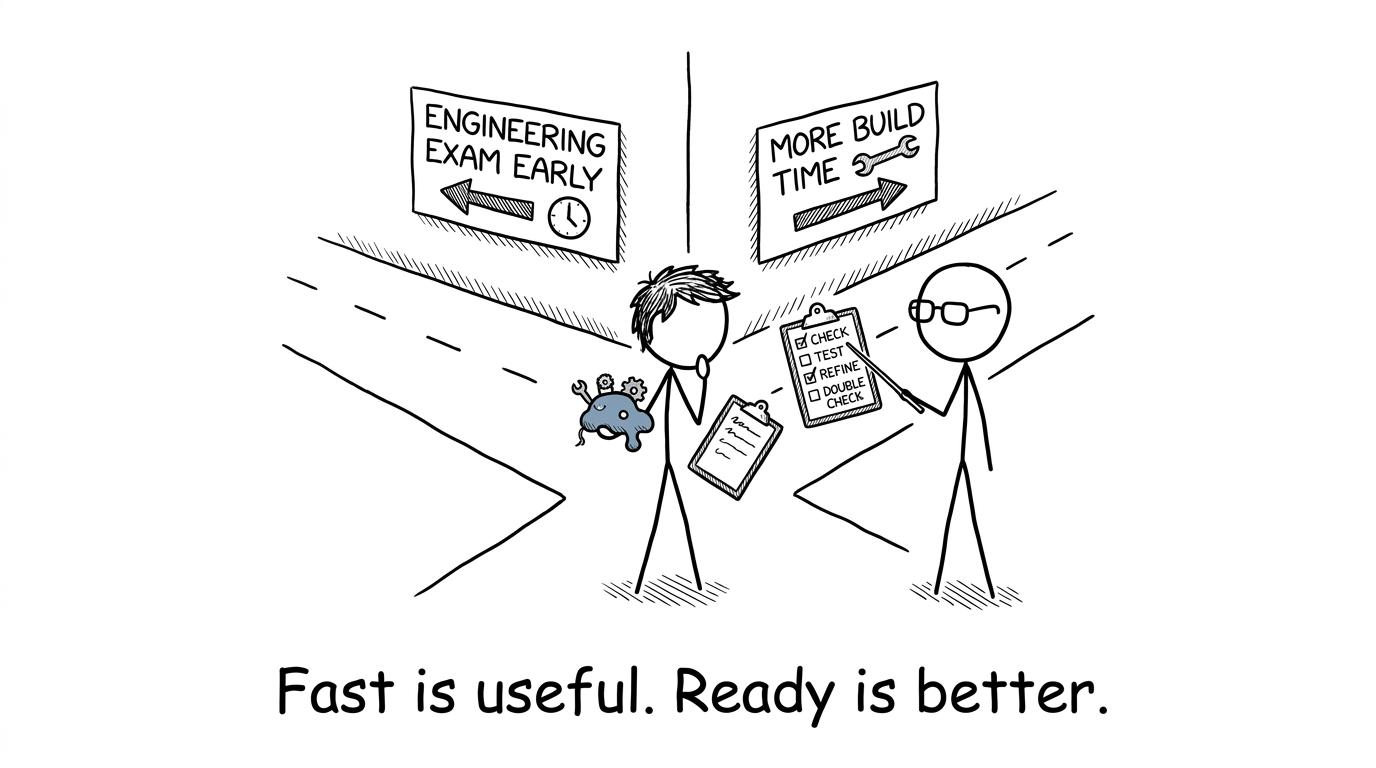 A student choosing between an early Engineering exam and more preparation time
Confirm which Engineering qualification you are taking
The word “Engineering” can describe different Key Stage 4 qualifications. Some students take an actual GCSE; others take a Level 1/Level 2 technical or vocational qualification with a different assessment structure and grading system. Do not rely on the course’s informal name.
Ask your school for:
- the full qualification title;
- the specification code;
- the awarding body;
- the assessment components;
- the certification date;
- the resit or re-entry arrangements.
For example, the current AQA GCSE Engineering specification is code 8852. It has a written paper worth 60%60\%60% and non-exam assessment, or NEA, worth 40%40\%40%. AQA states that there are no formal previous-learning requirements, although schools and colleges decide their own course-entry arrangements. The specification is not available to private candidates because its practical and assessment requirements need to be managed through an approved centre.
That balance matters. A student cannot judge readiness from written tests alone when a substantial part of the qualification depends on sustained practical engineering work. Equally, an attractive prototype does not prove that the underlying technical knowledge is ready for a written examination.
Exam-board names such as AQA, Edexcel, OCR and Eduqas are familiar from GCSEs, but not every Engineering course carrying one of those names is the same type of qualification. Compare your decision with the document your school is actually teaching.
When GCSE Engineering early entry may be a good idea
The complete course has already been taught
Early entry makes most sense when the course has genuinely been completed. Moving quickly through selected topics is not the same as covering the whole specification, revisiting it and applying it independently.
You should have encountered unfamiliar questions, design constraints, material choices, manufacturing considerations, testing and evaluation. If your understanding works only with familiar classroom tasks, another year may still add considerable value.
Your evidence is consistent
One excellent test is encouraging, but it is not a trend. Strong readiness evidence should include timed assessments, teacher feedback, practical work and the ability to explain decisions without heavy prompting.
Engineering often rewards connected thinking. Measurements affect manufacture; material properties affect design; testing affects evaluation. Being ready means holding those links together when the task changes.
The NEA is controlled rather than rushed
A practical project grows through iteration. A design is produced, tested, evaluated and improved. Entering early may work if those stages have been completed thoughtfully and within the awarding body’s assessment rules.
It is a warning sign if early entry would require you to compress research, development or testing simply to meet an earlier deadline. Finishing sooner is not the same as finishing well.
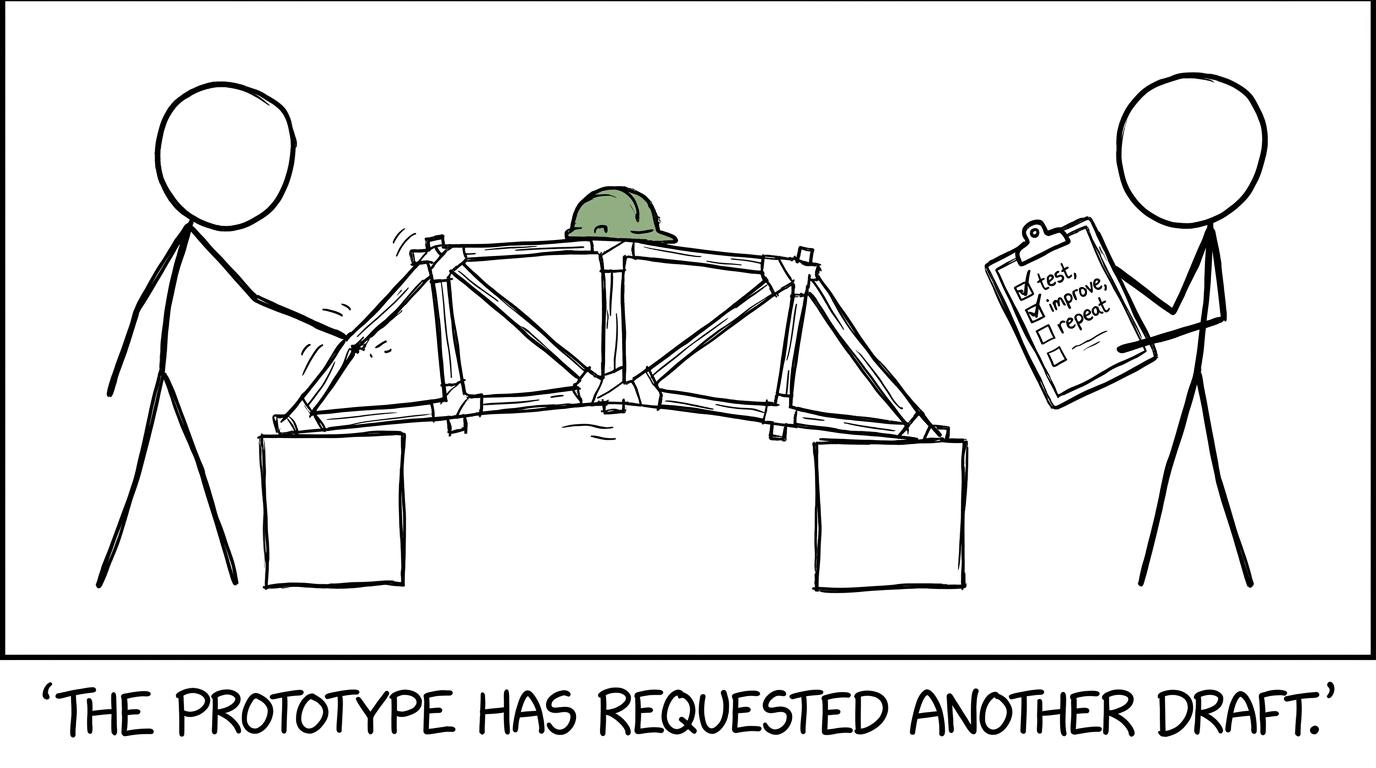 A tiny prototype bridge politely requesting another design draft
It creates useful time later
Completing Engineering early may release Year 11 time for other subjects, further technical study or a structured enrichment activity. That can be valuable, but only when the school has a clear plan.
Ask what will happen in the freed lessons. “More time” is an asset only when it has a purpose. Unstructured gaps have a habit of disappearing.
When waiting may be the stronger decision
Your predicted result could improve materially
Engineering knowledge can deepen significantly over a year. Students become better at technical writing, interpreting information and evaluating limitations. Their maths and science also become more secure.
If waiting is likely to improve your final grade or the quality of your practical work, completing the qualification early may offer little real benefit. Universities, colleges and employers are generally more interested in what you achieved and understood than whether you sat the assessment unusually young.
The decision would weaken core GCSE preparation
An early qualification still consumes revision time. That time must come from somewhere.
The question is not simply, “Can I pass Engineering now?” It is, “Can I prepare properly without reducing my performance elsewhere?” A student targeting demanding grades in maths, English, science and several option subjects may gain more from balance than acceleration.
Use a realistic timetable rather than an optimistic one. MathsGenie’s GCSE maths revision timetable guide can help you account for lessons, homework, practical deadlines, timed papers and rest.
You are relying on a later resit
A resit should not be treated as a free second attempt. Department for Education early-entry rules affect which result counts in school performance measures when a pupil takes more than one qualification in the same subject with the same discount code. Current guidance generally uses the first entry, although particular exceptions can apply.
That accountability rule is not the same as saying a later result disappears from your personal qualification record. However, it gives schools a legitimate reason to consider early entry carefully. Ask your exams officer how the current rules apply to your precise qualification and circumstances before agreeing.
How maths readiness supports Engineering
Engineering is practical, but it is never mathematics-free. Designs depend on quantities, units, scale and relationships. Common supporting skills include:
- ratio and proportion;
- unit conversion;
- perimeter, area, surface area and volume;
- interpreting graphs and tables;
- substitution and rearranging formulae;
- accuracy, tolerances and sensible rounding.
A model or drawing may use a scale factor kkk. Corresponding lengths then change by kkk, areas by k2k^2k2 and volumes by k3k^3k3. These are not isolated classroom facts; they explain why scaling an object changes the amount of material and internal space at different rates.
Use the GCSE Maths revision hub to select your exam board and tier. If scale is uncertain, revisit ratio questions and proportion. For dimensions and modelling, use similar shapes, area and volume revision. The conversions and units resources are also useful when calculations move between different measurements.
Formula confidence matters too. Engineering relationships may require substitution or changing the subject. MathsGenie’s rearranging harder formulae practice builds the algebraic control needed to manipulate powers, brackets and fractions.
The aim is not to learn mathematics separately and hope it transfers. It is to recognise that secure maths makes technical decisions easier to justify.
A practical way to make the decision
Ask for a meeting involving you, your Engineering teacher and, where appropriate, a parent or carer. Bring evidence rather than impressions.
Discuss these four areas:
Attainment
Look at recent assessments, specification coverage and the likely grade if you entered now. Ask what evidence supports that estimate and which weaknesses remain.
Practical completion
Confirm the NEA status, remaining controlled work and whether rushing would limit testing or evaluation. Your teacher must manage this according to the specification and exam-board rules.
Workload
Map the Engineering deadlines against maths tests, science assessments and other coursework. The one-month GCSE maths revision plan shows how quickly revision time fills when topic repair and paper practice are included.
The plan after entry
Clarify what you will do with the released time and whether further technical learning is available. A good early-entry plan looks beyond results day.
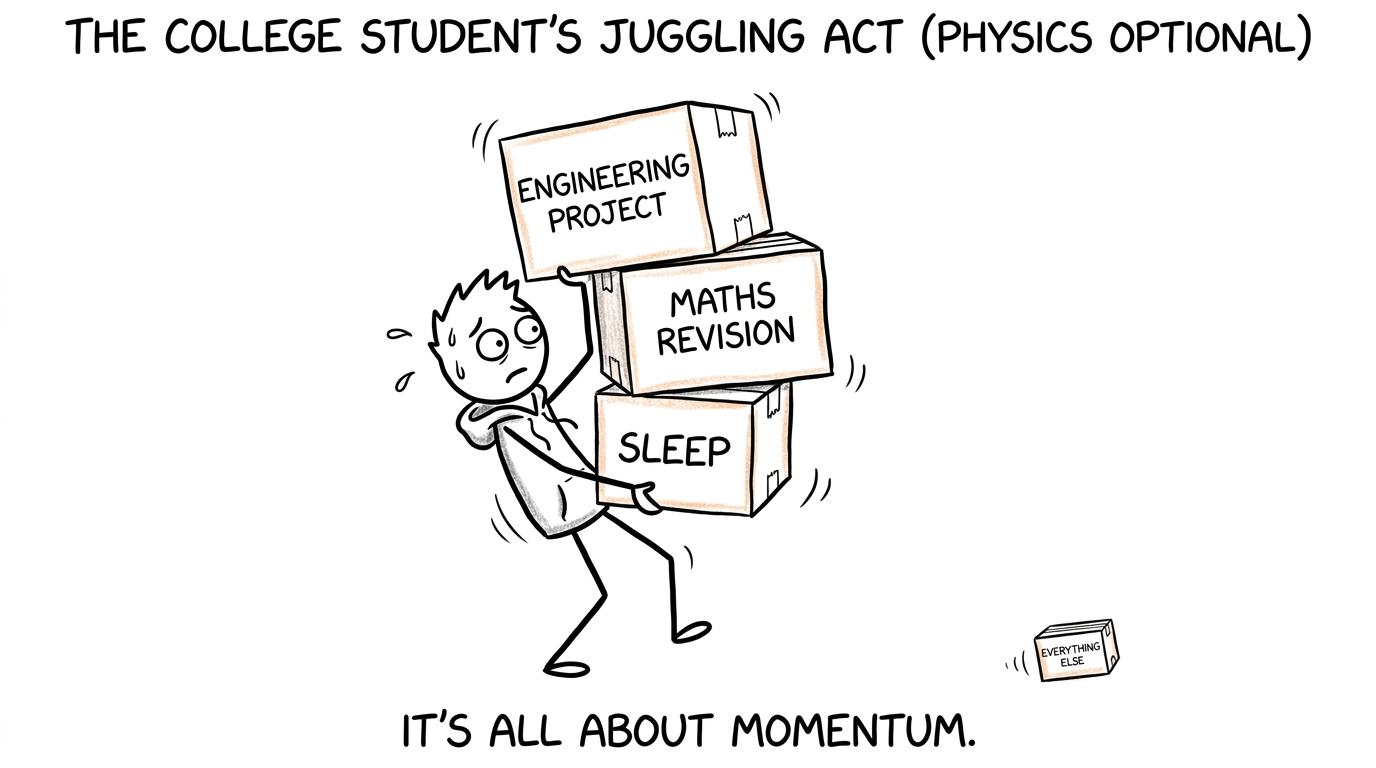 A student balancing Engineering, maths revision, sleep and everything else
Common mistakes when considering early entry
Confusing enthusiasm with exam readiness
Liking Engineering is important, but assessment readiness requires full coverage, accurate technical language and independent application.
Looking only at the written examination
For AQA GCSE Engineering, the written paper and NEA both contribute substantially. A decision based on mock-paper performance alone is incomplete.
Assuming the qualification can simply be retaken without consequences
Re-entry may involve timetable, assessment and accountability considerations. Obtain current advice from the school’s exams officer rather than relying on assumptions.
Ignoring the opportunity cost
Every extra Engineering revision session replaces something else. Protect enough time for maths, English, science, sleep and recovery.
Revising maths without checking your actual gaps
Do not revise every topic equally. Use a mini test or paper, mark it and identify precise weaknesses. MathsGenie’s guide to the best order for learning GCSE maths topics can help you repair prerequisites before tackling harder applications.
Make readiness the goal, not speed
Taking GCSE Engineering a year early can be a sound decision. It may suit a student who has completed the specification, produced secure practical work, performed consistently in timed assessments and protected the rest of their GCSE programme.
But there is no prize for reaching an examination room before your understanding arrives. Waiting can create better design decisions, stronger evaluation and a higher grade. Sometimes patience is not delay. It is part of the engineering process.
Before deciding, confirm the exact qualification, examine the evidence and agree on a plan for both the early assessment and the time afterwards. Then keep your supporting maths secure with MathsGenie: use free revision lessons to rebuild methods, practice questions and mini tests to expose gaps, and past papers, predicted papers, mark schemes and video solutions to prepare under realistic conditions.











