GCSE Ratio Questions Explained (With Worked Examples)
GCSE ratio questions explained with clear methods, worked examples, common mistakes and revision tips. Build confidence for foundation and higher tier.
When ratio questions feel like a trap (and how to unpick them)
In GCSE maths, ratio questions have a strange talent: they look friendly, then quietly steal your marks. You read “share £240 in the ratio 5:75:75:7” and your brain immediately starts doing two things at once, splitting and second-guessing. That’s not because you’re “bad at ratio”. It’s because ratio questions reward calm structure more than cleverness. Once you learn to turn every GCSE ratio question into the same small set of steps, they stop being scary and start being predictable.
Maths Genie has dedicated revision lessons and exam questions for ratio, sharing, and proportion, with mark schemes and video solutions. If you want the official methods in one place, start here: Sharing an amount between a given Ratio and Writing and Simplifying Ratios.
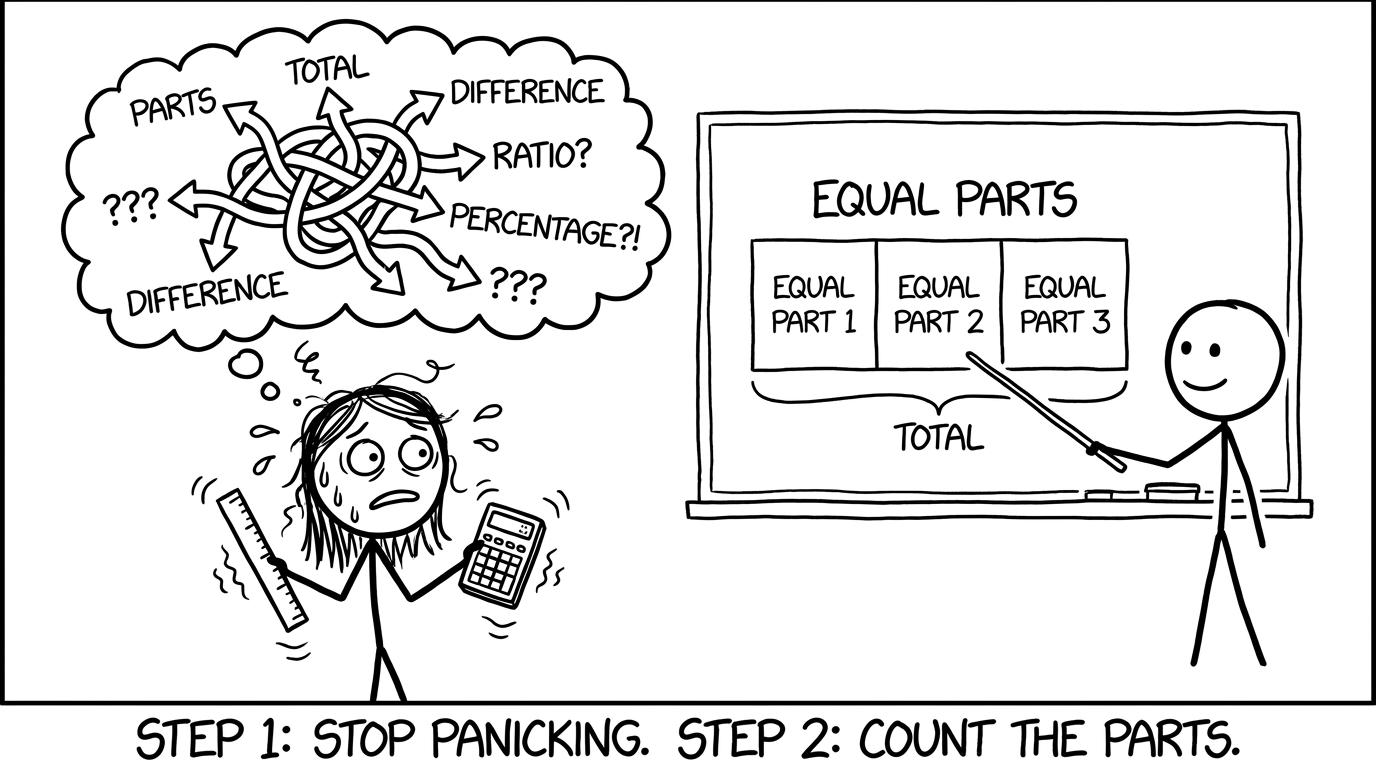 A stressed student learns the box method
Ratio questions checklist (the method that works in most GCSE papers)
When you see a GCSE ratio question, run this checklist before you touch your calculator:
- What is being compared? (money, lengths, quantities, ingredients, numbers of items)
- Is it a simple ratio (like 3:53:53:5) or a three-part ratio (like 2:3:42:3:42:3:4)?
- Do you know the total, one person’s share, or the difference between shares?
- Can you use the “equal parts” idea? (box model)
- Is it actually proportion? (recipes, best buys, direct proportion)
For targeted practice, Maths Genie has exam-style sets such as:
The core idea behind every GCSE ratio question: equal parts
A ratio like 2:12:12:1 means: “split something into 2+12+12+1 equal parts”. Those parts are the same size. The only difference is how many parts each person (or category) gets.
So if the ratio is a:ba:ba:b, then:
- Total parts =a+b=a+b=a+b
- One part =totala+b=\dfrac{\text{total}}{a+b}=a+btotal (if the total is known)
- Shares are aaa parts and bbb parts
This is why the box method is so popular on mark schemes: it makes the equal parts visible.
GCSE ratio sharing questions (total given)
This is the most common GCSE ratio format across Edexcel, AQA, OCR and Eduqas.
Worked example: sharing a total
Question: A and B share £360 in the ratio 5:75:75:7. Work out how much B gets.
Step 1: Count total parts
5+7=12 5+7=12 5+7=12Step 2: Find the value of one part
one part=36012=30 \text{one part}=\frac{360}{12}=30 one part=12360=30Step 3: Multiply by B’s parts
B gets 7×30=210 \text{B gets }7 \times 30=210 B gets 7×30=210So B gets £210.
If you want more examples exactly like this, practise with Sharing an amount between a given Ratio.
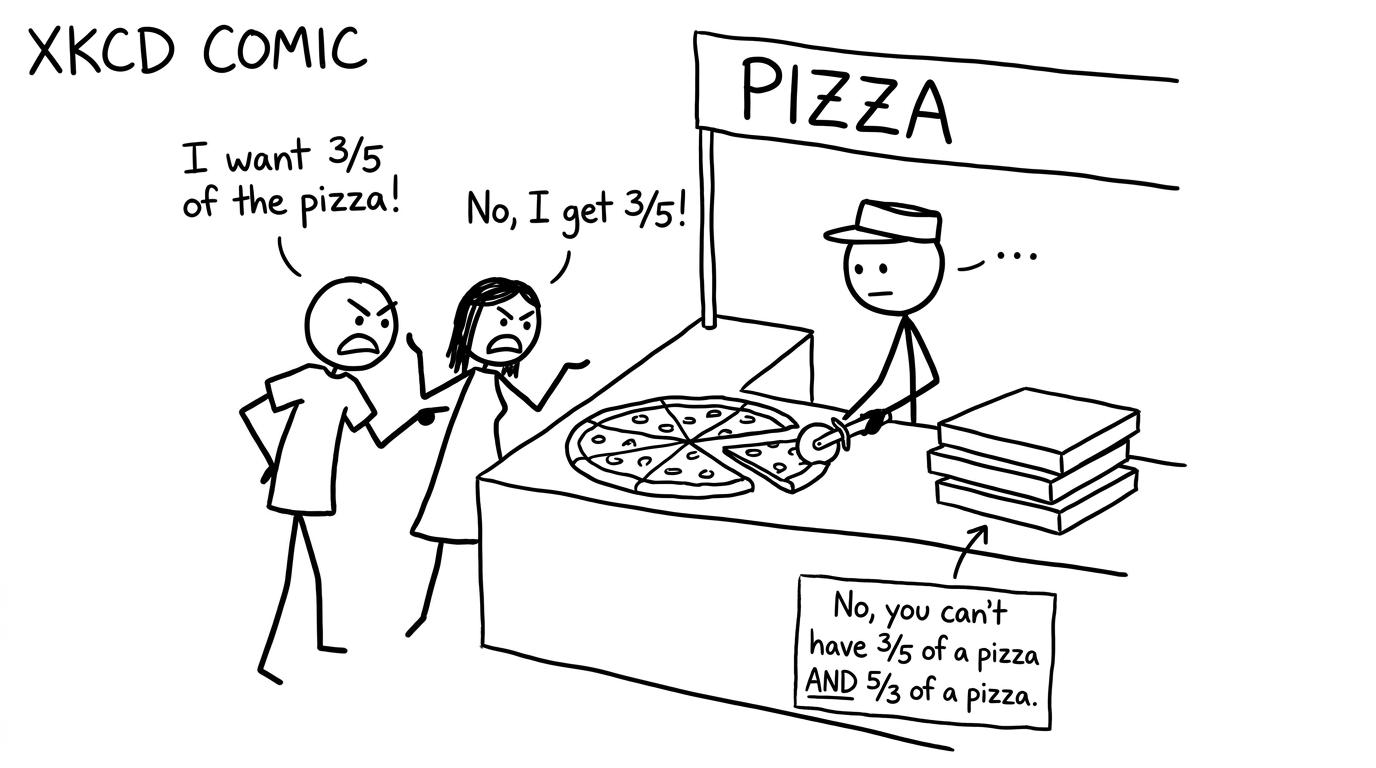 Pizza-counter ratio argument
GCSE ratio questions where one share is given
Sometimes the total isn’t given. Instead, you’re told what one person gets. That’s still an “equal parts” question; you just work backwards.
Worked example: one share given
Question: C and D share money in the ratio 3:53:53:5. C gets £48. Work out how much D gets.
C’s £48 represents 333 equal parts.
Step 1: Find one part
one part=483=16 \text{one part}=\frac{48}{3}=16 one part=348=16Step 2: Find D’s share (555 parts)
D gets 5×16=80 \text{D gets }5\times 16=80 D gets 5×16=80So D gets £80.
This style shows up a lot in GCSE papers because it tests whether you truly understand what the ratio numbers mean.
GCSE ratio questions where the difference is given
These are the ones that feel like a trick, but they’re actually very logical.
If the ratio is 3:53:53:5, the difference in parts is 5−3=25-3=25−3=2 parts. If you’re told the difference in money is £18, that means 222 parts are worth £18.
Worked example: difference given
Question: E and F share money in the ratio 4:94:94:9. F gets £55 more than E. Work out how much each gets.
Step 1: Difference in parts
9−4=5 9-4=5 9−4=5So the difference is 555 parts.
Step 2: Value of one part
one part=555=11 \text{one part}=\frac{55}{5}=11 one part=555=11Step 3: Find each share
E=4×11=44 E=4\times 11=44 E=4×11=44 F=9×11=99 F=9\times 11=99 F=9×11=99So E gets £44 and F gets £99.
This “difference in parts” method is exactly the kind of thing that earns method marks in GCSE mark schemes.
GCSE ratio and proportion: scaling recipes and ingredients
At some point, ratio questions stop being about sharing money and start being about scaling a recipe, a paint mix, or an ingredients list. That’s where proportion sits next to ratio.
Maths Genie has a focused page on this: Proportion Recipe Questions, plus the broader revision area: Proportion revision.
Worked example: scaling a recipe (direct proportion)
Question: A recipe uses flour, sugar and butter in the ratio 6:2:36:2:36:2:3. You need 550 g550\text{ g}550 g of mixture in total. How many grams of sugar are needed?
Step 1: Total parts
6+2+3=11 6+2+3=11 6+2+3=11Step 2: One part
one part=55011=50 \text{one part}=\frac{550}{11}=50 one part=11550=50Step 3: Sugar is 222 parts
sugar=2×50=100 \text{sugar}=2\times 50=100 sugar=2×50=100So you need 100 g100\text{ g}100 g of sugar.
Notice how this is structurally the same as sharing money. The context changes, but the method doesn’t.
GCSE ratio as a fraction of the whole (a common exam twist)
Exam boards love asking what fraction of a group is one category.
If the ratio of girls to boys is 2:32:32:3, then total parts are 2+3=52+3=52+3=5. The boys represent 333 parts out of 555, so the fraction is 35\dfrac{3}{5}53.
Worked example: ratio to fraction
Question: The ratio of red to blue counters is 7:87:87:8. What fraction of the counters are red?
Total parts:
7+8=15 7+8=15 7+8=15Fraction red:
715 \frac{7}{15} 157That’s already in simplest form.
This links closely to fraction skills, so if you’re rusty, use GCSE revision on Maths Genie to revisit fractions and proportional reasoning.
For A Level students: why GCSE ratio still matters
If you’re doing A Level Maths, ratio questions can feel “beneath you”. But ratio is really the language of modelling: gradients compare change in yyy to change in xxx, trigonometric ratios compare sides, and scaling arguments appear everywhere from mechanics to graphs.
Maths Genie’s A Level practice includes ratio ideas in a different outfit, like trigonometric ratios: A Level Trigonometric Ratios Questions. The point isn’t that A Level is full of “share £80” questions; it’s that the discipline of equal parts, consistent scaling, and clear structure carries upwards.
Common mistakes in GCSE ratio questions (and how to avoid them)
Even strong students lose easy GCSE marks on ratio because they rush the setup. Here are the patterns to watch.
Simplifying only one side of a ratio
To simplify 12:1812:1812:18, divide both sides by 666:
12:18=2:3 12:18=2:3 12:18=2:3If you only change one side, you’ve changed the comparison.
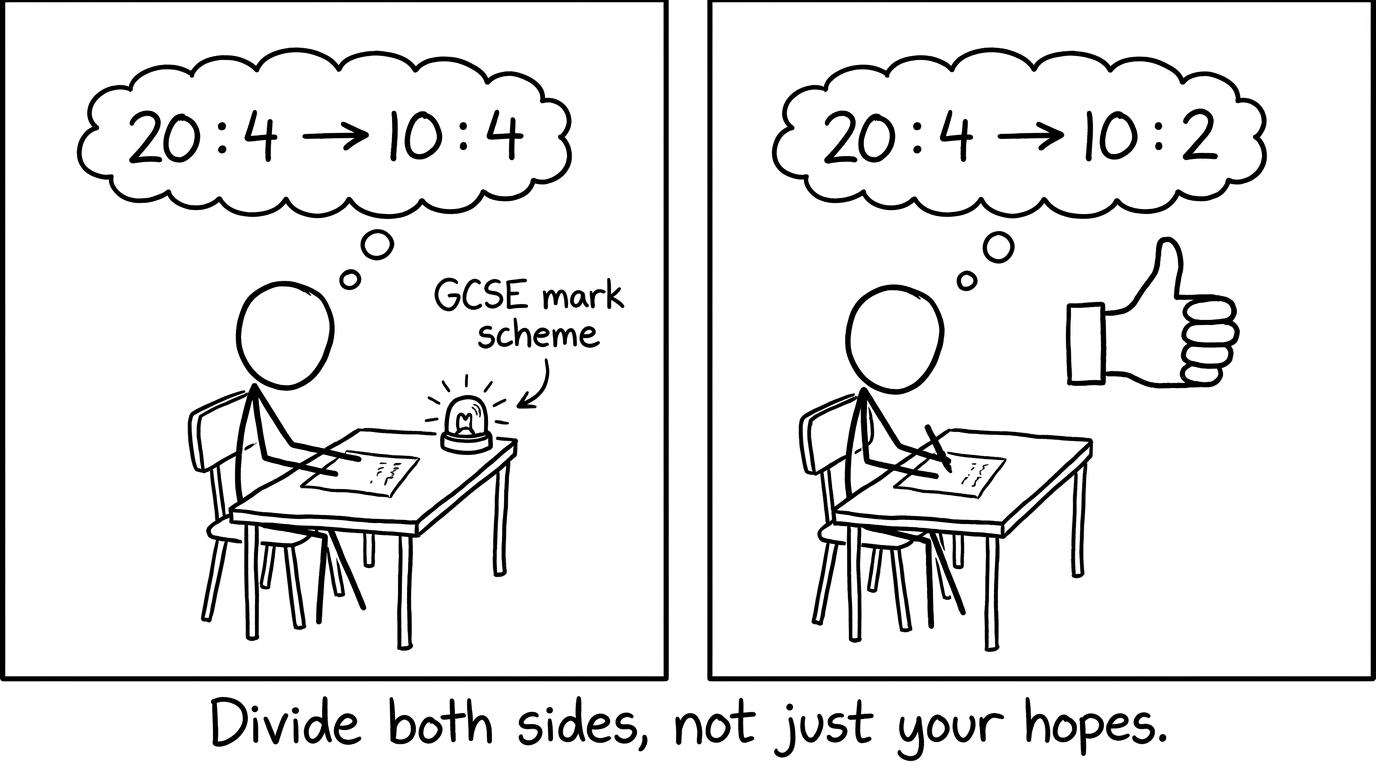 Divide both sides, not just your hopes
Forgetting to add parts for the total
In 5:75:75:7, total parts are 121212, not 777. A surprising number of GCSE mistakes come from dividing the total by the larger number in the ratio.
Mixing up “difference” and “total”
If you’re told “B gets £20 more than A”, that’s a difference question. The correct move is to subtract parts: b−ab-ab−a.
Not checking whether the question wants a ratio or an amount
Some GCSE questions ask you to “write the ratio in the form 1:n1:n1:n” or “in its simplest form”. Others want pounds, grams, or centimetres. Train yourself to circle what the final answer should look like.
Not using units consistently
Ratios must compare like with like. If you see 350 cm350\text{ cm}350 cm to 25 cm25\text{ cm}25 cm, that’s fine. But if it’s 3 m3\text{ m}3 m to 40 cm40\text{ cm}40 cm, convert first so the units match.
Bringing it together: make GCSE ratio questions predictable
A lot of revision advice sounds like motivation. Ratio doesn’t need motivation; it needs a repeatable structure. Every GCSE ratio question is really asking: “How many equal parts are there, and what is one part worth?” Once you train that habit, you stop relying on luck.
To push your ratio marks up quickly, use Maths Genie like a loop: learn the method, practise exam questions, mark with the solutions, then redo the ones you missed.
- Start with the lesson pages: Sharing an amount between a given Ratio and Writing and Simplifying Ratios
- Add proportion practice: Proportion revision and Proportion Recipe Questions
- Then test it under exam conditions: GCSE Predicted Papers and Target Tests
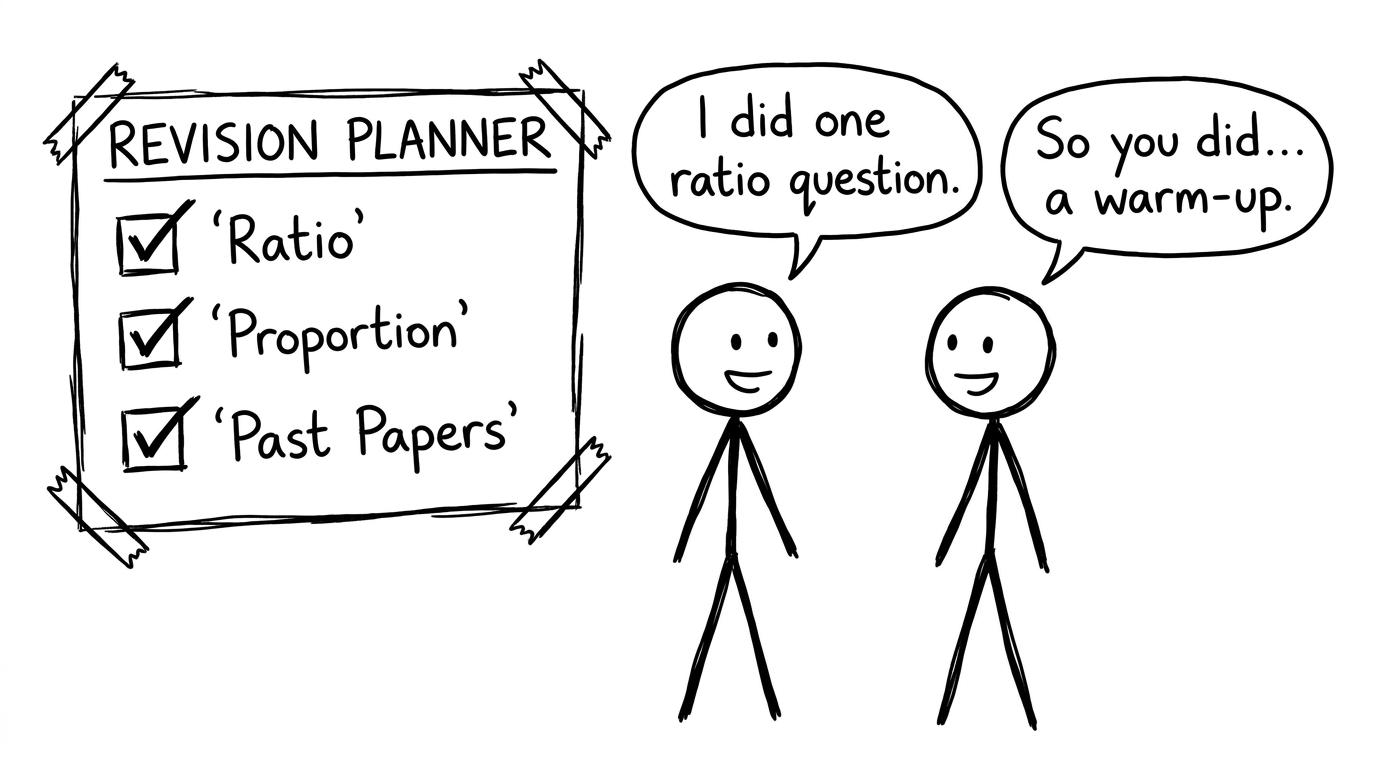 Revision planner humour
If you treat ratio as a skill you can rehearse, not a puzzle you must “figure out”, your GCSE confidence improves fast. And that confidence tends to spill into everything else, because the student who can organise a ratio question can usually organise a whole paper.