Is GCSE Economics Useful Without A Level?
GCSE Economics useful without A-level? Discover the maths, data and decision-making skills it builds, plus what colleges may expect after GCSE.
Choosing a GCSE can feel like choosing a road you must follow for years. It is not. If you are wondering whether GCSE Economics is useful without A-level Economics, the short answer is yes. It develops practical knowledge of money, markets and government decisions, alongside transferable skills in maths, data interpretation, argument and evaluation.
You do not need to continue the subject for that learning to matter. Economics can support your GCSE Maths revision, strengthen applications for other sixth-form courses and help you understand decisions that affect everyday life. Its value is not confined to becoming an economist.
What you gain at a glance
GCSE Economics can help you develop:
- confidence with percentages, averages and numerical change;
- the ability to read graphs, tables and economic data;
- structured analytical and evaluative writing;
- an understanding of prices, wages, taxation, interest and markets;
- better judgement about evidence, assumptions and competing viewpoints;
- useful foundations for subjects such as maths, geography, politics, business and sociology.
It is still important to be realistic. GCSE Economics does not automatically satisfy a college entry requirement, guarantee access to a particular career or replace a strong GCSE Maths grade. It is one useful part of a broader academic profile.
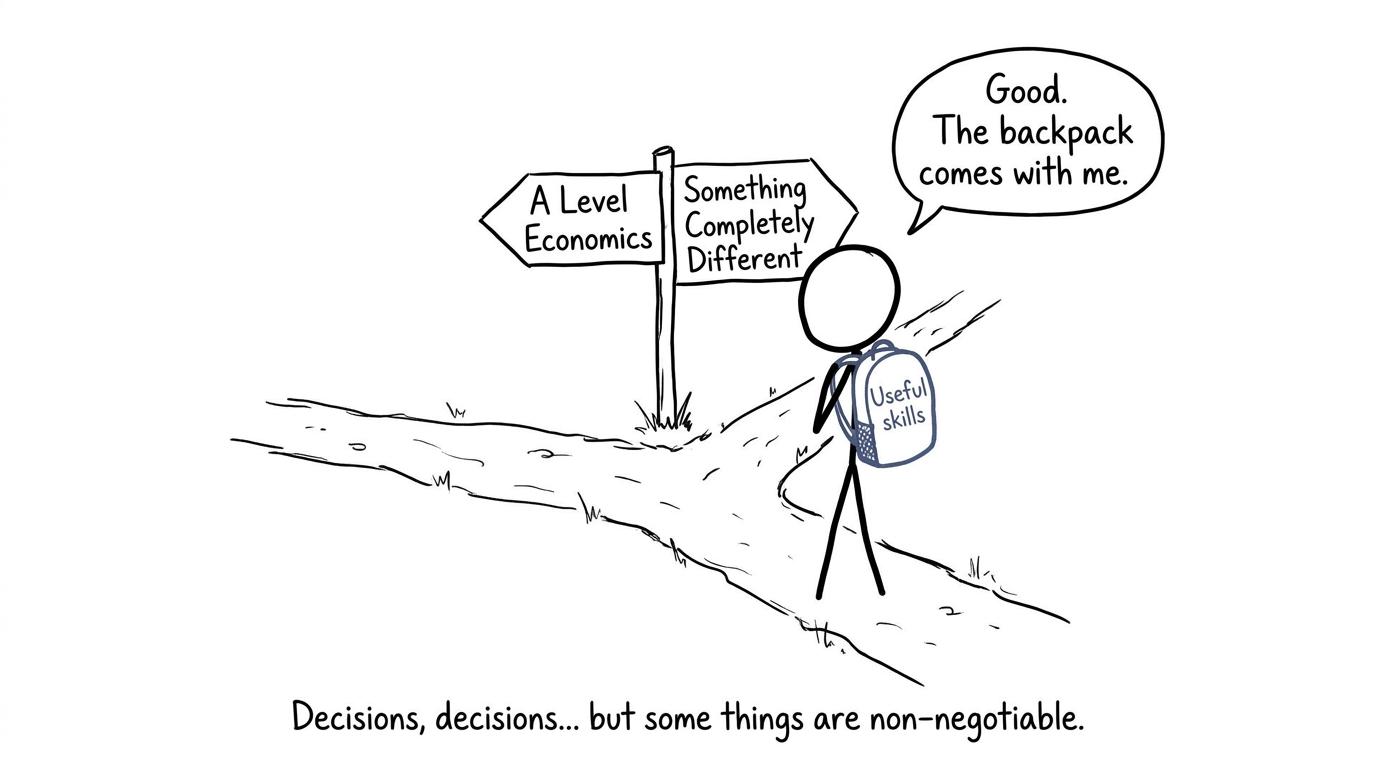 A student carries useful skills towards a different academic path
What GCSE Economics actually teaches you
The subject is partly about economic knowledge: scarcity, markets, supply and demand, production, government policy and the national and global economy. But the deeper benefit is learning how to think when there is no perfect answer.
Official GCSE subject content requires students to investigate economic situations, apply concepts, analyse evidence and make reasoned judgements using qualitative and quantitative data. A good response must do more than state an opinion. It needs a logical chain:
- identify the relevant economic idea;
- apply it to the information given;
- explain likely consequences;
- consider limitations or another perspective;
- reach a supported conclusion.
That structure transfers well. Geography asks students to interpret evidence and assess decisions. English develops arguments from texts. Sciences require conclusions supported by results. Even GCSE Maths increasingly rewards reasoning rather than unsupported answers.
Economics also gives context to terms you will meet outside school. Inflation, unemployment, taxation, interest rates and productivity stop being isolated headlines. You begin to ask who is affected, over what period and according to which evidence.
How GCSE Economics supports your maths
The overlap with GCSE Maths is meaningful, although Economics is not a substitute for maths revision.
Under the official requirements used by English exam boards, at least 10%10\%10% of GCSE Economics marks must reward quantitative skills at no lower than Key Stage 333 demand. AQA and OCR specifications include calculations involving:
- percentages and percentage changes;
- interest on savings;
- averages and average cost;
- revenue, costs and profit;
- gross and net income;
- graphs, charts and economic data.
The arithmetic is usually not the hardest part. The challenge is deciding what the result means in context.
Percentages become decisions
A percentage change in Economics may describe inflation, wages, prices or output. The familiar GCSE Maths relationship is:
percentage change=changeoriginal amount×100\text{percentage change}=\frac{\text{change}}{\text{original amount}}\times 100percentage change=original amountchange×100Economics makes the denominator matter. Students must recognise that percentage change is measured relative to the original value, then interpret the result appropriately.
If this is a weak area, use MathsGenie's best order for learning GCSE Maths topics to rebuild fractions, percentages and ratio before moving into mixed questions.
Graphs become arguments
In maths, you may be asked to plot, describe or interpret a graph. In Economics, a graph often becomes evidence within a decision. You need to notice:
- what each axis represents;
- the scale and units;
- whether the graph shows an amount, rate or percentage;
- the period covered;
- whether the data establishes causation or only shows a relationship.
This habit supports real-life graphs, statistics and problem-solving across foundation and higher tier. The GCSE Maths topics by exam board and tier guide can help you identify where graphs, percentages and statistics appear in your own Edexcel, AQA, OCR or Eduqas course.
Averages need interpretation
Economics reminds you that an average is a summary, not the full story. The arithmetic mean is:
mean=sum of the valuesnumber of values\text{mean}=\frac{\text{sum of the values}}{\text{number of values}}mean=number of valuessum of the valuesBut a mean can conceal variation, unusual values or differences between groups. Asking whether an average is representative is valuable in both Economics and GCSE Maths statistics. For focused resources, visit the free GCSE Statistics revision area.
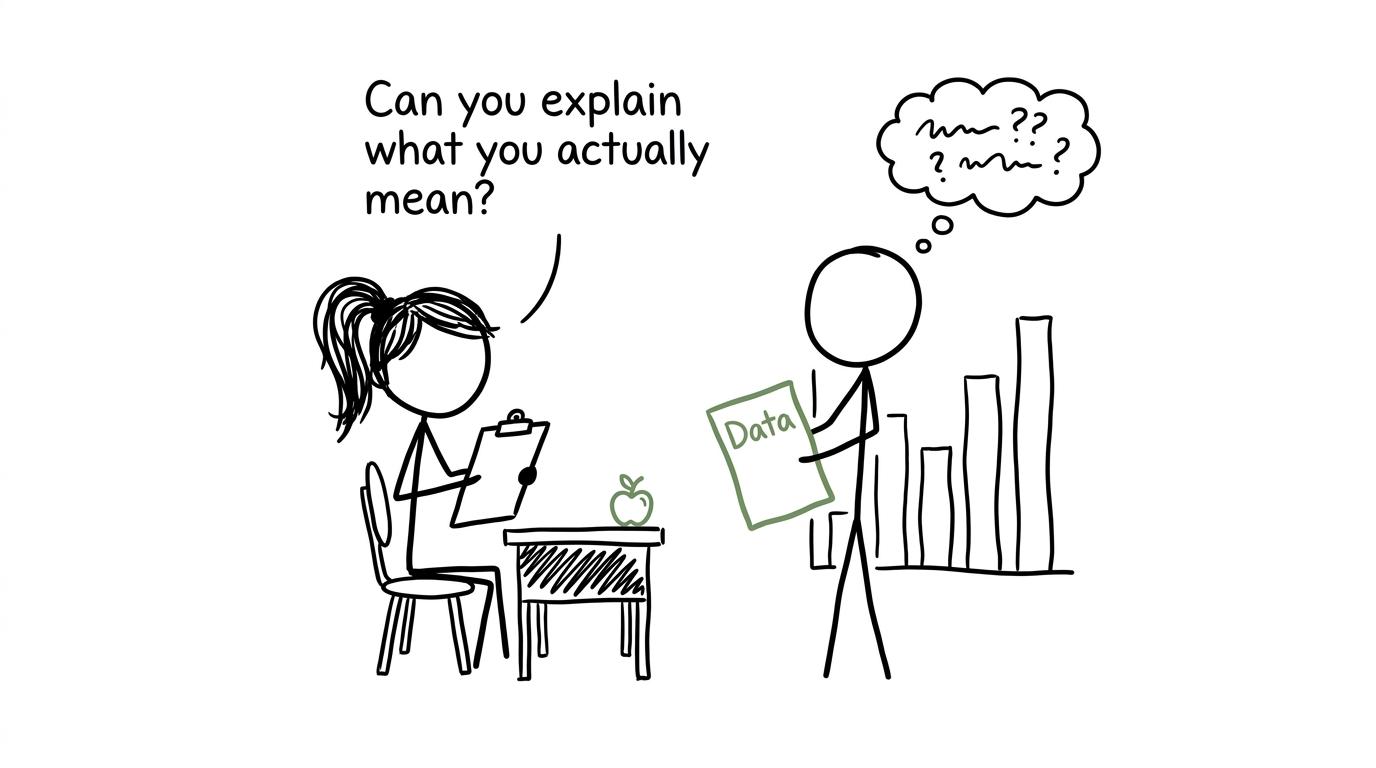 A student interviews a nervous bar chart about what the data means
Is GCSE Economics useful for other A-levels?
Yes, although the benefit depends on what you choose next.
For A-level Maths, Economics provides extra experience of percentages, data and graphs, but it does not teach the algebraic depth needed for the course. Your GCSE Maths knowledge and grade will normally be more important for admission.
For geography, politics and sociology, Economics provides useful ideas about development, inequality, employment, government intervention and global trade. For business, it helps distinguish decisions made inside a firm from wider forces affecting a market or economy.
It can also support essay-based subjects. Economic questions often require a balanced argument rather than a list of memorised facts. You learn to use phrases such as “this depends on” carefully: not as an escape from making a judgement, but as a way to identify the condition that could change the conclusion.
The transferable skill is disciplined uncertainty. You can make a decision while recognising that evidence has limits.
Does it affect sixth-form or college entry?
There is no single national admissions rule covering every sixth form and college. Providers set their own general and subject-specific requirements.
GCSE Economics is not normally a universal prerequisite for A-level Economics because many schools do not offer it at GCSE. Courses commonly allow students to begin without previous Economics study. However, an individual provider may set a required Economics grade if you have taken the subject. It may also place particular emphasis on GCSE Maths or English.
Therefore, check each provider's current prospectus rather than relying on a friend's entry requirements. Record:
- the overall GCSE grade profile required;
- the GCSE Maths requirement;
- the GCSE English requirement;
- whether Economics is required if previously studied;
- whether meeting the minimum grades guarantees consideration rather than a place.
MathsGenie's GCSE Economics grade and sixth-form guide explains why local requirements vary and what to check before applying.
If you are not continuing Economics, the grade can still contribute to your overall GCSE profile. Yet colleges may care more about a specific prerequisite. A course requiring a particular Maths grade will not usually treat Economics as a replacement, however numerate the subject may be.
The everyday value beyond qualifications
The long-term usefulness of Economics often appears in ordinary decisions rather than examination questions.
You become better equipped to distinguish a price rise from a percentage rise, understand why interest affects saving and borrowing, and recognise that every choice has an opportunity cost. You also become more alert to the way charts can frame a story through selected dates, scales or categories.
That does not make every economic decision easy. It gives you better questions:
- What is the evidence?
- Compared with what?
- Who benefits or loses?
- Is this a short-term or long-term effect?
- What assumption is being made?
These questions are useful whether you later study engineering, law, medicine, design or a vocational course. Most adult decisions involve limited time, limited money and competing priorities. Economics gives that problem a language.
How to use the overlap in your GCSE Maths revision
Do not revise Economics and Maths as if they were identical. Instead, use the overlap deliberately.
When you encounter an Economics calculation, identify its mathematical topic: percentage change, averages, money, units or graph interpretation. If the method is uncertain, return to a maths revision lesson and complete focused questions. Then revisit the skill inside an economic context.
For maths exams, follow a simple cycle:
- learn or review the method;
- complete topic-based practice questions;
- check the solution or mark scheme;
- record the exact reason for each lost mark;
- retest the topic in a mixed paper.
The guide to using GCSE past papers properly explains why the improvement happens after marking, not merely during the paper. Once your core methods are secure, Edexcel GCSE Maths predicted papers can provide fresh timed practice for Edexcel students.
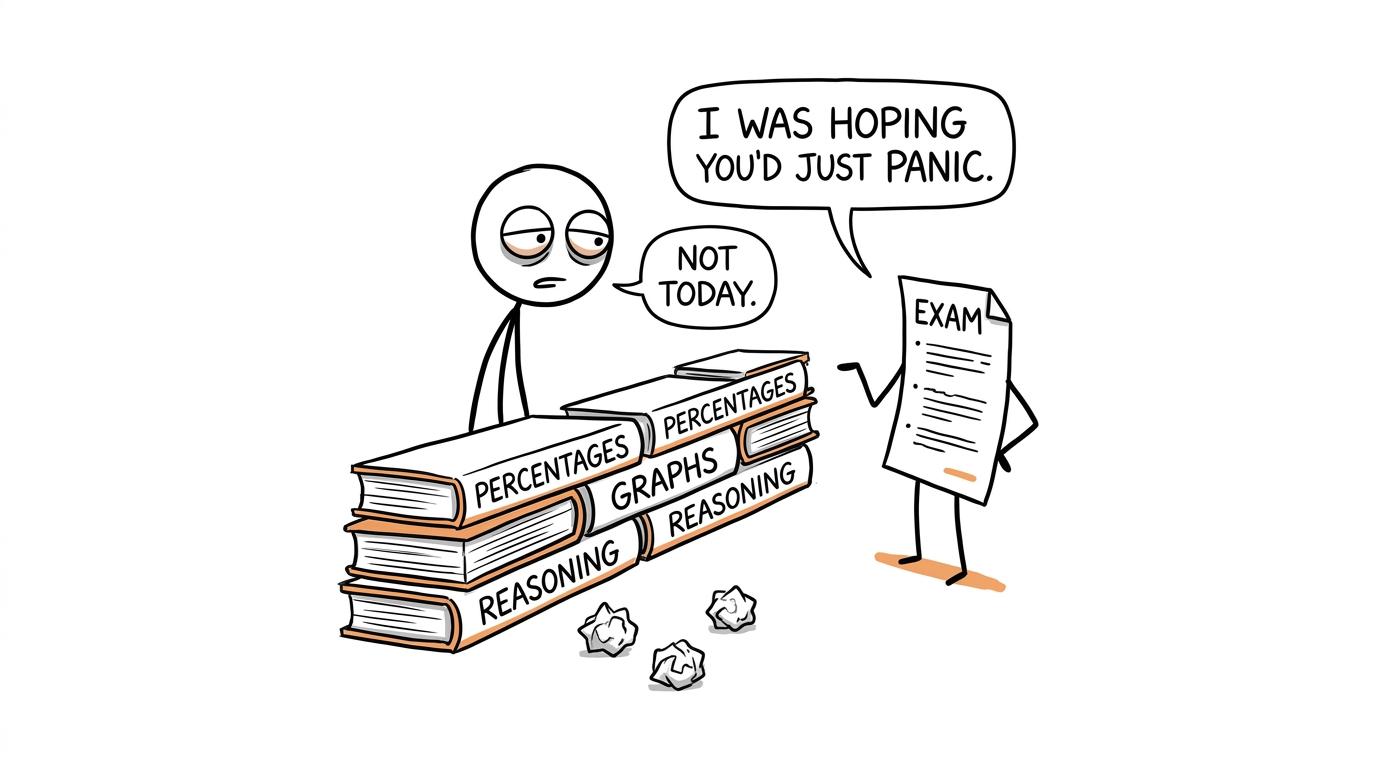 A student protects calm revision with a wall of percentages, graphs and reasoning
Common mistakes when judging the subject's usefulness
Assuming every GCSE must lead to an A-level
Education is not a narrow pipeline. A subject can be worthwhile because of the knowledge and habits it develops, even if you stop studying it formally after GCSE.
Believing Economics is mostly difficult maths
GCSE Economics includes quantitative skills, but it also depends heavily on explanation, application, analysis and evaluation. Strong arithmetic alone is not enough.
Treating it as a replacement for GCSE Maths
Economics gives your numerical skills a useful context. It does not cover the complete GCSE Maths specification or replace the grade required by a college.
Assuming all colleges have the same rules
Entry requirements differ and can change between application cycles. Always check the current information published by each provider and ask its admissions team if the wording is unclear.
Revising graphs without discussing meaning
A correctly read value is only the beginning. Check units, scale, time period and limitations before using the data to support a conclusion.
A useful subject does not need to become your destination
GCSE Economics remains useful without A-level study because it teaches you to connect numbers with choices and evidence with judgement. It can strengthen mathematical confidence, analytical writing and your understanding of the world, while contributing to your wider GCSE profile.
Your immediate priority, however, is to turn those transferable skills into exam marks. Use MathsGenie to organise that work calmly: follow a clear topic order, use revision lessons to repair gaps, complete practice questions and mini tests, and then move to past papers, predicted papers, mark schemes and video solutions. If time feels short, the one-week GCSE Maths revision plan provides a focused starting point.
A GCSE does not have to dictate your next subject to be valuable. Sometimes its best result is simpler: you leave with better tools for whatever you choose next.