GCSE Economics Revision: Silence or Noise?
GCSE economics revision silence or noise? See what research says about lyrics, instrumental music, memory, focus and realistic exam practice at home.
You sit down to revise market failure. The room feels too quiet, so you reach for a playlist. Ten minutes later, you know every lyric but cannot explain an external cost.
For GCSE economics revision, silence or noise is not simply a matter of preference. The best choice depends on what you are doing. Current evidence suggests that silence is the safest default for reading, learning definitions, remembering verbal material and writing extended answers. Quiet instrumental sound may be neutral for some students, but music with lyrics is more likely to interfere.
That answer is not as exciting as discovering a magical revision playlist. It is more useful.
The quick answer
Use this checklist when choosing your revision environment:
- Choose silence for learning new content, reading case studies, recalling definitions and planning analytical or evaluative answers.
- Avoid music with lyrics during language-heavy tasks. Lyrics compete with the words you are trying to process.
- Try quiet instrumental sound only if silence makes you restless or your environment contains unpredictable noise.
- Use realistic silence for timed questions and mock papers because your examination will not include a soundtrack.
- Test your performance, rather than trusting whether a session merely felt enjoyable.
- Remove notifications and conversations whichever sound condition you choose.
The central distinction is not between students who “can” and “cannot” revise with music. It is between feeling comfortable and learning effectively.
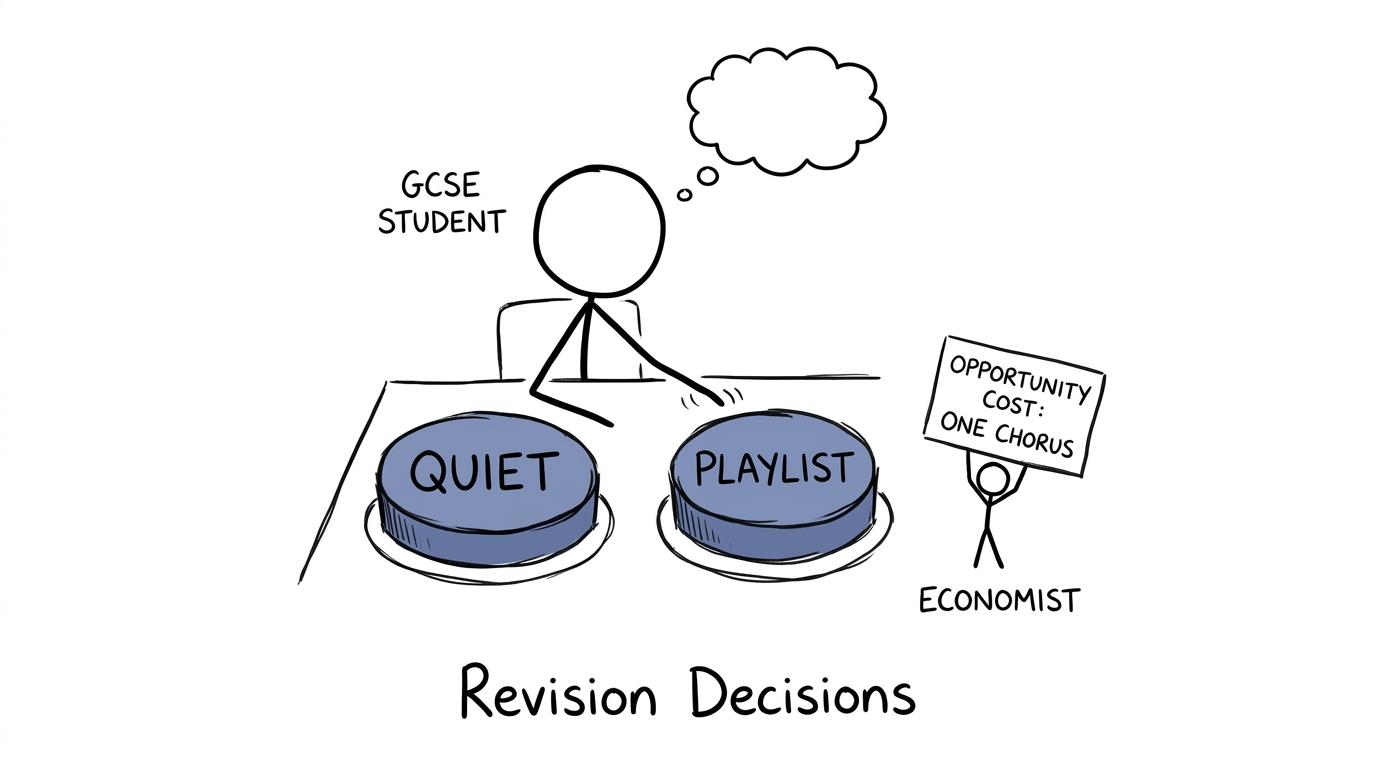 A student considering the opportunity cost of a revision playlist
What the evidence actually says about background noise
Research into background music is mixed because studies use different tasks, participants and types of sound. A broad systematic review published in 202220222022 examined 959595 articles containing 154154154 experiments across memory, language, attention, reasoning and other cognitive areas.
Most individual comparisons found no clear difference between music and silence. However, when significant effects did appear, they were usually negative. The review found a general detrimental effect on memory and language-related tasks, with lyrical music tending to be more disruptive than instrumental music.
Reading deserves particular attention. Research reviews have found that background music can slow reading, while songs with lyrics can reduce comprehension. A controlled study published in 202320232023 also found that verbal memory, visual memory and reading comprehension were worse with lyrical music than in silence. Its instrumental lo-fi condition produced no credible improvement or impairment.
A 202420242024 reading study reached a similar conclusion: comprehension was lower with lyrical pop music than without music, particularly when the lyrics were in the same language as the text.
There are important limits. Much of this research uses university students or adults completing short laboratory tasks. It does not prove that every GCSE student will respond identically, and it does not identify one universally perfect soundtrack. There is also little direct research specifically testing British GCSE Economics revision.
The honest conclusion is narrower: lyrics are a meaningful distraction risk for verbal learning, while instrumental music is often neutral rather than beneficial.
Why GCSE Economics often favours silence
GCSE Economics is language-heavy even when numbers and diagrams appear. Across regulated GCSE specifications, students are expected to demonstrate knowledge and understanding, apply ideas to contexts, and analyse and evaluate evidence. AQA and OCR, for example, use the common assessment objective weightings of 35%35\%35% for knowledge and understanding, 35%35\%35% for application and 30%30\%30% for analysis and evaluation.
That means revision involves several demanding verbal processes:
- reading unfamiliar economic contexts;
- remembering precise terms;
- distinguishing similar concepts;
- constructing chains of reasoning;
- selecting evidence;
- reaching justified conclusions.
If a song supplies another stream of meaningful words, your attention must handle both. You may still finish the page, but completion is not the same as comprehension.
The same principle matters in maths. Reading a multi-step problem, deciding which information is relevant and explaining a conclusion all require focused processing. MathsGenie’s GCSE Maths revision hub provides lessons, questions and papers across Edexcel, AQA, OCR and Eduqas, but the resource can only help if your attention remains on the task.
Silence is especially useful for difficult work
Choose a quiet setting when you are:
- learning a new topic;
- reading a data-response extract;
- memorising definitions through active recall;
- comparing policies or stakeholder effects;
- writing an extended response;
- correcting an answer with a mark scheme;
- completing a timed paper.
Difficulty matters. A familiar multiple-choice question may tolerate a little background sound. Building a balanced judgement about government intervention demands more mental control.
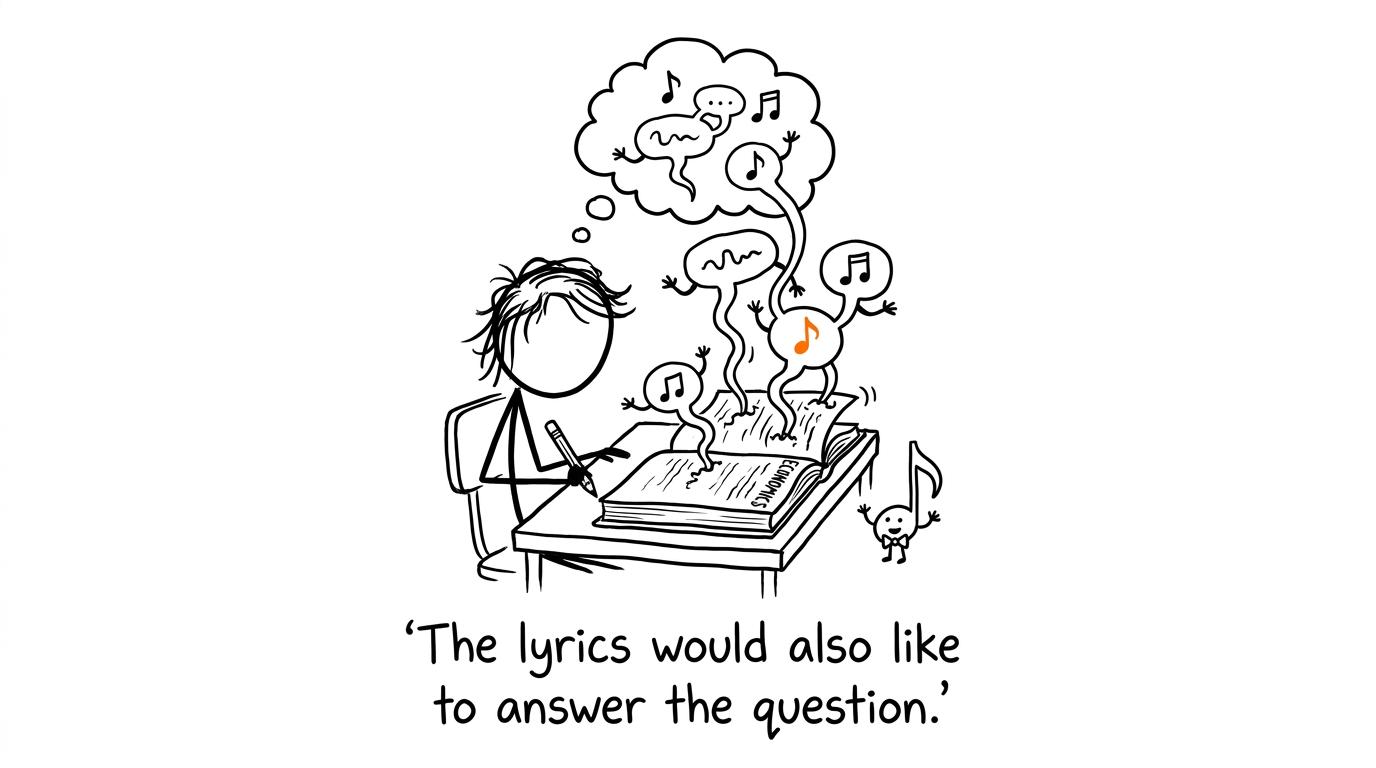 Song lyrics attempting to enter an Economics textbook
When background sound may still help
Silence is a strong default, not a moral rule. A completely quiet room may be unavailable, and some students find unpredictable household noise more distracting than a steady sound.
In that situation, low-volume instrumental audio, white noise or another stable non-verbal sound may mask interruptions. The evidence does not show that instrumental music reliably improves learning, but it is generally less risky than lyrical music.
If you use background audio, make it:
- quiet enough to forget;
- instrumental;
- familiar and predictable;
- free from dramatic changes;
- controlled before the session begins;
- played without opening an app repeatedly to change tracks.
Music should function like wallpaper. Once you begin following the melody, anticipating a favourite section or choosing the next track, it has become a second task.
Preference is not proof
Students sometimes say, “I work better with music,” when they mean, “I enjoy working more with music.” Enjoyment matters because it can help you begin. Yet it does not automatically mean that you remember more or write stronger answers.
Research has found that people can misjudge the effect of music on their own performance. Familiar routines feel fluent, and fluency can be mistaken for learning. The remedy is not to distrust yourself completely. It is to collect better evidence.
Run your own silence-versus-noise test
You do not need a laboratory. Choose two comparable Economics tasks and complete one in silence and one with your usual background sound. Keep the time, difficulty, room and access to notes as similar as possible.
After each session, record:
- how many questions were correct;
- how much relevant economic reasoning you included;
- how often you reread the material;
- how much you could recall later without notes;
- whether you reached a justified conclusion;
- how distracted you felt.
Swap the order on another day so that tiredness or familiarity does not always favour the same condition. Repeat the comparison rather than trusting one result.
Use delayed recall as the deciding measure. A playlist may make the first session feel smooth, but revision succeeds when the idea is still available tomorrow.
Maths students can run the same test using a GCSE mini test and revision resource or a short set of topic questions. For a more disciplined feedback process, follow MathsGenie’s guide to finding your weakest GCSE topics: attempt, mark, identify the gap and retest.
Match the sound to the stage of revision
A sensible approach changes as the session progresses.
Starting and organising
A short instrumental track may help you settle, arrange your notes and decide what to do. This is low-demand work. Set the task before pressing play so that choosing music does not become procrastination.
Learning and recalling
Turn the sound off when you read, retrieve definitions or construct reasoning. This is where silence offers the clearest advantage. Do not just reread: close the book, recall the idea, check it and correct the gap.
MathsGenie’s guide to a revision timetable that actually works uses the same principle of focused practice followed by marking and correction. You can transfer that structure directly to Economics.
Timed exam practice
Use silence. Exam preparation should eventually resemble the conditions in which you must perform. Complete the question without notes or music, then assess it against the relevant mark scheme.
For maths, using GCSE past papers properly means choosing the correct board and tier, working under timed conditions, marking carefully and repairing the exact weakness. Edexcel students can apply this with GCSE Maths past papers and mark schemes.
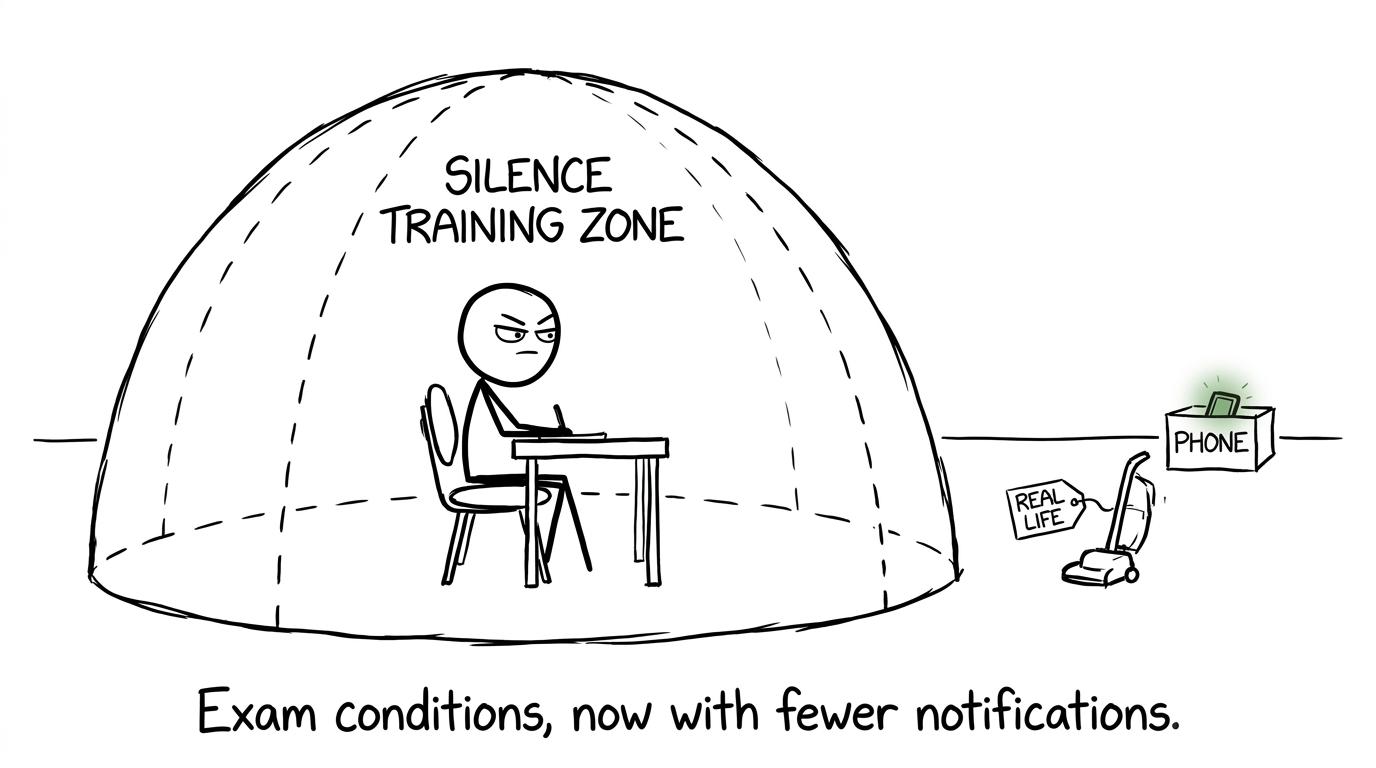 A determined student training in realistic silent exam conditions
Background noise is not the only distraction
A silent room with a phone beside you may be less focused than a café with steady background sound. Notifications, conversations and switching between tabs all interrupt the chain of thought needed for Economics analysis.
Before revising:
- put your phone out of reach;
- close unrelated tabs;
- gather the resources you need;
- define one precise outcome;
- decide when you will stop;
- take breaks away from the screen.
The aim is not sensory perfection. It is to reduce unnecessary decisions. MathsGenie’s one-month GCSE revision plan shows how short retrieval, focused topic work, exam questions and immediate feedback can form a repeatable routine.
Common mistakes when choosing revision sound
Playing songs with familiar lyrics
Familiarity does not remove language. In fact, a favourite lyric may be especially good at capturing attention. Save lyrical music for breaks or routine tasks that require little reading.
Assuming instrumental music boosts intelligence
The evidence does not support a universal cognitive benefit from classical music, lo-fi or any special frequency. Instrumental audio may be neutral or useful for masking disturbance, but it does not replace retrieval practice.
Measuring hours instead of learning
A long, pleasant session can produce little durable recall. Measure answers completed, errors corrected and ideas retrieved later.
Changing playlists repeatedly
Searching, skipping and checking the screen fragments attention. If you choose audio, prepare it beforehand and leave it alone.
Never practising in exam conditions
Comfortable revision and exam performance are different skills. Even if instrumental sound helps you begin, complete regular silent timed practice. MathsGenie’s guide to when you should start GCSE past papers explains how to progress from shorter diagnostic work to full papers.
Make silence your baseline, not your prison
For GCSE Economics, begin with silence. It is the lowest-risk choice for reading, memory, application and extended reasoning. If your environment is noisy or silence stops you settling, test quiet instrumental sound, but judge it by recall and answer quality, not mood alone.
Then train for the examination itself. Work without lyrics, remove your phone, answer timed questions and learn from the mark scheme. The environment matters, but the revision method matters more.
Bring that same discipline to maths with MathsGenie. Start in the free GCSE Maths revision area, use revision lessons and practice questions to repair weak topics, then build confidence with mini tests, past papers, predicted papers, mark schemes and video solutions. Choose a quiet task, attempt it properly and let the evidence from your own work decide what comes next.