

GCSE Economics: Revise Every Day or Rest?
GCSE economics revise every day or rest? Learn how spaced recall, planned rest days and sleep improve retention while protecting your energy for exams.
There is a particular kind of guilt that appears during exam season. You take one evening off, notice that someone else is revising, and begin to wonder whether rest is simply another word for falling behind.
So, should you revise GCSE Economics every day or rest? For most students, the strongest approach is neither relentless daily revision nor long periods of complete avoidance. Use short, focused sessions across the week, revisit the same material after a gap, and include genuine rest days. Spaced retrieval supports long-term retention, while sleep and recovery protect the attention needed to apply, analyse and evaluate economic ideas.
Daily contact can help when it is brief. Daily heavy revision usually cannot be sustained. The goal is not to defend an impressive streak. It is to remember the content and use it when the exam paper is in front of you.
The short answer: revise regularly, not relentlessly
A sensible GCSE Economics plan should include:
- several focused revision sessions each week
- gaps between attempts at the same topic
- active recall before looking at notes
- exam questions and immediate feedback
- at least one proper rest day
- enough sleep to think clearly
- lighter sessions when schoolwork or maths revision is demanding
In practical terms, you might revise Economics on 444 or 555 days each week rather than forcing a substantial session every day. A completely free day is not wasted time if it helps you return alert and ready to retrieve what you previously learnt.
The important distinction is between frequency and intensity. A 101010-minute recall session is not the same demand as a 909090-minute essay-writing session. You can sometimes maintain frequent contact with the subject while still building meaningful recovery into your timetable.
Why spacing helps GCSE Economics stick
Economics contains definitions, diagrams, chains of reasoning, calculations and extended judgements. You need to know ideas such as opportunity cost, market failure and inflation, but recognition alone is not enough. In an exam, you must retrieve the right idea and apply it to the context provided.
Research reviews in cognitive psychology consistently support two useful principles:
- Spacing: revisiting material across separate sessions generally produces stronger long-term retention than concentrating the same practice into one block.
- Retrieval practice: attempting to recall an idea strengthens memory more effectively than repeatedly rereading it.
This does not establish one perfect gap for every student or every topic. The best spacing depends on how well you know the material, how difficult it is and how far away the exam is. It does tell us that repeatedly reading one chapter in a single evening is unlikely to be the most efficient route to durable knowledge.
A simple sequence could be:
- first session: learn the concept and explain it without notes
- two or three days later: retrieve definitions and redraw key diagrams
- later that week: answer an exam question
- the following week: revisit mistakes in a mixed session
The gap makes recall feel harder. That is not necessarily a warning sign. Some effort is useful because you are rebuilding the route to the memory rather than merely recognising a familiar page.
Maths follows the same broad logic. MathsGenie's guide to stopping GCSE content from being forgotten shows how recall, spaced practice and exam questions can work together when Economics is competing with maths for revision time.
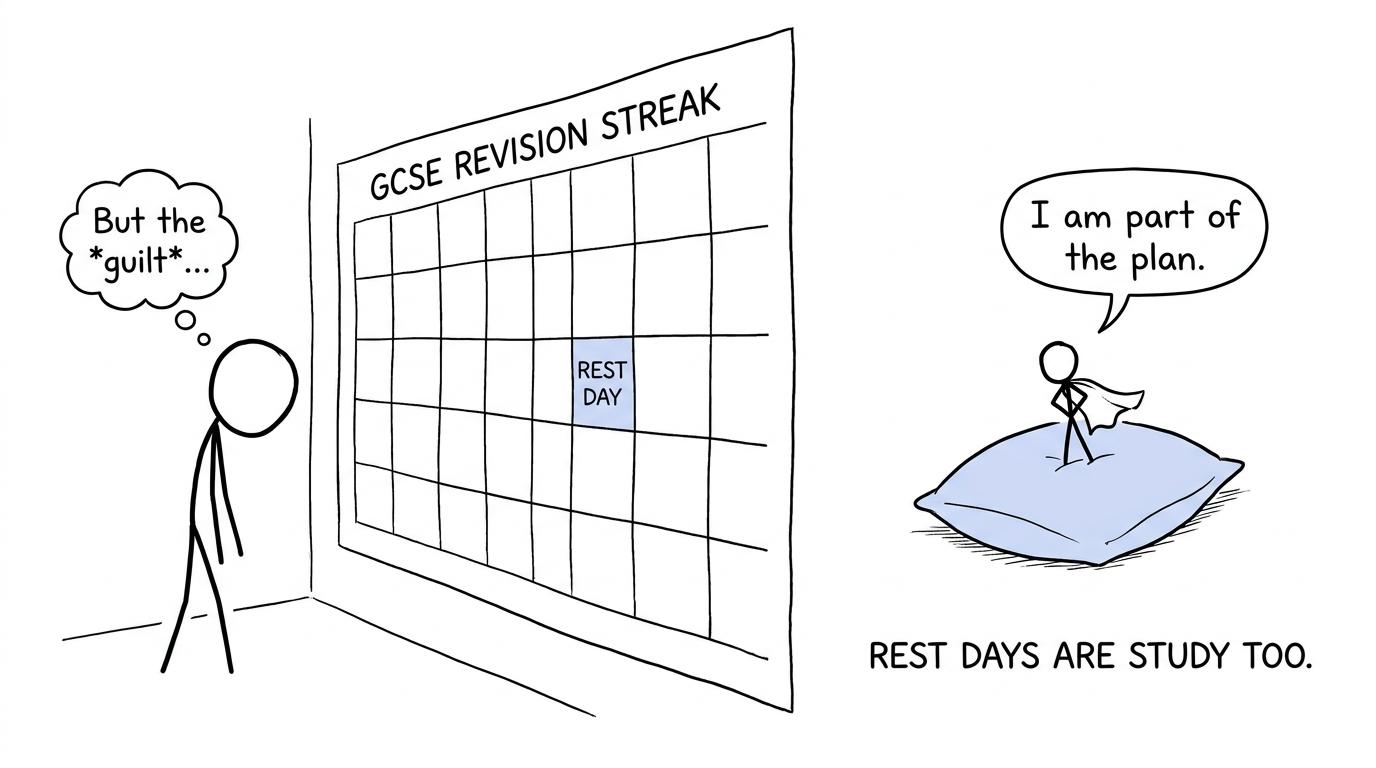 A student discovers that a rest day can be part of a revision plan
Rest days support learning rather than interrupting it
A rest day does not magically teach a topic. It does something quieter: it protects your capacity to learn the next one.
Attention, motivation and decision-making are limited. When every evening becomes compulsory revision, students often remain at their desks while the quality of the work falls. Notes are copied. Videos play without full attention. Familiar chapters are chosen because they feel comfortable.
A planned break can prevent that pattern. It also creates a natural spacing interval before you attempt to retrieve the material again.
Sleep matters too. NHS-linked guidance indicates that teenagers commonly need around 888 to 101010 hours of sleep, although individual needs vary. Cutting sleep to create extra revision time can leave you less alert when learning and retrieving information. A late-night session is a poor bargain if it makes the following school day ineffective.
Rest should therefore include more than switching from revision to anxious scrolling. Useful recovery might mean sleep, exercise, time outdoors, a hobby or an evening with family. The purpose is to step away sufficiently that concentration can recover.
Match your schedule to what Economics exams reward
Ofqual's assessment objectives for GCSE Economics place approximately 35%35\%35% on knowledge and understanding, 35%35\%35% on application, and 30%30\%30% on analysis and evaluation. Your exact paper structure depends on your specification, so check whether you take AQA, OCR or another available qualification and use the correct materials from your school.
Those weightings reveal why passive daily rereading is incomplete. Knowing a definition helps with knowledge, but marks also depend on using concepts in unfamiliar contexts, developing logical chains and reaching supported judgements.
Your weekly plan should therefore rotate between three kinds of work.
Recall sessions
Close your notes and retrieve key definitions, causes, consequences and diagram labels. Explain a concept aloud or write a short summary from memory. Then check what you missed.
These sessions can be brief. On a busy school night, 101010 to 202020 purposeful minutes may be more valuable than an unfocused hour.
Application and analysis sessions
Use data, extracts or short scenarios from material supplied by your teacher or exam board. Ask:
- Which economic concept is relevant?
- What detail from the context should appear in the answer?
- What happens next in the chain of reasoning?
- What assumption could weaken the argument?
This is where knowledge becomes exam performance.
Timed question sessions
Practise constructing responses under a time limit, then use the appropriate mark scheme. Record whether lost marks came from missing knowledge, weak application, incomplete analysis, unsupported evaluation or poor time management.
Maths students can use the same diagnostic mindset. The MathsGenie guide to finding your weakest GCSE topics explains how to turn lost marks into specific next actions instead of revising everything equally.
A sustainable weekly rhythm
There is no universal timetable, but a balanced week might look like this:
- Monday: 252525 minutes of recall and one short application task
- Tuesday: maths or another subject, with no Economics
- Wednesday: 353535 minutes of exam-question practice and marking
- Thursday: 101010 minutes retrieving Monday's weakest material
- Friday: complete rest from Economics
- Saturday: 454545 to 606060 minutes of mixed or timed practice
- Sunday: 151515 minutes reviewing errors and planning the next week
This gives you frequent retrieval without requiring a demanding Economics session every day. It also spaces repeated contact with difficult ideas.
If your exams are close, you can increase the amount of exam practice while retaining breaks. If you are months away, shorter sessions with wider gaps may be enough. If you are exhausted, unwell or unable to concentrate, reduce the session rather than collecting unproductive hours.
For students balancing Economics with maths, the GCSE maths revision timetable and GCSE twenty-minute revision routine offer practical ways to divide limited time without allowing one subject to consume every evening.
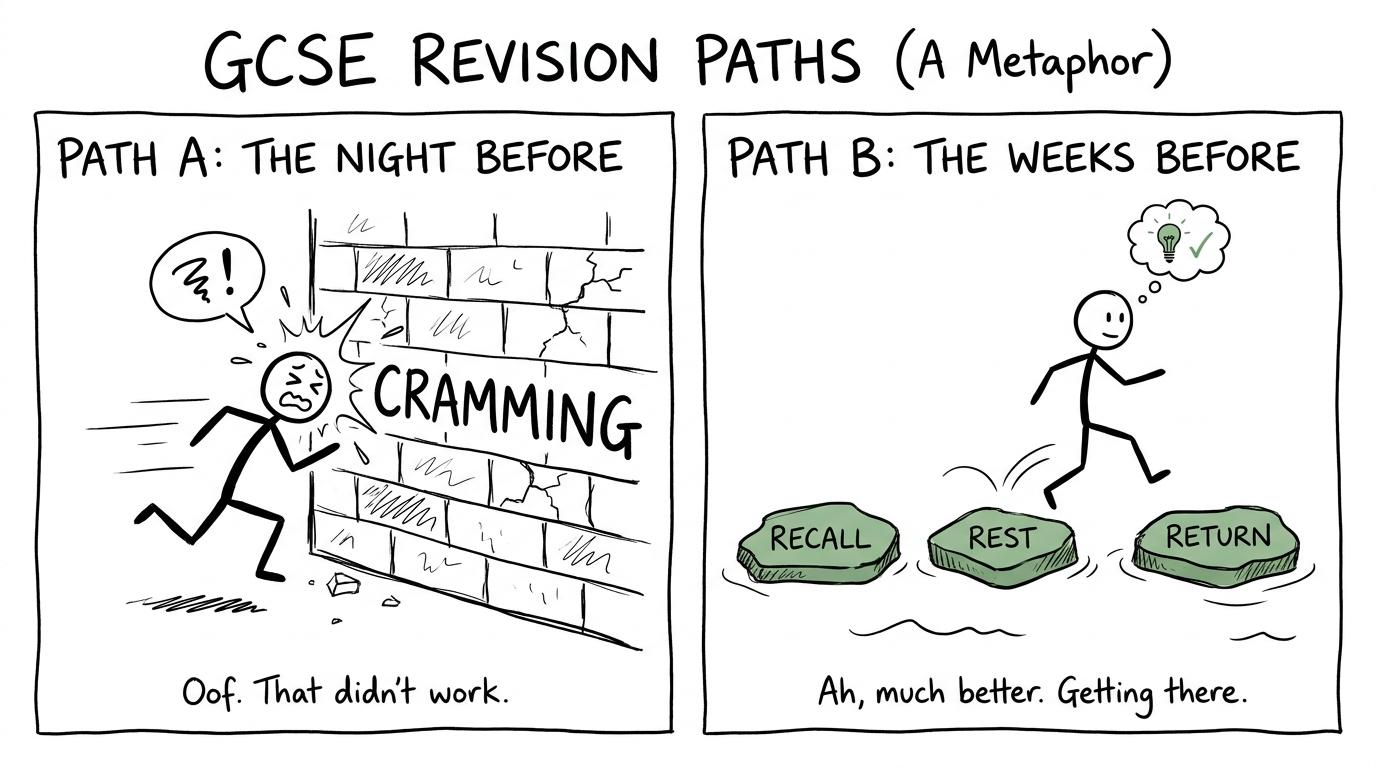 Two students discover the difference between cramming and spaced revision
When daily revision can make sense
Daily Economics revision is not automatically harmful. It can work when sessions are deliberately small and varied.
A daily approach may be useful during the final run-up to an exam if you:
- keep most sessions short
- alternate recall, application and timed responses
- stop when concentration has clearly deteriorated
- retain breaks between demanding blocks
- avoid sacrificing sleep
- continue revising maths and other subjects
For example, daily contact might mean a few flashcards or one plan for an extended response, not a complete paper every night. The danger is not the calendar entry. It is allowing “every day” to become “as long as possible”.
A low-pressure daily minimum can also help students who struggle to begin. However, the minimum should be small enough to survive difficult days. Consistency is useful only when the work remains attentive.
How to decide whether you need a rest day
Do not judge only by whether you feel guilty. Look for evidence in your work.
Take a rest or reduce the session if:
- you repeatedly read the same paragraph without processing it
- recent mistakes are caused by rushing rather than missing knowledge
- you cannot explain material you revised moments earlier
- revision is regularly displacing adequate sleep
- you have stopped marking questions because you only want to finish them
- your timetable leaves no catch-up space when life changes
Continue with a planned session if you are alert, can retrieve material and know exactly what task you will complete. A clear 202020-minute objective is often easier to assess than the vague instruction to “revise Economics”.
Common mistakes when planning GCSE Economics revision
Treating rest as failure
An intentional rest day is part of a sustainable schedule. The mistake is not resting; it is disappearing from the subject for several weeks and relying on a final cram.
Revising every topic in the same way
Definitions need retrieval. Diagrams need accurate reconstruction and explanation. Quantitative skills need practice. Evaluation needs balanced reasoning and a supported conclusion. Match the activity to the skill.
Counting time instead of checking retention
Hours measure presence, not learning. Test whether you can explain the idea without notes and apply it to a new context.
Rereading instead of retrieving
Rereading feels smooth because the page is familiar. Start with a closed-book attempt, check the answer, correct it and schedule another attempt after a gap.
Ignoring maths because Economics feels essay-based
Economics specifications include quantitative skills, and confidence with percentages, ratios, averages, graphs and interpreting data can reduce avoidable errors. Use the GCSE maths revision hub to select your exam board and strengthen the relevant foundations.
Doing papers without learning from them
A completed paper is only evidence. The improvement comes from marking, classifying errors and revisiting weak skills. MathsGenie's Edexcel GCSE mini tests provide shorter practice when a full maths paper would overload an already busy week.
Build a revision system you can return to
The question is not whether the most disciplined student revises every day. It is whether your schedule helps you remember economic knowledge, apply it accurately and think clearly under exam conditions.
Revise regularly. Retrieve before rereading. Return to difficult material after a gap. Use exam questions and mark schemes. Protect sleep, and take planned rest without treating it as a moral weakness.
Then apply the same disciplined rhythm to maths. Start from MathsGenie's free GCSE maths revision resources, use revision lessons and practice questions to repair weak topics, and build towards mini tests, predicted papers and full papers. If you take Edexcel, use the Edexcel GCSE past papers; AQA students can use the AQA GCSE past papers, while OCR students can work from the OCR GCSE maths revision hub.
Mark each attempt, consult the mark scheme or video solution, and schedule the correction for another day. That final gap is not empty space. It is where a revision plan becomes something you can sustain.










