

GCSE Economics Homework Grade Impact: Does It Matter?
GCSE economics homework grade impact explained: learn when homework raises exam marks, when it wastes time, and how to build a smarter revision routine.
A completed homework sheet can feel reassuring. The boxes are filled, the deadline is met and the task disappears into your bag. But the question that matters is harder: did it make you more capable of earning marks?
The GCSE economics homework grade impact is real, but indirect. Homework is not usually a separate contribution added to your final GCSE Economics grade. For current AQA and OCR specifications, the qualification is externally assessed through examinations. Homework matters when it strengthens the knowledge, quantitative skills, application and evaluation that those examinations reward.
In other words, completing more homework does not automatically produce a higher grade. Completing purposeful work, checking it and changing what you do next can.
The short answer: how much does homework matter?
Research reviewed by the Education Endowment Foundation indicates that homework has a positive average effect at secondary level. However, the evidence is not a promise about any individual student or subject, and the EEF rates its security as low. It also suggests that task quality matters more than sheer quantity, particularly when homework connects to classroom learning, has a clear purpose and receives feedback.
That leads to a practical checklist:
- Homework can improve your grade indirectly by building knowledge and exam skills.
- It does not normally count directly towards the final GCSE Economics mark.
- Retrieval, exam questions and corrections are usually more valuable than copying notes.
- Feedback matters only if you use it in the next task.
- More time is not always better if the activity is passive or poorly targeted.
- Economics must share your time sensibly with GCSE Maths, English and your other subjects.
The useful question is therefore not, “How many hours did I do?” It is, “What can I now recall, calculate or explain that I could not do before?”
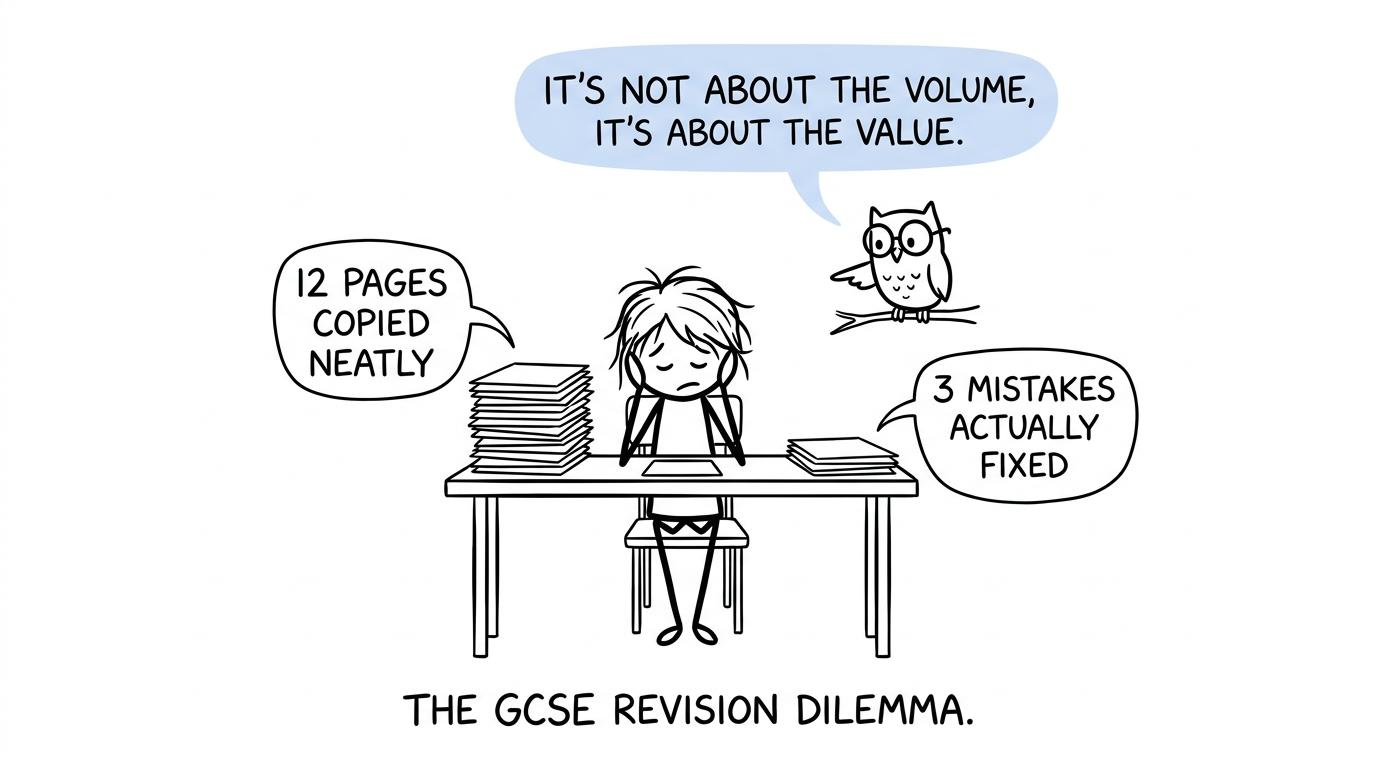 A student discovers that fixing three mistakes matters more than copying twelve pages
Why homework can move an Economics grade
GCSE Economics combines several kinds of thinking. You need accurate definitions, an understanding of cause and effect, the ability to apply ideas to a context, and enough judgement to reach a supported conclusion. There are also quantitative demands.
For example, the current AQA specification states that at least 10%10\%10% of the total marks assess quantitative skills at Key Stage 333 level or above. These include percentages, percentage changes, averages, costs, revenue, profit and the interpretation of graphs and data. OCR also assesses quantitative skills across its externally assessed papers.
That means effective Economics homework can improve four distinct areas.
Knowledge becomes retrievable
Reading a definition can create familiarity: it looks obvious while the page is open. An examination asks for something different: retrieval without the page.
Short self-quizzes, blank-page recall and closed-book definitions make your brain practise the action it will need in the exam. This is more demanding than highlighting, but that difficulty is useful. If you cannot recall an idea at home, you have found the gap while there is still time to repair it.
Chains of reasoning become clearer
Economic answers often depend on connected reasoning. A change affects households, firms, government or the wider economy, which then creates another effect. Homework gives you time to inspect whether each link is explained rather than merely asserted.
A strong chain should make the direction and mechanism clear. Ask:
- What changes first?
- Who is affected?
- Why does their behaviour change?
- What is the likely consequence?
- What condition might weaken or reverse that result?
This is where a short, carefully reviewed paragraph can be worth more than several pages written on autopilot.
Quantitative confidence improves
Economics students sometimes treat a calculation as an interruption to the “real” subject. It is not. Data can support an argument, challenge a claim or reveal the scale of a change.
The basic percentage-change structure is:
percentage change=new value−original valueoriginal value×100\text{percentage change}=\frac{\text{new value}-\text{original value}}{\text{original value}}\times 100percentage change=original valuenew value−original value×100If these skills are slowing you down, use MathsGenie’s percentages revision lesson and practice and repeated percentage change guide. For data handling, the GCSE Statistics revision hub provides lessons, questions and past-paper support.
Feedback makes mistakes visible
A marked homework task is not the end of the process. It is a diagnosis.
Sort each lost mark into a useful category: missing knowledge, weak application, incomplete analysis, unsupported judgement, quantitative error or misreading the command word. Then make one specific correction. “Revise inflation” is vague; “explain one consequence of inflation for savers without notes” creates an action.
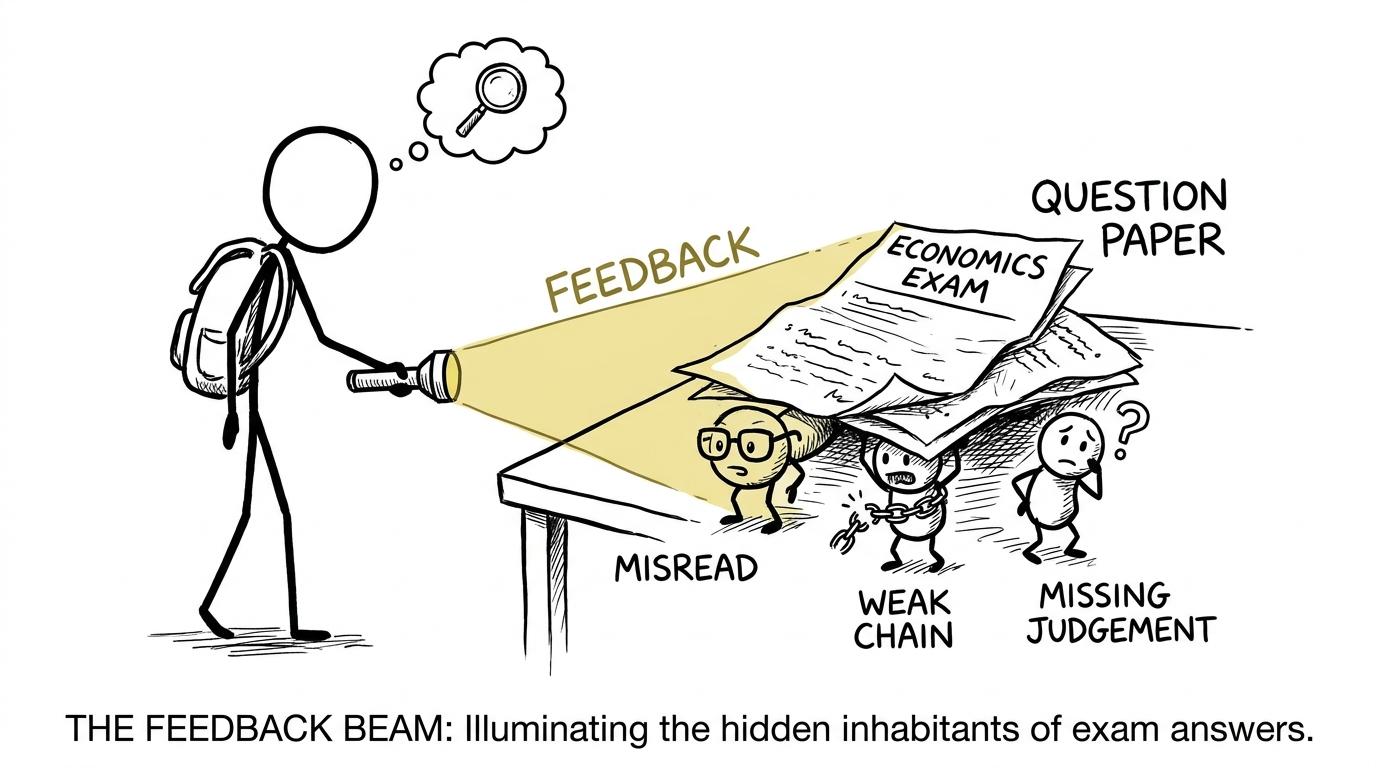 A feedback torch reveals the small errors hiding beneath an exam paper
When Economics homework has little grade impact
Homework has a low return when it produces activity without learning. Neatly copying a textbook may take a long time while demanding almost no retrieval. Looking at the answer before attempting a question removes the struggle that reveals what you know. Completing an essay without reading the feedback allows the same weakness to survive.
Be cautious when a task involves:
- copying large sections of notes;
- answering with the textbook open throughout;
- spending too long making revision materials decorative;
- repeating questions you can already answer securely;
- guessing, marking and moving on without correction;
- sacrificing sleep to finish low-value work.
Homework can also become inefficient when one subject consumes all the available time. Economics may matter to you, but so do compulsory GCSE subjects and any qualification affecting your next step. The rational choice is not to ignore Economics homework. It is to allocate time according to deadlines, weaknesses and the likely learning return.
A high-impact homework routine
A useful session has a beginning, a test and a response. It does not need to become a marathon.
Clarify the purpose
Before starting, decide what the task is meant to improve. Is it checking definitions, practising data interpretation, developing an extended response or preparing for a lesson? If the purpose is unclear, ask your teacher.
Attempt before checking
Work without notes for the first attempt wherever appropriate. Put a small mark beside anything uncertain. This prevents an open textbook from disguising a weak memory.
Mark and classify
Use teacher feedback, a mark scheme or a model response. Do not record only the score. Identify why each mark disappeared and what would recover it.
This same habit is valuable in maths. The guide to using Edexcel GCSE Maths past papers properly explains how to diagnose errors rather than merely total a mark. AQA students can use the AQA GCSE Maths past papers, while Edexcel students can work from the Edexcel GCSE Maths paper collection.
Correct from memory
Close the model answer and improve the work yourself. If you simply copy the correction, you have recorded the right answer without proving that you can produce it.
Revisit after a gap
Return to the idea later using a fresh question or a brief recall test. Delayed success is better evidence of learning than an immediate second attempt while the answer remains in short-term memory.
Homework or independent revision: where should time go?
During an ordinary school week, teacher-set homework should usually come first because it is likely to connect with current lessons and may generate feedback. But once it is complete, independent revision should target the weaknesses exposed by tests and past questions.
Near an examination, the balance may change. If a low-value task is taking far longer than expected, speak to your teacher rather than silently abandoning it. They may clarify the expected depth, help with a barrier or suggest a more appropriate route.
A balanced week might contain:
- short Economics retrieval sessions;
- one structured exam response;
- one quantitative or data task;
- corrections from recent feedback;
- scheduled GCSE Maths practice;
- rest and protected sleep.
Use the principles in MathsGenie’s GCSE revision timetable guide to organise work around actual gaps rather than whichever subject feels most urgent in the moment.
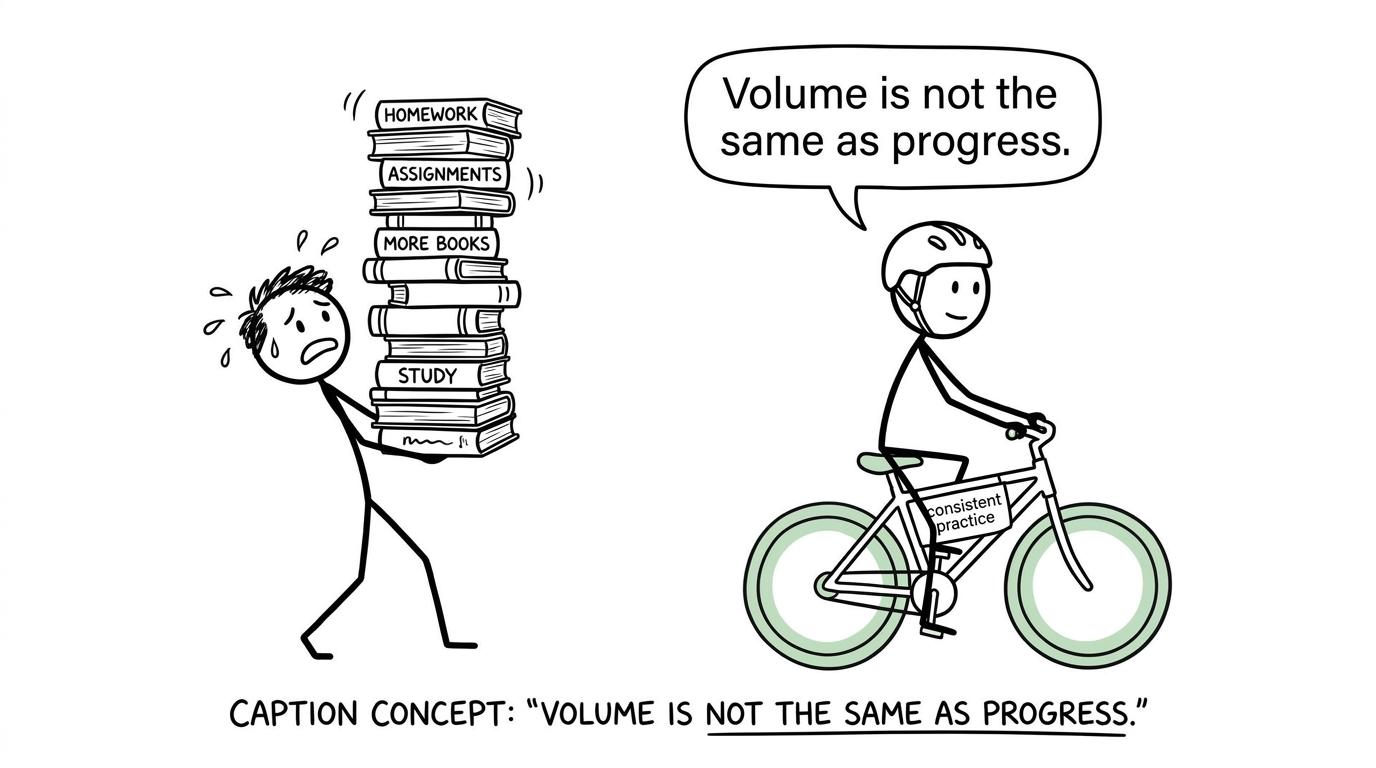 A calm student on a consistency bicycle passes an enormous tower of homework books
Common homework mistakes that limit progress
Measuring effort only in minutes
Time is an input, not an outcome. Track what you can now do independently: definitions recalled, calculations completed accurately, chains developed or judgements supported.
Treating completion as mastery
Finishing a task with notes beside you does not prove that you can reproduce the thinking under examination conditions. Include closed-book attempts.
Ignoring the exact specification
AQA and OCR GCSE Economics, and Pearson Edexcel International GCSE Economics, have different structures and terminology. Use material matched to the qualification your school has entered. Do not assume every online resource fits your paper.
Revising Economics while neglecting its maths
Percentages, averages and graphs are part of economic reasoning. Weak numerical fluency can cost marks and make data questions feel harder than they are. MathsGenie’s GCSE Maths topic and exam-board guide can help you locate the right supporting skills.
Doing papers without repairing gaps
A paper measures performance; correction builds it. After any timed practice, use the mark scheme, revisit weak topics and test them again. Maths students can then add GCSE predicted papers and mini tests once their underlying skills are secure.
Make homework earn its place
Homework matters, but its value is not printed in the number of pages completed. It lies in the change between the student who began the task and the student who finished reviewing it.
For Economics, prioritise retrieval, application, developed reasoning, quantitative fluency and feedback. For GCSE Maths, build the same cycle with MathsGenie: use free revision lessons to understand a method, practice questions to test it, mark schemes and video solutions to correct it, mini tests to check retention, and past papers or predicted papers to build examination readiness.
Start with one recent mistake. Identify its cause, repair the skill and revisit it later. That is when homework stops being something you hand in and starts becoming something that can move your grade.










