Repeated Percentage Change
x

Revision notes for Edexcel GCSE Maths Repeated Percentage Change. Open the guide for explanations and worked examples. Written against the Edexcel GCSE Maths (1MA1) specification, so the content matches what's examinable rather than general Maths background.

Repeated Percentage Change

What you'll learn

  • Turn percentage increases and decreases into multipliers.
  • Use powers for changes that happen again and again.
  • Work backwards from a final amount using division or roots.
  • Link percentage changes in length to changes in area and volume.

1. Start with percentage multipliers

A percentage multiplier is the number you multiply by to apply a percentage change in one go.

For example, increasing by 10% means you now have 110% of the original, so the multiplier is 1.10.

Decreasing by 10% means you now have 90% of the original, so the multiplier is 0.90.

Definition

Percentage multiplier

  • For an increase of p%p\%p%, the multiplier is 1+p1001+\frac{p}{100}1+100p​.

  • For a decrease of p%p\%p%, the multiplier is 1−p1001-\frac{p}{100}1−100p​.

Example

Using a multiplier for one change

A jacket costs £80. Its price is increased by 15%. Find the new price.

A bar model showing that a 15% increase changes £80 to 115% of the original price.

  1. A 15% increase means the new price is 115% of the original.

  2. Convert 115% into a multiplier:

    115%=1.15115\% = 1.15115%=1.15
  3. Multiply the original price by the multiplier:

    80×1.15=9280 \times 1.15 = 9280×1.15=92
  4. The new price is £92.

2. Repeating the same percentage change

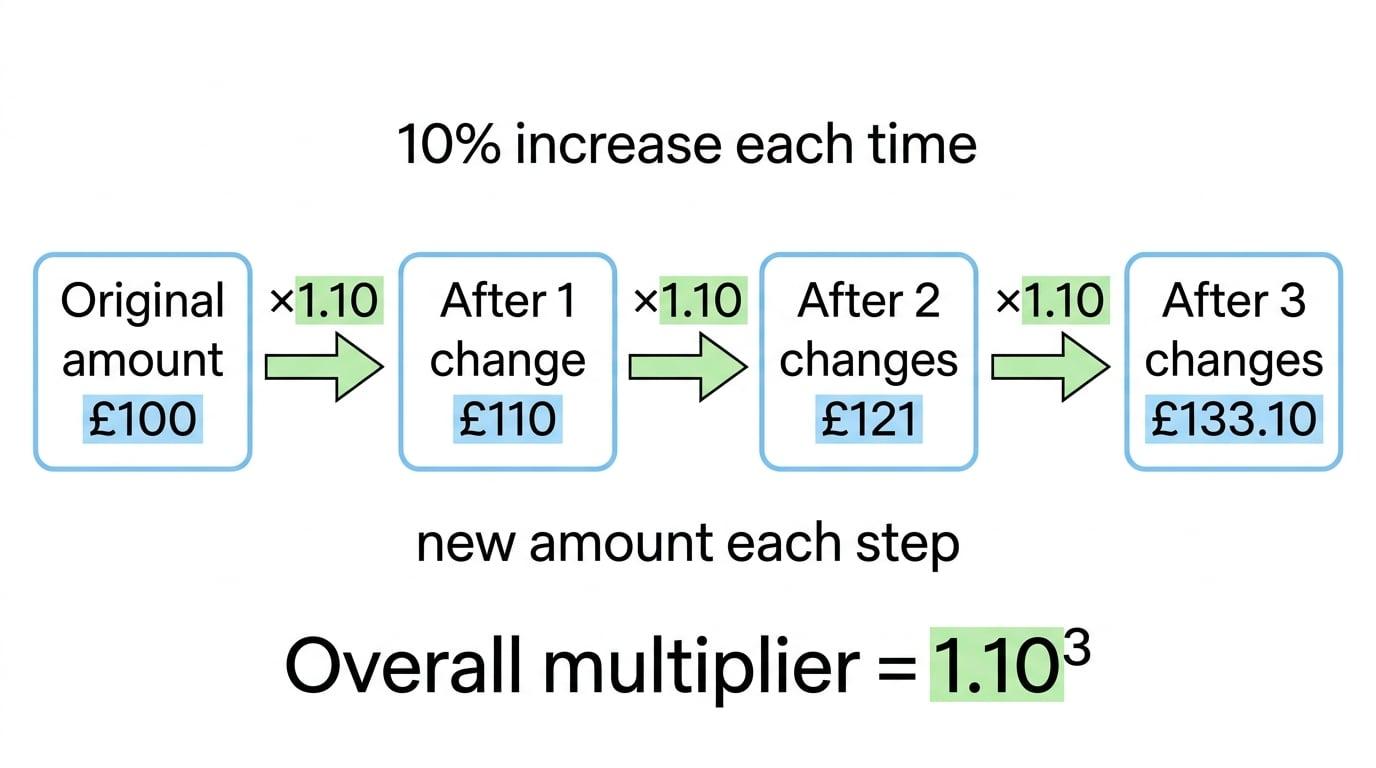
A repeated percentage change means the percentage change is applied more than once. Each change is applied to the new amount, not the original amount.

If the multiplier is mmm and it happens nnn times, the overall multiplier is mnm^nmn.

Key Idea

Repeated means powers

If the same percentage change happens several times, use a power: multiplier to the power number of changes.

Example

Population increasing every hour

A yeast population increases by 12% each hour. Find the percentage increase over 3 hours.

A three-step multiplier chain showing the population being multiplied by 1.12 each hour.

  1. The multiplier for a 12% increase is 1.12.

  2. Apply this multiplier 3 times:

    1.123=1.4049281.12^3 = 1.4049281.123=1.404928
  3. This means the final population is 140.4928% of the original.

  4. Subtract 100% to find the increase:

    140.4928−100=40.4928140.4928 - 100 = 40.4928140.4928−100=40.4928
  5. The population has increased by about 40.5%.

3. Different percentage changes in a row

When percentages happen one after another, multiply the multipliers together.

A 10% decrease followed by a 20% decrease is not usually a 30% decrease, because the second decrease is taken from the already-reduced amount.

Common Mistake

Adding the percentages

Do not add repeated percentage changes unless the question specifically says they are both taken from the original amount.

Tip

Start with 100

If a question only asks for the overall percentage change, choosing a starting value of 100 often makes the working clearer.

Example

Two reductions in a shop

A shop reduces all prices by 15%, then later reduces the new prices by another 20%. Has the price gone down by 35% overall?

A price reduction chain showing that the second percentage decrease is taken from the already-reduced price.

  1. Start with an easy original price of £100.

  2. A 15% decrease has multiplier 0.85, and a 20% decrease has multiplier 0.80.

  3. Multiply both changes:

    100×0.85×0.80=68100 \times 0.85 \times 0.80 = 68100×0.85×0.80=68
  4. The final price would be £68.

  5. So the overall decrease is £32 out of £100, which is 32%.

  6. No, the overall decrease is not 35%.

4. Compound interest and working backwards

Compound interest is interest added to an account, where future interest is calculated on the new total. Per annum means per year.

For compound interest:

final amount=starting amount×multipliernumber of years\text{final amount} = \text{starting amount} \times \text{multiplier}^{\text{number of years}}final amount=starting amount×multipliernumber of years

To work backwards, divide by the multiplier power.

Example

Finding the original investment

Aisha has £5624.32 after 3 years in an account paying 4% compound interest per annum. How much did she invest?

A compound interest timeline showing three yearly multiplications by 1.04 and the reverse division to find the starting amount.

  1. Let the starting investment be AAA pounds.

  2. The multiplier for a 4% increase is 1.04.

  3. After 3 years, the equation is:

    A×1.043=5624.32A \times 1.04^3 = 5624.32A×1.043=5624.32
  4. Divide by 1.0431.04^31.043:

    A=5624.321.043=5000A=\frac{5624.32}{1.04^3}=5000A=1.0435624.32​=5000
  5. Aisha invested £5000.

5. Finding an unknown repeated percentage

Sometimes you know the overall change, but not the yearly percentage.

An nth root undoes a power. For example, a fifth root undoes “to the power 5”.

If the overall multiplier is MMM over nnn equal time periods, the one-period multiplier is:

Mn\sqrt[n]{M}nM​
Example

Finding an annual growth rate

A colony of insects increases by 75% over 5 years. It increases by x%x\%x% each year. Find xxx to 1 decimal place.

A five-year equal-growth timeline showing that the same unknown multiplier is applied five times to make an overall multiplier of 1.75.

  1. A 75% increase means the overall multiplier is 1.75.

  2. Let the yearly multiplier be mmm.

  3. Over 5 years:

    m5=1.75m^5 = 1.75m5=1.75
  4. Take the fifth root:

    m=1.755≈1.1184m=\sqrt[5]{1.75}\approx1.1184m=51.75​≈1.1184
  5. Convert the multiplier back to a percentage increase:

    (1.1184−1)×100≈11.84(1.1184-1)\times100\approx11.84(1.1184−1)×100≈11.84
  6. So x=11.8x=11.8x=11.8 to 1 decimal place.

Common Mistake

Forgetting what remains

If something decreases by 60%, the remaining multiplier is 0.40, not 0.60.

Example

Finding an annual decrease rate

A machine loses value at x%x\%x% each year. After 6 years, it is worth 40% of its original value. Find xxx to 2 decimal places.

  1. Being worth 40% of the original means the overall multiplier is 0.40.

  2. Let the yearly multiplier be mmm.

  3. Over 6 years:

    m6=0.40m^6 = 0.40m6=0.40
  4. Take the sixth root:

    m=0.406≈0.85837m=\sqrt[6]{0.40}\approx0.85837m=60.40​≈0.85837
  5. Convert this to a percentage decrease:

    (1−0.85837)×100≈14.1626(1-0.85837)\times100\approx14.1626(1−0.85837)×100≈14.1626
  6. So x=14.16x=14.16x=14.16 to 2 decimal places.

6. When the first year is different

Sometimes the first year has a known rate, then the remaining years use an unknown rate. Deal with the known year first, then solve the repeated part.

Example

Known first year, then unknown rate

Ben invests £2000 for 4 years. In the first year, the interest is 3%. For the next 3 years, the interest is x%x\%x% per annum. At the end he has £2317.22. Find xxx.

A mixed-rate investment timeline separates the known first-year multiplier from the three repeated unknown multipliers.

  1. After the first year:

    2000×1.03=20602000 \times 1.03 = 20602000×1.03=2060
  2. Let the multiplier for each of the next 3 years be mmm.

  3. Use the final amount:

    2060m3=2317.222060m^3=2317.222060m3=2317.22
  4. Divide by 2060:

    m3=2317.222060≈1.12486m^3=\frac{2317.22}{2060}\approx1.12486m3=20602317.22​≈1.12486
  5. Take the cube root:

    m=1.124863≈1.04m=\sqrt[3]{1.12486}\approx1.04m=31.12486​≈1.04
  6. A multiplier of 1.04 means an increase of 4%, so x=4x=4x=4.

7. Area and volume changes

For shapes, percentage changes in length affect area and volume differently.

  • Area depends on length squared, so square the length multiplier.
  • Volume depends on length cubed, so cube the length multiplier.
  • To work backwards from area, use a square root.
  • To work backwards from volume, use a cube root.
Example

Radius change to area change

A circle’s radius is increased by 6%. Find the percentage increase in its area.

Two circles illustrate that increasing the radius by 6% makes the area scale by the square of the length multiplier.

  1. The radius multiplier is 1.06.

  2. A circle’s area depends on r2r^2r2, so square the radius multiplier:

    1.062=1.12361.06^2=1.12361.062=1.1236
  3. The area is now 112.36% of the original.

  4. The area has increased by 12.36%, which is about 12.4%.

Example

Volume change back to cube length

A cube’s volume is increased by 20%. Find the percentage increase in its side length, to 3 significant figures.

A cube diagram shows that volume scales with the cube of the side length multiplier, so the side multiplier is found by a cube root.

  1. The volume multiplier is 1.20.

  2. For a cube, volume depends on s3s^3s3, where sss is the side length.

  3. Take the cube root to find the side length multiplier:

    1.203≈1.06266\sqrt[3]{1.20}\approx1.0626631.20​≈1.06266
  4. Convert this multiplier into a percentage increase:

    (1.06266−1)×100≈6.266(1.06266-1)\times100\approx6.266(1.06266−1)×100≈6.266
  5. The side length has increased by 6.27% to 3 significant figures.

Exam technique

In the exam

  1. Write the multiplier first before doing any repeated percentage calculation.

  2. Use powers when the same percentage change repeats, and roots when you need to find the single repeated rate.

  3. For area and volume, remember: square for area, cube for volume, square root or cube root when working backwards.

Self review

Check yourself

  • If a price drops by 10% and then rises by 10%, is it back to the original price?

  • A population doubles in 8 years. What equation would you write for the yearly multiplier?

  • If a cube’s side length increases by 5%, should its volume increase by exactly 15%?

Recap questions

Test yourself with 5 quick questions on this guide. Answer them all correctly to complete it.

You've reached the end

Test yourself on this topic, or move on to the next guide.

Practice questionsTake a quick quiz on this topicFlashcardsSelf-test with active recall
Expanding Triple BracketsUp next

How was this guide?

Repeated Percentage Change Revision Guide

  1. GCSE
  2. /Maths
  3. /Repeated Percentage Change