

GCSE Economics Discord Server: Is It Worth It?
GCSE economics Discord server: learn what it adds to revision, how to check advice, protect your privacy and avoid replacing proper exam practice.
Revision can feel strangely lonely. You may understand most of a topic, yet one awkward question about inflation or market failure can stop an entire evening. A GCSE economics Discord server can help by giving you somewhere to ask questions, compare ideas and find encouragement. But it should be a supplement to structured revision, not your teacher, specification or main source of exam practice.
The short answer is simple: a well-moderated subject community may be worth joining if you use it deliberately. It is less useful when constant notifications, unverified answers and general conversation begin replacing the work that earns marks.
A quick checklist before joining
A useful GCSE Economics community should have:
- clear rules and active, visible moderation;
- separate channels for different topics and exam boards;
- explanations rather than unexplained final answers;
- no pressure to share personal information;
- sensible controls on direct messages and self-promotion;
- discussion that follows current GCSE specifications;
- a culture that encourages independent attempts first;
- links back to authoritative materials rather than anonymous claims.
If several of these are missing, leaving is usually a better decision than hoping the server improves.
What a GCSE economics Discord server can offer
The strongest benefit is not access to secret knowledge. There is no secret version of the specification hidden inside a chat channel. The real benefit is reducing the delay between becoming confused and taking the next useful action.
Quick clarification of difficult ideas
Economics contains terms that appear similar but have precise meanings. A discussion may help you separate economic growth from economic development, demand from quantity demanded, or a budget deficit from government debt.
Explaining an idea to another student can also expose gaps in your own understanding. If your explanation depends on vague phrases such as “it affects the economy”, you have probably found something worth revising more carefully.
However, speed is not the same as reliability. Treat a chat response as a possible explanation to investigate, not as an automatic correction to your notes.
Exposure to alternative explanations
Sometimes your textbook’s wording simply does not click. Another student may describe the same chain of reasoning in a clearer way. A discussion can also reveal that several valid arguments are possible, especially in evaluation questions where the outcome depends on context, scale or time.
This is useful preparation for economics because strong responses do more than recall a definition. They apply knowledge to the information given, develop logical consequences and reach a supported judgement.
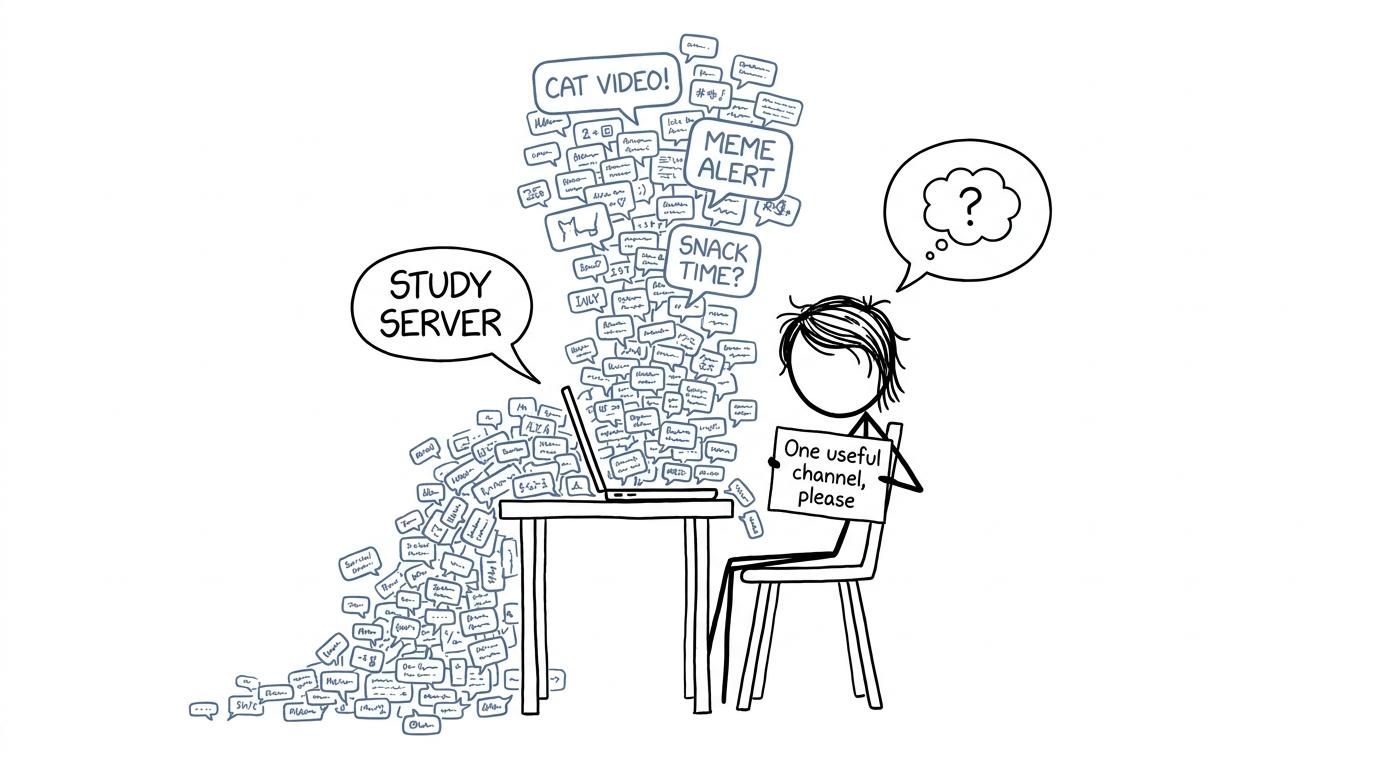 A student asks for one useful study channel while notifications pour from a laptop
Accountability and shared revision
A quiet channel where students state what they plan to complete can make revision feel more concrete. Yet accountability only works when the conversation leads to action. Writing that you will revise market structures is not the same as answering questions on them.
A better approach is to decide your task before opening Discord. Use the MathsGenie revision planner to organise your broader workload, complete the task, and then use the community only for a specific unresolved question.
Where online communities become unreliable
A server can sound confident while being wrong. GCSE students may be taking different qualifications, following different teachers or remembering material from older courses. Even a mathematically correct answer can fail to address the economic context or command word.
Advice may not match your exam board
AQA GCSE Economics and OCR GCSE Economics are distinct specifications. Pearson Edexcel also offers International GCSE Economics, which should not be assumed to have identical content or assessment arrangements. Before following advice, check the board and qualification named on your exam entry.
For quantitative revision aligned to AQA, MathsGenie’s quantitative skills in economics guide covers percentages, averages, costs, revenue, profit, pay and data interpretation.
Official AQA and OCR specifications require quantitative skills to be applied in economic contexts, with at least 10%10\%10% of the total GCSE marks rewarding them. That makes the maths important, but a calculation alone may not complete the answer. You often need to interpret the result and connect it to the question.
Model answers may create false confidence
Reading polished answers feels productive because the finished argument looks obvious. In the exam, however, you must generate that chain of reasoning yourself.
Do not copy a response from a server into your notes and count the topic as complete. Close the message and reconstruct the argument independently. Then compare your version with your class materials, specification and an official mark scheme where available.
Busy servers fragment attention
A revision community can quietly become entertainment with an educational label. One economics question turns into checking several channels, reacting to a meme and following an unrelated debate.
Notifications are particularly deceptive because each interruption feels small. Together, they can prevent the sustained concentration needed for calculations, extended responses and timed papers. Mute non-essential channels and give Discord a defined purpose: ask, check, leave.
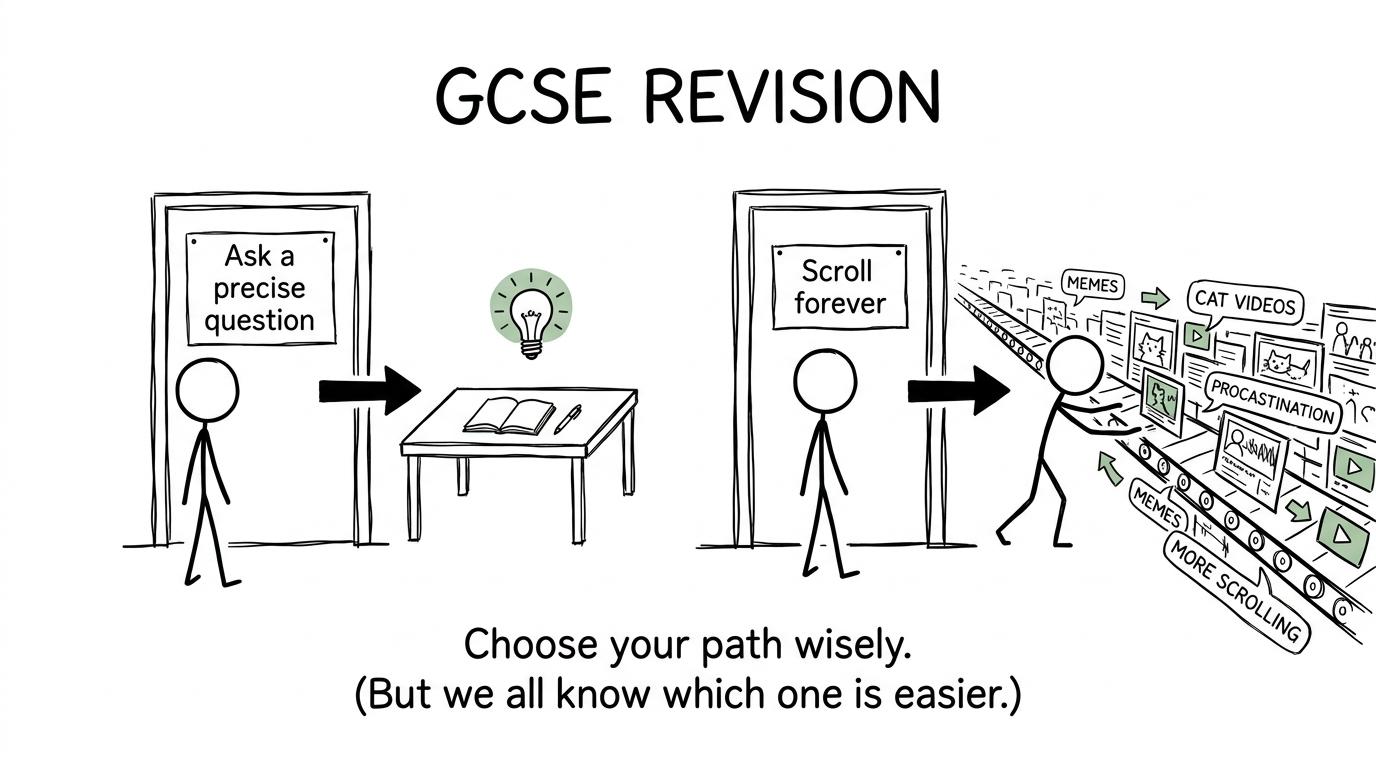 Two revision doors lead either to a clear question or an endless conveyor belt of memes
How maths revision supports GCSE Economics
Economics questions often place familiar mathematical skills inside unfamiliar contexts. You may need to calculate percentage change, interpret a graph, compare averages or distinguish revenue from profit.
Important relationships include:
Percentage change=new value−original valueoriginal value×100%\text{Percentage change}=\frac{\text{new value}-\text{original value}}{\text{original value}}\times 100\%Percentage change=original valuenew value−original value×100% Total revenue=price×quantity sold\text{Total revenue}=\text{price}\times\text{quantity sold}Total revenue=price×quantity sold Profit=total revenue−total cost\text{Profit}=\text{total revenue}-\text{total cost}Profit=total revenue−total costThese formulas are not difficult in isolation. The challenge is recognising which relationship the question requires, using the original value correctly and interpreting the result in context.
If percentage calculations are slowing you down, revisit the MathsGenie percentages lesson. The wider best order for learning GCSE maths topics can help you repair earlier gaps in number, ratio, graphs and statistics.
This is where a subject server can be genuinely useful. Ask why a method applies, rather than requesting an answer. A precise question such as “Why is the original figure the denominator in percentage change?” is more valuable than posting a screenshot with “Help”.
A safer way to use Discord for revision
Discord’s terms require users to be at least 131313 and to meet any higher minimum age required by local law. UK users also receive safety features intended to reduce exposure to sensitive content and unwanted contact. Those protections help, but they do not make every server or user trustworthy.
Use your real age when creating an account. If you are under 181818, involve a parent or carer when deciding whether a public community is appropriate.
Keep these boundaries:
- use a nickname that does not reveal your full identity;
- never share your school, timetable, address, phone number or live location;
- restrict direct messages and friend requests from people you do not know;
- do not move conversations to private calls because someone claims to be a tutor;
- block and report unwanted, abusive or suspicious contact;
- leave any community that pressures you to reveal personal details;
- never download unknown files or pay for supposedly leaked papers.
No legitimate revision community needs your password, exam candidate details or private photographs.
Turn discussion into marks
The difference between helpful community use and passive scrolling is what happens afterwards. Follow a simple revision loop:
- Attempt: answer the question before asking for help.
- Ask: identify the exact step, concept or command word causing difficulty.
- Check: compare replies with your specification, teacher’s guidance and trusted revision materials.
- Practise: answer another question without the chat open.
- Review: record the mistake and revisit it later.
The same loop works for maths. MathsGenie’s guide to starting GCSE past papers explains how timed practice should develop from shorter tasks into complete papers. If you need a more structured month, use the GCSE maths one-month revision plan.
Predicted papers can provide fresh practice, but they are not forecasts of exact questions. MathsGenie’s article on using predicted GCSE topics without guessing explains why recurring specification skills matter more than rumours. For additional timed work, use the Edexcel GCSE Maths predicted papers alongside official past papers and mark schemes.
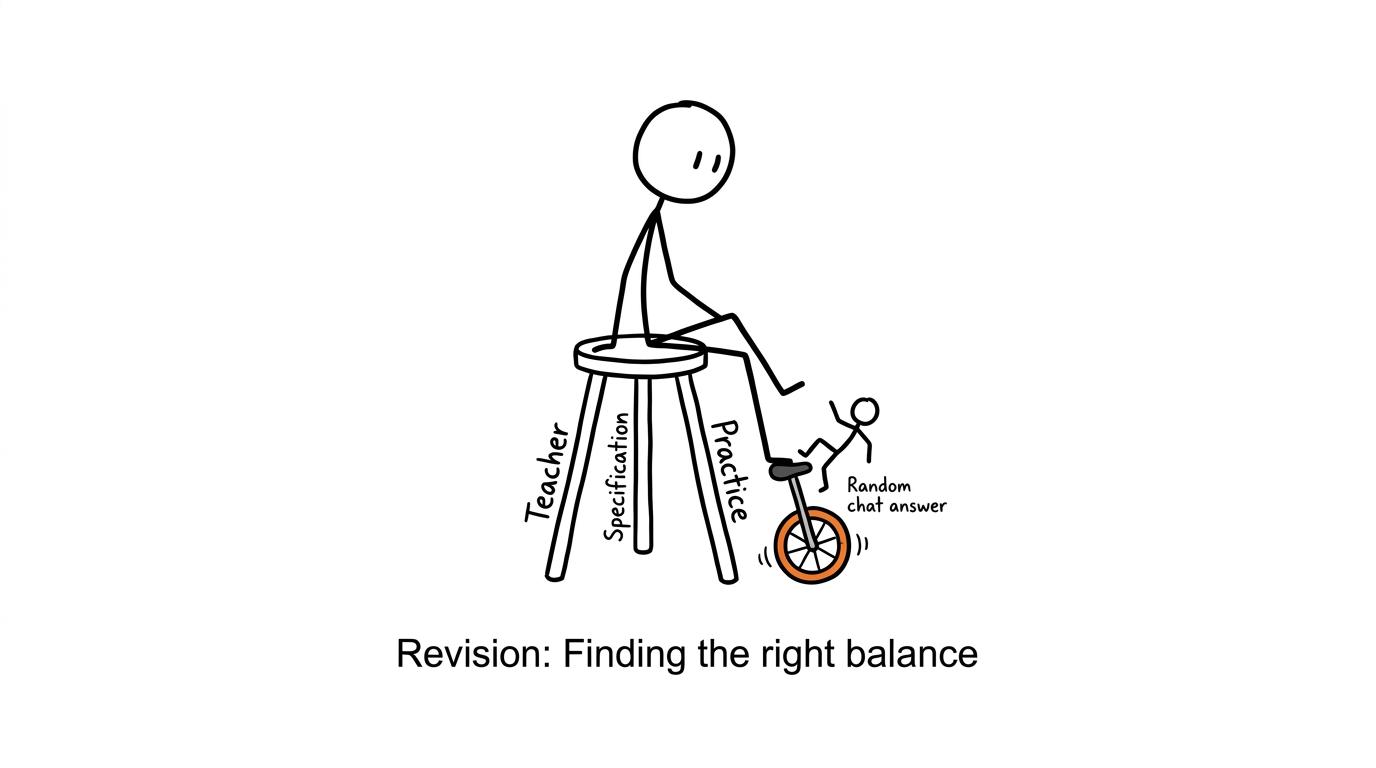 A stable revision stool is compared with a wobbly unicycle carrying a random chat answer
Common mistakes when using subject servers
Asking for answers before attempting the question
An instant answer removes the productive struggle that helps you remember a method. Show what you have tried and state where your reasoning breaks down.
Trusting popularity instead of evidence
A heavily reacted-to message can still be inaccurate. Check claims against the current specification, your teacher’s advice and official assessment materials.
Collecting resources without using them
Saving dozens of files creates the feeling of preparation without the benefit of practice. Keep only the resources that fit your board and immediate revision plan.
Confusing discussion with exam practice
Debating an economic issue may deepen understanding, but it does not automatically improve timing or written structure. You still need closed-book questions, mark schemes and timed papers.
Allowing one community to control your revision
Server activity reflects what members happen to discuss, not the full specification. Quiet topics may still appear in your exam. Use a specification checklist to maintain balanced coverage.
Is joining worth it?
A GCSE economics Discord server is worth joining when it solves a narrow problem: finding clarification, discussing reasoning or adding limited accountability. It is not worth relying on when it replaces your teacher, distracts you from practice or encourages you to trust anonymous answers.
Think of the community as a waiting room for questions, not the place where all revision happens. Your real progress is built when you attempt problems, check reliable explanations, learn from mark schemes and return to difficult skills.
Make MathsGenie your structured revision base. Use free revision lessons to repair gaps, practice questions and mini tests to build accuracy, and past papers or predicted papers to develop exam technique. Ask the community when you genuinely need another explanation, then close the chat and put that explanation to work.











