

GCSE Dance Exam Paper Guide: Every Component Explained
GCSE dance exam paper guide covering AQA components, written sections, question styles and timing, plus the new WJEC format for Wales from 2026.
A GCSE Dance paper can feel strangely unfamiliar. You may be comfortable performing, creating movement and discussing choreography in class, yet still wonder what will actually appear when the written paper lands on your desk.
This GCSE dance exam paper guide gives you the answer immediately: under the current AQA specification, GCSE Dance has one practical component worth 60%60\%60% and one written Dance Appreciation paper worth 40%40\%40%. The written paper lasts one hour and 303030 minutes, contains three compulsory sections and is marked out of 808080.
That structure matters. Once you know what each section expects, the paper stops being an unknown event and becomes something you can rehearse.
GCSE Dance assessment at a glance
This checklist covers the AQA GCSE Dance specification, code 823682368236, used by schools in England. Students beginning the new WJEC Made-for-Wales qualification from September 202620262026 have a different structure, explained later in this guide.
| Component | Assessment | Weighting | Main focus |
|---|---|---|---|
| Component 1 | Non-exam assessment | 60%60\%60% | Performance and choreography |
| Component 2 | Written examination | 40%40\%40% | Dance appreciation |
For AQA, Component 1 is divided equally between performance and choreography. Each contributes 30%30\%30% of the overall qualification. Component 2 assesses knowledge of choreographic processes and performing skills, reflection on your own practical work, and critical appreciation of professional works.
The qualification is linear, so all assessment is completed at the end of the course and within the same exam series. There is no foundation or higher tier in GCSE Dance.
Component 1: performance and choreography
Component 1 is not a traditional written paper. It is non-exam assessment completed through practical work, internally marked by your school or college and externally moderated by AQA. It is marked out of 808080 before scaling.
Performance
The performance element is worth 30%30\%30% of the GCSE and 404040 raw marks. It contains two connected tasks:
- a solo performance using two set phrases prescribed by AQA
- a performance in a duet or trio
The two solo phrases produce approximately one minute of performance in total. The duet or trio must last at least three minutes and no longer than five minutes. Your assessment considers physical, technical, expressive and mental skills, including accuracy, timing, control, projection, concentration and sensitivity to other dancers.
This is sometimes described informally as the practical exam, but it is not a paper you sit in an examination hall. Your teacher should explain the recording, assessment and moderation arrangements used by your centre.
Choreography
Choreography is also worth 30%30\%30% of the qualification and 404040 raw marks. You create a complete dance in response to a task set by AQA.
You may choreograph:
- a solo lasting between two and two-and-a-half minutes
- a group dance lasting between three and three-and-a-half minutes for between two and five dancers
The choreography is judged on how effectively you select, develop and structure movement to communicate your choreographic intention. Action, dynamics, space, relationships, aural setting and choreographic devices should feel connected rather than added as separate ingredients.
The task is externally set, but your work is assessed by your centre and moderated by AQA. Read the exact task issued for your assessment year rather than relying on an older stimulus.
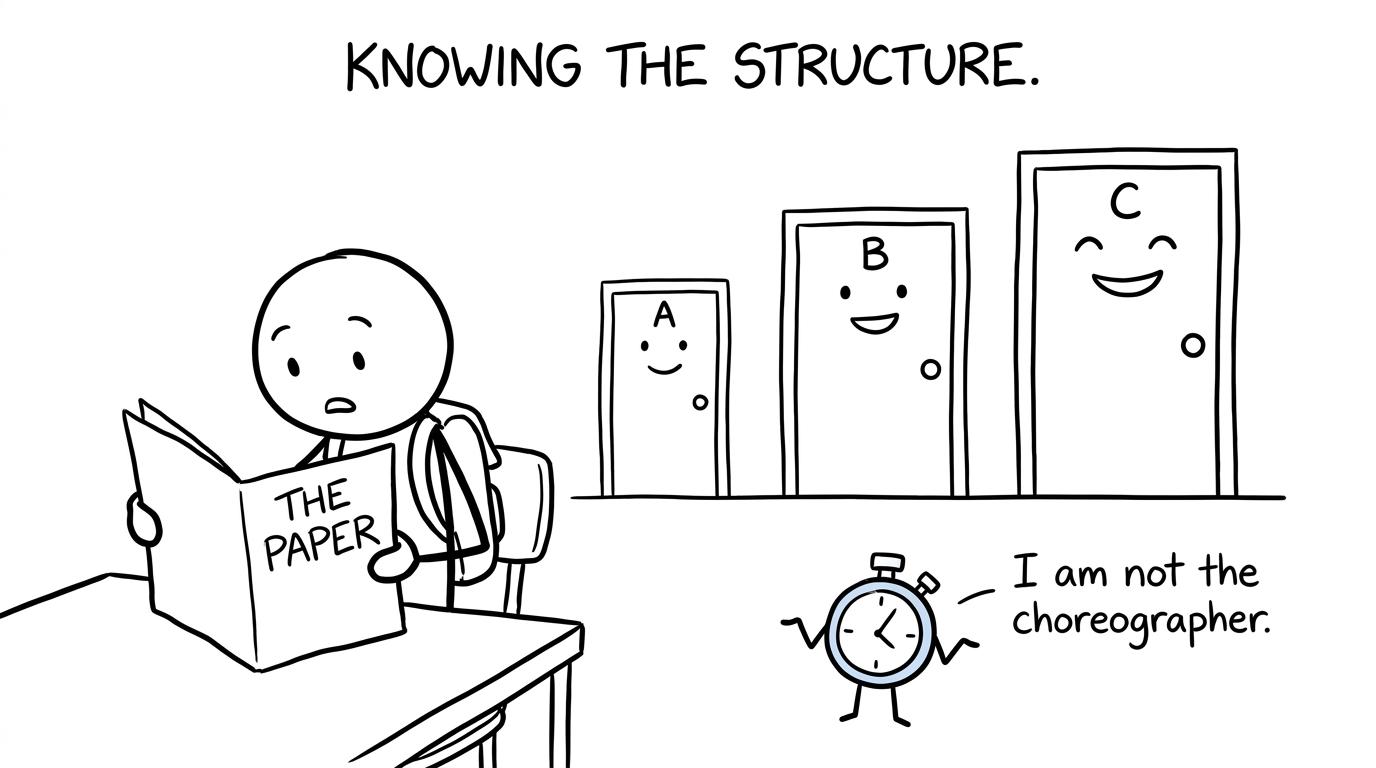 A student meets three increasingly large exam sections
Component 2: the Dance Appreciation paper
Component 2 is the only written AQA GCSE Dance examination. It lasts one hour and 303030 minutes, is worth 808080 raw marks and contributes 40%40\%40% of the final qualification.
The paper uses a consistent three-section structure:
- Section A: choreographic processes and performing skills
- Section B: critical appreciation of your own work
- Section C: critical appreciation of professional works
All questions are compulsory. There is no choice of sections or anthology works on the day. Question demand generally increases as the paper progresses, moving from brief knowledge-based responses towards extended analysis, interpretation, evaluation and comparison.
Section A: choreographic processes and performing skills
Section A begins with an unseen stimulus for a hypothetical choreography. You are asked to apply your practical understanding by making appropriate creative decisions. You might need to identify or explain actions, spatial content, dynamics, relationships, structures, devices or an aural setting.
The second part of the section assesses performing skills. This can include physical, technical, expressive and mental skills as well as safe working practices. Questions are generally short and may include multiple-choice items. Many are worth between 111 and 333 marks.
Short does not mean vague. For a one-mark question, give one precise answer. If a question asks for an explanation, connect the skill or decision to its effect. Writing several loosely related ideas can hide the relevant point rather than strengthen it.
Build a secure vocabulary bank covering:
- action, dynamics, space and relationships
- choreographic processes, structures and devices
- physical, technical, expressive and mental skills
- safe execution, warming up, cooling down, dancewear, nutrition and hydration
Section B: critical appreciation of your own work
Section B asks you to reflect critically on the performance and choreography completed during your course. AQA describes the section as three questions worth 666 marks each.
Your answer must be grounded in your own practical experience. Examiners are not rewarding a memorised paragraph that could describe anyone's dance. They need a clear identification of what you did, an explanation of its effect and a judgement linked to choreographic intention or performance quality.
Prepare by keeping concise notes on:
- the intention of your choreography
- important movement and choreographic choices
- strengths and limitations in rehearsal or performance
- feedback you received and how you responded
- ways your skills improved
- the contribution of dancers, structure and aural setting
Do not invent details in the examination. Revisit recordings and teacher feedback before the paper so that your evidence is accurate and specific.
Section C: critical appreciation of professional works
Section C focuses on the AQA GCSE Dance Anthology. You study all six professional works:
- Artificial Things
- A Linha Curva
- Within Her Eyes
- Emancipation of Expressionism
- Shadows
- Infra
The paper draws on four of the six works in different combinations. You do not know in advance which four will appear, and a work appearing in one year does not prevent it from appearing again. Selective revision is therefore a dangerous gamble.
Questions progress from contextual or short-response items to extended writing. The longer questions include analysis of a single work and comparison between works, with 121212-mark questions requiring sustained, relevant discussion.
For every anthology work, know the choreographic intention and be able to analyse movement, dancers, aural setting and physical setting. Physical setting can include costume, lighting, set, properties, staging and, where relevant, camera work.
The strongest responses explain relationships. Instead of listing that a work uses particular lighting or movement, consider how that choice supports mood, meaning, context or choreographic intention. Comparison also needs direct connections: identify a similarity or difference, give evidence from both works and explain its significance.
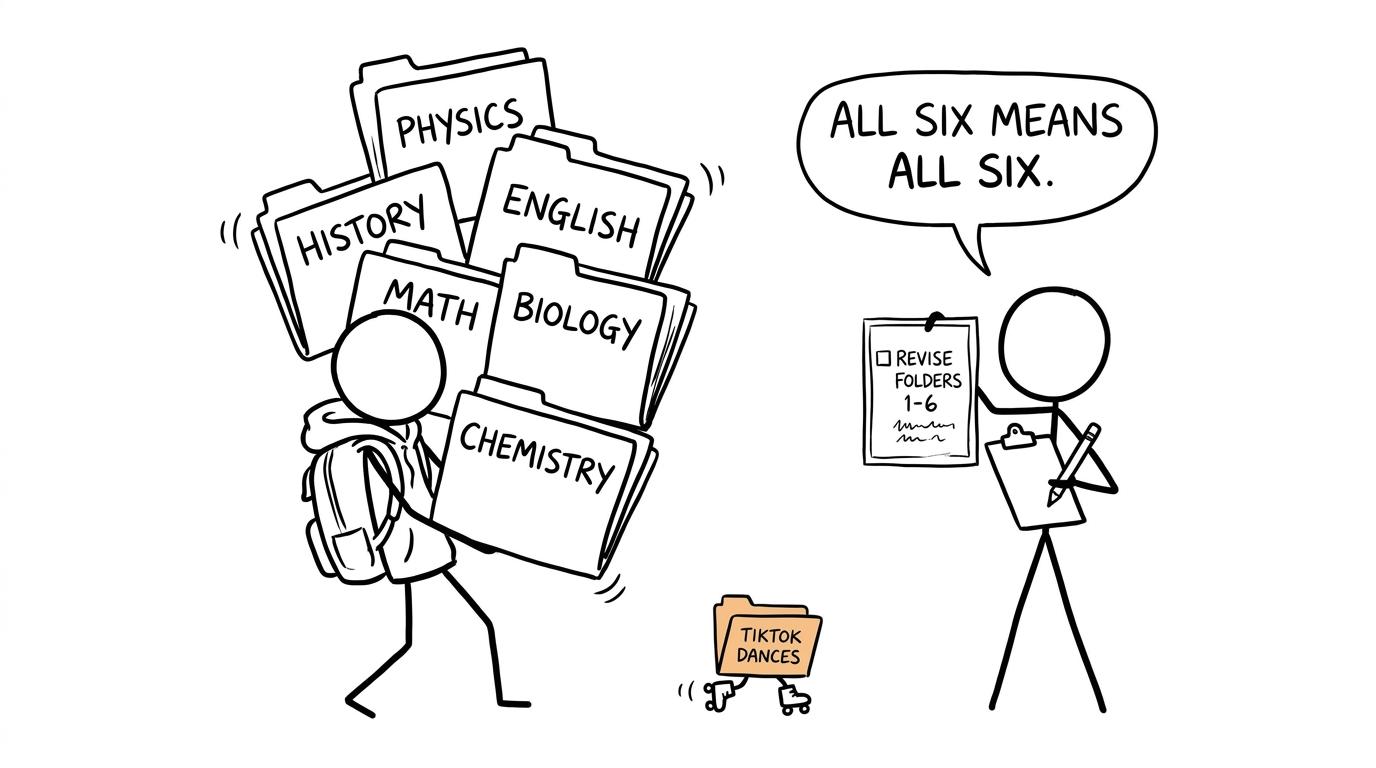 A student tries to keep all six dance-work folders together
How to manage the written paper
A good timing plan protects the extended questions without rushing the opening section. Before the examination, practise with a complete current paper and decide how you will divide the one hour and 303030 minutes.
Use these principles:
- check the marks before deciding how much to write
- answer every compulsory question
- keep short answers concise and terminology accurate
- leave enough time for the later extended responses
- plan longer answers briefly before writing
- return to incomplete questions if time remains
Command words should shape your response. Identify normally needs a precise feature. Explain requires a reason or effect. Analyse asks how constituent features communicate meaning or intention. Evaluate requires a supported judgement. Compare needs evidence from both named works throughout the response.
This discipline transfers directly to maths revision. A paper is most useful when you complete it, mark it and repair the weaknesses it reveals. MathsGenie's guide to using GCSE past papers properly explains that feedback loop clearly.
A practical revision plan for GCSE Dance
Begin with the specification rather than a pile of disconnected notes. Turn each section into a checklist, then use past papers to test whether you can retrieve and apply the content.
Build knowledge by category
Create separate retrieval sets for performance skills, choreography, your own work and each anthology work. This makes it easier to see whether a mistake came from missing knowledge or weak application.
Short, frequent retrieval is usually more manageable than rereading for an entire evening. The structure in MathsGenie's 20-minute GCSE revision routine can be adapted across subjects: recall, attempt questions, mark and record the next priority.
Practise each question style
Do not move immediately from notes to full papers. Practise short Section A responses, six-mark reflections and extended Section C analysis separately. Then combine them under timed conditions.
Use official AQA papers and mark schemes supplied by your school or examination board for Dance. MathsGenie specialises in maths rather than Dance, but its GCSE maths revision hub shows how lessons, questions and assessment can be organised into one revision pathway.
Mark for improvement
After each practice response, identify whether you lost marks through knowledge, evidence, terminology, explanation, comparison or timing. Then rewrite only the weakest part. Simply reading a mark scheme can create recognition without building recall.
Students balancing Dance with maths can use the same process with Edexcel GCSE Maths past papers, followed by targeted topic practice and video solutions. Closer to the examinations, GCSE predicted maths papers can provide additional unseen practice, although they should supplement rather than replace official past papers.
The new WJEC GCSE Dance format in Wales
Students in Wales beginning the Made-for-Wales WJEC GCSE Dance qualification in September 202620262026 follow a different specification, with first assessment and certification in summer 202820282028.
It has three compulsory units:
| Unit | Assessment | Weighting |
|---|---|---|
| Unit 1: Choreography | Non-exam assessment | 40%40\%40% |
| Unit 2: Performance | Non-exam assessment | 30%30\%30% |
| Unit 3: Dance Appreciation | Digital examination | 30%30\%30% |
Unit 3 is a digital-only examination lasting one hour and 454545 minutes and marked out of 727272. It contains objective, short and extended responses based on set and unseen works.
Do not revise the AQA anthology if your centre has entered you for WJEC. Confirm your awarding body, specification and assessment year with your teacher because the set works and task requirements are board-specific.
Common mistakes that cost marks
Revising only favourite anthology works
Any of the six AQA works may be needed. Cover every work, then strengthen comparisons between contrasting pieces.
Describing without analysing
A list of movements, costumes or lighting states what happens. Analysis explains how those features communicate intention, mood or meaning.
Giving generic answers about your own work
Section B needs accurate evidence from your performance and choreography. Prepare specific moments, decisions, feedback and improvements.
Ignoring the number of marks
A brief response cannot fully answer a 121212-mark question, while an essay for a one-mark item wastes valuable time. Let the mark allocation guide depth.
Treating a completed paper as finished revision
The learning happens after marking. Categorise each lost mark, revisit the missing knowledge and attempt another question. MathsGenie's one-month GCSE revision plan and GCSE exam-week checklist show how to make that cycle manageable alongside your other subjects.
Walk into the paper knowing the route
The AQA format is stable: practical performance and choreography contribute 60%60\%60%, while one written Dance Appreciation examination contributes 40%40\%40%. In that written paper, Section A tests choreography and performing skills, Section B examines your own work, and Section C assesses professional works from the anthology.
Knowing the route does not remove the challenge. It removes unnecessary surprise.
For Dance, use the current specification, official papers and guidance supplied by AQA and your teacher. For maths, make MathsGenie's free GCSE revision resources your next stop. Combine revision lessons and practice questions with mini tests, past papers, predicted papers, mark schemes and video solutions. When every paper has a familiar structure and every mistake produces a clear next step, exam preparation becomes calmer and far more useful.











