

GCSE Computer Science Predicted Grades Accuracy
GCSE computer science predicted grades accuracy explained: learn how reliable forecasts are, why results differ, and what you can control before exam day.
A predicted grade can feel oddly final. It appears on a report, sits beside your name and quietly begins to look like a result that has arrived early. But it is not a result.
The short answer on GCSE computer science predicted grades accuracy is that forecasts can be useful indicators, particularly when supported by several assessments, but they are not reliably exact for every student. Research across GCSE subjects suggests that predictions are often within one grade, while exact matches are much less certain. Computer Science forecasts may also lean slightly high on average, although this varies between schools, cohorts and prediction methods.
Most importantly, your predicted grade does not decide the grade awarded in a normal exam series. Your marked assessment and the final grade boundaries do.
Predicted grades at a glance
Keep these ideas in mind when you read your next report:
- A predicted grade is an estimate, not a ceiling or promise.
- Schools do not all calculate predictions in the same way.
- Several recent assessments are more informative than one mock.
- Predictions can be higher or lower than the eventual result.
- Grade boundaries are set after the exams, so they are not known when most predictions are made.
- The best response is to investigate the marks behind the prediction.
- Regular timed practice gives you better evidence of your current level.
That last point matters across both Computer Science and maths. A label tells you roughly where you are. Marked questions tell you what to do next.
How reliable are GCSE Computer Science predicted grades?
There is no honest universal accuracy percentage for an individual Computer Science prediction. The meaning of “predicted grade” itself varies. One school might extrapolate from mock marks, another might combine assessments, classwork and prior attainment, while another report might display a target grade rather than a genuine forecast.
Broader evidence gives us a useful sense of scale. An Ofqual literature review reported that, across OCR GCSE subjects in a 2014 study, approximately 43%43\%43% of forecast grades were exactly correct and 87%87\%87% were within one grade. Those figures cover subjects collectively, not today’s Computer Science specification, so they should not be treated as a personal probability.
A more recent FFT Education Datalab analysis, based on participating secondary schools, found that average predicted and achieved grades were fairly close across subjects. However, exact pupil-level matches were below 50%50\%50% in most subjects. Computer Science had the largest average gap in that analysis: predictions were about 0.40.40.4 of a grade higher than results on average.
That does not mean every Computer Science prediction is inflated by 0.40.40.4. An average can hide many exact predictions, some large overpredictions and some underpredictions. It tells us something about a group, not the destiny of one student.
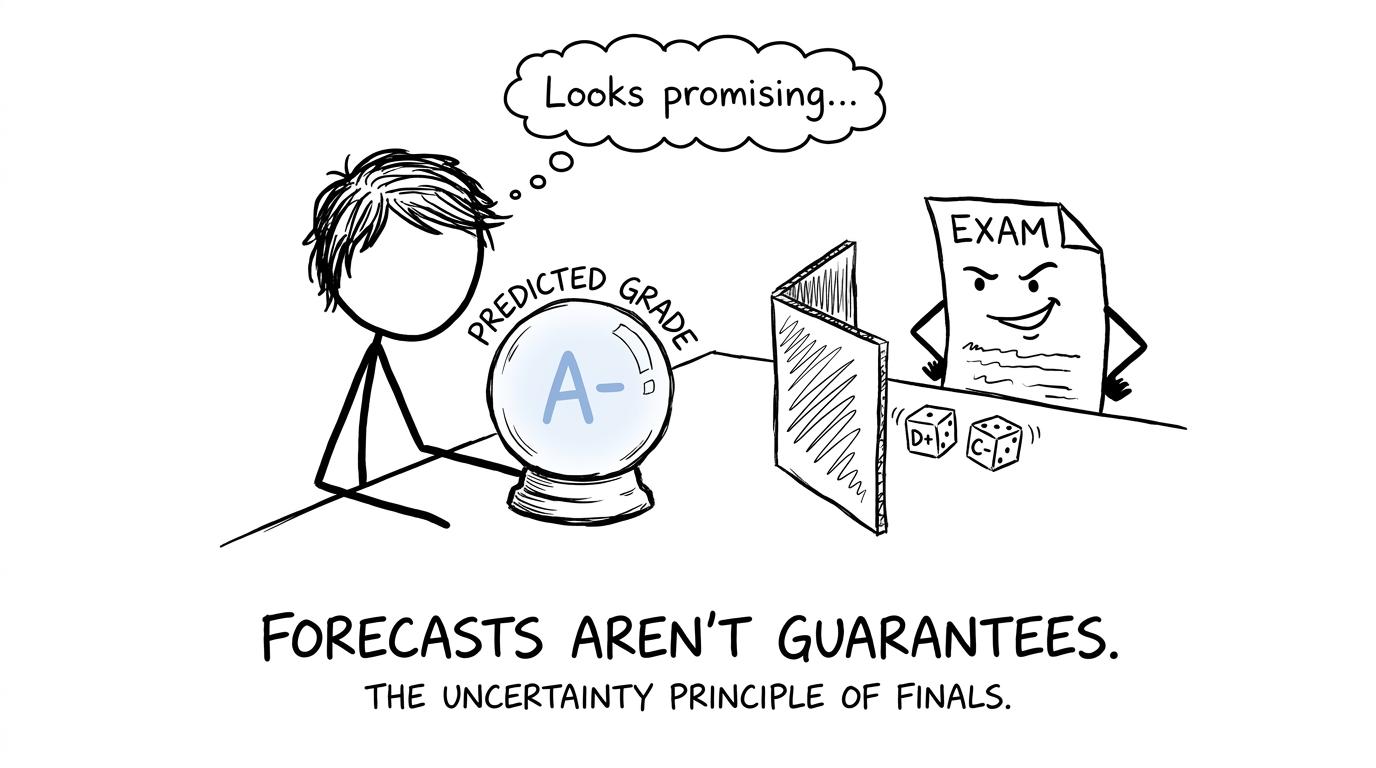 A student consults a predicted-grade crystal ball while the exam paper has other ideas
What does “accurate” actually mean?
Accuracy can be measured in different ways. Let the prediction error be:
E=predicted grade−achieved gradeE = \text{predicted grade} - \text{achieved grade}E=predicted grade−achieved gradeAn exact prediction has E=0E=0E=0. A prediction within one grade has:
∣E∣≤1|E| \leq 1∣E∣≤1These are very different standards. A forecast of grade 666 followed by a grade 555 is not exact, but it may still have been a reasonable estimate months before the examination.
Timing matters too. A prediction made early in Year 101010 has much more uncertainty than one based on several recent Year 111111 assessments. Students learn, revision changes performance and different papers expose different strengths.
For practical purposes, treat a predicted grade as a range rather than a precise endpoint. If several properly timed papers consistently indicate similar performance, that evidence is more dependable than one isolated number.
Why predicted grades can be higher than results day
Optimism is sometimes built into the forecast
Teachers may predict what a student is capable of achieving after continued teaching and revision, rather than what the student would achieve if the examination happened today. This can be useful as encouragement, but it makes the figure partly aspirational.
It is worth asking whether the number is a target, a current working grade or a predicted result. Those labels are often used differently.
Mocks do not reproduce every exam demand
A mock might cover only part of the specification. It may favour topics you know well, use familiar question styles or be marked against boundaries borrowed from an earlier paper.
The real qualification assesses a broader combination of computational thinking, algorithms, programming concepts, data representation, computer systems, networks, cyber security and wider impacts, with the precise coverage depending on whether you take AQA, OCR, Edexcel or Eduqas.
Knowing definitions is not always enough. Students must apply knowledge to unfamiliar scenarios, trace logic accurately and communicate extended answers clearly.
Grade boundaries are not fixed in advance
A school can estimate a grade using historical boundaries, but the boundaries for your examination series are confirmed only after the papers have been sat and marked. Exam boards use statistical and expert judgement to maintain standards.
This means the same raw mark has not necessarily represented the same grade in every series. Using one previous boundary as though it were permanent creates false precision.
Performance under pressure can change
Timing, sleep, anxiety and question selection can all affect performance on the day. These factors do not make an exam meaningless, but they explain why a forecast based on ordinary classroom conditions may not reproduce the final result exactly.
Why predicted grades can be lower than results day
Predictions miss improvement as well as decline.
A student may receive a forecast before completing the course, then strengthen weak topics through deliberate practice. Some students become much better at interpreting mark schemes, managing time and recognising command words during the final months.
One poor mock can also distort the picture. Illness, unfinished revision or an unusually weak topic mix may produce a score below the student’s established standard. If the school gives that assessment heavy weighting, the prediction may lag behind current performance.
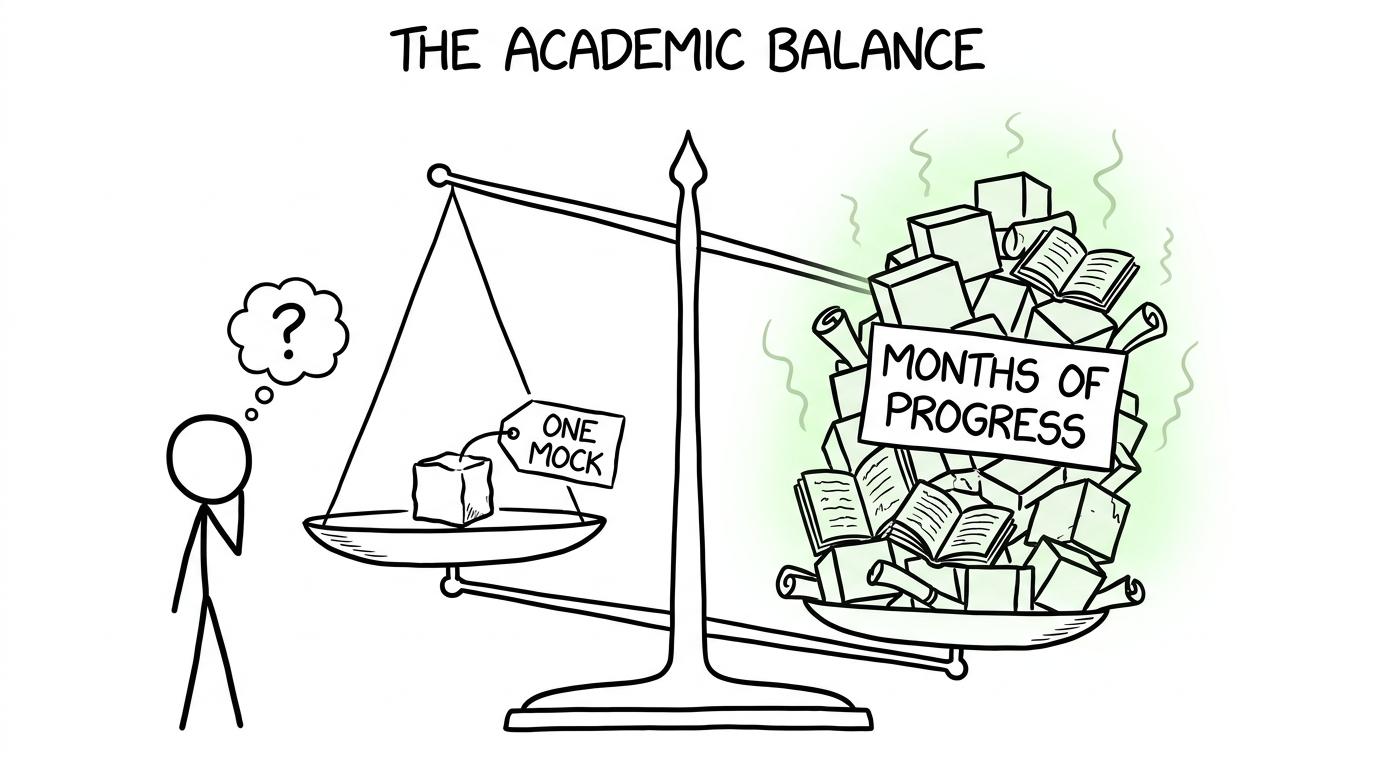 One mock attempts to outweigh months of progress
The same principle applies to maths. A grade calculated before you repair algebra, ratio or geometry gaps cannot automatically account for the marks you will gain later. MathsGenie’s GCSE maths revision hub lets you move from revision lessons to topic questions, then test whether that improvement survives under exam conditions.
How to judge whether your prediction is well supported
Ask for the evidence behind the grade. You are not challenging your teacher; you are trying to understand the forecast.
Useful questions include:
- Which assessments contributed to the prediction?
- Were they completed under timed, closed-book conditions?
- Did they cover the full specification?
- Which grade boundaries were used?
- Is this a target, working grade or forecast?
- Which topics caused most lost marks?
- How consistent have recent scores been?
A robust prediction normally rests on a pattern. If three broad assessments produce similar marks, the estimate has firmer foundations. If it comes from one partial mock, uncertainty is naturally larger.
Do not compare raw percentages across different papers without context. Papers can differ in difficulty, total marks and grade boundaries. Instead, compare how securely you handled each specification area and whether the same weaknesses recur.
Turn the prediction into a revision decision
A predicted grade becomes useful when it changes what you do next.
Start with one timed Computer Science paper or substantial section. Mark it carefully using the official mark scheme, then classify each lost mark:
- missing knowledge;
- incorrect application;
- weak programming logic;
- vague extended writing;
- misreading the command word;
- timing or avoidable accuracy errors.
Choose the two or three patterns costing the most marks. Revise those areas, answer fresh questions and retest them later. This produces current evidence rather than repeatedly staring at an old forecast.
For maths, the same paper, mark, repair cycle is built into MathsGenie. Use GCSE predicted papers for fresh exam-style practice, but combine them with official past papers rather than trying to guess the examination. The guide to using Edexcel GCSE maths past papers properly explains how to turn every lost mark into targeted revision.
If full papers feel premature, begin with mini tests and topic practice through the GCSE maths resources hub. Then follow a realistic GCSE maths revision timetable so that improvement is measured over time rather than guessed from one session.
Common mistakes when interpreting predicted grades
Treating the grade as a limit
A forecast describes current evidence and assumptions. It does not cap what you can achieve. A lower prediction should lead to a diagnostic question: where are the recoverable marks?
Treating the grade as a guarantee
A high prediction can create false comfort. Keep practising until your performance is repeatable across unfamiliar questions and timed papers.
Obsessing over one boundary
Being a few marks above an old grade boundary does not make a future grade certain. Build a buffer by improving weak areas instead of aiming for the historical minimum.
Revising only predicted topics
No unofficial list can know the exact paper. MathsGenie’s guide to GCSE predicted topics explains why predictions should prioritise revision, not replace specification coverage.
Completing papers without reviewing them
A score is feedback, not the finished task. Mark schemes and video solutions reveal where marks are awarded. If you are preparing for maths alongside Computer Science, the collection of Edexcel GCSE maths past papers makes that review cycle easier.
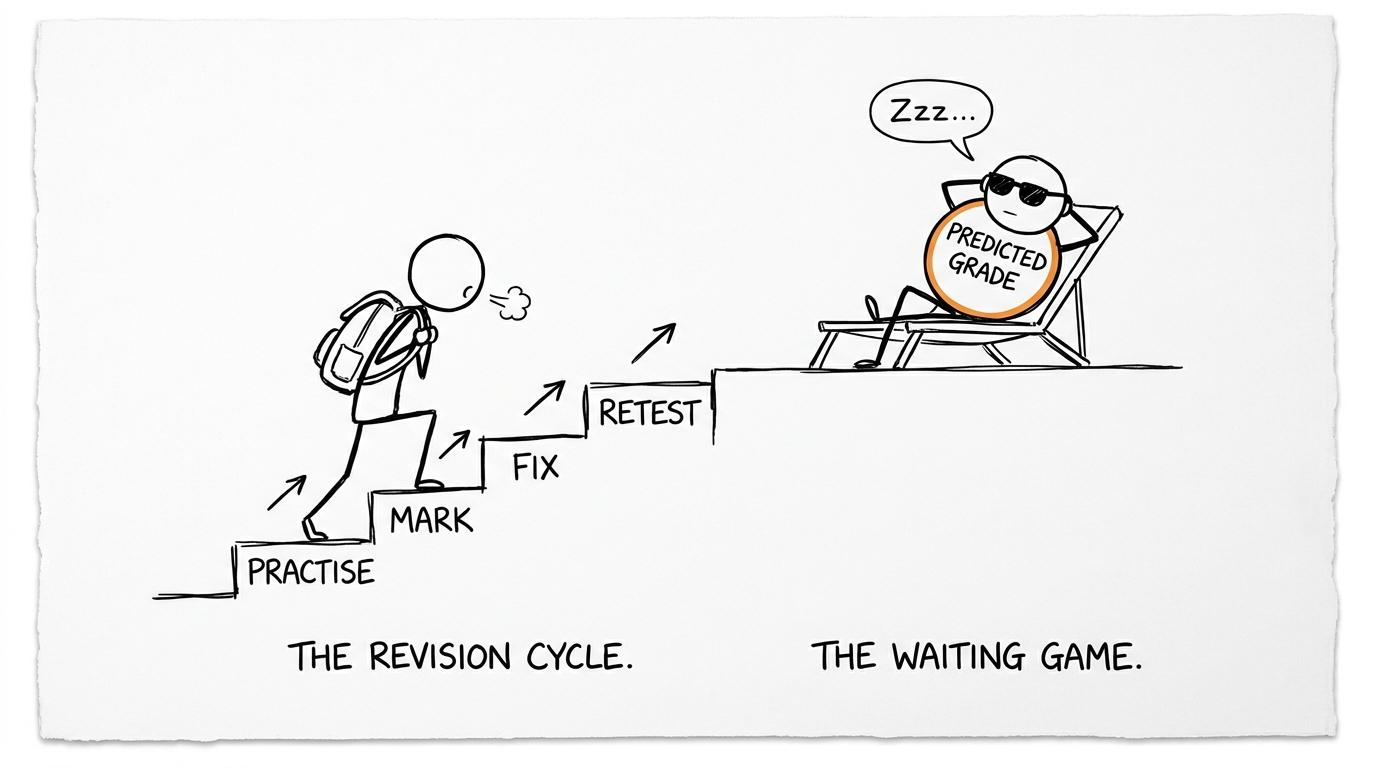 The predicted grade relaxes while the student climbs the practise, mark, fix and retest steps
Your result is still being written
Predicted grades are useful when they are treated as weather forecasts: informed, imperfect and worth preparing around. They are harmful when they become identities.
Look beneath the Computer Science grade. Find the assessments, marks and recurring weaknesses that produced it. Then create better evidence through timed practice, careful marking and focused correction. Whether your current forecast feels encouraging or disappointing, that process is within your control.
Use MathsGenie as your free maths revision base alongside your Computer Science preparation. Start with revision lessons and practice questions, build confidence through mini tests, then move to past papers, predicted papers, mark schemes and video solutions. If you are unsure when to make that transition, read when to start GCSE past papers.
A predicted grade is one snapshot. Your revision is what happens after the photograph is taken.











