GCSE Computer Science Cram Guide: 1-Week Plan
GCSE computer science cram guide 1 week plan: prioritise core topics, practise exam questions, fix weak areas and reach exam day with confidence.

The uncomfortable part of late revision is not the shortage of time. It is the feeling that every topic deserves your attention at once. It does not.
If you searched for a GCSE computer science cram guide: 1 week is still enough time to improve, provided you stop trying to relearn the entire course. Your job is to identify gaps, retrieve essential knowledge, practise applying it and correct the mistakes most likely to cost marks.
This no-nonsense plan gives each day a clear purpose. Aim for around 222 hours of focused revision daily, split into manageable blocks. If Computer Science is sharing the week with maths and other exams, shorten the blocks rather than abandoning the structure.
Your one-week revision checklist
Before starting, gather:
- your exam board's current specification;
- one recent past paper for each component;
- the corresponding mark schemes;
- concise notes or flashcards;
- your programming language and pseudocode conventions;
- a blank error log;
- a timer and a realistic daily slot.
Use the same revision loop throughout the week:
Recall⟶Questions⟶Mark⟶Fix⟶Retest\text{Recall} \longrightarrow \text{Questions} \longrightarrow \text{Mark} \longrightarrow \text{Fix} \longrightarrow \text{Retest}Recall⟶Questions⟶Mark⟶Fix⟶RetestThis is more productive than repeatedly reading notes. MathsGenie's guide to building a GCSE revision timetable that actually works applies the same principle to maths: choose a target, practise it actively and use mistakes to decide what happens next.
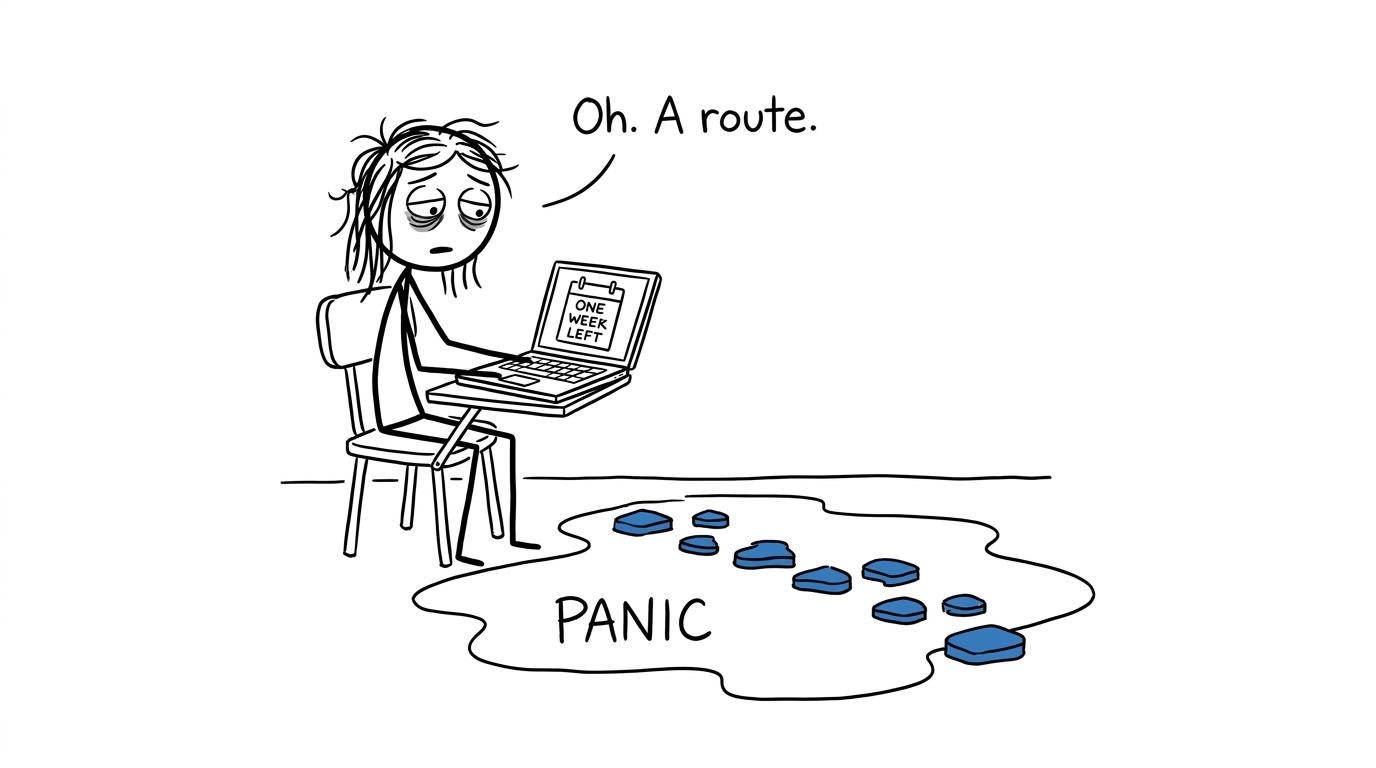 A student discovers seven stepping stones across a puddle labelled panic
Check your exam board before you revise
GCSE Computer Science has common national content, including algorithms, programming, data representation, computer systems, networks, cyber security and the impacts of digital technology. However, the papers are not identical across AQA, OCR, Pearson Edexcel and Eduqas.
For example, boards differ in paper length, topic grouping, pseudocode conventions and how practical programming is assessed. Pearson Edexcel includes an onscreen programming assessment, while AQA and OCR use different written-paper structures. Specifications can also change between exam series.
Do not build your week from a generic online topic list. Open the current specification for your qualification and compare it with the front of a recent paper. If your teacher has supplied a checklist, use it alongside the official specification rather than instead of it.
Mark every topic red, amber or green:
- Red: you cannot explain or apply it without help.
- Amber: you recognise it but make errors in questions.
- Green: you can answer an exam question from memory.
Spend most of the week on red and amber material. Familiar topics feel reassuring, but reassurance and mark improvement are not always the same thing.
The seven-day GCSE Computer Science cram plan
Day One: Diagnose before revising
Set a timer and attempt a substantial section from a recent paper without notes. You are not trying to earn a flattering score. You are collecting evidence.
Mark the work immediately and classify each lost mark:
- Knowledge: you did not know the fact or definition.
- Application: you knew the content but could not use it in context.
- Programming: your logic, syntax or trace was wrong.
- Exam technique: you misread the command word or gave insufficient detail.
- Timing: you rushed or left the question unfinished.
Now choose no more than five priority areas. Broad labels such as “programming” are not useful. Write precise targets such as “trace nested selection”, “compare RAM and secondary storage” or “explain how phishing can be prevented”.
If you are balancing several GCSEs, adapt the diagnostic approach in MathsGenie's one-week revision plan for maths. It helps you organise short-term revision around actual weaknesses rather than guesses.
Day Two: Computer systems and architecture
Concentrate on the machinery behind computation. Depending on your specification, this is likely to include CPU components, the fetch-decode-execute cycle, memory, storage, embedded systems, operating systems and utility software.
Use blank-page recall first. Draw or list what you remember, then check your notes. Follow this with comparison questions because examiners often require more than isolated definitions. You may need to select suitable storage, explain the role of cache or compare characteristics in a stated situation.
Finish by writing concise answers to command words such as state, describe, explain and compare. An explanation needs a linked consequence; a comparison needs both sides.
Day Three: Data representation and computer science maths
Revise binary, hexadecimal, character encoding, images, sound, compression and data capacity as required by your specification. These topics reward careful, repeatable procedures, so they are useful targets during a short revision window.
Know the relationships between units and the factors affecting file size. For an uncompressed bitmap image, the underlying relationship is:
file size in bits=width×height×colour depth\text{file size in bits} = \text{width} \times \text{height} \times \text{colour depth}file size in bits=width×height×colour depthFor uncompressed digital sound, the corresponding relationship is:
file size in bits=sample rate×sample resolution×duration\text{file size in bits} = \text{sample rate} \times \text{sample resolution} \times \text{duration}file size in bits=sample rate×sample resolution×durationCheck whether channel count is relevant to the question and use the unit conventions stated by your exam board or paper. Practise conversions, binary shifts, binary addition and truth tables without looking at a method sheet.
These skills overlap with the numerical accuracy required in GCSE maths. If calculations are slowing you down, use the free GCSE maths revision hub to strengthen number skills alongside your Computer Science work.
Day Four: Algorithms and programming
Programming cannot be revised effectively by reading completed code. You need to predict, trace, write and debug it.
Prioritise:
- sequence, selection and iteration;
- variables, constants and data types;
- string handling and arithmetic operations;
- one-dimensional and two-dimensional arrays where specified;
- validation, authentication and test data;
- functions, procedures and parameters;
- searching and sorting algorithms;
- decomposition, abstraction and algorithm design.
Trace short programs by hand. Then write small algorithm fragments from a requirement without autocomplete or copied templates. Use the pseudocode style expected by your board, while remembering that sound logic matters more than decorative formatting.
When debugging, state the problem and the correction. “The code is wrong” earns little because it does not identify why the program fails.
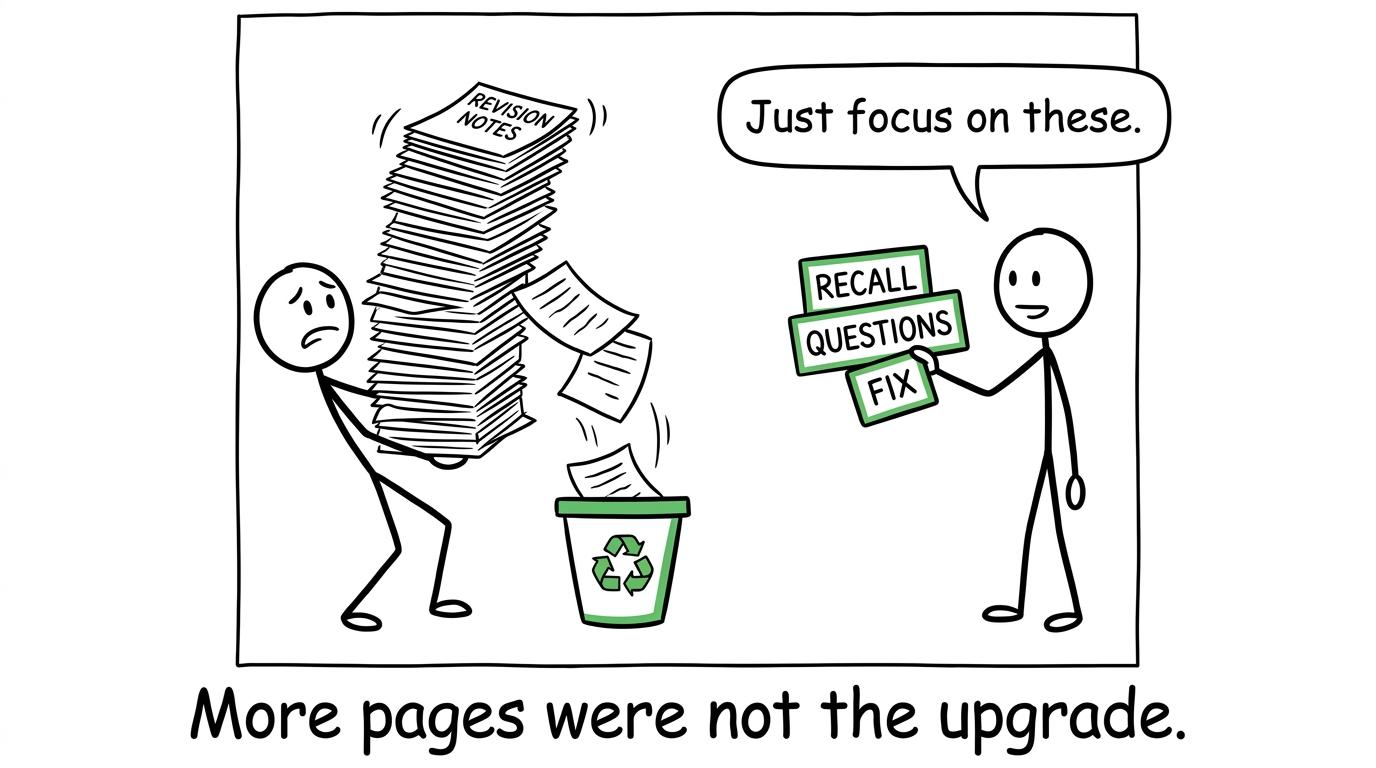 A giant pile of notes loses to three useful revision cards
Day Five: Networks, cyber security and impacts
Revise network types, hardware, protocols, layers and wired or wireless communication according to your specification. Build linked chains rather than disconnected definitions:
feature⟶effect⟶consequence in context\text{feature} \longrightarrow \text{effect} \longrightarrow \text{consequence in context}feature⟶effect⟶consequence in contextApply the same approach to cyber security. Connect each threat with an appropriate prevention method, but do not assume one defence solves every problem. Authentication, access levels, encryption, penetration testing, firewalls and staff training have different purposes.
For ethical, legal, cultural and environmental questions, avoid vague claims. Identify the stakeholder, explain the effect and consider a counterargument. Longer responses are judged on reasoning and application, not simply on how many buzzwords appear.
End the session with mixed questions. Interleaving topics forces you to recognise what a question is testing, which is closer to the real exam than completing an entire page of nearly identical prompts.
Day Six: Sit papers and investigate every error
Attempt a complete paper or the longest realistic section under proper conditions. Use the correct time allowance and permitted equipment. Put your phone elsewhere.
Mark strictly. A past paper is not finished when you calculate the total; it is finished when every useful mistake has produced a next action. MathsGenie's advice on when to start using GCSE past papers explains why feedback matters more than merely accumulating completed papers.
For each error, record:
| Question area | Why the mark was lost | Precise fix |
|---|---|---|
| Knowledge | Fact or process was missing | Retrieve it from memory twice |
| Application | Answer ignored the context | Add a specific consequence |
| Programming | Logic or trace failed | Rewrite and dry-run the algorithm |
| Technique | Command word was misread | Annotate the demand before answering |
| Timing | Too long spent on one item | Practise a timed question set |
The MathsGenie past-paper system models the right wider habit: sit papers with a timer, check mark schemes and keep track of performance rather than treating each attempt as disposable.
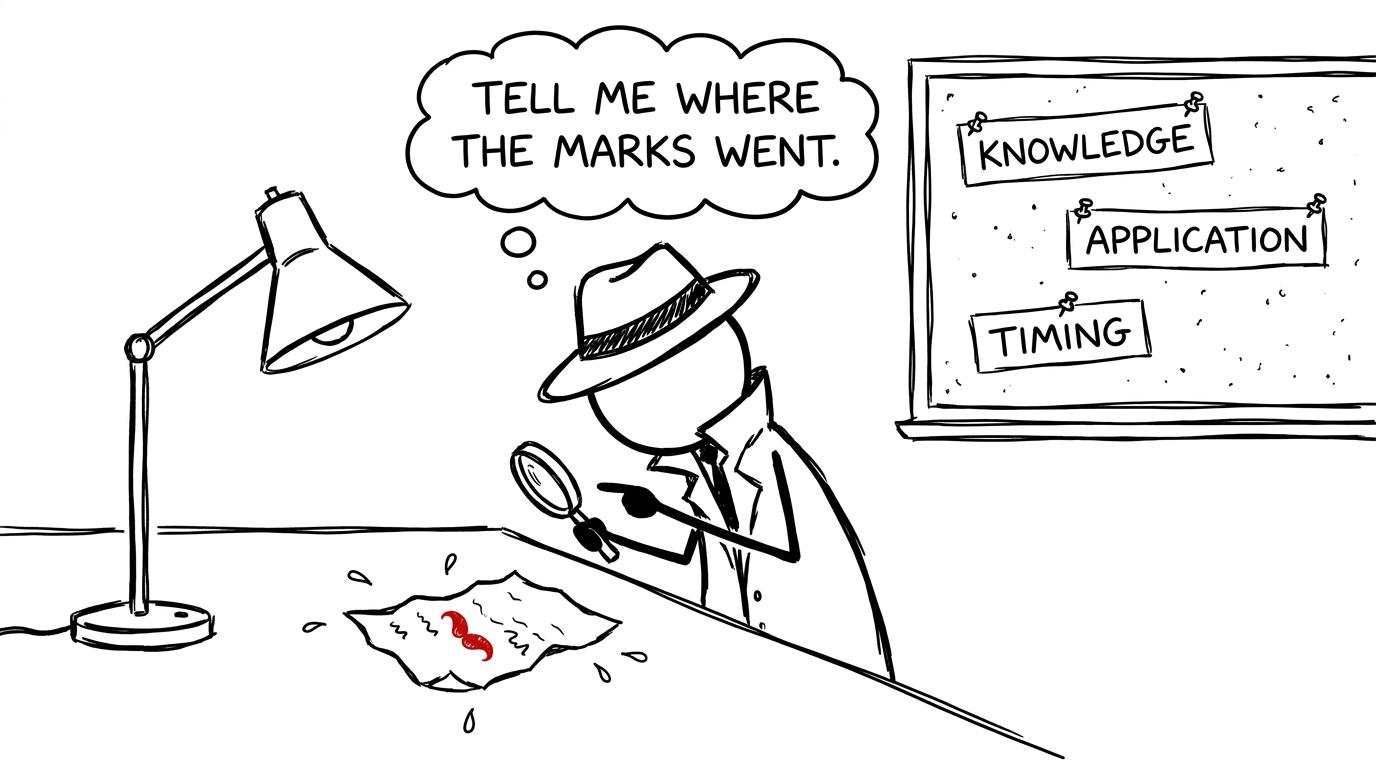 A student investigates a past paper to discover where the marks went
Day Seven: Retest, compress and stop
Do not spend the final day learning a huge untouched topic. Return to your error log and retest the five priorities chosen on Day One. Answer from memory before checking anything.
Create one compact final-review sheet containing:
- easily confused terms;
- algorithm patterns you tend to forget;
- protocol purposes;
- cyber threats matched to suitable defences;
- data-representation relationships;
- reminders about command words.
Then complete a short mixed set rather than another exhausting paper. Prepare your equipment, confirm the exam time and finish revision at a sensible hour. The final evening should protect recall and concentration, not create another layer of panic.
If maths is also approaching, use MathsGenie's guide to GCSE topics that recur regularly to prioritise specification staples, then organise targeted questions rather than gambling on predictions.
Common mistakes in one-week revision
Trying to cover everything equally
The specification may be large, but your gaps are not evenly distributed. Diagnose first and direct more time towards weak, frequently assessed skills.
Copying notes instead of retrieving knowledge
Neat notes can create the illusion of progress. Close the book, write what you know and then check it. The struggle to recall is part of revision.
Ignoring programming until the end
Programming and computational thinking require repeated practice. Include at least one tracing, writing or debugging task on several days rather than isolating all code on Day Four.
Marking answers too generously
Compare your wording with the mark scheme. Technical vocabulary must be accurate, and contextual questions need contextual answers. The same discipline applies when using GCSE maths past papers and mark schemes: honest marking reveals what to fix.
Treating predicted content as a guarantee
Predictions can provide fresh practice, but they cannot replace the specification. MathsGenie's discussion of predicted GCSE topics makes the broader lesson clear: prioritise recurring core skills without assuming that an unmentioned topic cannot appear.
Seven focused days are better than seven worried days
Starting late changes the strategy, not the possibility of progress. Diagnose your gaps, learn only what you can actively retrieve, practise questions every day and let the mark scheme shape tomorrow's work. That is the whole plan.
For the maths exams surrounding your Computer Science paper, make MathsGenie your free revision base. Use revision lessons to rebuild a weak method, practice questions and mini tests to check it, then move to past papers and predicted papers with mark schemes and video solutions. Open the revision planner, choose today's priority and begin with one honest question.