GCSE Combined Science Grade Boundaries Explained
GCSE combined science grade boundaries explained clearly: see why raw marks change each year, how double grades work, and how to revise confidently.
A percentage can feel reassuringly solid. You add your marks, divide by the total and expect the answer to tell you your grade. Yet GCSE Combined Science does not use a permanent percentage-to-grade conversion. The same percentage can produce a different grade in different exam series.
That is the central idea behind GCSE combined science grade boundaries explained: your raw marks are compared with boundaries set for your exam board, specification, tier and examination series. Those boundaries are confirmed after the papers have been taken and marking is nearly complete, so they can reflect how demanding that particular assessment proved to be.
This is not randomness. It is an attempt to keep the standard represented by each grade comparable when one year's papers are harder or easier than another's.
The short answer
Before interpreting any Combined Science mark, check:
- the exam board and specification, such as AQA Trilogy, Edexcel Combined Science or an OCR pathway;
- whether the entry was foundation or higher tier;
- the correct examination series;
- the total qualification mark across all components;
- whether any component marks have been scaled;
- the official overall boundary, rather than an unofficial predicted boundary;
- the paired grade, such as 777-777 or 666-555.
A boundary is the minimum total mark required for a particular grade. It is not a permanent percentage and it is not normally a grade awarded separately to each paper.
For a broader introduction, read GCSE grade boundaries explained.
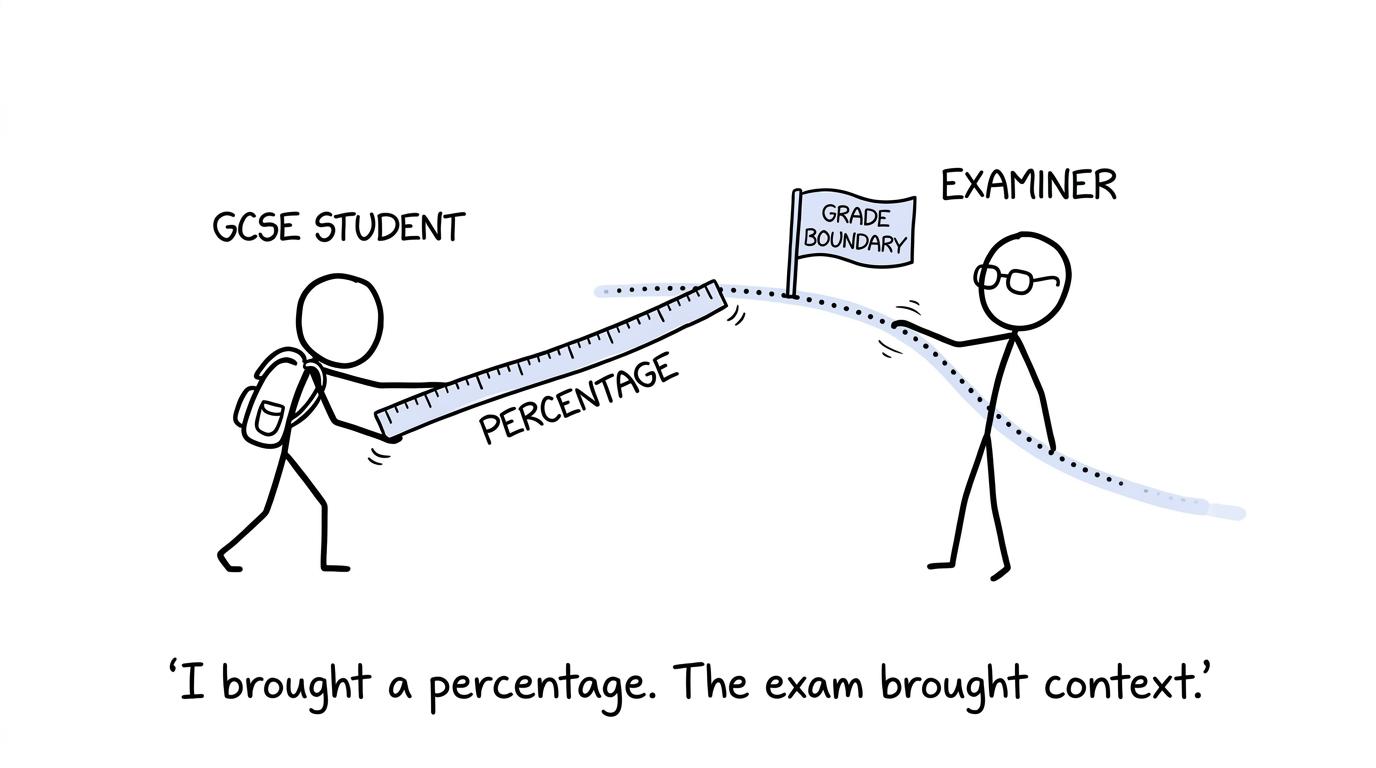 A student discovering that percentages do not tell the whole grading story
Why your percentage is not automatically your grade
A percentage describes how much of the available mark you gained. If your total raw mark is RRR and the maximum available mark is MMM, then:
Percentage=RM×100\text{Percentage}=\frac{R}{M}\times 100Percentage=MR×100That calculation is useful. It lets you compare your performance across papers with different maximum marks. But it does not, by itself, award a GCSE grade.
There is no universal rule saying that a particular percentage always equals a grade 777, or that another fixed percentage always equals a grade 444. The official boundary table converts your total subject mark into a result for that specific series.
Suppose one year's paper contains unfamiliar contexts, unusually demanding calculations or questions that take longer than expected. Students may gain fewer raw marks even though their underlying scientific knowledge is comparable with that of the previous cohort. A lower boundary can compensate for that increased demand.
If a paper is more accessible, boundaries may rise. The raw mark moves; the intended standard behind the grade remains the focus.
This is why a past boundary is evidence, not a promise. MathsGenie's Combined Science grade boundaries history can show how figures have changed, but no historical table can reveal the boundary for an examination that has not yet been awarded.
How GCSE Combined Science boundaries are set
Exam boards do not simply choose an attractive percentage before students enter the examination hall. Awarding takes place after the assessments have been sat and marking is sufficiently advanced.
Evidence from student performance
Exam boards examine how the cohort performed across the qualification. Statistical evidence helps them compare the current group with previous cohorts, including evidence about prior attainment where appropriate.
This does not mean that a fixed number of students must receive each grade. GCSE grading is not a simple competition in which only a predetermined percentage can pass. The evidence helps exam boards judge whether changes in marks arise from the assessment's demand, changes in the cohort or both.
Judgement from senior examiners
Senior examiners review scripts around important potential boundaries. They consider the quality of work and whether it represents the expected standard for the grade.
The statistical and judgemental evidence is considered together. Neither a spreadsheet nor one examiner's impression acts alone.
Setting the remaining boundaries
For reformed GCSE qualifications, particular key boundaries receive close attention during awarding. Other boundaries can then be calculated between those points according to the grading rules. Combined Science has additional intermediate paired grades, so its published scale contains more steps than a single GCSE.
The final boundary table gives the minimum subject mark for every available outcome. Until that process is finished, figures shared online are predictions rather than confirmed boundaries.
Why Combined Science gives two grades
GCSE Combined Science is a double award worth two GCSEs. Students receive two equal or adjacent grades, giving 171717 possible outcomes from 999-999 through to 111-111.
Possible results include:
- equal grades, such as 888-888 or 555-555;
- adjacent grades, such as 888-777 or 555-444.
You cannot receive a widely separated combination such as 888-555. The higher number is reported first when the grades differ.
The paired result does not mean that one grade belongs to biology and the other belongs to chemistry or physics. It is one overall Combined Science award based on performance across the qualification.
That distinction matters. A student might feel stronger in biology than physics, but the final result is produced from the combined subject mark, not by assigning three independent science grades and averaging their labels.
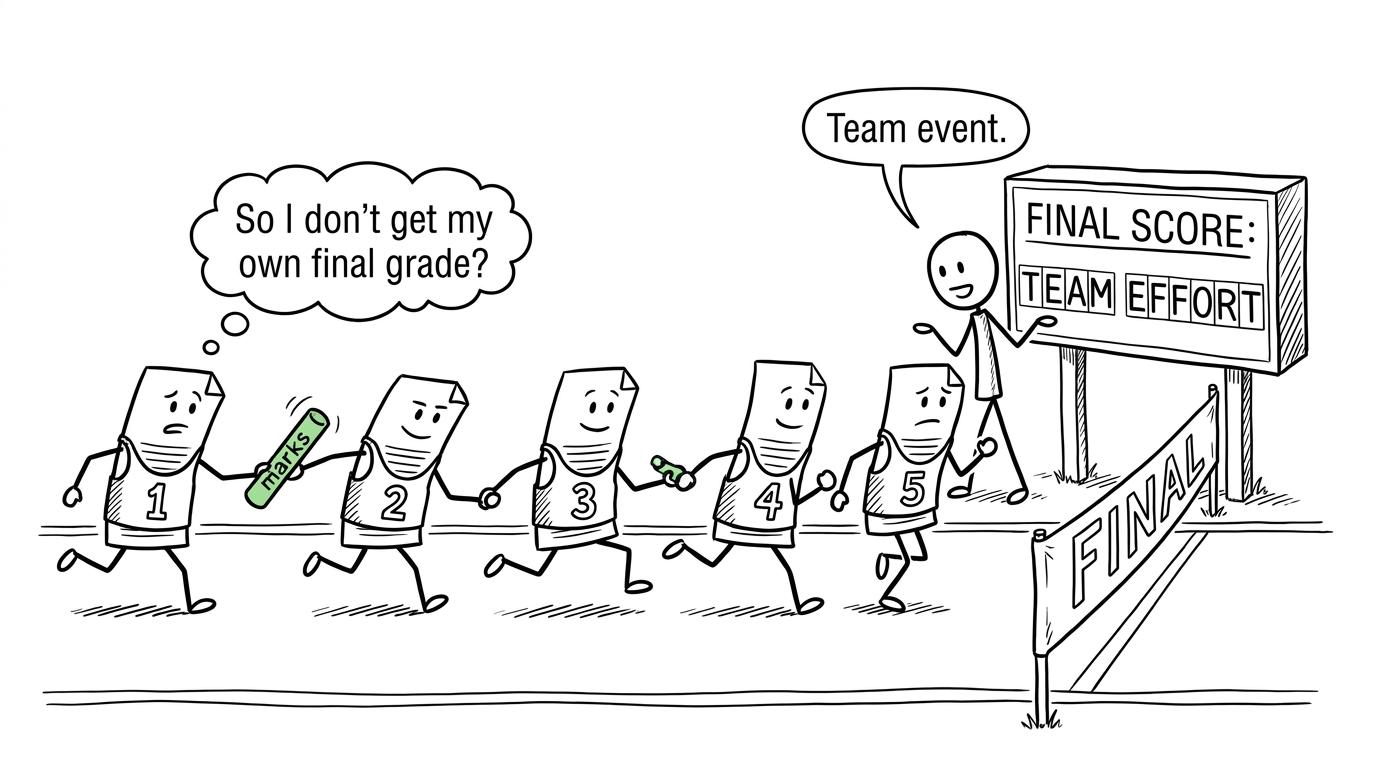 Six papers working together as one qualification
Raw marks, total marks and paper boundaries
A raw mark is the mark awarded for what you wrote on an individual component before any necessary scaling. In many qualifications, component marks can simply be added. Where components have different weightings, the exam board applies the appropriate scaling before forming the overall subject mark.
The important sequence is:
component marks⟶subject total⟶qualification boundary⟶final grade\text{component marks}\longrightarrow\text{subject total}\longrightarrow\text{qualification boundary}\longrightarrow\text{final grade}component marks⟶subject total⟶qualification boundary⟶final gradeOfficial documents may also publish notional component boundaries. These indicate what a grade boundary might look like on one paper if that paper were graded separately. They are useful for analysis, but they do not create separate final grades.
A strong mark on one component can therefore compensate for a weaker mark elsewhere. What matters for certification is the overall qualification total after the board's weighting rules have been applied.
Maximum marks also vary by specification. For example, the official June 202520252025 tables show AQA Combined Science: Trilogy with a maximum subject mark of 420420420, while Pearson Edexcel Combined Science had a maximum of 360360360. Comparing their raw boundaries without checking those totals would be misleading.
If you follow OCR, use the dedicated guide to OCR GCSE Combined Science grade boundaries and make sure you select the correct OCR specification.
What foundation and higher tier change
Tier affects which grades are available and which papers you sit. Foundation tier is designed around the lower and middle part of the grade range, while higher tier gives access to the highest grades.
For Combined Science in England, foundation tier normally offers outcomes up to 555-555. Higher tier provides access to grades up to 999-999, with a restricted lower range and an allowed outcome just below the normal lower threshold in defined circumstances.
Do not compare a foundation raw mark directly with a higher raw mark. The papers are different, their demand is different and their boundary tables are different. A lower raw mark on a higher paper does not automatically represent weaker scientific understanding.
Your school decides the appropriate tier entry with you. If you are uncertain which table applies, check your statement of entry or ask your teacher before drawing conclusions from a mark.
How to use boundaries during revision
Grade boundaries are best treated as a measuring tool, not a target to scrape past.
When marking a past paper set, use the official boundary from the same exam series, specification and tier. Then record three things:
- your total mark;
- the historical grade indicated by that series;
- the topics and question types responsible for lost marks.
The third item has the greatest revision value. A boundary can tell you where you stood. It cannot tell you how to improve.
Because boundaries move, aim for a buffer above previous thresholds rather than revising towards one exact number. Compare several complete paper sets so that one unusually comfortable or difficult assessment does not distort your expectations.
The same principle helps with maths revision. Begin at the GCSE Maths revision hub, choose your exam board and tier, and use topic lessons and practice questions to repair the methods costing you marks. The Edexcel GCSE Maths revision pathway provides a board-specific route for Edexcel students.
Once individual skills are secure, move into timed papers. The guide to when to start GCSE past papers explains how to progress from short diagnostic work to complete examination practice.
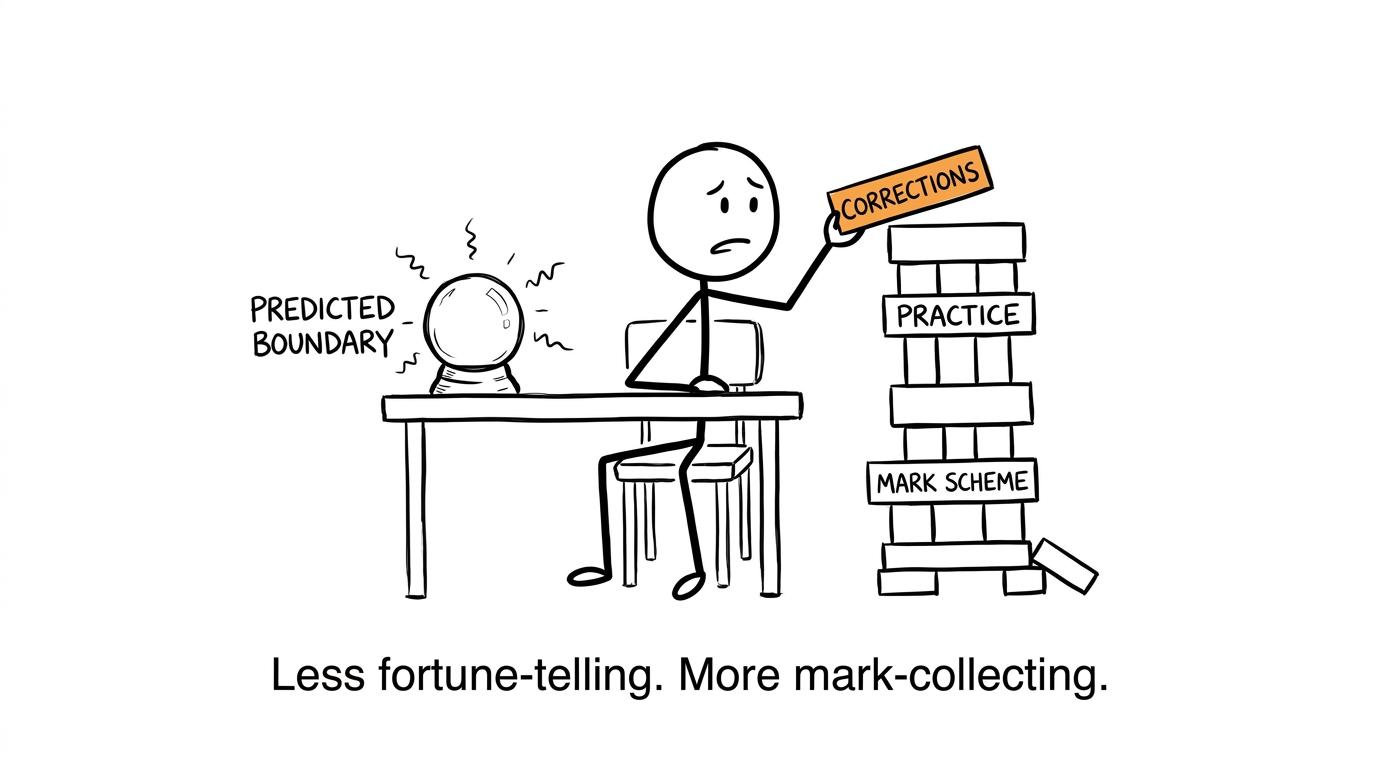 A student choosing practice over predicting an unknown boundary
Common mistakes when reading Combined Science boundaries
Treating percentages as permanent grade rules
A percentage is a useful summary of your mark, but only the correct boundary table determines the grade. Avoid claims such as “this percentage is always a grade 777”.
Looking at the wrong exam board or specification
AQA, Edexcel, OCR and Eduqas do not share one boundary table. Even within an exam board, different specifications may have different maximum marks and assessments.
Using a boundary from the wrong year
A June 202420242024 boundary belongs to the June 202420242024 papers. It can help interpret that past-paper attempt, but it is not a confirmed target for a later series.
Assigning a final grade to one paper
Notional paper boundaries are not qualification grades. Add all relevant component marks, applying any published scaling, before consulting the overall boundary.
Splitting the double grade between subjects
A result such as 777-666 does not mean grade 777 in one science and grade 666 in another. It is a paired award for Combined Science as a whole.
Chasing predictions instead of marks
Predicted boundaries can create false confidence or unnecessary panic. The more useful question is not “Will the boundary fall?” but “Which reliable marks can I add before the examination?”
Turn uncertainty into a revision plan
You cannot know the next boundary in advance. You can know whether you checked units, showed your calculations, interpreted graphs accurately and answered the command word in front of you.
That is the quieter advantage of understanding grade boundaries. Once you realise the threshold can move, you stop trying to forecast one perfect percentage and start building a safer total mark.
Use MathsGenie's one-month GCSE maths revision plan to organise that work. Combine free revision lessons with practice questions, mini tests and video solutions. Then test the result through past papers and predicted papers, marking every attempt carefully with the mark scheme.
Boundaries explain the result after the examination. Deliberate practice changes the result before it. Start with one weak topic on MathsGenie today, correct one recurring error and turn uncertainty into another mark you can keep.