GCSE Combined Science Grade Boundaries History
GCSE combined science grade boundaries history explained year by year, with Edexcel marks, pandemic context and advice for using past papers in revision.
A past paper score can feel wonderfully precise. You have a mark, a published boundary and, apparently, an answer about your grade. Yet GCSE combined science grade boundaries history shows why that answer needs context: boundaries move because the difficulty of papers and national grading arrangements change.
The short answer is that recent boundaries have generally risen from the more generous pandemic-transition levels of 2022, but the movement has not been smooth or identical across exam boards. A higher boundary does not automatically mean the qualification became harder. It may mean that students found that particular set of papers more accessible.
What to check before comparing boundaries
Use this checklist whenever you analyse past GCSE combined science grade boundaries:
- Match the exam board and specification: Edexcel, AQA, OCR or Eduqas.
- Compare the same tier: foundation with foundation, or higher with higher.
- Check the total available marks.
- Compare overall qualification boundaries, not unofficial paper grades.
- Treat 2020, 2021 and 2022 separately because grading arrangements were exceptional.
- Remember that Combined Science awards two linked grades, such as 777-777 or 777-666.
The safest starting point is your board's own data. Maths Genie provides dedicated tables for Edexcel GCSE grade boundaries and AQA Combined Science grade boundaries.
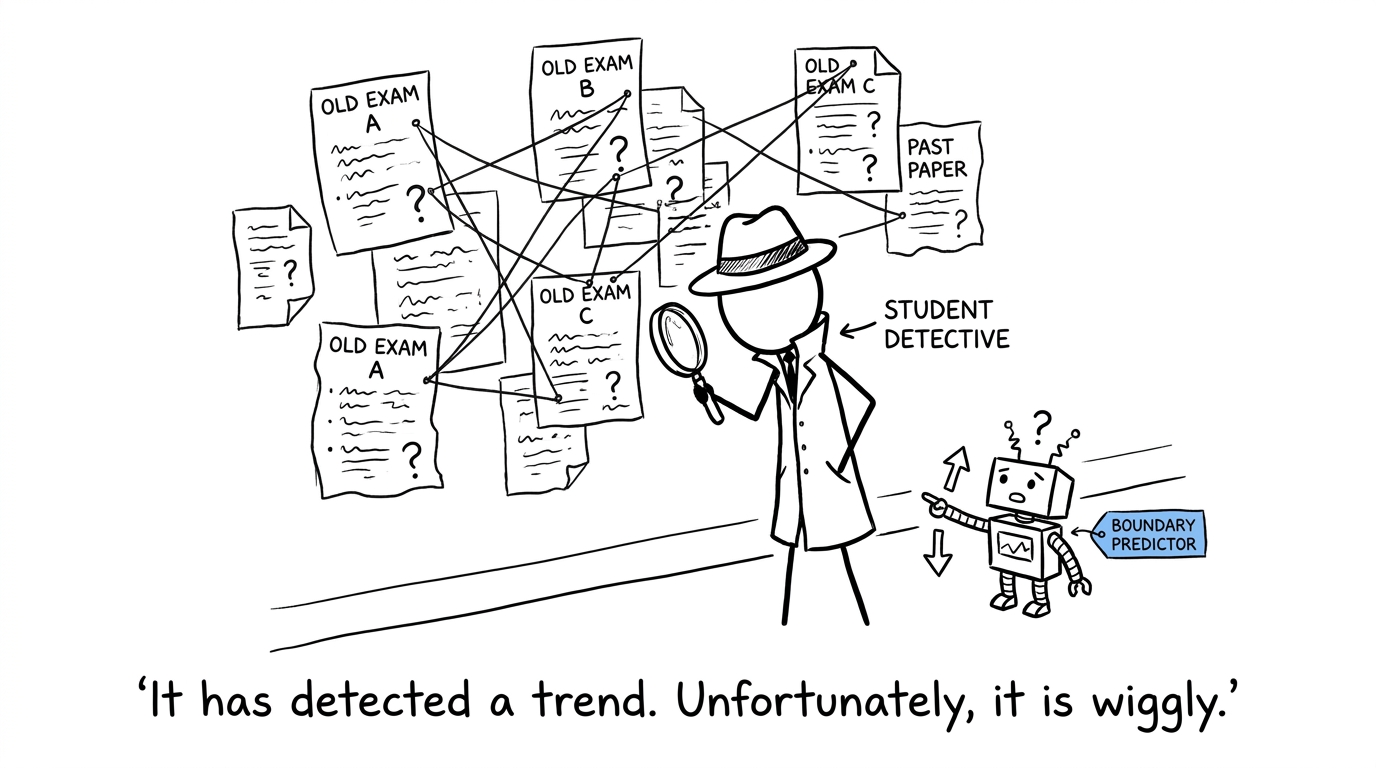 A student detective and a confused boundary-predicting robot investigate a wiggly trend
Year-by-year Combined Science grade boundary trends
For a consistent comparison, the table below follows Pearson Edexcel Combined Science foundation tier. The qualification has six papers and a total of 360360360 marks. It shows the boundaries for 555-555 and 444-444, with percentages rounded to the nearest whole percentage.
| Exam series | 555-555 boundary | Approximate percentage | 444-444 boundary | Approximate percentage | Context |
|---|---|---|---|---|---|
| June 2018 | 193193193 | 54%54\%54% | 154154154 | 43%43\%43% | First assessment of the reformed specification |
| June 2019 | 203203203 | 56%56\%56% | 162162162 | 45%45\%45% | Last normal pre-pandemic summer series |
| Summer 2020 | Not applicable | Not applicable | Not applicable | Not applicable | Summer examinations were cancelled |
| Summer 2021 | Not applicable | Not applicable | Not applicable | Not applicable | Grades were determined through teacher assessment |
| June 2022 | 203203203 | 56%56\%56% | 164164164 | 46%46\%46% | Transitional grading after the pandemic |
| June 2023 | 224224224 | 62%62\%62% | 189189189 | 53%53\%53% | Return towards pre-pandemic grading standards |
| June 2024 | 217217217 | 60%60\%60% | 178178178 | 49%49\%49% | Normal grading arrangements continued |
| June 2025 | 215215215 | 60%60\%60% | 174174174 | 48%48\%48% | Latest published summer boundary in this comparison |
You can inspect the complete set of adjacent double-grade boundaries with Maths Genie's Edexcel Combined Science grade calculator.
2018 and 2019: establishing the standard
The reformed Combined Science qualifications were first assessed in 2018. Boundaries then changed in 2019 as examiners had another complete set of scripts and a new paper series to consider.
For Edexcel foundation tier, the 444-444 boundary rose from 154154154 to 162162162. That does not prove that science became harder in 2019. Boundaries are set after students have taken the papers so that differences in paper demand can be considered.
2020 and 2021: the break in the series
There were no normal summer GCSE examinations in 2020 or 2021. Grades were awarded through alternative arrangements, including teacher-assessed grades in 2021. Consequently, there is no directly comparable summer Combined Science boundary for either year.
Some exam boards published boundaries for additional autumn series, but these involved different and much smaller cohorts. They should not be inserted into a summer trend line as though nothing changed.
2022: a transition year
Examinations returned in summer 2022, but grading was deliberately transitional. Ofqual described the intended national outcome as a midpoint between 2019 and 2021, reflecting disruption to students' education.
This makes 2022 useful for practising questions, but less suitable as the sole basis for predicting a current mock grade. Ofqual later advised schools to disregard boundaries from the exceptional 2020, 2021 and 2022 series when estimating the standard expected under normal grading.
2023 to 2025: normal grading, moving boundaries
England returned to pre-pandemic grading standards in 2023, with protection built into that year's grading process. Normal arrangements continued from 2024.
Edexcel's foundation 444-444 boundary reached 189189189 in 2023, then fell to 178178178 in 2024 and 174174174 in 2025. This is the clearest lesson in GCSE combined science grade boundary trends: boundaries respond to each paper series. They do not simply rise every year.
The pattern also differs by board. For example, AQA Trilogy higher tier's 777-777 boundary was 199199199 out of 420420420 in 2019, 202202202 in 2022, 220220220 in 2023, 215215215 in 2024 and 228228228 in 2025. Never apply an Edexcel percentage to an AQA paper.
What the history means for your revision
A boundary is best treated as a range, not a promise. When marking a paper, compare your result with its original boundary, then ask whether you could still reach your target if the threshold moved by several marks.
More importantly, inspect where marks were lost. The Edexcel Combined Science revision hub brings together lessons, questions and revision tools, while the AQA Combined Science revision hub helps AQA students stay aligned with their specification.
This matters for maths preparation too. Science papers reward accurate substitution, rearranging formulae, interpreting graphs, proportional reasoning and handling units. Maths Genie's GCSE maths revision resources can strengthen those transferable skills.
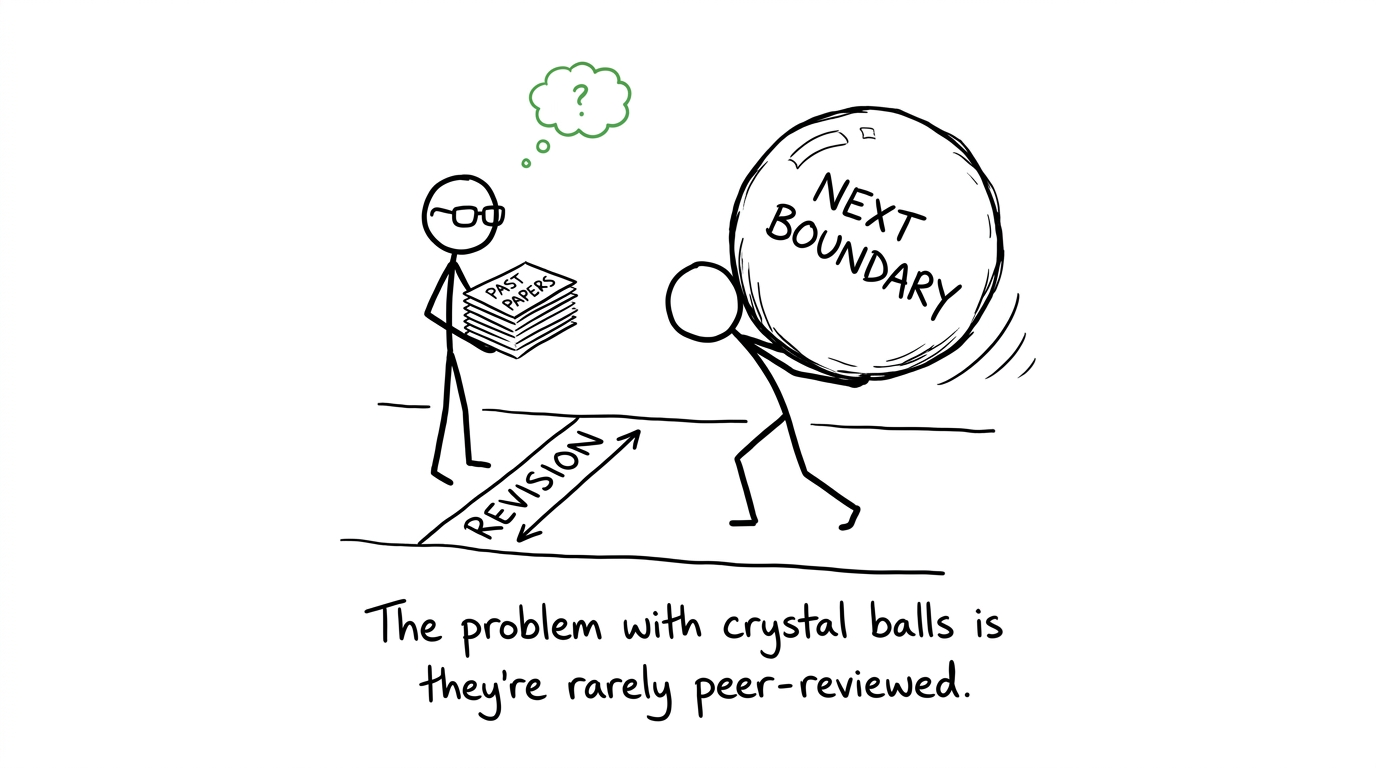 One student carries past papers while another loses control of a giant boundary-predicting crystal ball
Common mistakes when analysing old boundaries
Comparing raw marks from different boards
AQA Trilogy totals 420420420 marks, while Edexcel totals 360360360. Compare percentages cautiously and never transfer a raw boundary between specifications.
Treating a paper boundary as a final grade
Combined Science grades are based on the qualification total. Notional component boundaries can be useful guides, but they are not separate official paper grades.
Using 2022 as a prediction without context
The 2022 transition was intentionally more generous than normal pre-pandemic grading. Use the paper for practice, but compare performance across several normal series too.
Revising only until you touch last year's boundary
A threshold is not a target to balance upon. Build a margin for normal variation, difficult questions and avoidable errors.
Turn the trend into useful evidence
The history is reassuring in one important way: no boundary can be known before the papers have been taken and reviewed. You cannot control it, but you can control the evidence you create in revision.
Start with Edexcel GCSE Combined Science past papers. Complete a paper under timed conditions, use the official mark scheme, record every lost mark and revisit the relevant revision lesson or practice questions. Then repeat with another year rather than trying to predict the next boundary.
Maths Genie gives you the full revision loop: lessons, past papers, predicted papers, practice questions, mark schemes, video solutions and mini tests. Use the boundary as context. Let consistent, accurately marked practice determine your next step.