

Is GCSE Combined Science Foundation Tier Easier?
GCSE combined science foundation tier easier? Compare content, maths demand, grades and exam questions, then create a smarter revision plan with MathsGenie.

The word Foundation can sound reassuring. It can also sound like a verdict. Students sometimes hear it and assume the paper will be simple, or that choosing it means giving up on a respectable result. Neither conclusion is accurate.
So, is GCSE Combined Science Foundation Tier easier? In one important sense, yes: its questions target grades 111 to 555, it excludes some higher-only content, and its assessed maths has a lower minimum level of demand. But it is not simply a watered-down qualification. You still need scientific knowledge, calculations, practical understanding, data analysis and clear written explanations. Moreover, earning a grade 444 or 555 should represent a comparable standard on either tier.
Foundation is best understood as a different route through the qualification: one designed to make lower and middle grades more accessible, while capping the highest available result.
The quick answer
Here is the distinction that matters:
- Foundation questions are targeted at grades 111 to 555.
- Higher questions are targeted at grades 444 to 999.
- Foundation Combined Science offers grades from 111-111 to 555-555.
- Higher offers grades from 444-444 to 999-999, with a limited 444-333 safety-net grade for students narrowly below 444-444.
- Some higher-only scientific content does not appear on Foundation papers.
- The mathematical demand is generally lower on Foundation, but calculations remain a substantial part of the qualification.
- A Foundation grade 555-555 is intended to be comparable with a Higher grade 555-555.
The right tier is therefore not the paper that sounds easier. It is the paper whose available marks and grade range fit your current performance and realistic target.
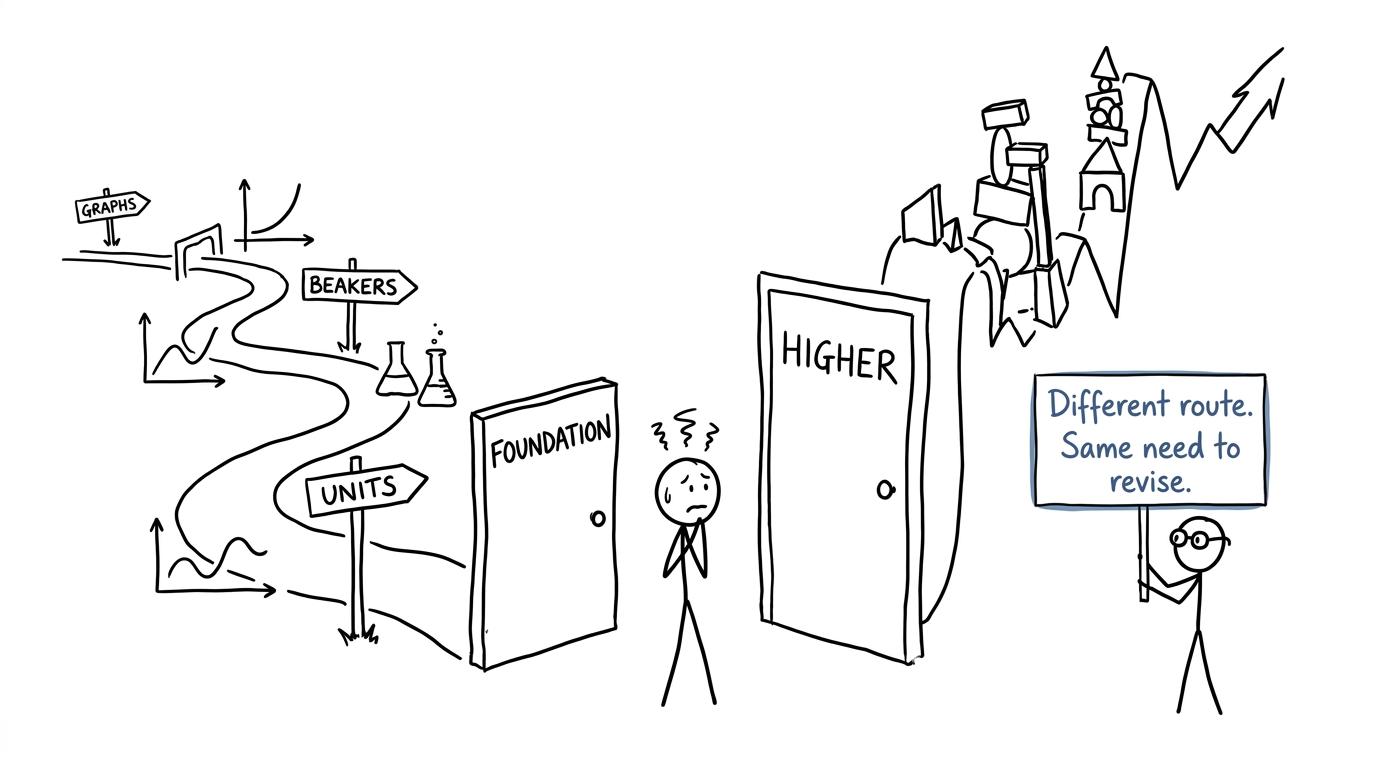 A student discovers that Foundation and Higher are different revision routes rather than easy and hard doors
What Foundation Tier actually changes
It changes the grade range
Combined Science is a double award. Your result is reported as two grades, which are either equal or adjacent, such as 444-444 or 555-444. Marks from the qualification's papers are combined before the overall grade boundaries are applied; individual papers do not produce separate GCSE grades.
| Tier | Targeted grades | Normally available grades |
|---|---|---|
| Foundation | 111 to 555 | 111-111 to 555-555 |
| Higher | 444 to 999 | 444-444 to 999-999, plus the limited 444-333 safety net |
This creates a clear trade-off. Foundation prevents you from achieving above 555-555, but it gives students working around grades 333, 444 and 555 access to a broader range of suitably demanding questions. Higher opens the route to grades 666-666 and above, but its lower end carries more risk if performance falls well below the grade 444 standard.
Your school makes the entry, using evidence such as classwork, assessments and mock exams. If you are unsure, ask which tier you are currently entered for and what evidence would support changing it.
It changes some of the content
The national Combined Science subject content distinguishes material required for Higher Tier but not Foundation Tier. Exam-board specifications usually identify this higher-only material clearly, although its presentation varies between AQA, Edexcel, OCR and Eduqas.
That means Foundation students generally have less content to prepare. Yet the shared curriculum remains broad: biology, chemistry and physics concepts, working scientifically, practical methods, graphs, calculations and evaluation all remain relevant.
Less content is not the same as little content. A student who ignores required practicals or assumes every question will be direct recall can still find the paper difficult.
It changes how questions are pitched
Foundation papers contain more low- and standard-demand questions. You are more likely to receive scaffolding, familiar contexts or clearer stages in a calculation. Higher papers contain more questions requiring several ideas to be connected with less guidance.
However, the core assessment objectives remain the same across the qualification. Ofqual requires approximately 40%40\%40% for knowledge and understanding, 40%40\%40% for application, and 20%20\%20% for analysis and evaluation. Foundation therefore still asks you to apply ideas, interpret evidence, judge conclusions and improve experimental procedures.
The paper may offer a gentler starting point. It does not remove the need to think.
Is a grade 4 or 5 easier on Foundation?
Not in the sense of being worth less or representing a deliberately weaker standard.
The tiers overlap at grades 444 and 555. Ofqual requires at least 20%20\%20% of the marks on each tier to come from common questions targeted at those grades. Exam boards use this overlap to help align standards, so achievement at 444-444, 555-444 and 555-555 is intended to be comparable across tiers.
What changes is access. A student targeting a grade 444 may encounter more questions within reach on Foundation, rather than spending much of a Higher paper facing grade 666 to 999 demand. That can make the exam experience feel more manageable and create more opportunities to collect marks steadily.
It is a little like choosing the right-sized ladder. The destination at grade 555 is meant to be the same height. Foundation simply provides more useful rungs for a student travelling through grades 111 to 555.
The maths is easier in level, not optional
For a student preparing for GCSE maths, this is where Science and Maths revision begin to reinforce each other.
At least 20%20\%20% of the marks in Combined Science must assess mathematical skills. Those marks are allocated across biology, chemistry and physics in the ratio 1:2:31:2:31:2:3, so physics carries the largest share. Foundation mathematical assessment must be no lower in demand than Key Stage 333 maths, while Higher must be no lower than Foundation Tier GCSE Maths.
Foundation calculations may be more direct, but you can still be assessed on:
- decimals, fractions, ratios and percentages;
- standard form and orders of magnitude;
- means and appropriate rounding;
- unit conversions;
- substitution and straightforward rearrangement;
- plotting and interpreting graphs;
- gradients, areas and volumes in scientific contexts;
- checking whether an answer is reasonable.
These skills can be strengthened through the free GCSE Maths revision hub. If percentages, ratio and drawing graphs feel unreliable, the structured resources in MathsGenie's Stage 4 learning pathway offer revision videos, exam questions and solutions.
Do not revise the maths in isolation, though. Science calculations also test whether you can choose the correct information, attach units and interpret the answer. Mathematical fluency frees up attention for the scientific decision surrounding the calculation.
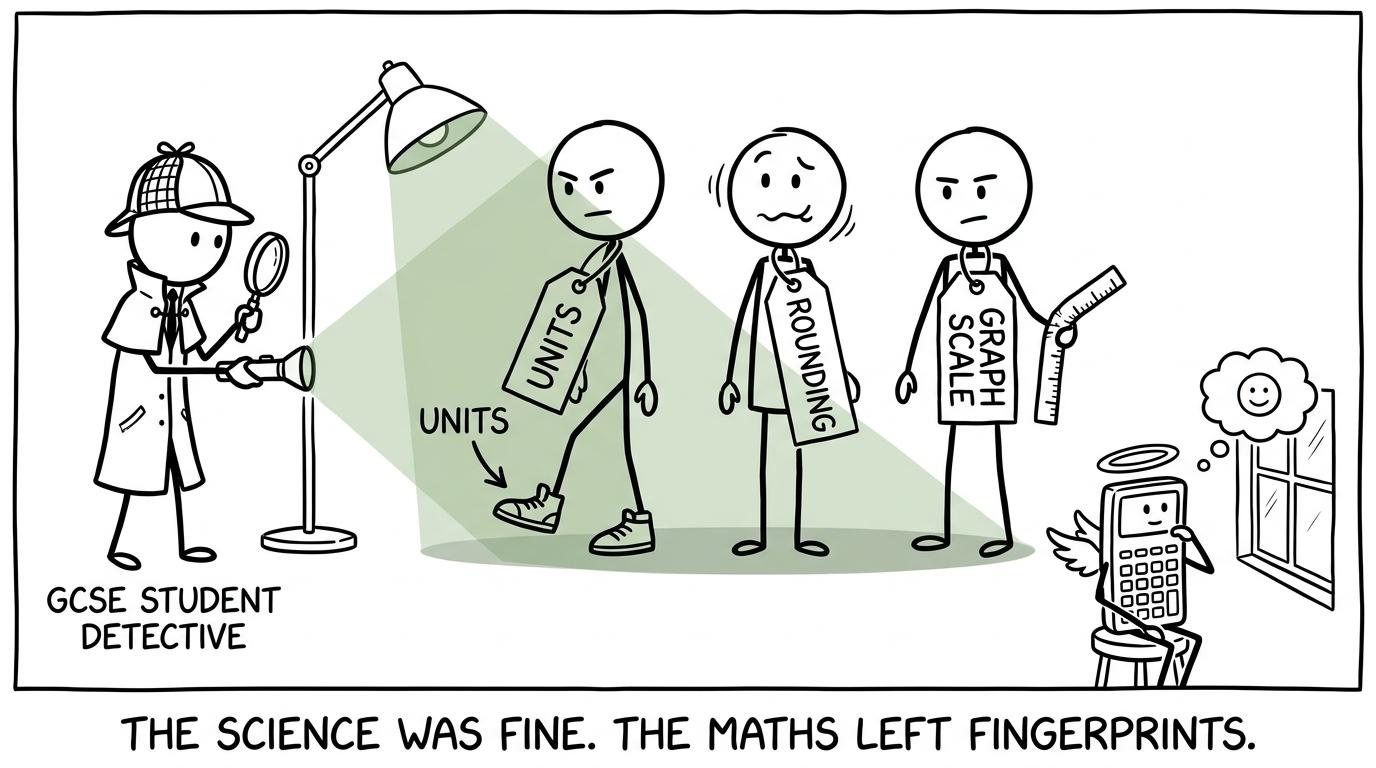 A student detective discovers that units, rounding and graph scales caused the missing science marks
Why Foundation can still feel difficult
Difficulty is partly about the paper and partly about preparation. A Foundation paper can feel demanding when a student knows isolated facts but cannot recognise when to use them.
Application still matters
Knowing a definition is only the first layer. A question may place the idea inside an unfamiliar experiment, diagram or data table. You must identify the relevant principle and apply it without being distracted by the context.
Practical knowledge is examined
At least 15%15\%15% of Combined Science marks assess practical skills. You may need to identify variables, describe a method, explain a safety precaution, interpret results or suggest an improvement. Foundation Tier does not remove this requirement.
Precision still earns marks
A scientifically sensible answer may miss a mark if it is too vague. Terms such as energy, force, concentration or rate have precise meanings. Likewise, a correct calculator display can lose credit when the unit, conversion or requested rounding is wrong.
The maths preparation in GCSE Chemistry revision for pass-grade students is particularly useful for building a routine around units, percentages, ratio, standard form and graphs.
How to decide whether Foundation fits you
Do not base the decision on one unusually good or bad paper. Look for a pattern across several assessments completed under realistic conditions.
Foundation may be suitable when:
- your realistic target is between 111-111 and 555-555;
- Foundation questions provide enough challenge without long sections being inaccessible;
- your marks on Higher papers place you at risk of missing the narrow lower-grade safety net;
- securing grade 444 or 555 matters more than preserving access to grades 666 to 999.
Higher may be more appropriate when:
- you are consistently demonstrating grade 666 or stronger performance;
- higher-only content and less-scaffolded calculations are secure;
- your intended next step has entry expectations above grade 555;
- timed Higher papers provide evidence, not merely hope, that the grade range suits you.
This should be a conversation with your science teacher. Grade boundaries vary by exam board and series, so do not convert one raw mark using an unrelated year's boundary. Compare like with like: the correct specification, tier, paper and exam series.
A revision plan that treats Foundation seriously
A good plan begins with diagnosis rather than confidence. Confidence can change overnight; evidence is steadier.
Audit the science and maths separately
Complete a Foundation paper or timed section, then classify every lost mark as:
- scientific knowledge;
- application;
- practical understanding;
- maths method;
- units or rounding;
- exam technique.
This prevents a low mark from becoming the unhelpful conclusion, “I am bad at science.” The mark is usually a collection of smaller, repairable problems.
Repair one mathematical weakness at a time
Use the GCSE topics by exam board and tier guide to identify the underlying skill. Watch a revision lesson, complete practice questions, check the solutions and revisit the topic later.
For a manageable weekly structure, adapt the cycle in the GCSE one-month revision plan: focused topic work, short retrieval, a mini test and a timed paper section. The method transfers well to science calculations.
Use papers to test transfer
Past-paper questions reveal whether a skill survives unfamiliar wording and time pressure. After marking, return to topic practice rather than immediately attempting another full paper. MathsGenie's guide to starting and using GCSE past papers explains how to move from short sections towards complete timed papers.
For additional maths rehearsal, use GCSE predicted papers and revision resources. Predicted papers should supplement official past papers, not replace them.
Common mistakes about Foundation Tier
Assuming every question will be easy
Questions still progress in demand, and the top end targets grade 555. Expect unfamiliar contexts, calculations and extended responses.
Believing Foundation grades count less
The certificate does not identify the tier, and overlapping grades are intended to be comparable. The meaningful limitation is the maximum available grade of 555-555.
Revising only facts
Recall matters, but application and analysis together account for a substantial proportion of assessment. Practise interpreting data, evaluating methods and explaining cause-and-effect relationships.
Ignoring maths because it is a science exam
At least 20%20\%20% of Combined Science marks assess mathematical skills. Units, graphs, percentages and rearranging equations can quietly decide many marks.
Practising with the wrong tier or specification
AQA, Edexcel, OCR and Eduqas organise content and papers differently. Always check the board, specification and tier printed on the paper before using it as evidence of your current level.
Foundation is a strategic route, not an easy label
Foundation Tier is genuinely less demanding in its grade targeting, higher-only content and minimum mathematical level. But it is also different rather than simply easy. It rewards the same broad habits that strong GCSE performance always requires: accurate knowledge, careful application, practical understanding and reliable maths.
Choose the tier that gives you the best opportunity to demonstrate what you know. Then prepare for it without embarrassment or complacency.
Start with the free MathsGenie GCSE Maths revision hub. Use revision lessons to rebuild weak methods, practice questions and mini tests to develop fluency, and past papers or predicted papers to test your work under pressure. Mark carefully with the available mark schemes and use video solutions when a method remains unclear. The right tier matters, but what you do repeatedly before the exam matters more.











