GCSE Combined Science Flashcards Quizlet Guide
GCSE combined science flashcards Quizlet guide: find reliable exam-board decks, check accuracy and build fast cards that improve active recall.
A large flashcard deck can create a comforting illusion: if it contains everything, perhaps learning everything is simply a matter of flipping through it. But coverage is not the same as recall, and recall is not the same as answering an exam question.
The best GCSE combined science flashcards Quizlet resources are matched to your exam board, divided into narrow topics and accurate enough to trust. Start with Quizlet's organised GCSE Combined Science collections or a teacher-checked, specification-specific set. Then build a smaller personal deck from the facts, practical methods, equations and units you repeatedly forget.
Flashcards are particularly useful for definitions, processes, required practicals and equation selection. They cannot replace application questions, calculations or past papers.
Your quick flashcard checklist
Before committing time to a deck, check that it:
- names your exam board and course, such as AQA Combined Science: Trilogy, Pearson Edexcel Combined Science, OCR Gateway or OCR Twenty First Century Science
- matches your foundation or higher content where the specification distinguishes between them
- separates Biology, Chemistry and Physics into manageable topics
- covers required practical knowledge, including variables, apparatus, methods and sources of error
- uses correct scientific terminology and units
- asks you to retrieve answers rather than merely recognise them
- has been checked against your current specification, class materials or an official exam-board source
- is followed by exam-style questions and marking
A deck that fails the first two checks may teach perfectly accurate science that you do not need, while missing content that you do.
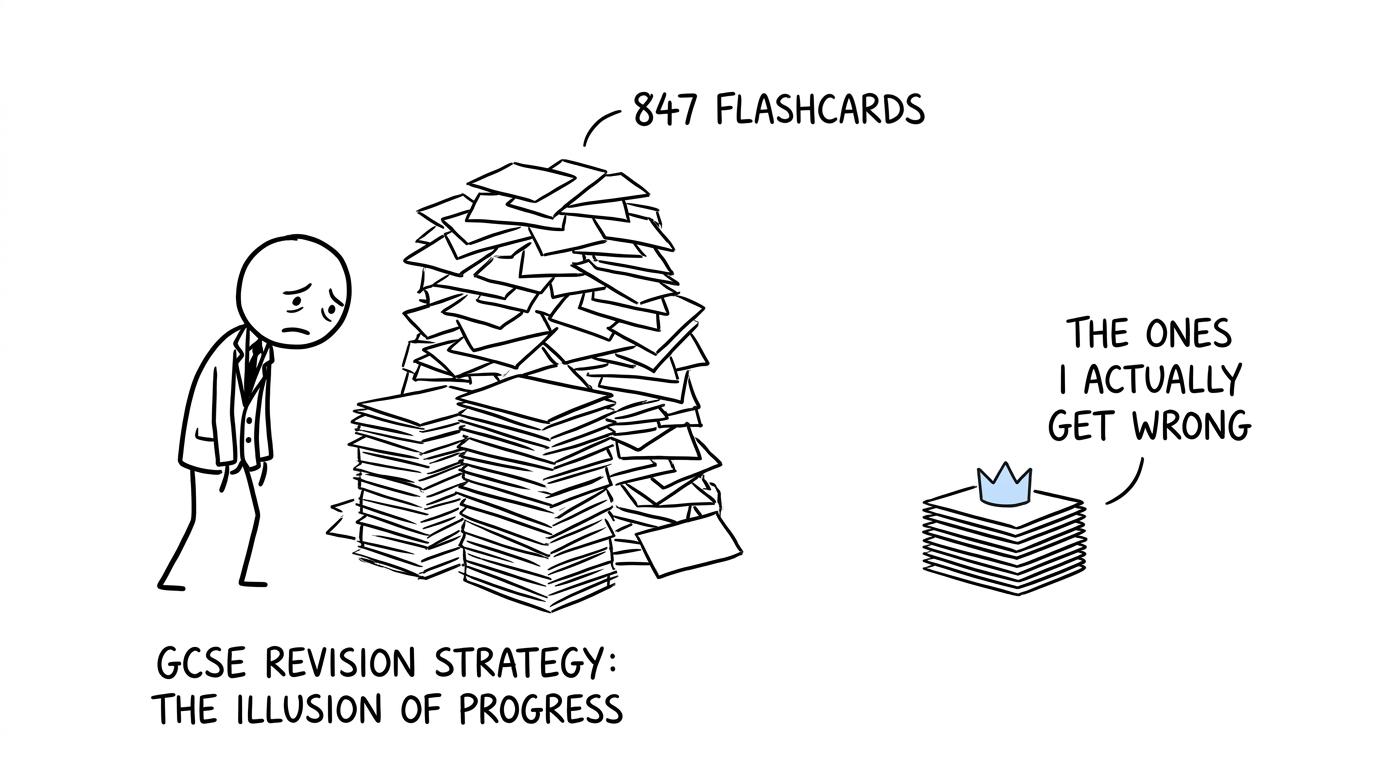 A student choosing a useful little flashcard stack instead of an enormous pile
Which GCSE Combined Science flashcard decks are worth using?
There is no single public deck that is automatically best for every student. AQA, Edexcel, OCR and Eduqas organise and phrase their specifications differently. Public Quizlet sets can also be created by students, teachers or publishers, so authorship and accuracy matter more than popularity alone.
Officially organised Quizlet GCSE collections
Quizlet provides GCSE Combined Science resource collections, including an AQA-specific collection. These are a sensible first place to look because they are organised around GCSE content rather than an unidentified course.
Choose the collection for your board, then select one paper or topic at a time. Do not combine the entire qualification into one endless session. A focused set on cell biology or electricity gives clearer feedback than hundreds of mixed cards when you are still learning the material.
Quizlet's Learn mode can turn cards into different question formats and focus practice on less secure material. Test mode can provide another check. Features and access arrangements can change, however, so treat the cards themselves as the important resource rather than building your whole plan around one platform feature.
Teacher-created, specification-matched decks
A deck shared by your science department is often more useful than a highly rated public set. Your teacher can confirm whether it follows the course being taught and may use the wording expected in your lessons and assessments.
Look for a precise title containing the board, qualification, paper and topic. A title such as “Science revision” tells you very little. A set labelled for AQA Combined Science: Trilogy, Biology Paper One and cell biology is much easier to verify.
Even then, sample several cards. Check technical terms, equations and units against your specification or trusted notes before using the whole set.
Required practical flashcards
Practical work deserves its own decks. Official specifications require students to study prescribed practical activities, although their number and organisation differ between boards. Good cards should test more than the name of an experiment.
Include prompts about:
- the independent, dependent and control variables
- apparatus and measurement choices
- the main stages of the method
- safety considerations
- expected patterns or observations
- graph selection and interpretation
- limitations, errors and possible improvements
Avoid cards that ask for an entire method in one answer. Break the practical into individual decisions. This makes retrieval more demanding and reveals exactly which step is missing.
Equation, unit and science-maths decks
Equation cards are valuable, but only if they test meaning as well as appearance. For example, a card involving density should connect:
ρ=mV\rho = \frac{m}{V}ρ=Vmwith the quantities, suitable units and the need to rearrange when another variable is required.
For the 2026 GCSE Physics and Combined Science examinations, official exam-board guidance confirms that students receive a revised equation sheet containing the relevant physics equations. Check your own board's current examination materials because arrangements are time-sensitive. An equation sheet reduces pure memorisation, but it does not choose the correct relationship, convert units or rearrange the formula for you.
MathsGenie's changing the subject of a formula revision, standard form topic resources and speed and density revision guide help turn remembered equations into usable calculation skills.
How to check a Quizlet set before trusting it
Spend two minutes checking a set before spending two weeks learning it.
First, compare its topic list with your specification. Then inspect a sample from the beginning, middle and end. Look closely at definitions, practical methods, symbols and units. Cards should distinguish easily confused ideas rather than blur them together.
Be cautious if a set:
- does not identify an exam board
- mixes Combined Science with separate Biology, Chemistry or Physics without labelling the extra material
- contains unexplained abbreviations
- gives long copied paragraphs as answers
- omits units from equations
- treats correlation as proof of causation
- presents a practical method without variables or measurements
- has visible spelling, notation or factual errors
A deck can be mostly correct and still embed one costly misconception. If you find repeated errors, leave it rather than repairing someone else's entire resource.
How to build your own science Quizlet deck fast
Making cards can become another form of copying. The goal is not to produce beautiful notes. It is to create prompts that expose what you cannot yet retrieve.
Start with your specification and error log
Choose one narrow topic. Use your specification, teacher materials and marked questions to identify the essential knowledge. Your lost marks are especially useful because they show where a generic deck should become personal.
The method in MathsGenie's guide to finding your weakest GCSE topics can be adapted to science: label each error as recall, application, maths, graph interpretation or practical knowledge. Build cards for recall gaps. Use questions for the other categories.
Keep one testable idea on each card
A useful front asks one unambiguous question. The back gives the shortest complete answer that would satisfy it. Split lists and processes when each part needs independent retrieval.
Effective card types include:
- Definition cards: one scientific term and its precise meaning
- Comparison cards: one important difference between two commonly confused ideas
- Sequence cards: the next stage in a biological or chemical process
- Practical cards: one variable, control, risk or improvement
- Equation cards: relationship, symbols and units
- Diagram-label cards: one hidden structure at a time
- Exam-language cards: a command word and what the response must do
Do not paste an entire revision page onto the back. If an answer cannot be checked quickly, it is probably several cards disguised as one.
Import in batches, then proofread
Quizlet supports creating sets by entering terms individually or importing prepared term-and-definition pairs. Drafting a clean list in a document can therefore speed up production.
Create a modest topic batch, check every card and test it immediately. Add cards only when a lesson, mini test or marked question reveals a genuine gap. A growing deck built from mistakes is usually more valuable than a giant deck built from fear.
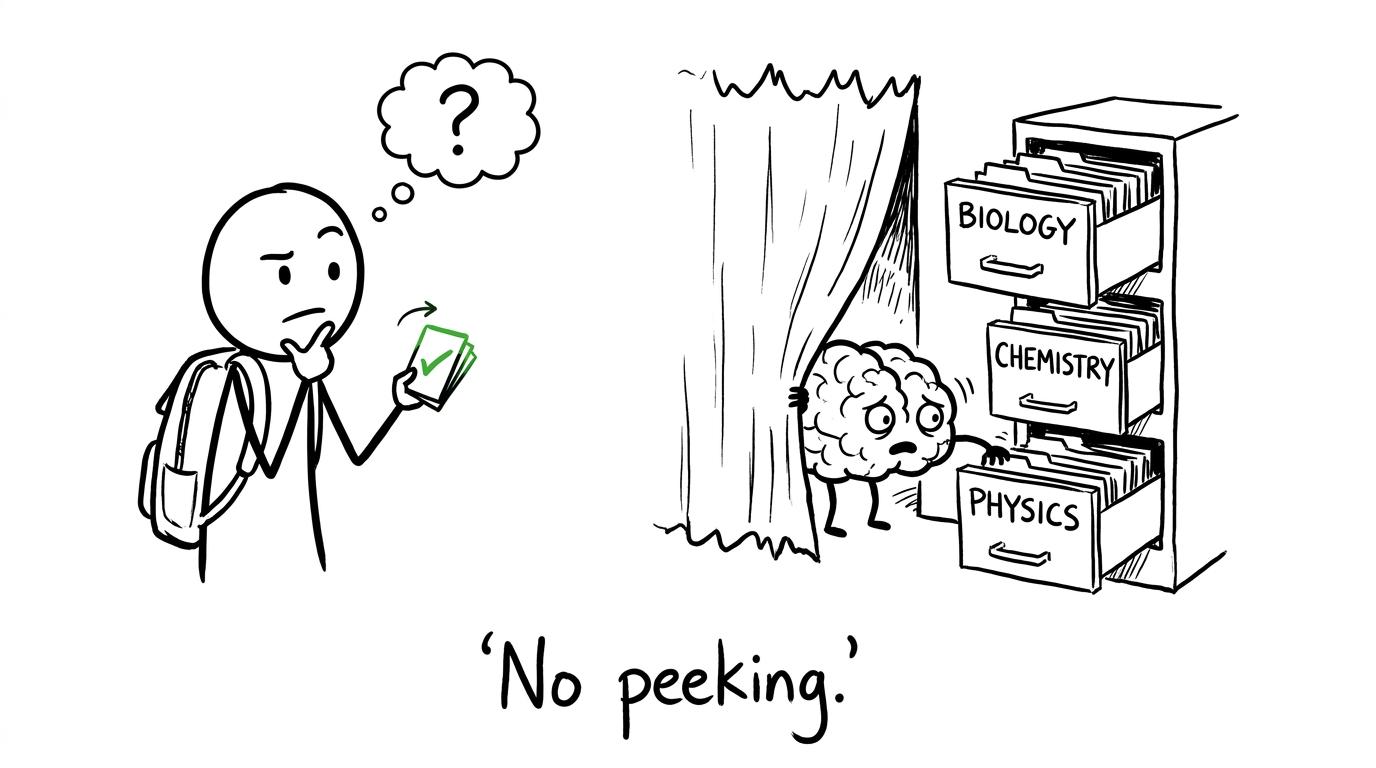 A brain searching Biology, Chemistry and Physics filing cabinets during active recall
How to use flashcards so they improve recall
Reading the front and quickly revealing the back feels fluent, but recognition can masquerade as knowledge. Pause. Say or write the complete answer before turning the card.
Research on retrieval practice supports actively recalling previously learned material, especially when attempts are repeated after a delay and followed by corrective feedback. The Education Endowment Foundation also cautions that retrieval should use an appropriate level of challenge, address misconceptions and extend beyond simple factual recall.
A practical routine is:
- select one small topic deck
- answer without notes
- mark the response honestly
- correct errors immediately
- revisit difficult cards after a delay
- finish with several exam-style questions
You can fit that cycle into MathsGenie's twenty-minute GCSE revision routine. For science calculations, follow the cards with targeted maths questions rather than assuming formula recognition equals fluency.
Why flashcards must lead to exam questions
Combined Science papers assess knowledge in unfamiliar contexts. You may need to interpret data, explain a result, evaluate a method or complete a multi-stage calculation. A flashcard can remind you that gradient represents a rate; only question practice teaches you to identify suitable points and communicate the method under pressure.
MathsGenie's distance to time relationship revision shows how scientific understanding and graph skills meet. The main GCSE maths revision hub also provides free lessons, question banks, worksheets and board-specific resources for calculation skills used across science.
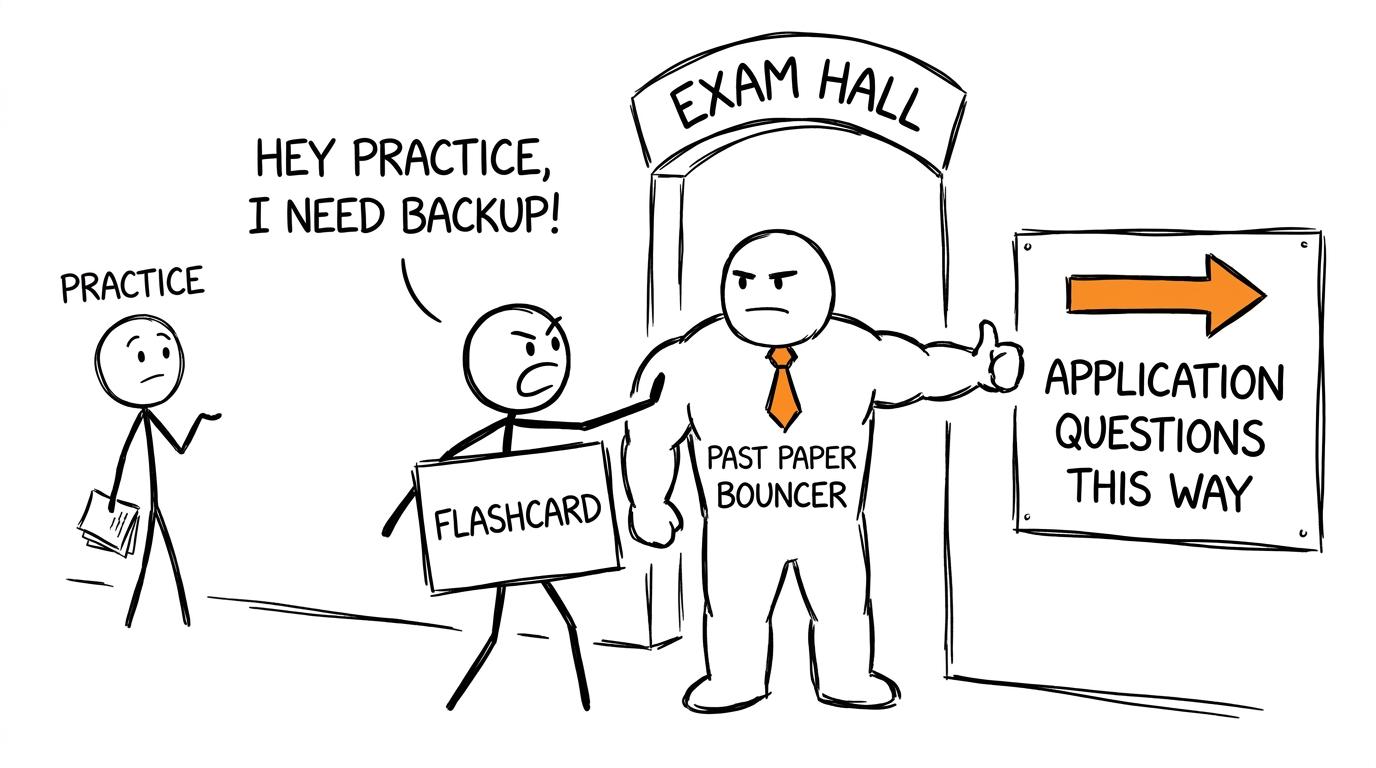 A flashcard discovering that it needs practice questions to enter the exam hall
Common mistakes with science flashcards
Choosing by size or popularity
A large set may contain duplicates, irrelevant separate-science content or outdated wording. Choose by specification match and accuracy instead.
Revising only comfortable cards
Easy cards make sessions feel successful while leaving weak topics untouched. Star difficult material, shuffle the order and begin future sessions with yesterday's errors.
Learning equations without units or meaning
A card showing only symbols is incomplete. Know what each symbol represents, which units are compatible and how to rearrange the relationship.
Copying paragraphs onto every card
Long answers encourage recognition rather than precise retrieval. Divide them into smaller questions that can be marked decisively.
Treating flashcards as complete exam preparation
Flashcards build accessible knowledge. They do not fully train extended explanations, practical evaluation, unfamiliar data or multi-step calculations. Use MathsGenie's GCSE mini tests and follow the past-paper revision loop: attempt, mark, diagnose, repair and retest.
Turn remembered facts into usable marks
The best deck is not necessarily the one with the most cards. It is the one that matches your course, asks precise questions and changes in response to your mistakes.
Begin with a verified, exam-board-specific Quizlet collection or a set approved by your teacher. Build short personal decks for weak definitions, practical decisions, equations and units. Retrieve answers without peeking, correct them promptly and then apply the knowledge in questions.
For the maths inside Combined Science, use MathsGenie's free revision lessons and practice questions to strengthen rearranging, standard form, graphs, ratio and unit work. Then move into mini tests, past papers and predicted papers, checking mark schemes and video solutions carefully. Flashcards help you remember the tools. MathsGenie helps you learn when and how to use them.