

GCSE Combined Science 6 to 9: A Practical Plan
GCSE combined science 6 to 9 guidance covering higher-tier knowledge, application, scientific maths, practical skills and focused exam revision.
A grade 666 often means you understand most of the science. You can recall key facts, use familiar equations and answer straightforward questions. Yet harder questions still feel unpredictable, and marks disappear through vague explanations, unfamiliar contexts or small calculation errors.
Moving through gcse combined science 6 to 9 is therefore not mainly about revising for longer. It is about changing the kind of revision you do. You must close remaining content gaps, apply ideas without prompts, strengthen scientific maths, evaluate practical methods and learn exactly what mark schemes reward.
Combined Science is a double award, so results contain two equal or adjacent grades, such as 666-666, 777-666 or 999-999. Marks from all the papers contribute to one overall result rather than separate Biology, Chemistry and Physics grades. Aiming for “grade 999” usually means working towards the top double grades on higher tier.
Your grade 666 to grade 999 checklist
Use this as the short version of the plan:
- Confirm that you are entered for higher tier, because foundation tier cannot award the top grades.
- Audit every specification topic rather than repeatedly revising favourites.
- Replace passive reading with retrieval and exam questions.
- Separate lost marks into knowledge, application, practical, maths and exam-technique errors.
- Secure equations, units, conversions, graphs, ratios and standard form.
- Practise explaining unfamiliar situations using precise scientific chains.
- Review required practicals as examinable ideas, not remembered classroom stories.
- Complete timed papers and use mark schemes to repair weaknesses.
The jump is not one heroic leap. It is a collection of smaller mark leaks being closed.
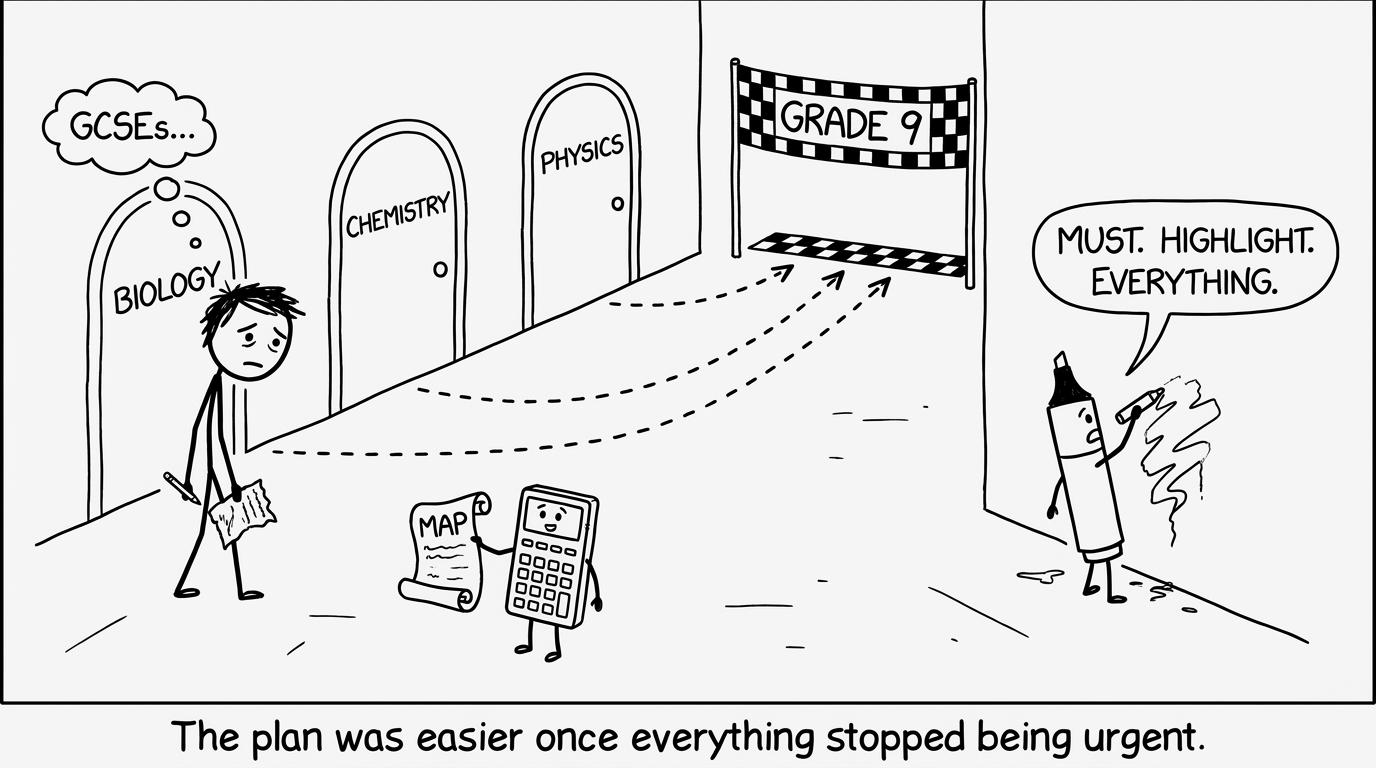 A student choosing a calmer route through Biology, Chemistry and Physics revision
What separates a grade 666 from a grade 999?
A grade 666 student commonly has reasonable knowledge but depends on familiar wording. A grade 999 student can select relevant knowledge when the context, data or diagram looks new.
That distinction matters because the regulated assessment objectives for GCSE Combined Science place approximately 40%40\%40% of the assessment on knowledge and understanding, 40%40\%40% on application, and 20%20\%20% on analysis and evaluation. The precise balance on an individual paper can vary, but recall alone cannot carry a top-grade performance.
Knowledge becomes precise and connected
At grade 666, a student may know that increasing temperature can increase reaction rate. At the highest level, the explanation must connect the relevant ideas accurately: particles have greater kinetic energy, collisions happen more frequently, and a greater proportion of collisions have sufficient energy to react.
This is not about making every answer longer. It is about building an unbroken scientific chain. Each sentence should earn its place.
Top-grade knowledge is also connected across topics. You may need to combine ideas about enzymes and temperature, energy transfer and insulation, or current, resistance and power. Rather than learning isolated paragraphs, ask:
- What causes this process?
- What changes when a variable increases?
- What evidence would support the conclusion?
- Which other topic uses the same principle?
Application replaces pattern matching
Students around grade 666 can often answer a question they have seen before. Higher-grade questions may place the same science inside an unfamiliar industrial process, medical treatment or environmental investigation.
The solution is not to memorise more scenarios. Strip the context back to the underlying principle. Identify the variable, process, equation or particle model being tested. Then rebuild the answer using details from the question.
When marking practice, do not write “did not understand” beside an application question. Name the missing step: failed to identify diffusion, ignored the control variable, selected the wrong equation, or did not connect the graph to collision theory. Specific diagnoses create specific improvements.
Scientific maths is a major opportunity
At least 20%20\%20% of GCSE Combined Science marks assess mathematical skills, allocated across Biology, Chemistry and Physics in a 1:2:31:2:31:2:3 ratio. For a student already reaching grade 666, these marks are often among the most controllable.
The essential toolkit includes:
- ratios, fractions and percentages;
- means and interpretation of data;
- significant figures and sensible rounding;
- standard form and orders of magnitude;
- substituting into and rearranging equations;
- unit conversions;
- gradients and areas under graphs;
- proportional relationships.
Use MathsGenie to strengthen ratio and proportion skills, percentage change and standard form. These are maths topics, but they sit underneath questions about percentage yield, efficiency, magnification, populations and very large or small measurements.
For equation questions, use a repeatable structure:
- write the relevant equation;
- convert units before substitution;
- substitute values clearly;
- rearrange without skipping risky steps;
- include the final unit;
- check whether the size of the answer is reasonable.
If changing the subject causes difficulty, revisit rearranging formulae practice. For rate and motion graphs, the ideas in the equation of a line revision guide help make gradients more secure.
Turn required practicals into marks
Practical work is not a small appendix to Combined Science. Regulations require at least 15%15\%15% of the qualification marks to assess knowledge, skills and understanding relating to practical work. Students must also be given opportunities to complete the specified practical activities.
For each required practical on your exam board's specification, know:
- the independent, dependent and control variables;
- the equipment and method;
- why important steps are necessary;
- the main safety considerations;
- how results should be recorded or displayed;
- likely random and systematic errors;
- realistic improvements;
- whether the evidence supports the conclusion.
Weak evaluations use generic phrases such as “repeat it” or “use better equipment”. Strong evaluations identify a problem and explain how the change addresses it. Repetition can help reveal variation and allow a mean to be calculated, but it does not automatically remove systematic error.
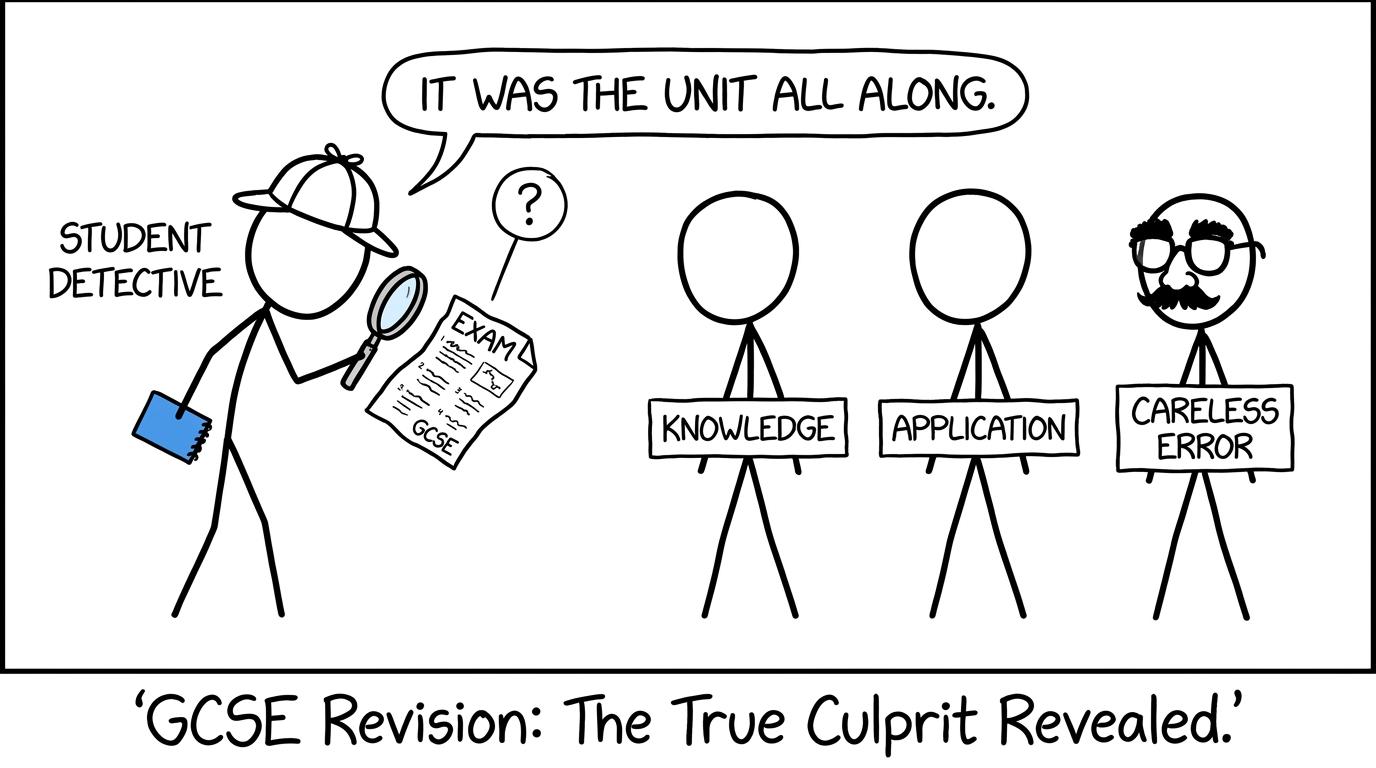 A student detective identifies the real source of lost science marks
Build revision around evidence, not mood
The most comfortable topic is rarely the best topic to revise. Begin with a specification checklist and recent assessments. Colour-code each area:
- secure and accurate under exam conditions;
- partly secure but inconsistent;
- unable to recall or apply independently.
Then create a marks-leak log. For every lost mark, record the topic, error type, correct principle and next action. A brief entry such as “Chemistry: converted volume incorrectly; practise cubic unit conversions” is more useful than copying an entire model answer.
A productive session follows this loop:
- retrieve a small topic from memory;
- check what was missing;
- repair the gap using notes or a lesson;
- answer exam-style questions;
- mark them immediately;
- return to the same weakness later without notes.
This approach feels harder than highlighting because it exposes uncertainty. That discomfort is useful information.
For the mathematical foundation beneath your science, the free GCSE Maths revision hub provides lessons, revision guides, question banks, worksheets and flashcards. Use MathsGenie's revision timetable guide to organise short, repeatable sessions rather than relying on occasional long evenings.
Use papers to practise decisions
Past papers reveal whether knowledge survives unfamiliar wording and time pressure. Complete papers from your own board and specification, whether AQA, Edexcel, OCR or Eduqas, because content organisation, paper structure and mark-scheme language differ.
Do not obsess over one historical grade boundary. Boundaries are set for each exam series, and Combined Science grades come from the overall qualification mark. Track raw marks and error patterns instead.
After each timed section, classify every lost mark:
- Knowledge: the fact or process was missing.
- Application: you knew the science but did not connect it to the context.
- Analysis: you misread data, evidence or a graph.
- Practical: the method, variable or evaluation was weak.
- Maths: the equation, conversion, rounding or unit failed.
- Communication: the answer was vague or contradicted itself.
The principle in MathsGenie's guide to using past papers properly transfers directly: paper, mark, fix, retest, then move on. MathsGenie's mini tests and predicted maths papers can also pressure-test the calculation skills that science questions depend upon.
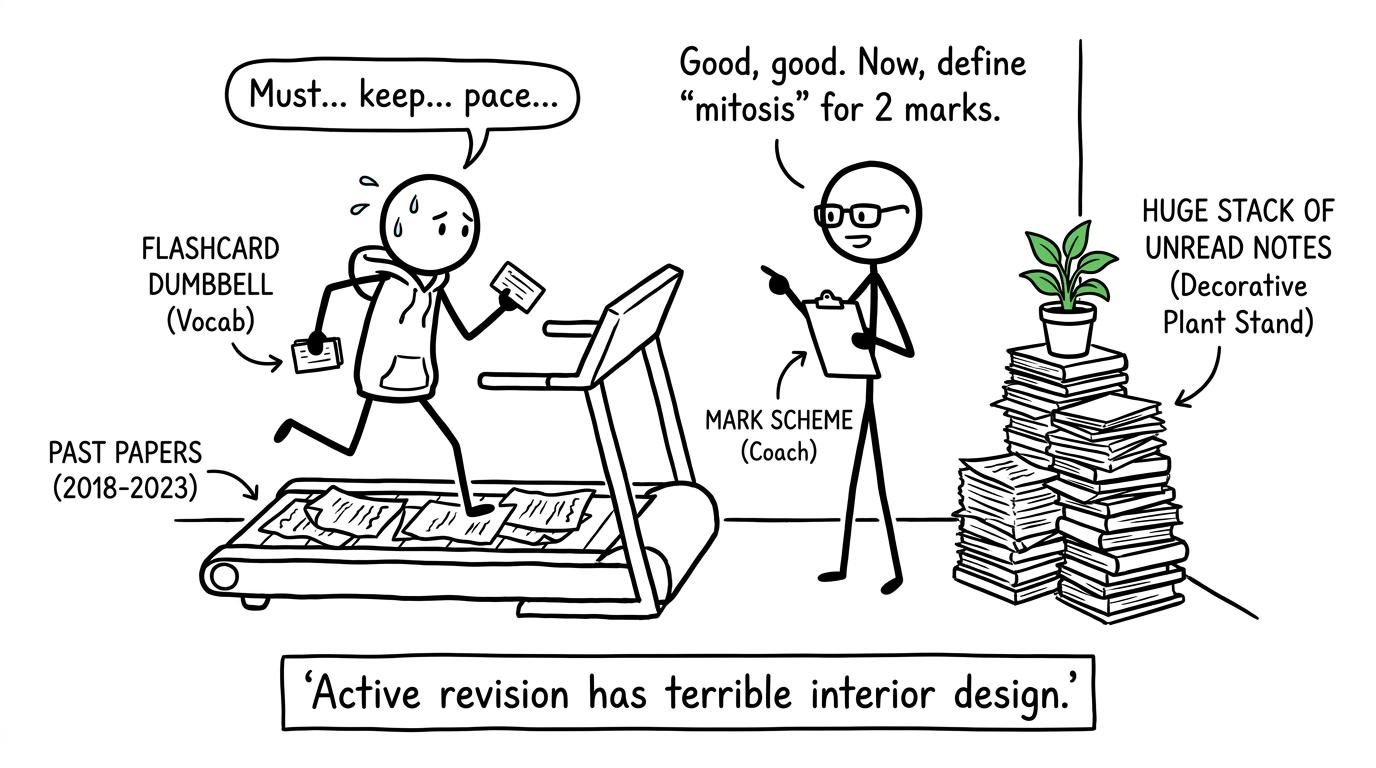 A mark scheme coaches active revision while unread notes become furniture
Common mistakes that block top grades
Revising content but not application
Knowing a definition is only the first layer. Follow recall with questions that use diagrams, data tables, unfamiliar organisms, industrial processes or experimental results.
Writing everything you remember
Long answers can introduce contradictions. Identify the command word and build only the scientific chain required. “Describe” needs relevant features or changes; “explain” needs linked reasons; “evaluate” needs evidence, limitations and a supported judgement.
Ignoring units until the final line
Units are part of the calculation. Convert before substitution and write units through the working where useful. Be particularly careful with prefixes and squared or cubed units.
Treating all errors as carelessness
A repeated “careless” mistake is usually a system problem. If you repeatedly omit units, build a final-unit check. If you choose the wrong equation, practise identifying quantities before touching the calculator.
Memorising mark schemes word for word
Mark schemes show the required ideas, not a script for every future context. Learn the scientific relationship behind the credited wording so that you can adapt it.
Avoiding difficult questions
Aiming for the top grades requires regular contact with questions you cannot answer immediately. Attempt them, inspect the mark scheme, repair the missing idea and then answer a similar question without support.
Make the next grade band your immediate target
The distance from grade 666 to grade 999 can look intimidating because the label hides all the smaller stages. In practice, your next goal may be more precise explanations, reliable unit conversions, stronger practical evaluations or fewer weak papers across the full qualification.
Start today with one assessment. Sort every lost mark, choose the two most common causes and repair them. Then repeat the process next week.
MathsGenie can provide the mathematical engine for that improvement. Use the free revision lessons to rebuild weak skills, practice questions and mini tests to create fluency, and past papers, predicted papers, mark schemes and video solutions to develop performance under pressure. A grade rises when revision stops being a record of time spent and becomes a record of mistakes removed.











