Percentage Change
x

Revision notes for AQA GCSE Maths Percentage Change. Open the guide for explanations and worked examples. Written against the AQA GCSE Maths (8300) specification, so the content matches what's examinable rather than general Maths background.

Percentage Change

What you'll learn

  • How to find a percentage increase or decrease.
  • Why you always compare the change with the original amount.
  • How profit and loss questions use the same method.
  • How to round answers to 1 decimal place or 3 significant figures.

1. Percentages and the original amount

A percentage is a way of comparing something to 100.

Definition

Percentage

A percentage means “out of 100”. For example, 25% means 25 out of every 100.

In percentage change questions, there is usually an original value and a new value.

  • The original value is the starting amount.
  • The new value is the amount after it has changed.
  • The change is the difference between the two amounts.
Key Idea

The original amount is the base

For percentage change, divide by the amount you started with, not the amount you ended with.

Example

Finding a change as a percentage

A coat originally costs £80. Its price is reduced by £20. Find the reduction as a percentage of the original price.

Bar model showing the £20 reduction compared with the original £80 price.

  1. Identify the original amount and the change: original £80, change £20.

  2. Compare the change with the original amount:

    2080×100=25\frac{20}{80} \times 100 = 258020​×100=25
  3. The reduction is 25% of the original price.

2. Percentage increase and percentage decrease

An increase means the new value is bigger than the original value.

A decrease means the new value is smaller than the original value.

Definition

Percentage change

Percentage change tells you how big the change is compared with the original value.

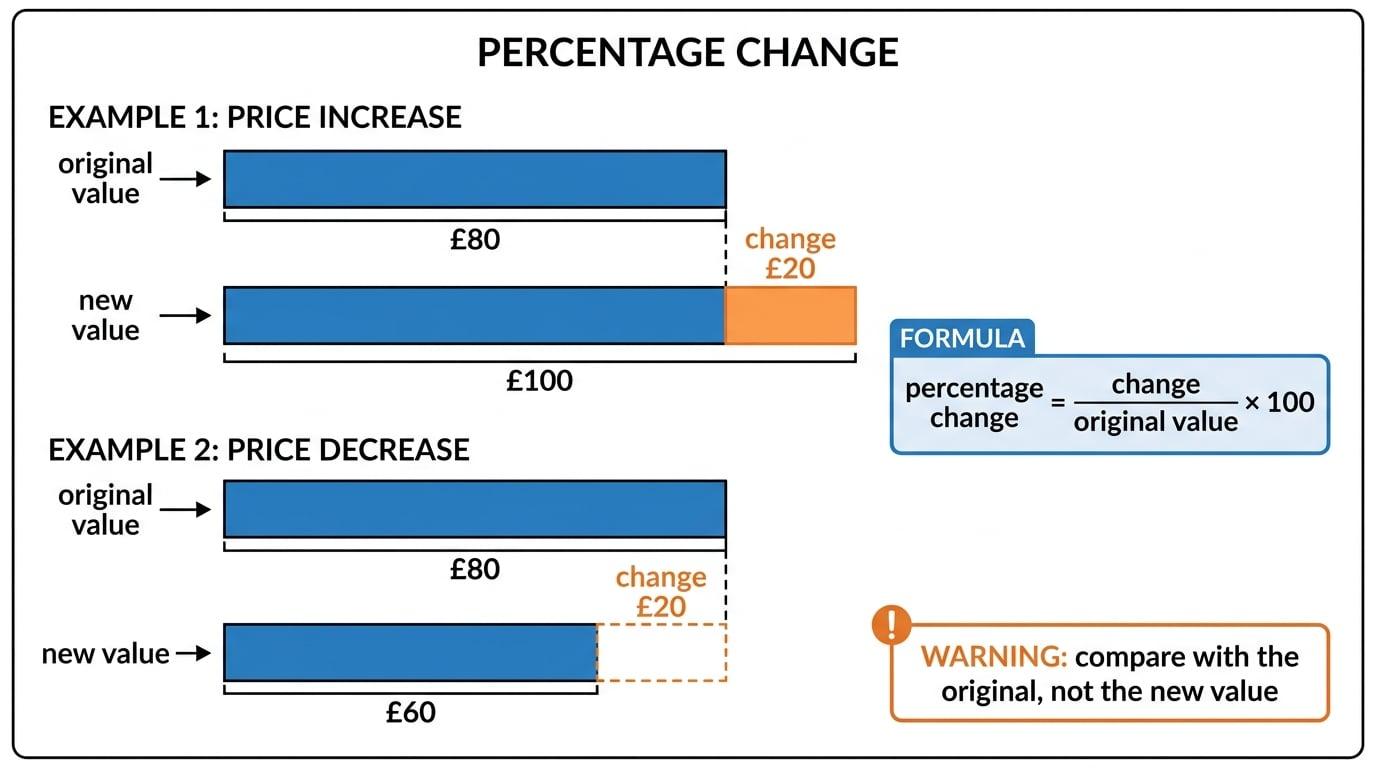
percentage change=changeoriginal value×100\text{percentage change} = \frac{\text{change}}{\text{original value}} \times 100percentage change=original valuechange​×100

The method is:

  1. Find the original value.
  2. Find the new value.
  3. Work out the change.
  4. Divide the change by the original value.
  5. Multiply by 100.
  6. Say whether it is an increase or a decrease.
Example

Percentage increase

Last year, a bill was £1680. This year, it is £1764. Work out the percentage increase, giving your answer to 1 decimal place.

Number-line model showing the bill increasing from £1680 to £1764 by £84.

  1. Identify the original and new amounts: original £1680, new £1764.

  2. Find the change:

    1764−1680=841764 - 1680 = 841764−1680=84
  3. Divide the change by the original amount, then multiply by 100:

    841680×100=5\frac{84}{1680} \times 100 = 5168084​×100=5
  4. The bill went up, so the answer is 5.0% increase to 1 decimal place.

Example

Percentage decrease

A yearly insurance cost was £386. The next year it was £354. Work out the percentage decrease to 1 decimal place.

Number-line model showing the insurance cost decreasing from £386 to £354 by £32.

  1. Identify the original and new amounts: original £386, new £354.

  2. Find the change:

    386−354=32386 - 354 = 32386−354=32
  3. Divide by the original amount and multiply by 100:

    32386×100=8.290…\frac{32}{386} \times 100 = 8.290\ldots38632​×100=8.290…
  4. The cost went down, so the answer is 8.3% decrease to 1 decimal place.

Common Mistake

Dividing by the new amount

Do not divide by the new value. If a price changes from £80 to £100, the original amount is £80, so the change is compared with £80.

Comparison diagram emphasising that the £20 change is divided by the original £80, not the new £100.

3. Profit and loss

A cost price is the amount paid to buy something.

A selling price is the amount received when it is sold.

A profit is made when the selling price is bigger than the cost price.

A loss is made when the selling price is smaller than the cost price.

For percentage profit or percentage loss, the original amount is the cost price.

Example

Percentage profit

Aisha buys a flat for £185,000. She later sells it for £199,800. Calculate her percentage profit.

Profit is shown as the difference between the selling price and the original cost price.

  1. Find the profit by subtracting the cost price from the selling price:

    199800−185000=14800199800 - 185000 = 14800199800−185000=14800
  2. Compare the profit with the original cost price:

    14800185000×100=8\frac{14800}{185000} \times 100 = 818500014800​×100=8
  3. Aisha made an 8% profit.

Example

Percentage loss

Ben buys a car for £12,500. He sells it for £9,800. Work out his percentage loss.

Loss is shown as the shortfall from the original cost price to the selling price.

  1. Find the loss by subtracting the selling price from the cost price:

    12500−9800=270012500 - 9800 = 270012500−9800=2700
  2. Compare the loss with the original cost price:

    270012500×100=21.6\frac{2700}{12500} \times 100 = 21.6125002700​×100=21.6
  3. Ben made a 21.6% loss.

4. Multi-step selling questions

Some questions do not give you the selling price straight away. You may need to calculate the total money made from selling items.

Useful conversions:

  • 100p = £1
  • 50p = £0.50
  • 1 kg = 1000 g
Tip

Convert units first

If the cost is in pounds, convert selling prices like 30p or 45p into pounds before adding them.

Example

Selling bags of sweets

Maya buys 1.2 kg of sweets for £2.40. She puts 200 g of sweets into each bag. She sells each bag for 50p. Work out her percentage profit.

Flow diagram showing the sweets converted into six 200 g bags before finding the selling total.

  1. Convert 1.2 kg into grams:

    1.2×1000=12001.2 \times 1000 = 12001.2×1000=1200
  2. Work out how many bags she can make:

    1200÷200=61200 \div 200 = 61200÷200=6
  3. Convert 50p to £0.50, then find the total selling money:

    6×0.50=3.006 \times 0.50 = 3.006×0.50=3.00
  4. Find the profit:

    3.00−2.40=0.603.00 - 2.40 = 0.603.00−2.40=0.60
  5. Compare the profit with the original cost:

    0.602.40×100=25\frac{0.60}{2.40} \times 100 = 252.400.60​×100=25
  6. Maya made a 25% profit.

5. Rounding your percentage answer

Sometimes the question tells you how to round.

A decimal place is a digit after the decimal point. For example, 8.3 has 1 decimal place.

A significant figure is an important digit, starting from the first non-zero digit. For example, 6.08 has 3 significant figures.

Tip

Round at the end

Keep the full calculator answer until the final step. Rounding too early can make your final answer slightly wrong.

Example

Rounding to 3 significant figures

A company sold 14.8 million devices one year and 13.9 million the next year. Work out the percentage decrease to 3 significant figures.

Bar model showing the decrease in device sales from 14.8 million to 13.9 million by 0.9 million.

  1. Identify the original and new amounts: original 14.8 million, new 13.9 million.

  2. Find the change:

    14.8−13.9=0.914.8 - 13.9 = 0.914.8−13.9=0.9
  3. Divide by the original amount and multiply by 100:

    0.914.8×100=6.081081…\frac{0.9}{14.8} \times 100 = 6.081081\ldots14.80.9​×100=6.081081…
  4. Round to 3 significant figures: 6.08% decrease.

Exam technique

In the exam

  1. Write down the original value first, especially if the question says “last year” and “this year”.

  2. Find the change before using the percentage formula.

  3. Always finish with a label: increase, decrease, profit, or loss.

Self review

Check yourself

  • If a price rises from £60 to £75, which amount is the original value?
  • A person loses £250 on something bought for £1000. What calculation gives the percentage loss?
  • Why should you convert 45p to £0.45 before working out total selling money?

Recap questions

Test yourself with 5 quick questions on this guide. Answer them all correctly to complete it.

You've reached the end

Test yourself on this topic, or move on to the next guide.

Practice questionsTake a quick quiz on this topicFlashcardsSelf-test with active recall
Exchange RatesUp next

How was this guide?

Percentage Change Revision Guide

  1. GCSE
  2. /Maths
  3. /Percentage Change